Gerardo Kowalczyk Insurance Producer, Property, Casualty, Life, Accident and Health Milwaukee, 53204, United States [email protected] · (414) 555-0160
12 September 2026
Ms. Annika Lindqvist Agency Principal Kettle Moraine Insurance Partners Waukesha, United States
Application for Insurance Producer, Kettle Moraine Insurance Partners
Dear Ms. Lindqvist,
I am applying for the Insurance Producer post at Kettle Moraine Insurance Partners. I hold a Wisconsin resident producer license, #WI-3308291, with property, casualty, personal lines, life, and accident and health authority, non-resident licenses in Illinois and Minnesota, and appointments with nine carriers across personal, small commercial and life products. My National Producer Number is 19447206 if you would like to verify any of that before we speak.
I currently carry 1,340 policies in force across 720 households and $2.4 million of annualised premium, at 91 percent policy retention and a 9 percent lapse rate. The work behind those figures is unglamorous: I moved renewal contact to 45 days ahead of the effective date, which took the lapse rate down from 13 percent, and I put an annual coverage review on every household in the book, which took lines per household from 1.6 to 2.3. Last year I wrote 286 new policies worth $486,000 of new annualised premium, and I handled 94 first notices of loss, advocating on 11 disputed claims of which 7 were reopened and settled.
Your agency writes a good deal of small commercial in the Waukesha corridor and holds appointments I do not have, which is the part that interests me. Six of my nine appointments overlap with yours, so the book I know how to write transfers on day one, and the three that do not would let me place risks I currently send to a wholesaler. I would bring the annual coverage review across, since it is the only thing I have found that reliably moves cross-sold lines.
My continuing education is complete for the current biennial cycle, including the ethics hours, and I am a named producer on an errors and omissions policy. I can start on four weeks' notice. Thank you for your time.
Sincerely, Gerardo Kowalczyk
Summary
An insurance agent cover letter tells an agency principal what you may legally sell and what you have sold: the producer licenses and lines of authority you hold, the carriers that have appointed you, and the book behind them in policies, premium and retention. This guide gives you an adaptable letter, the openings that work, and what to write when you are newly licensed with no book yet.
Insurance Agent cover letter examples by experience level
An insurance agent cover letter answers an agency principal's first two questions before they ask: what are you licensed and appointed to sell, and what have you written with it.
Everything else is secondary, because until those facts are on the page the reader cannot tell whether hiring you means production next month or three months of paperwork first.
Guide to an insurance agent cover letter
This guide and the corresponding insurance agent cover letter example will cover:
- How to structure the letter paragraph by paragraph
- Why the lines of authority and appointments belong in the opening
- How to describe a book without naming a client
- What to write when you are newly licensed and have no book yet
How to write an insurance agent cover letter
| Paragraph | Its job | Length |
|---|---|---|
| Opening | The post, your licenses and lines, and your appointments | 2 to 3 sentences |
| Evidence | The book in policies, premium and persistency, plus one thing you changed | 4 to 5 sentences |
| Fit | Something real about their agency, and what you would bring or build | 3 to 4 sentences |
| Close | Continuing education, errors and omissions, availability, thank you | 2 sentences |
Lines of authority and appointments, both in the opening
A producer license is issued by a state and carries named lines of authority; an appointment is a carrier authorizing you to represent it. A principal needs both.
Put them in one sentence: "I hold a Wisconsin resident producer license with property, casualty, personal lines, life, and accident and health authority, non-resident licenses in Illinois and Minnesota, and appointments with nine carriers."
Then give the National Producer Number in the letter or the signature block. It makes every claim above verifiable in one lookup, and offering the check before it is asked for is unusual enough to be noticed.
An insurance agent cover letter example you can adapt
Dear Ms. Lindqvist,
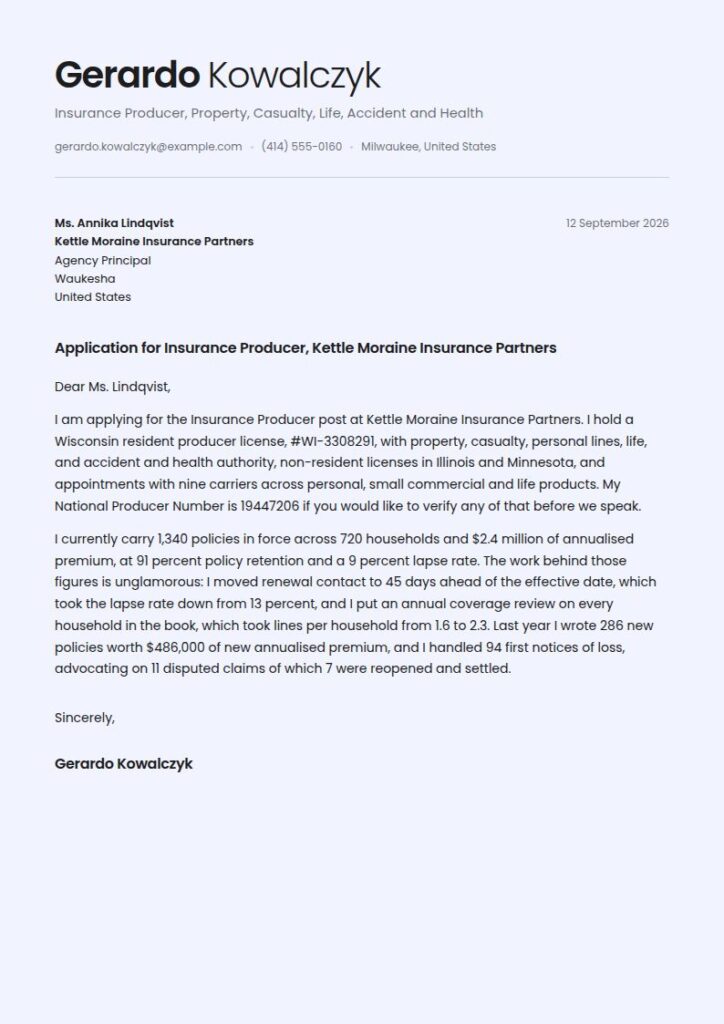
I am applying for the Insurance Producer post at Kettle Moraine Insurance Partners. I hold a Wisconsin resident producer license, #WI-3308291, with property, casualty, personal lines, life, and accident and health authority, non-resident licenses in Illinois and Minnesota, and appointments with nine carriers across personal, small commercial and life products. My National Producer Number is 19447206 if you would like to verify any of that before we speak.
I currently carry 1,340 policies in force across 720 households and $2.4 million of annualised premium, at 91 percent policy retention and a 9 percent lapse rate. The work behind those figures is unglamorous: I moved renewal contact to 45 days ahead of the effective date, which took the lapse rate down from 13 percent, and I put an annual coverage review on every household in the book, which took lines per household from 1.6 to 2.3. Last year I wrote 286 new policies worth $486,000 of new annualised premium, and I handled 94 first notices of loss, advocating on 11 disputed claims of which 7 were reopened and settled.
Your agency writes a good deal of small commercial in the Waukesha corridor and holds appointments I do not have, which is the part that interests me. Six of my nine appointments overlap with yours, so the book I know how to write transfers on day one, and the three that do not would let me place risks I currently send to a wholesaler. I would bring the annual coverage review across, since it is the only thing I have found that reliably moves cross-sold lines.
My continuing education is complete for the current biennial cycle, including the ethics hours, and I am a named producer on an errors and omissions policy. I can start on four weeks' notice. Thank you for your time.
Sincerely, Gerardo Kowalczyk
Openings that work
| Instead of | Use |
|---|---|
| I am a licensed and motivated insurance professional | I hold a Wisconsin producer license with property, casualty, personal lines, life, and accident and health authority |
| I have strong relationships with many carriers | I hold appointments with nine carriers across personal, small commercial and life products |
| I have built a substantial book of business | I carry 1,340 policies across 720 households and $2.4 million of annualised premium |
| I pride myself on client retention | 91 percent policy retention and a 9 percent lapse rate, down from 13 percent |
| I am skilled at identifying client needs | Lines per household went from 1.6 to 2.3 through an annual coverage review |
Describing a book without naming a client
You can be specific about production and say nothing about any individual. Describe the book, never the people in it.
| Kind of evidence | What it looks like in a sentence |
|---|---|
| Size | 1,340 policies in force across 720 households, $2.4 million of annualised premium |
| Mix | 71 percent personal lines, 19 percent small commercial, 10 percent life and health |
| Persistency | 91 percent policy retention and a 9 percent lapse rate, down from 13 percent |
| Cross-sell | Lines per household 2.3, up from 1.6 |
| New production | 286 new policies and $486,000 of new annualised premium last year |
| Claims work | 94 first notices of loss, 11 disputed claims advocated, 7 reopened and settled |
| Reach | Non-resident licenses in two states for cross-border households |
Naming a policyholder, household or commercial account in a cover letter is a privacy failure and reads as one. The segment and the number are what the reader needs.
When you are newly licensed with no book yet
Lead with the license in full: issuing state, number, lines of authority and your National Producer Number. Say which examinations you have passed and which you are sitting next. Convert agency service experience into production language: policies serviced, endorsements processed, first notices of loss taken. Name any appointment you already hold. Say your continuing education plan for the first cycle.
Do not imply a line of authority you are only studying for; it is checkable in a state lookup in seconds. Do not claim an appointment that has been terminated, since the carrier filed a notice of it. Do not quote an agency's overall figures as your own production. Do not name a policyholder. Do not describe yourself as a natural salesperson in place of giving a number.
Growing occupation, and two-thirds of it inside agencies
Insurance sales agents held 572,600 jobs in 2025, with 3 percent projected growth through 2035, a gain of 18,800 positions and about 43,100 openings a year, at a typical entry requirement of a high school diploma or equivalent (BLS Occupational Outlook Handbook, 2025-35 projections). The median annual wage was $62,280, or $29.94 an hour, with the lowest 10 percent under $37,330 and the highest 10 percent above $138,140 (BLS, May 2025).
Insurance agencies and brokerages employ 63 percent of the occupation and self-employed agents account for another 12 percent (BLS, May 2025). Most of the people reading your letter are therefore intermediaries, not carriers.
That is why appointments carry so much weight in the opening paragraph. An agency is calculating how much of your book knowledge transfers through carrier relationships they already hold, and a letter that names the overlap has already done that arithmetic for them.
Length, format and sending it
One page, four paragraphs, 250 to 400 words. PDF unless the agency's portal says otherwise, named for yourself and the post: gerardo-kowalczyk-insurance-producer.pdf.
Address a person. Principals and sales managers are usually named on the agency's own site, and a letter carrying license numbers should not open with "Dear Hiring Manager".
Keep every figure identical to your resume. Our insurance agent resume example uses the numbers in this letter, and a principal who finds a mismatch will assume the flattering one is wrong.
Key takeaways
- Open with the issuing state, the license number and every line of authority.
- Name your carrier appointments and how many there are.
- Give the National Producer Number so the reader can verify it all.
- Describe the book in policies, households and annualised premium.
- Give retention and lapse together, with a before and after if you have one.
- Name the overlap between your appointments and theirs.
- Close with continuing education, errors and omissions and a start date.
Write your insurance agent cover letter in 10 minutes.
Insurance agent cover letter questions, answered
How long should an insurance agent cover letter be?
One page, four paragraphs, 250 to 400 words. A principal reads for licenses, appointments and a book figure, so put all three in the first half and stop.
Should I put my license number in a cover letter?
Yes, with the issuing state and the lines of authority, and add your National Producer Number. Both are matters of public record through state lookups, and volunteering them tells a principal you expect the check.
What do I write if I am newly licensed with no book?
Write the license in full, then say which examinations you passed and when, and which line you are adding next. Convert whatever agency work you have done into production language: policies serviced, endorsements processed, first notices of loss taken, quotes run. A newly licensed producer with one line and a clean record is a normal hire.
Should I mention commission expectations in the letter?
Name the model you have worked under, not a figure. New and renewal commission on written premium, salary plus commission, or a draw against commission are different risk positions, and naming yours tells a principal how you are used to being paid without opening a negotiation in writing.
How do I research an agency before writing?
Look at what they write and who they write it with. Their site usually names carriers and lines, and their job posting says which appointments they are short of. One accurate sentence about the overlap between their carriers and yours is the most useful thing in the letter, and it cannot be reused anywhere else.