Retail Merchandiser, Grocery and Mass Rudy Santangelo
Retail Merchandiser
[email protected] | (407) 555-0158 | Orlando, United States
Profile
Retail merchandiser servicing 18 grocery and mass stores a week for a field agency across the Orlando metro, averaging 21 calls a week at 96 percent on-time call compliance. Reset 4 to 6 bays a call to planogram and closed an average of 9 voids a store by pulling from backstock and flagging ordering gaps, photographing each corrected section in the retail execution app. Built 34 secondary displays in a single holiday period and worked 3 full-aisle resets as part of an overnight crew.
Work Experience
06/2016 - Present, Retail Merchandiser, Sunward Field Services, Orlando, United States
- Service 18 grocery and mass stores a week across the Orlando metro, averaging 21 calls a week at 96 percent on-time call compliance.
- Reset 4 to 6 bays a call to planogram and photograph every corrected section in the retail execution app.
- Close an average of 9 voids a store from backstock and flag ordering gaps to the department manager.
- Built 34 secondary displays in a single holiday period and worked 3 full-aisle resets on an overnight crew.
- Complete store sign-in, vendor check-in and weekly reporting for every call without a late submission in 14 months.
08/2014 - 05/2016, Overnight Stock Associate, Brightmarket Grocery, Orlando, United States
- Worked overnight replenishment for a 48,000 square foot grocery store, 6 aisles a shift to plan.
- Ran date code and rotation checks and prepared sections for supplier resets.
Education
08/2014 - 05/2016, Associate of Arts, Business Administration, Valencia College, Orlando, United States
Completed while working overnight replenishment.
Skills
Planogram reading and shelf sets, 75
Void and out-of-stock resolution, 80
Backstock reconciliation, 75
Retail execution app and photo audits, 85
Secondary display building, 70
Rotation and date code checks, 85
Store sign-in and vendor check-in, 80
Languages
English, native
Spanish, intermediate
Certificates
03/2025, Powered Pallet Jack Operator Training, Employer equipment program
Refreshed annually.
03/2025, Ladder and Overhead Safety Training, Employer safety program
Summary
A merchandiser resume is a one page document built on the call file: stores on your route, calls completed against the cycle, planogram compliance on photo-verified audits, voids closed, facings gained and resets worked. This guide gives you three adaptable versions, tells you how to declare which kind of merchandiser you are, and gives current Bureau of Labor Statistics data.
Merchandiser resume examples by experience level
A merchandiser resume is a one page document built on a record somebody else keeps: the call file.
Field merchandising is one of the few sales jobs where almost everything you did is already logged, photographed and time-stamped by the retail execution app on your phone. Stores serviced, calls completed, planogram compliance, voids closed, displays built. A supplier or agency hiring you can picture that file exactly, and the resume that hands it over reads completely differently from the one that says "maintained store appearance and built strong relationships with store management".
There is a second job that carries this title, and the first line of your resume has to say which one you are. More on that below.
Resume guide for a merchandiser resume
This guide and the corresponding merchandiser resume example will cover:
- How to write a merchandiser resume, section by section
- The call file numbers a territory manager checks, and where yours live
- Three adaptable summaries: agency merchandiser, territory merchandiser and field manager
- Why buying-side merchandising is a different job with different evidence
- What the market looks like and what the Bureau of Labor Statistics actually publishes
How to write a merchandiser resume
Six blocks: contact header with your territory and driving radius, summary, the call file numbers, field experience, skills, then education and certifications. One page.
The territory belongs in the header because it is half the hiring decision. A supplier filling a route is asking whether you live inside it, whether you can cover the driving, and whether you are free on reset nights and early mornings.
| Block | What it answers | Where it goes |
|---|---|---|
| Territory and radius | Do they live in the route, and how far will they drive? | Contact header, one line |
| Call file numbers | Do they complete the cycle and hold the planogram? | Directly under the summary |
| Reset and remodel work | Can they be sent on a project crew overnight? | Inside field experience, with counts |
| Class of trade | Grocery, mass, club, convenience, drug, home improvement | Inside field experience, named |
Export your call file before your last day
Almost everything a hiring manager wants is in the retail execution app: calls scheduled against calls completed, on-time compliance, average time in store, photo audit pass rates, void counts and display counts. Very few merchandisers think to write any of it down before their access is switched off.
Ask your supervisor for your compliance report for the last two quarters and your audit pass rate, and note your store count, your call cycle and your class of trade while you still remember the detail.
If you worked through an agency and cannot get the report, reconstruct it honestly: number of stores, calls a week, the banners you serviced and the projects you were pulled onto. A stated route with a store count is still verifiable by anyone who calls your supervisor.
Put the finished file through the free Rezoom ATS resume checker before you submit it. Suppliers and merchandising agencies both recruit at volume through systems that parse your file first.
Choosing the best resume format for a merchandiser resume
Reverse chronological, one page, with the call file numbers high. Field merchandising hiring runs on route history and reliability, and both are chronological facts.
Agency work, part-time routes and overlapping contracts are normal here. Keep them, label them, and give each one a store count and a call frequency. Two agencies at once with 40 combined stores is a fuller week than one supplier route, and it only reads that way if you say so.
Include your contact information
| ✅ Right | ❌ Wrong |
|---|---|
| Rudy Santangelo | Rudy Santangelo |
| Territory Merchandiser, Grocery and Mass, Central Florida | Detail-oriented retail professional |
| 34 stores, 60-mile radius, available for overnight resets | Willing to travel |
| (407) 555-0158, [email protected], Orlando, FL | (407) 555-0158, [email protected] |
Say the radius as a number and say whether you are available for overnight reset crews. Those are the two questions a territory manager has before they read anything else, and most resumes answer neither.
Make use of a summary
Four lines: your store count and class of trade, calls a week with on-time compliance, planogram compliance and how it is audited, and one result you moved.
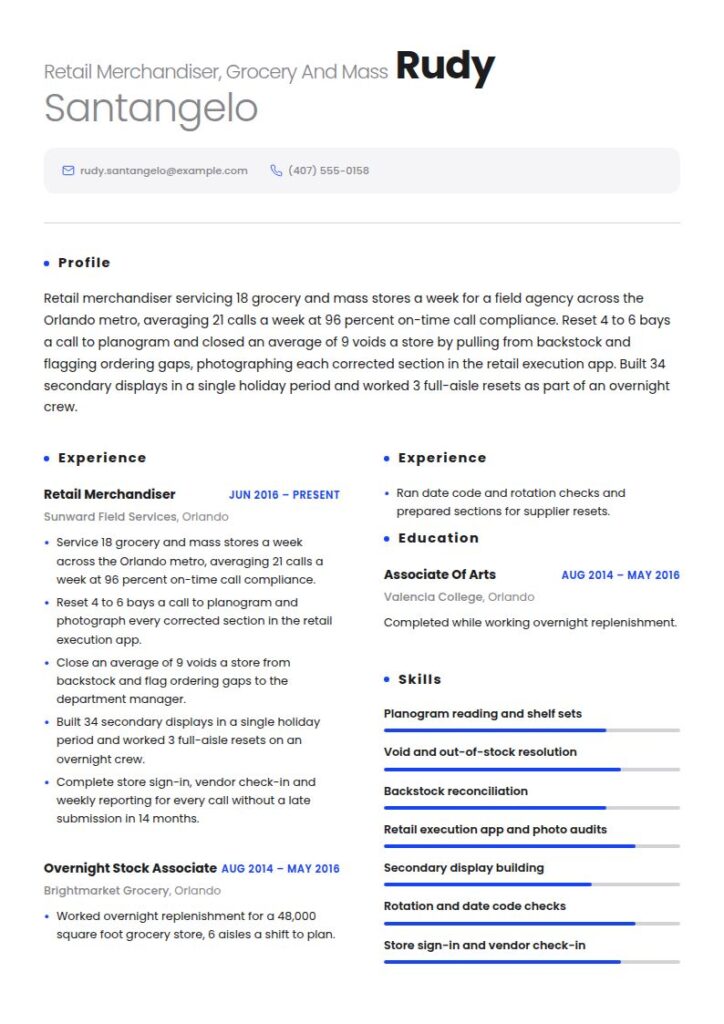
Retail merchandiser servicing 18 grocery and mass stores a week for a field agency across the Orlando metro, averaging 21 calls a week at 96 percent on-time call compliance. Reset 4 to 6 bays a call to planogram and closed an average of 9 voids a store by pulling from backstock and flagging ordering gaps, photographing each corrected section in the retail execution app. Built 34 secondary displays in a single holiday period and worked 3 full-aisle resets as part of an overnight crew.
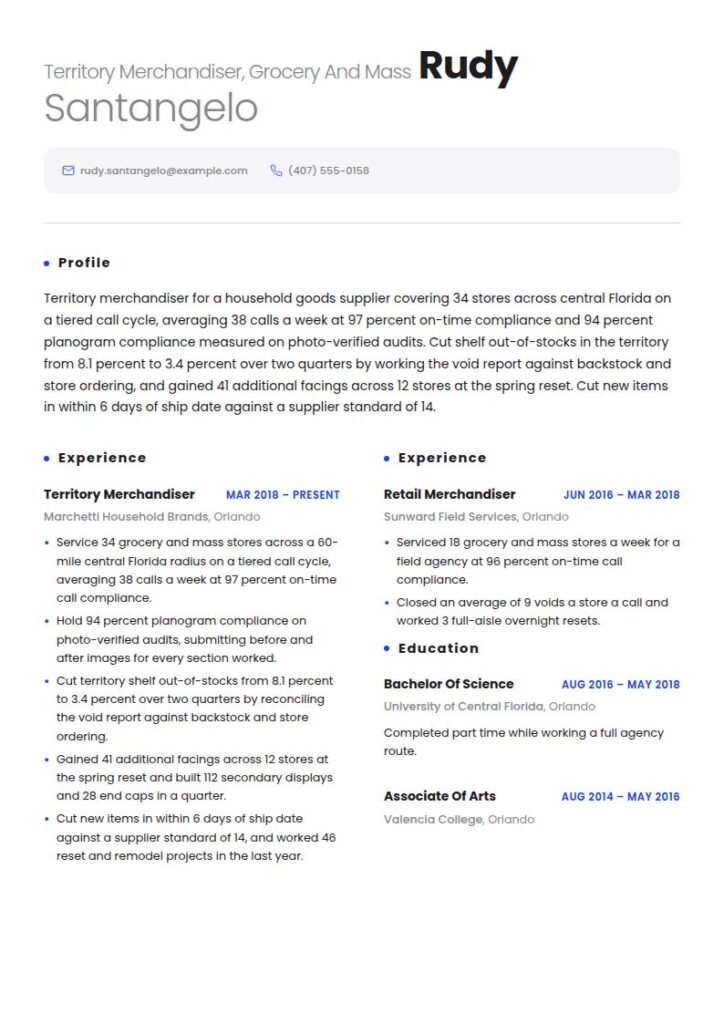
Territory merchandiser for a household goods supplier covering 34 stores across central Florida on a tiered call cycle, averaging 38 calls a week at 97 percent on-time compliance and 94 percent planogram compliance measured on photo-verified audits. Cut shelf out-of-stocks in the territory from 8.1 percent to 3.4 percent over two quarters by working the void report against backstock and store ordering, and gained 41 additional facings across 12 stores at the spring reset. Cut new items in within 6 days of ship date against a supplier standard of 14.
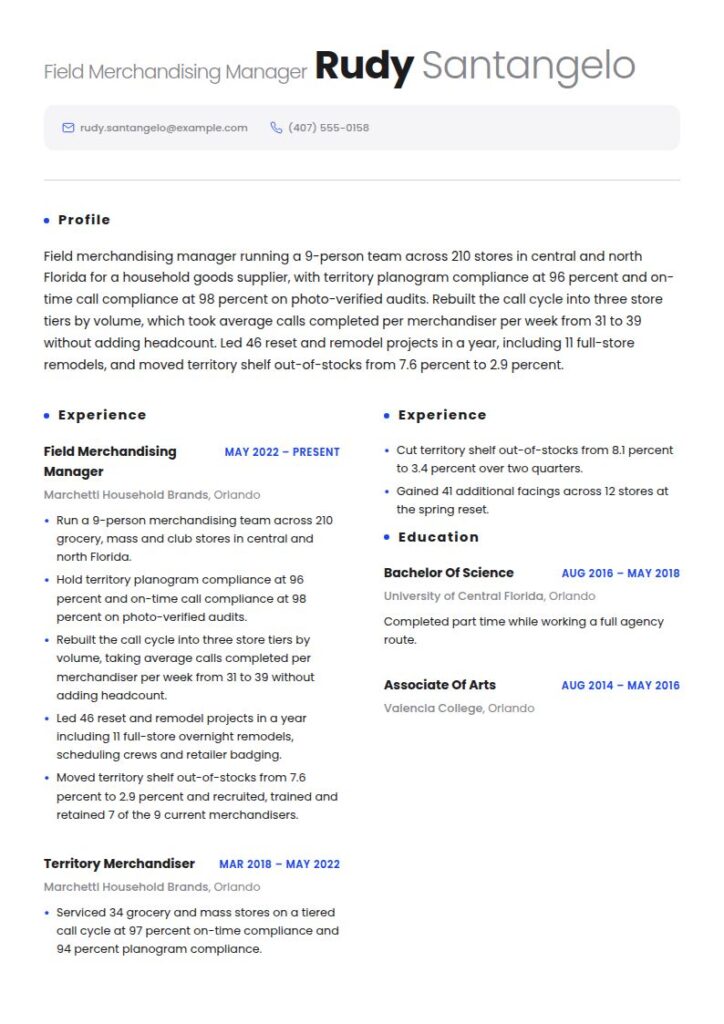
Field merchandising manager running a 9-person team across 210 stores in central and north Florida for a household goods supplier, with territory planogram compliance at 96 percent and on-time call compliance at 98 percent on photo-verified audits. Rebuilt the call cycle into three store tiers by volume, which took average calls completed per merchandiser per week from 31 to 39 without adding headcount. Led 46 reset and remodel projects in a year, including 11 full-store remodels, and moved territory shelf out-of-stocks from 7.6 percent to 2.9 percent.
Right vs wrong: the same merchandiser summary, twice
| ✅ Right | ❌ Wrong |
|---|---|
| 34 stores across central Florida on a tiered call cycle, 38 calls a week. | Serviced multiple retail locations in the local area. |
| 94 percent planogram compliance on photo-verified audits. | Ensured products were displayed according to company standards. |
| Cut shelf out-of-stocks from 8.1 percent to 3.4 percent over two quarters. | Helped improve product availability on shelf. |
| Gained 41 additional facings across 12 stores at the spring reset. | Built strong relationships with store management. |
The right column can be checked against the call file in about four minutes. The left column is what a territory manager reads twenty times a week and cannot rank.
Outline your field experience
Employer, whether you were direct to a supplier or through an agency, the class of trade, the store count, the territory and the dates. Then four or five bullets, each with a count, a percentage or a project.
| Instead of | Use |
|---|---|
| Serviced retail accounts in my area | Serviced 34 grocery and mass stores across a 60-mile radius on a tiered call cycle |
| Ensured products were merchandised correctly | Held 94 percent planogram compliance across 34 stores on photo-verified audits |
| Restocked shelves and kept sections tidy | Closed an average of 9 voids a store a call from backstock, cutting out-of-stocks from 8.1 to 3.4 percent |
| Built displays and promotional setups | Built 112 secondary displays and 28 end caps in a quarter, 100 percent photographed and submitted |
| Assisted with store resets | Worked 46 reset and remodel projects in a year, 11 of them full-store overnight remodels |
Territory Merchandiser, Marchetti Household Brands, Orlando, FL, grocery and mass, 34 stores, March 2018 to Present
Service 34 stores across a 60-mile central Florida radius on a tiered call cycle, averaging 38 calls a week at 97 percent on-time call compliance.
Hold 94 percent planogram compliance on photo-verified audits, submitting a before and after image for every section worked through the retail execution app.
Cut territory shelf out-of-stocks from 8.1 percent to 3.4 percent over two quarters by reconciling the void report against backstock and store ordering, then agreeing corrected order points with each department manager.
Gained 41 additional facings across 12 stores at the spring reset and built 112 secondary displays and 28 end caps in a quarter.
Cut new items in within 6 days of ship date against a supplier standard of 14, and worked 46 reset and remodel projects in the last year including 11 overnight full-store remodels.
Planogram compliance, resets and the store call file
Field merchandising is judged on a file, not on an impression. Write the resume as though the reader is about to open it.
| Measure | Mine | Standard or territory average | Period |
|---|---|---|---|
| Stores on route | 34, three tiers by volume | 30 | Current |
| Calls completed a week | 38 | 33 | Last 2 quarters |
| On-time call compliance | 97% | 90% standard | Last 2 quarters |
| Planogram compliance, photo-audited | 94% | 88% standard | Last 2 quarters |
| Shelf out-of-stocks | 3.4%, from 8.1% | 6.0% | Two quarters |
| Facings gained at reset | 41 across 12 stores | n/a | Spring reset |
| Secondary displays and end caps built | 112 displays, 28 end caps | 74 and 19 | Last quarter |
| New item cut-in speed | 6 days from ship date | 14-day standard | Last 12 months |
| Reset and remodel projects worked | 46, 11 full-store | 30 | Last 12 months |
Stores and call frequency by tier. Give the store count, the geography and the cycle. Most routes are tiered, so a high-volume store may be a twice-weekly call and a small one a fortnightly call. Saying "34 stores on a three-tier cycle, 38 calls a week" tells a territory manager more about your week than any duty list.
Calls completed and on-time compliance. This is the reliability number, and it is the first thing a manager looks at. Give completed calls against scheduled calls and your on-time percentage against the standard your employer set.
Planogram compliance, and how it was audited. Compliance means nothing without the audit method beside it. Say whether it was self-reported, photo-verified in the retail execution app, audited by your supervisor on a ride-along, or measured by a third-party audit firm. Photo-verified is the strongest claim most merchandisers can make, and it is the one that separates a real number from an assertion.
Out-of-stocks and voids closed. A void is a slot with no product. Closing voids is the most valuable thing a field merchandiser does, because a facing with nothing in it sells nothing. Give the average voids you close a call, the method you used, and the before-and-after out-of-stock rate for the territory.
Share of shelf and facings gained. Every reset is a negotiation with a category manager and a store team. If you gained space, say how much, in how many stores, at which reset. Facings gained is the only number on the page that grows the supplier's business rather than protecting it.
Secondary displays and end caps. Count them, and say whether you built to a national program or negotiated the placement yourself. A merchandiser who secures an unplanned end cap in a store is doing selling work, not stocking work, and that should be labeled clearly.
New item cut-in speed. When a supplier ships a new item, the gap between ship date and shelf date is money. Give your average days to cut in against the standard you were set.
Reset and remodel projects. These are the overnight and early-morning jobs that decide whether you are on a project crew list. Give the number worked in a year, how many were full-store remodels, whether you led a crew, and the crew size.
Photo-verified audits and the paperwork. Say which retail execution app you worked in, whether you submitted before and after images on every section, and what you handled on the administrative side: store sign-in and vendor check-in procedures, retailer badging, credit and damage paperwork, backstock reconciliation, and the weekly report to your territory manager. Suppliers lose money on merchandisers whose paperwork is late more often than on merchandisers whose shelves are untidy.
Which merchandiser are you? The word covers two different jobs. Field merchandising is the work above, in other people's stores. Buying-side merchandising sits inside the retailer, choosing assortment, managing open to buy, setting markdowns and owning sell-through and margin against a plan. The evidence is completely different: category sales and margin, sell-through percentage, weeks of supply, markdown rate, vendor negotiations and open to buy managed. If that is your job, the Bureau of Labor Statistics counts you closer to buyers and purchasing agents, whose median annual wage was $77,710 with employment of 516,100 in 2025 and 6 percent projected growth to 2035, a rise of 30,800 jobs, and a retail trade industry median of $57,840 (BLS Occupational Outlook Handbook, 2025-35 projections and May 2025 wage data). Declare which one you are in the first line of the summary, because the two resumes share a title and nothing else.
A small, growing occupation with no published wage spread
Merchandise displayers and window trimmers, the occupation closest to field merchandising, held 164,800 jobs in 2025 with a projected increase of 4,400 jobs, or 3 percent, to 2035, and a median annual wage of $39,390 as of May 2025 (BLS Occupational Outlook Handbook, Data for Occupations Not Covered in Detail, modified 27 August 2026).
That entry carries no percentile spread and no annual openings figure, because the Bureau publishes no detailed Handbook profile for the occupation. Anyone quoting a tenth or ninetieth percentile for merchandisers is quoting something else.
The practical consequence is that published data will not tell an employer what you are worth. Your call file will. A route with 34 stores, 97 percent on-time compliance and photo-verified planogram compliance at 94 percent is an argument for the top of a pay band in a way that no national median can be.
Build a snapshot of your key merchandiser skills
Twelve to fourteen entries in four groups: execution, selling at store level, projects, and systems.
Execution: Planogram reading and shelf sets, Void and out-of-stock resolution, Backstock reconciliation, Rotation and date code checks, Shelf tags, signage and price integrity
Store-level selling: Department manager relationships, Secondary display placement negotiation, Order point correction, Facings and share of shelf gains
Projects: Overnight reset crews, Full-store remodels, New item cut-ins, Seasonal and holiday program sets, Crew leading
Systems and administration: Retail execution app and photo audits, Handheld scanner and inventory lookup, Store sign-in and vendor check-in, Credit and damage paperwork, Weekly territory reporting
List your education and certifications
Education is short. What matters more is the driving record, the equipment you are cleared to use, and anything showing you can be trusted in a store overnight.
Bachelor of Science, Marketing, University of Central Florida, Orlando, FL, 2018
Associate of Arts, Business Administration, Valencia College, Orlando, FL, 2016
Powered pallet jack operator training, employer equipment program, 2025
Ladder and overhead safety training, employer safety program, 2025
Valid Florida driver license, clean record, own reliable vehicle, insurable for business use
Available for overnight and early-morning reset crews, 60-mile radius, occasional out-of-market travel
Choose the right layout and design
One page, single column, 10 or 11 point, no photograph, no graphics. Put the call file table near the top and hold a plain-list version in case a portal strips the table. Name the file for yourself and the role and save as a PDF.
Declare in the first line whether you are field or buying-side. Give the store count, the radius and the call cycle. Give calls completed against scheduled, with on-time compliance. State how planogram compliance was audited. Give voids closed and the out-of-stock movement. Count displays, end caps and reset projects. Say you are available for overnight work if you are.
Do not write "maintained store appearance". Do not claim a planogram compliance number without saying how it was measured. Do not name the retailers you serviced in a way that implies you worked for them; you worked in their stores for a supplier or an agency. Do not hide agency and part-time routes; combine them and give the total store count. Do not run to two pages.
Merchandiser job market and outlook
Field merchandising is counted by the Bureau of Labor Statistics under merchandise displayers and window trimmers, an occupation with no detailed Handbook profile.
| Measure | Value |
|---|---|
| Merchandise displayer and window trimmer jobs, 2025 | 164,800 |
| Projected change, 2025-35 | +4,400, which is 3 percent |
| Median annual wage, May 2025 | $39,390 |
| Percentile wage spread | Not published |
| Projected annual openings | Not published |
Source: U.S. Bureau of Labor Statistics, Occupational Outlook Handbook, Data for Occupations Not Covered in Detail, modified 27 August 2026.
For the buying-side job that shares the title, the comparison is buyers and purchasing agents: a median annual wage of $77,710, employment of 516,100 in 2025, and 6 percent projected growth to 2035, an increase of 30,800 jobs, with a retail trade industry median of $57,840 (BLS, May 2025).
Those two rows explain why the first line of your resume matters so much. A gap of nearly forty thousand dollars sits between two jobs called merchandiser, and a reader who cannot tell which one you do in the first sentence will guess, usually wrong.
What salary you can expect as a merchandiser
Merchandise displayers and window trimmers had a median annual wage of $39,390 as of May 2025 (BLS Occupational Outlook Handbook, Data for Occupations Not Covered in Detail, modified 27 August 2026). The Bureau publishes no percentile spread for the occupation, so there is no honest tenth or ninetieth percentile to quote.
Three things move field merchandising pay above that median in practice. Direct employment by a supplier rather than an agency, since supplier routes usually come with a salary, mileage reimbursement and benefits where agency work is often hourly and part time. Project and overnight reset work, which is generally paid at a premium and is the reason availability belongs on the page. And team leadership, where a territory or district role carries a step up that the route roles do not.
Mileage is the quiet part of the offer. A 60-mile radius route can mean 300 miles a week, and whether that is reimbursed, at what rate, and from which point in the day, changes the real value of the job more than a dollar an hour does. Ask before you accept.
If your work is buying-side, the relevant figure is the buyers and purchasing agents median of $77,710, with a retail trade median of $57,840 as of May 2025 (BLS, May 2025). That is the clearest financial reason to be precise about which job you are applying for.
Key takeaways for a merchandiser resume
- Declare field or buying-side merchandising in the first line; they are different jobs.
- Put your store count, radius and reset availability in the header.
- Give calls completed against scheduled, with on-time compliance.
- State how planogram compliance was audited, and say photo-verified if it was.
- Give voids closed per call and the territory out-of-stock movement.
- Count facings gained, displays, end caps and reset projects.
- Name the retail execution app and the paperwork you owned.
Build your merchandiser resume in 15 minutes.
Related sales resume examples
- Sales representative resume
- Sales associate resume
- Field sales professional resume
- Account manager resume
- Sales manager resume
- Car sales resume
- Sales assistant resume
- Sales resume
- Account executive resume
- Customer success manager resume
- Telemarketer resume
- Sales engineer resume
Pair it with a matching merchandiser cover letter.
Merchandiser resume questions, answered
How long should a merchandiser resume be?
One page. The call file numbers, the territory and the project history all fit. If you have worked several agency routes, combine them into one block with a total store count rather than listing each contract separately.
What do I put on a merchandiser resume with no experience?
Anything physical, early and reliable: stocking, receiving, warehouse, retail floor, or overnight work of any kind. Then say what you bring on day one, which is a reliable vehicle, a clean driving record, availability for 5 a.m. starts and overnight resets, and the ability to read a planogram, which you can learn from any published example before the interview. Reliability is the whole hiring question for a first route.
Is a merchandiser the same as a retail buyer?
No, and the shared title causes real confusion. Field merchandising is executing in other people's stores for a supplier or agency. Buying-side merchandising sits inside the retailer and owns assortment, open to buy, markdowns and sell-through. The Bureau of Labor Statistics counts the second closer to buyers and purchasing agents, median $77,710 as of May 2025, against $39,390 for merchandise displayers (BLS, May 2025).
How do I prove planogram compliance if I no longer have access to the app?
Give the number with the method and the period, and be ready to say who can confirm it. "94 percent planogram compliance on photo-verified audits across 34 stores, last two quarters, confirmable with my territory manager" is a claim a hiring manager can check with one call, which is all they need.
Should I name the retailers I serviced?
Name the class of trade and the banner type rather than implying you were employed by them: grocery, mass, club, drug, convenience or home improvement. It is accurate, it protects you from suggesting an employment relationship you did not have, and class of trade is the part a territory manager is actually matching against their open route.