Associate Product Owner Ivana Dimitrov
Associate Product Owner, Dispatch Board
[email protected] | (813) 555-0604 | Tampa, United States
Profile
Associate product owner on a transport management platform, holding the dispatch board backlog with one scrum team of six on two-week sprints. Came to product from four years dispatching for a regional carrier, which is why this backlog is ordered by the load that fails at 4pm rather than by the loudest request. Cut items entering a sprint without acceptance criteria from 9 a sprint to 0 across two quarters. Ordering is mine, inside a quarterly product goal set with the product manager.
Work Experience
03/2021 - Present, Associate Product Owner, Dispatch Board, Drayburn Logistics Software, Tampa, United States
- Held the dispatch board backlog for one scrum team of six on two-week sprints.
- Cut items entering a sprint without acceptance criteria from 9 a sprint to 0 across two quarters.
- Ordered the backlog inside a quarterly product goal set with the product manager.
06/2017 - 02/2021, Dispatch Supervisor, Halcott Freight Lines, Lakeland, United States
- Dispatched 38 drivers across regional lanes, planning loads daily against hours-of-service limits.
- Ran the carrier side of the electronic logging rollout, training 38 drivers and writing the exception process still used for roadside inspections.
- Handled 12 to 18 same-day reschedules a week, which is where the ordering instinct behind the product work came from.
Education
08/2012 - 05/2016, Bachelor of Science, Supply Chain Management, University of South Florida, Tampa, United States
Coursework in transportation management, operations planning and information systems.
Skills
Backlog ordering, 70
Acceptance criteria, 75
Refinement facilitation, 65
Dispatch and load planning, 90
Driver hours and electronic logging compliance, 85
Jira and Confluence, 75
Languages
English, native
Bulgarian, native
Spanish, beginner
Certificates
06/2021, Certified Scrum Product Owner (CSPO), Scrum Alliance
Renewal due every two years with Scrum Education Units.
Summary
A product owner resume is a one to two page document naming the backlog you order, the rule you order it by, the acceptance criteria that let work enter a sprint, and what you decided in each scrum event. This guide gives you three adaptable versions, the scrum role as its own framework defines it, and current Bureau of Labor Statistics pay for the occupations product owners are counted under.
Product Owner resume examples by experience level
In short, a product owner resume is a one to two page document naming the backlog you order, the rule you order it by, the acceptance criteria that let work enter a sprint, and what you decided in each scrum event.
In fact, product owner is one of the few titles on a resume that comes with a written definition. Specifically, the Scrum Guide makes the product owner accountable for maximizing product value and for four things inside backlog management: developing and communicating the product goal, creating and communicating backlog items, ordering them, and keeping the backlog transparent (Scrum Guide, November 2020). As a result, a hiring manager can hold your resume against those four, and most product owner resumes do not survive it.
Resume guide for a product owner resume
To that end, this guide and the corresponding product owner resume example will cover:
- To begin with, how to write a product owner resume, section by section
- Then, the backlog block: what you order, and the rule you order it by
- Also, three adaptable summaries: associate, practicing and lead product owner
- In addition, what you decided in each scrum event, and where the product manager line falls
- Finally, what the job market looks like and what you can expect to earn
How to write a product owner resume
Overall, six sections: contact header, summary, experience, a backlog and ceremonies block, skills and tools, and education with certifications. One page for your first five years, two once you serve more than one team.
The order tracks what a delivery organization tests for: the product and the team you sat with, then evidence that you order a backlog rather than relay a list, then one decision to push on at interview.
| Section | What it is answering | Where it goes |
|---|---|---|
| Summary | Which product, which team, and what moved? | Top, four lines |
| Experience | Did you decide, or write down what somebody else decided? | Reverse chronological |
| Backlog and ceremonies | What do you order, on what rule, and what do you decide in each event? | Its own block after experience |
| Skills and tools | Which practices, which domain, which tracker? | Grouped |
| Education and certifications | Which credential, from which body, still current? | Last, brief |
Say which product owner job you had, because there are three
Some organizations run the title exactly as scrum defines it: one person, one backlog, one team, accountable for value. Some use product owner as their word for product manager. Some use it for an analyst writing stories for an outsourced team. Nobody can tell which you did from the title alone.
Say it in the first four lines: the product, the backlog, the team and the reporting line. "Product owner for the dispatch board on a transport management platform, one scrum team of eight, backlog of 214 items, reporting to the head of product."
If the ordering was decided above you, write that too. "Ordered the team backlog inside a quarterly product goal set by the product manager" is honest, common, and better than being found out at the second interview.
Run the finished file through the free ATS checker before you submit, since product roles are usually posted through the same requisition pipeline as engineering and the parser reads your file first.
Choosing the best resume format for a product owner resume
Reverse chronological, single column. Generally, one page for your first five years, two once you serve several teams or hold an area.
A functional format sits badly here. A reader needs the sequence: which product, which team, how long, and whether the backlog grew or the team count went up. That sequence is the only progression signal this job has, since there is no license, no budget authority and no headcount to point at instead.
Include your contact information
| ✅ Right | ❌ Wrong |
|---|---|
| Ivana Dimitrov | Ivana Dimitrov |
| Product Owner, Driver Mobile and Compliance | Agile product owner and customer advocate |
| One scrum team of 8, 214-item backlog, two-week sprints | Certified in agile methodologies |
| (813) 555-0604, [email protected], Tampa, FL | (813) 555-0604, [email protected] |
The third line is the one to copy: team size, backlog size and sprint length place you inside a delivery organization before anyone has read a bullet.
Make use of a summary
In effect, four lines: the product and the team you sit with, the backlog and the rule you order it by, one outcome with a period attached, and the boundary of your authority.
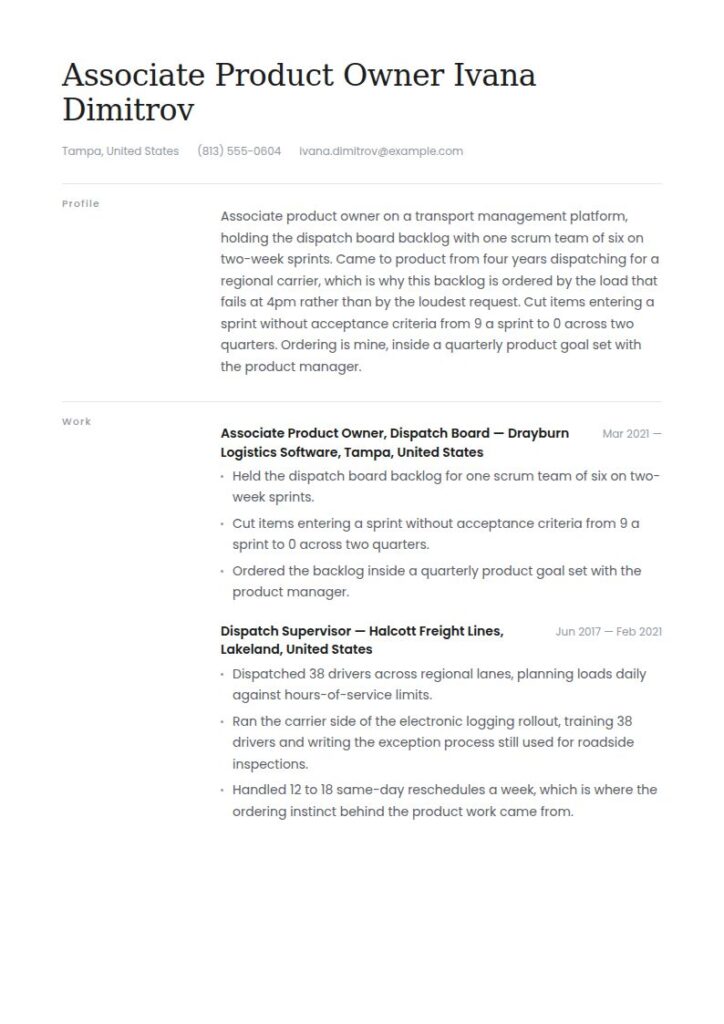
Associate product owner on a transport management platform, holding the dispatch board backlog with one scrum team of six on two-week sprints. Came to product from four years dispatching for a regional carrier, which is why this backlog is ordered by the load that fails at 4pm rather than by the loudest request. Cut items entering a sprint without acceptance criteria from 9 a sprint to 0 across two quarters. Ordering is mine, inside a quarterly product goal set with the product manager.
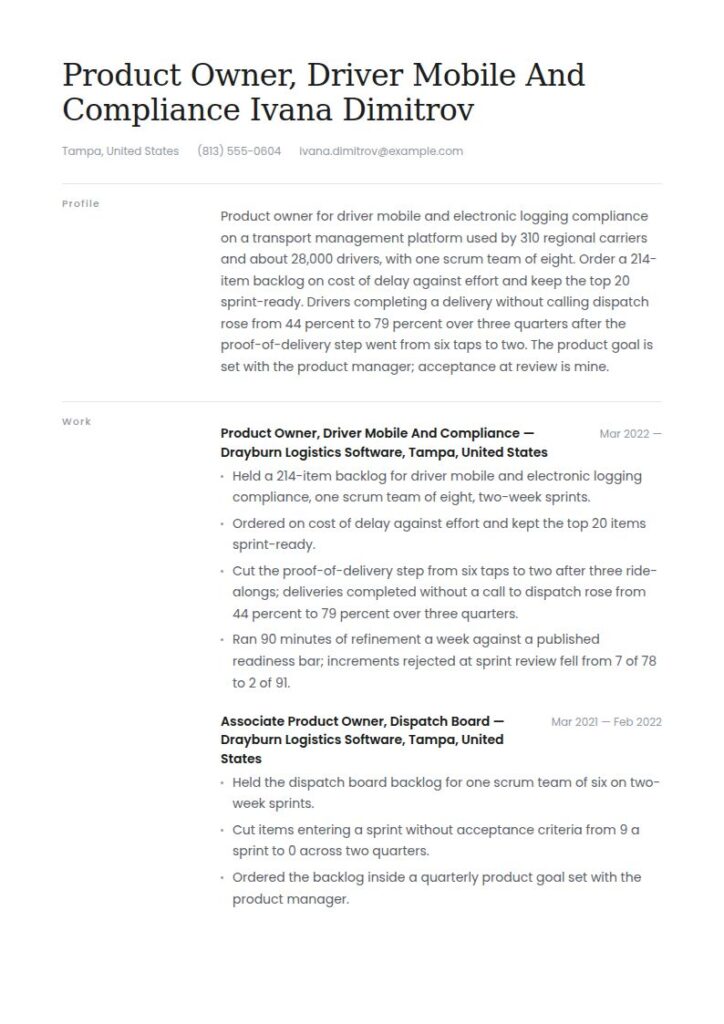
Product owner for driver mobile and electronic logging compliance on a transport management platform used by 310 regional carriers and about 28,000 drivers, with one scrum team of eight. Order a 214-item backlog on cost of delay against effort and keep the top 20 sprint-ready. Drivers completing a delivery without calling dispatch rose from 44 percent to 79 percent over three quarters after the proof-of-delivery step went from six taps to two. The product goal is set with the product manager; acceptance at review is mine.
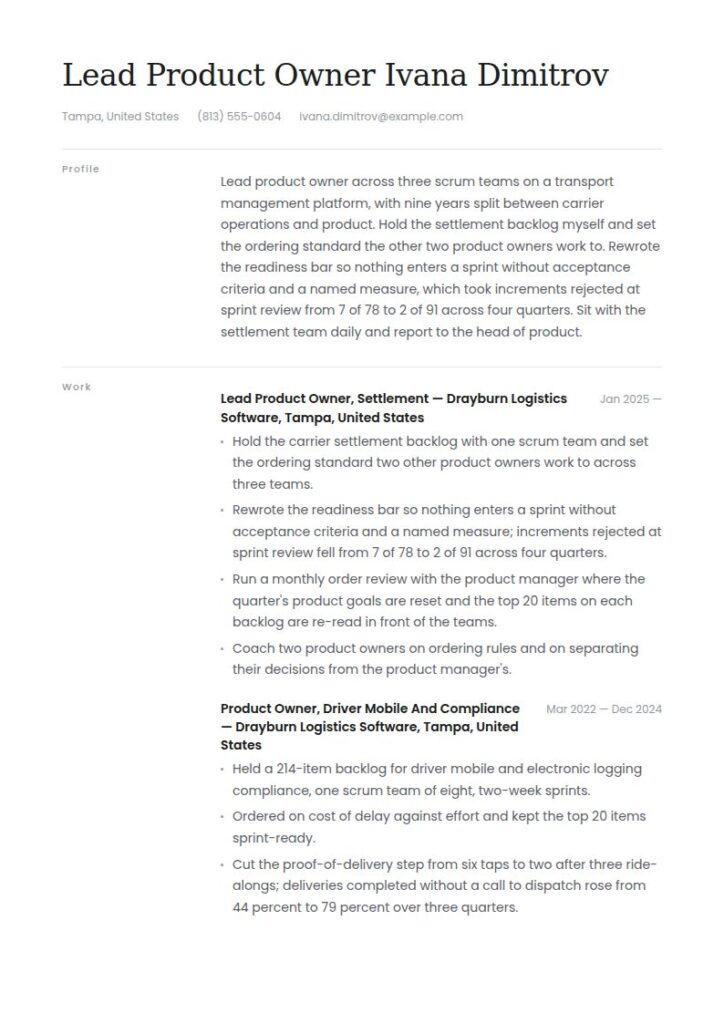
Lead product owner across three scrum teams on a transport management platform, with nine years split between carrier operations and product. Hold the settlement backlog myself and set the ordering standard the other two product owners work to. Rewrote the readiness bar so nothing enters a sprint without acceptance criteria and a named measure, which took increments rejected at sprint review from 7 of 78 to 2 of 91 across four quarters. Sit with the settlement team daily and report to the head of product.
Right vs wrong: the same product owner summary, twice
| ✅ Right | ❌ Wrong |
|---|---|
| Product owner for driver mobile and compliance, one scrum team of eight, 214-item backlog, two-week sprints. | Certified product owner experienced in agile delivery and stakeholder management. |
| Order the backlog on cost of delay against effort and keep the top 20 sprint-ready. | Prioritized the product backlog and groomed user stories for the development team. |
| Drivers completing a delivery without calling dispatch rose from 44 percent to 79 percent over three quarters. | Delivered features that improved the user experience and drove business value. |
On one hand, the left column describes someone with an ordering rule. On the other hand, the right column describes someone who received the order and typed it in.
Outline your product owner experience
Then give the employer, what the product does, the team, the sprint length and dates. Then four to six bullets, each carrying a decision and a number.
| Instead of | Use |
|---|---|
| Prioritized the product backlog | Ordered a 214-item backlog on cost of delay against effort, reviewed weekly with the team |
| Groomed the backlog with the team | Ran 90 minutes of refinement a week, taking 12 items a sprint to a published readiness bar |
| Wrote user stories and acceptance criteria | Cut items entering a sprint without acceptance criteria from 9 a sprint to 0 |
| Acted as the voice of the customer | Rode with 14 drivers and sat 6 dispatch shifts in a year |
| Participated in sprint ceremonies | Made 23 in-sprint scope calls across a year, none of which reopened a sprint goal |
| Worked with stakeholders to gather requirements | Held a standing Thursday slot for three account managers; 61 requests entered the backlog with a named requester |
Product Owner, Driver Mobile and Compliance, Drayburn Logistics Software, Tampa, FL, March 2022 to Present
Hold the backlog for driver mobile and electronic logging compliance on a transport management platform used by 310 regional carriers and about 28,000 drivers. One scrum team of eight, two-week sprints, product goal set each quarter with the product manager.
Order 214 backlog items on cost of delay against effort and keep the top 20 sprint-ready, so planning starts from a list the team has already seen.
Cut the proof-of-delivery step from six taps to two after three ride-alongs. Drivers completing a delivery without calling dispatch rose from 44 percent to 79 percent over three quarters.
Run 90 minutes of refinement a week against a published readiness bar. Items entering a sprint without acceptance criteria fell from 9 a sprint to 0, and increments rejected at sprint review from 7 of 78 to 2 of 91.
Made 23 in-sprint scope calls in a year, each recorded with the date and the option dropped. None reopened a sprint goal.
Hold a standing Thursday slot for account management, where 61 requests entered the backlog with a named requester and a stated outcome.
Show the backlog you own and what you decided in each ceremony
This is the block that wins a product owner resume, and almost nobody writes it, because the events are so familiar that candidates assume attendance is the claim. It is not. Moreover, the Scrum Guide is explicit that the product owner "is one person, not a committee" and that "those wanting to change the Product Backlog can do so by trying to convince the Product Owner" (Scrum Guide, November 2020). In other words, both describe a decision with an owner.
The backlog. How many items, for which surface, and how many are kept ready. The Scrum Guide calls it "an emergent, ordered list of what is needed to improve the product" and says items "that can be Done by the Scrum Team within one Sprint are deemed ready for selection" (Scrum Guide, November 2020), so a count of ready items measures whether the job is being done.
The product owner ordering rule and readiness bar
The ordering rule. The most useful line on the page and the one most often missing. Name it: cost of delay against effort, weighted shortest job first, a scored model with its weights stated, or regulatory date first and value second. Then say who may change the order. A resume without one reads as a backlog sorted by whoever emailed most recently.
The readiness bar. What must be true before an item may enter a sprint, with a before and after number, because refinement is invisible work otherwise.
The events, and what you decided in each.
Backlog: 214 items for driver mobile and compliance, one scrum team of 8, two-week sprints, top 20 kept sprint-ready. Ordering rule is cost of delay against effort, reviewed weekly with the team and reset against the product goal each quarter.
Refinement: 90 minutes a week, 12 items a sprint taken to a readiness bar of acceptance criteria, a named measure, a sized slice and identified dependencies. Items entering a sprint without acceptance criteria fell from 9 a sprint to 0.
Sprint planning: propose the sprint goal and the ordered candidate list; the team decides how much it takes. 24 sprints last year, 22 with a goal unchanged from planning to review.
Daily scrum: the 15-minute event belongs to the developers (Scrum Guide, November 2020). Available inside the hour for scope questions; 23 in-sprint scope calls in a year, each logged with the date and the option dropped.
Sprint review: accept or reject the increment against the acceptance criteria. 91 increments reviewed across four quarters, 2 rejected, each with the reason recorded and the item reordered rather than quietly carried.
Retrospective: attend as a team member; two of the last eight actions changed the readiness bar.
Two cautions keep this block credible. Do not claim a decision the scrum master or the product manager made: ordering, refinement, acceptance and in-sprint scope are yours, while team capacity, engineering approach and the investment envelope usually are not, and a reader who has run a team spots the overreach in one line.
Also, do not quote velocity as an achievement. After all, it is a planning aid for one team, so "raised velocity from 32 to 48" reads as a change in estimating. In contrast, increments accepted at review, items meeting the readiness bar and sprint goals met mean the same thing in two different companies.
Product owner and product manager: say which arrangement you worked in
Plenty of companies use the two titles interchangeably, and plenty run both at once with a real division. There is no standard, so say which arrangement you were in.
Where both exist, the usual split is that the product manager holds the outcome across the product and the quarter, and the product owner holds one team's backlog and the acceptance of its work. Write it as two sentences: what you decided, and what somebody else decided. Where only one title exists and you did both jobs, write around the wider scope, starting from the product manager resume example.
Build a snapshot of your key skills
For skills, similarly, twelve to fifteen entries in four groups: backlog and ordering, scrum practice, domain, and tools.
Backlog and ordering: Backlog ordering on cost of delay, product goal setting, readiness bar definition, acceptance criteria, slicing to a one-sprint increment, dependency identification, in-sprint scope decisions
Scrum practice: Sprint planning with the team, refinement facilitation, increment acceptance at review, retrospective participation, working to a definition of done, one-week and two-week cadences
Domain: Dispatch and load planning, driver hours and electronic logging compliance, proof of delivery, carrier settlement
Tools: Jira, Azure DevOps, Confluence, Miro, Amplitude, SQL for backlog evidence
However, domain is the group most product owner resumes leave out and the one that decides shortlists. For example, someone who has dispatched loads knows which screen a driver uses in the rain.
List your education and certifications
Degree, institution and year, then credentials with the issuing body, the year and whether they are current.
Bachelor of Science, Supply Chain Management, University of South Florida, Tampa, FL, 2016
Certified Scrum Product Owner (CSPO), Scrum Alliance, 2021, renewed 2025
Certificate in Product Ownership Analysis (IIBA-CPOA), International Institute of Business Analysis, 2024
Additional training: SQL for product evidence, 2023. Cost of delay ordering, 2024.
There is no license for this work and no credential that gates entry, so read what each one certifies before paying for it.
In particular, Scrum Alliance's Certified Scrum Product Owner is course-based and, unusually, does not last: holders are told to "renew your certification every two years by submitting the renewal fee and the required number of Scrum Education Units (SEUs)" (Scrum Alliance, accessed 14 September 2026). Put the renewal year on the page, because a lapsed credential is easy to check. Likewise, the International Institute of Business Analysis offers a Certificate in Product Ownership Analysis, which it describes as recognizing "the integration of Business Analysis and Product Ownership with an Agile mindset to maximizing value" (IIBA, accessed 14 September 2026).
Neither gets you hired. They read as sensible when you are moving into product ownership from operations, support or analysis, and as padding on a file with four years of backlog ownership already on it.
Choose the right layout and design
In general, single column, 10 or 11 point, plain headings, no photograph, no rating bars, no burndown chart. Also keep the backlog and ceremonies block on page one, because it is the part a delivery lead reads twice.
Name the product surface, team size, sprint length and backlog size in the header. State the ordering rule and who may change the order. Give the readiness bar with a before and after number. Write what you decided at planning, at review and in-sprint. Separate your decisions from the product manager's. Name the domain you know.
Do not list the ceremonies you attended, because attendance is not a decision. Do not quote velocity as an achievement. Do not claim the roadmap if you ordered one team's backlog inside somebody else's quarter. Do not name a customer account or an unreleased product; describe the segment instead.
Product owner job market and outlook
The Bureau of Labor Statistics publishes no Occupational Outlook Handbook profile for product owner, because the Handbook measures broad occupations rather than job titles. This one, for instance, sits in at least three of them.
For instance, where the product is software and the role sits in a technology function, product owners are usually counted with computer systems analysts, whom the Handbook describes as people who "study an organization's current computer systems and design ways to improve efficiency". In a delivery function, however, employers commonly code it with project management specialists. Meanwhile, in many non-technology employers it falls into the residual business operations category, published with no openings figure and no wage percentiles.
| Bracketing occupation | Employment, 2025 | Projected change, 2025 to 2035 | Annual openings | Median annual wage, May 2025 |
|---|---|---|---|---|
| Computer systems analysts | 544,400 | 8 percent growth, to 587,200 | About 32,900 | $105,850 |
| Project management specialists | 1,094,300 | 7 percent growth, to 1,167,400 | About 76,500 | $102,320 |
| Business operations specialists, all other | 1,157,600 | 4 percent growth, to 1,202,300 | Not published | $83,050 |
Source: U.S. Bureau of Labor Statistics, Occupational Outlook Handbook, May 2025 wage data and 2025 to 2035 projections, published 27 August 2026, including the Handbook's Data for Occupations Not Covered in Detail table, which publishes employment, projections and medians but no annual openings and no wage percentiles.
Two of the three brackets ask for no prior experience at all
Computer systems analysts numbered 544,400 in 2025 and are projected to reach 587,200 by 2035, a rise of 8 percent that the Handbook calls much faster than average, with about 32,900 openings a year and a median annual wage of $105,850 in May 2025. Typical entry is a bachelor's degree with no prior work experience in a related occupation and no on-the-job training. Project management specialists show the same shape: 1,094,300 jobs in 2025, 7 percent growth to 1,167,400, about 76,500 openings a year, a median of $102,320, and again no prior experience listed as typical entry (BLS Occupational Outlook Handbook, May 2025 and 2025 to 2035 projections).
The third bracket is the warning. Business operations specialists, all other had a median of $83,050 in May 2025, about $22,800 below the computer systems analysts median, and it is where the title lands when the role is coded as generic business support (BLS Occupational Outlook Handbook, published 27 August 2026). That gap is what your resume argues about.
What salary you can expect as a product owner
No federal median exists for the job title, so any single figure offered for it is an estimate rather than a measurement. Therefore, what BLS publishes is the range across the occupations that count the role.
Specifically, computer systems analysts had a median annual wage of $105,850 in May 2025, project management specialists $102,320, and business operations specialists, all other $83,050 (BLS Occupational Outlook Handbook, May 2025). Moreover, industry moves it again: within project management specialists, finance and insurance paid a median of $120,700 against $98,730 in construction (BLS, May 2025). Both published distributions are wide, running from under $67,340 to over $167,710 and from under $61,580 to over $167,970 (BLS, May 2025).
Three things on the page move which band you are read into, and none is the certification: whether you order the backlog or receive the order, whether acceptance is yours, and whether you bring a domain the employer cannot hire cheaply. Ask at offer stage which job family the role is coded to, because that is what the range was built from.
Key takeaways for a product owner resume
- Firstly, name the product, team size, sprint length and backlog size in the header.
- Secondly, state the ordering rule and who may change the order.
- Give the readiness bar with a before and after number.
- Equally, write what you decided at planning, at review and in-sprint, not what you attended.
- Finally, separate your decisions from the product manager's.
- Use increments accepted and sprint goals met instead of velocity.
- Name the domain, because it is the part of this job that cannot be certified.
Build your product owner resume in 15 minutes with our AI resume builder.
Related business and management resume examples
- Product manager resume
- Project manager resume
- Program manager resume
- Project coordinator resume
- Business analyst resume
- Senior business analyst resume
- Entry level business analyst resume
- Business intelligence resume
- Customer success resume
- Team lead resume
- CTO resume
- Business management resume
Pair it with a matching product owner cover letter.
Product owner resume questions, answered
How long should a product owner resume be?
One page for your first five years. Two once you serve more than one team or set the standard other product owners work to, provided the second page carries decisions rather than a longer list of shipped items.
Do I need a scrum certification to get a product owner job?
It helps you get read and it will not get you hired. Scrum Alliance's product owner certification is course-based and must be renewed every two years with Scrum Education Units (Scrum Alliance, accessed 14 September 2026), so it signals current practice rather than judgment. Postings often list it, which is reason enough to hold one. The interview turns on whether you can state your ordering rule and defend one item you kept out of a sprint.
What is the difference between a product owner and a product manager?
Where both exist, the product manager usually holds the outcome across the product and the quarter, and the product owner holds one team's backlog and accepts its work. Where only one exists, the job is whatever the organization made it, so state which arrangement you worked in rather than rely on the word.
What do I put on a product owner resume with no product owner title?
The ordering decisions you already make. Support leads who decide which defects get escalated, operations staff who set the order a queue is worked, and analysts who decide which requests reach a development team are all ordering a backlog without the word. Write one as a list, a rule, a decision and an outcome, then name the domain you know better than anyone applying from outside it.
How do I write results when the team built the thing, not me?
Claim the decisions, not the build. The Scrum Guide puts the increment on the whole team: "The entire Scrum Team is accountable for creating a valuable, useful Increment every Sprint" (Scrum Guide, November 2020). Yours is the order, the readiness bar, the acceptance and the scope calls inside the sprint. Write those with numbers, then let one outcome sentence say what changed for users. Leave velocity off entirely; it is a planning aid for one team and does not compare across teams.