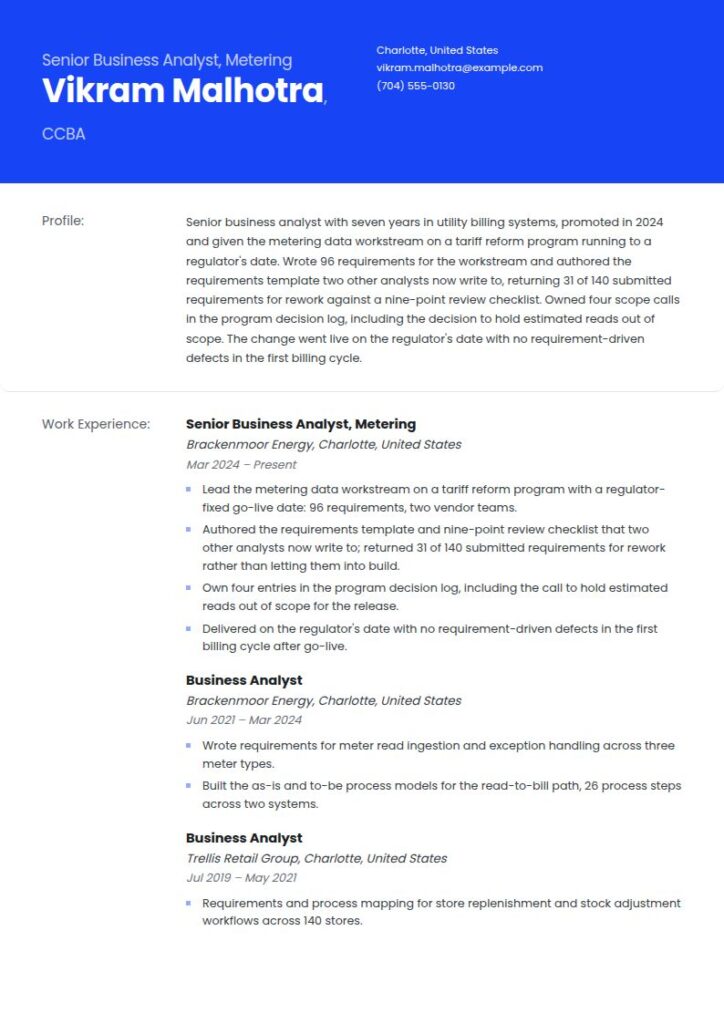
Senior Business Analyst, Metering Vikram Malhotra CCBA
Senior Business Analyst, Metering
[email protected] | (704) 555-0130 | Charlotte, United States
Profile
Senior business analyst with seven years in utility billing systems, promoted in 2024 and given the metering data workstream on a tariff reform program running to a regulator's date. Wrote 96 requirements for the workstream and authored the requirements template two other analysts now write to, returning 31 of 140 submitted requirements for rework against a nine-point review checklist. Owned four scope calls in the program decision log, including the decision to hold estimated reads out of scope. The change went live on the regulator's date with no requirement-driven defects in the first billing cycle.
Work Experience
03/2024 - Present, Senior Business Analyst, Metering, Brackenmoor Energy, Charlotte, United States
- Lead the metering data workstream on a tariff reform program with a regulator-fixed go-live date: 96 requirements, two vendor teams.
- Authored the requirements template and nine-point review checklist that two other analysts now write to; returned 31 of 140 submitted requirements for rework rather than letting them into build.
- Own four entries in the program decision log, including the call to hold estimated reads out of scope for the release.
- Delivered on the regulator's date with no requirement-driven defects in the first billing cycle after go-live.
06/2021 - 03/2024, Business Analyst, Brackenmoor Energy, Charlotte, United States
- Wrote requirements for meter read ingestion and exception handling across three meter types.
- Built the as-is and to-be process models for the read-to-bill path, 26 process steps across two systems.
07/2019 - 05/2021, Business Analyst, Trellis Retail Group, Charlotte, United States
- Requirements and process mapping for store replenishment and stock adjustment workflows across 140 stores.
Education
08/2015 - 05/2019, Bachelor of Science, Industrial Engineering, North Carolina State University, Raleigh, United States
Coursework in process design, operations research and quality systems.
Skills
Workstream leadership, 75
Requirements review against a checklist, 80
Decision log ownership, 70
Regulatory requirement decomposition, 75
BPMN and read-to-bill process modeling, 85
Vendor requirement negotiation, 70
SQL for rule validation, 75
Languages
English, native
Hindi, native
Punjabi, intermediate
Certificates
05/2023, Certification of Capability in Business Analysis (CCBA), International Institute of Business Analysis
Requires 3,750 hours of business analysis work experience in the last seven years. CBAP hours logged toward application.
Summary
A senior business analyst resume is a two page document showing the workstream you led, the domain you own, the standard other analysts write to, and the decisions you made when two stakeholders wanted different things. This guide gives you three adaptable versions, a decision log block that proves seniority, and current Bureau of Labor Statistics pay and outlook for the occupations this job is measured under.
Senior Business Analyst resume examples by experience level
A senior business analyst resume is a two page document showing the workstream you led, the domain nobody else has to cover, the standard other analysts write their requirements to, and the calls you made when two stakeholders wanted different things.
The most common failure on these files is not weakness. It is that they are business analyst resumes with the word senior added: the same artifacts, the same elicitation counts, the same acceptance criteria, described with bigger adjectives. A hiring panel reading a senior application is checking for four structural changes, and none of them is vocabulary. Did you lead, rather than contribute? Do you own a domain, rather than work in one? Does anyone else write to a standard you set? And when the room disagreed, did the decision come to you?
Resume guide for a senior business analyst resume
This guide and the corresponding senior business analyst resume example will cover:
- How to write a senior business analyst resume, section by section
- The four structural signals that separate senior from practicing
- Three adaptable summaries: newly senior, domain owner and practice lead
- Why a decision log belongs on the page, and what one entry looks like
- What the job market looks like and what you can expect to earn
How to write a senior business analyst resume
Six sections: contact header, summary, experience, a decisions and review block, skills and methods, and education with certifications. Two pages is normal at this level, and the second page has to be scope and judgment rather than a longer tool list.
The order follows what the panel is testing. Program leadership scans for the size of what you led, then for whether other analysts depend on you, then for one decision to interrogate. Everything else is background.
| Section | What it is answering | Where it goes |
|---|---|---|
| Summary | What do you lead, which domain do you own, and what did you decide? | Top, four lines |
| Experience | Did you lead a workstream, or contribute to one? | Reverse chronological, leadership verbs and numbers |
| Decisions and review | Whose work did you shape, and which calls were yours? | Its own block after experience |
| Skills and methods | What can you set a standard in, not just perform? | Grouped, with depth implied by the grouping |
| Education and certifications | Do you clear the senior credential bar? | Last, with issuing body and date |
Seniority is scope of decision, not years served
"Eight years of experience" is not a senior claim. It is a duration, and plenty of eight-year analysts have done the same year eight times.
The claim that reads as senior is a sentence with a decision in it. "Led the metering workstream on a tariff reform program: 96 requirements, two analysts writing to a template I authored, and the four scope calls that went to the program decision log were mine." A panel can size that, and it says something the year count cannot.
If you have just stepped up, write the step explicitly. "Promoted to senior business analyst in 2024 and given the metering domain" is a stronger line than pretending the seniority was always there, because it dates the change and tells the reader what triggered it.
Run the finished file through the free ATS resume checker before you submit. Senior analyst roles are still posted through corporate requisition pipelines that parse your file into fields before anyone reads it.
Choosing the best resume format for a senior business analyst resume
Reverse chronological, single column, two pages. The step from analyst to senior analyst is visible only in a timeline, and a panel wants to see when it happened and what changed on that date.
Resist the consultant-style format that leads with three engagement case studies and puts employment at the end. It works for a consultancy partner and fails here, because the panel needs to know which organization gave you which scope. Leading a workstream in a twelve-person delivery and leading one in a five-workstream regulatory program are different claims in the same words.
Include your contact information
| ✅ Right | ❌ Wrong |
|---|---|
| Vikram Malhotra | Vikram Malhotra |
| Senior Business Analyst, Billing and Metering | Senior business professional with extensive experience |
| CBAP, International Institute of Business Analysis | Certified senior analyst |
| (704) 555-0130, [email protected], Charlotte, NC | (704) 555-0130, [email protected] |
If you also hold the CCBA, list only the CBAP in the header. IIBA states that "Holders of both CCBA and CBAP certifications will only have to recertify for CBAP, and CCBA will be covered" (IIBA, accessed September 2026), which is a fair signal that the higher tier is the one that speaks.
Make use of a summary
Four lines: what you lead, the domain you own, whose work you shape, and one decision or quality movement with a period attached.
Senior business analyst with seven years in utility billing systems, promoted in 2024 and given the metering data workstream on a tariff reform program running to a regulator's date. Wrote 96 requirements for the workstream and authored the requirements template two other analysts now write to, returning 31 of 140 submitted requirements for rework against a nine-point review checklist. Owned four scope calls in the program decision log, including the decision to hold estimated reads out of scope. The change went live on the regulator's date with no requirement-driven defects in the first billing cycle.
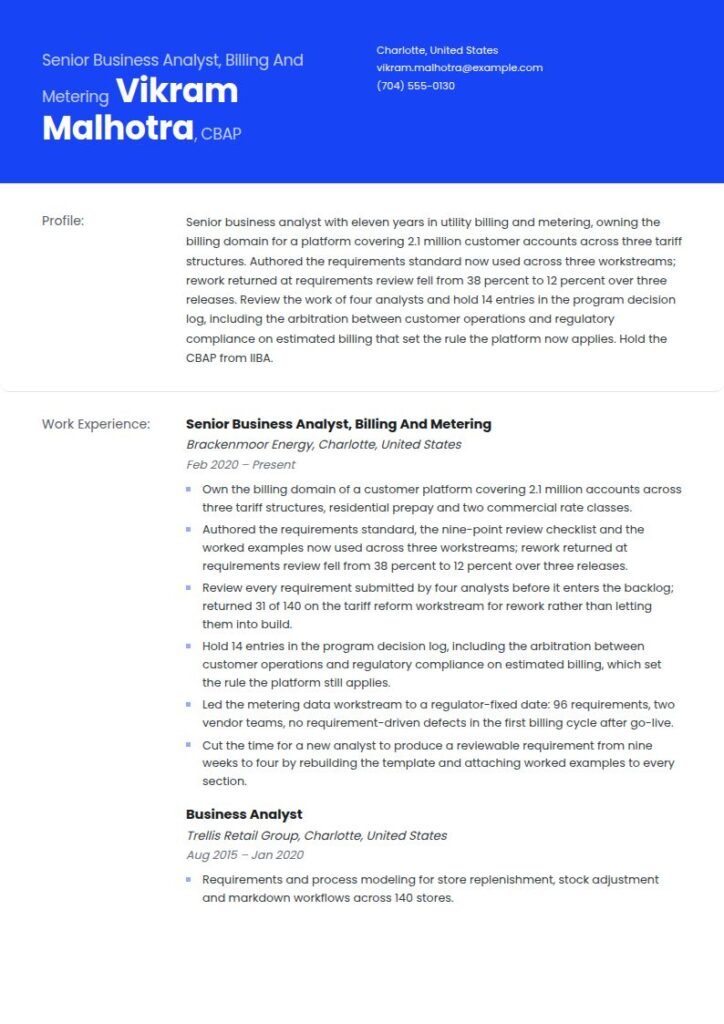
Senior business analyst with eleven years in utility billing and metering, owning the billing domain for a platform covering 2.1 million customer accounts across three tariff structures. Authored the requirements standard now used across three workstreams; rework returned at requirements review fell from 38 percent to 12 percent over three releases. Review the work of four analysts and hold 14 entries in the program decision log, including the arbitration between customer operations and regulatory compliance on estimated billing that set the rule the platform now applies. Hold the CBAP from IIBA.
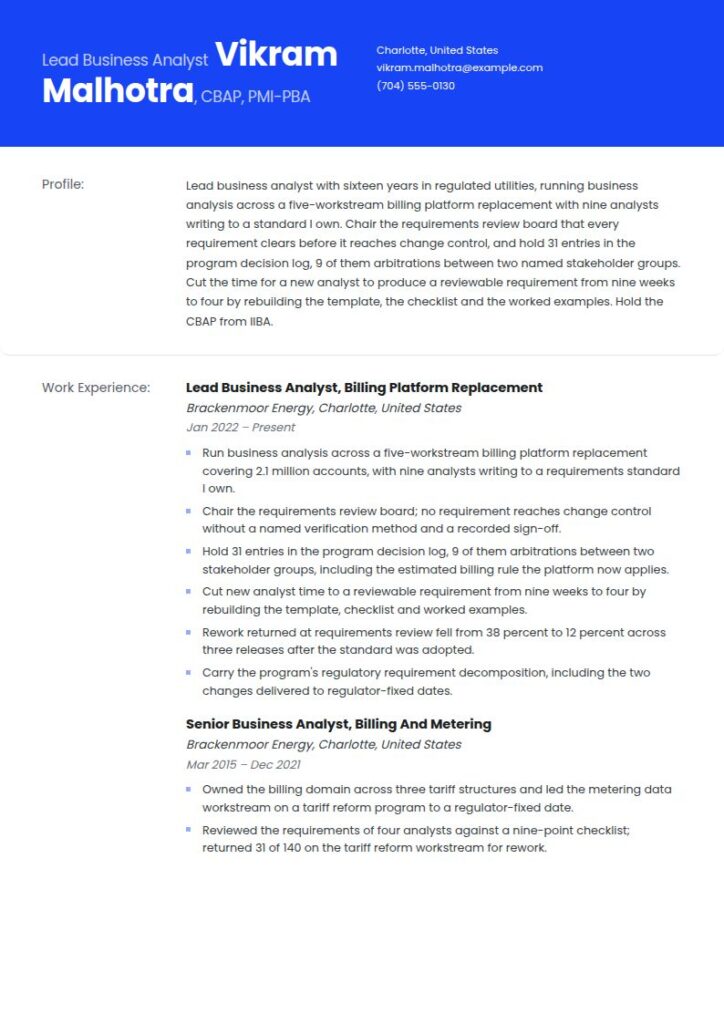
Lead business analyst with sixteen years in regulated utilities, running business analysis across a five-workstream billing platform replacement with nine analysts writing to a standard I own. Chair the requirements review board that every requirement clears before it reaches change control, and hold 31 entries in the program decision log, 9 of them arbitrations between two named stakeholder groups. Cut the time for a new analyst to produce a reviewable requirement from nine weeks to four by rebuilding the template, the checklist and the worked examples. Hold the CBAP from IIBA.
Right vs wrong: the same senior business analyst summary, twice
| ✅ Right | ❌ Wrong |
|---|---|
| Own the billing domain for a platform covering 2.1 million customer accounts across three tariff structures. | Senior business analyst with extensive experience across large-scale transformation programs. |
| Authored the requirements standard now used across three workstreams; rework at review fell from 38 percent to 12 percent. | Mentored junior analysts and championed best practice in requirements engineering. |
| Hold 14 entries in the program decision log, including the estimated billing arbitration between operations and compliance. | Trusted advisor to senior stakeholders, skilled at building consensus. |
The right column names things that exist: a domain, a standard, a log. The wrong column describes a disposition, and a panel shortlisting senior analysts has read that paragraph forty times this month.
Outline your senior business analyst experience
Employer, title, the domain and its scale, the number of analysts you shape, and dates. Then five to six bullets, and at least two of them should have a decision or a review in them rather than an artifact.
| Instead of | Use |
|---|---|
| Led requirements for a large transformation program | Led the metering workstream on a tariff reform program: 96 requirements, 2 analysts, a regulator-fixed go-live date |
| Mentored junior business analysts | Review every requirement from 4 analysts against a 9-point checklist; returned rework fell from 38 percent to 12 percent over three releases |
| Established best practices for the business analysis team | Authored the requirements standard and worked examples now used across 3 workstreams; new analyst time to a reviewable requirement fell from 9 weeks to 4 |
| Managed stakeholder expectations across the business | Arbitrated the estimated billing rule between customer operations and regulatory compliance; the decision and its rationale are logged and still applied |
| Worked with senior stakeholders to agree scope | Owned 14 entries in the program decision log, 5 of them scope exclusions carried into change control with impact analysis |
| Ensured requirements quality across the program | Chair the requirements review board; no requirement reaches change control without a named verification method attached |
Senior Business Analyst, Billing and Metering, Brackenmoor Energy, Charlotte, NC, February 2020 to Present
Own the billing domain of a customer platform covering 2.1 million accounts across three tariff structures, residential prepay and two commercial rate classes.
Authored the requirements standard, the nine-point review checklist and the worked examples now used across three workstreams; rework returned at requirements review fell from 38 percent to 12 percent over three releases.
Review every requirement submitted by four analysts before it enters the backlog, and returned 31 of 140 on the tariff reform workstream for rework rather than letting them into build.
Hold 14 entries in the program decision log, including the arbitration between customer operations and regulatory compliance on estimated billing, which set the rule the platform now applies and has not been reopened.
Led the metering data workstream to a regulator-fixed date: 96 requirements, two vendor teams, and no requirement-driven defects in the first billing cycle after go-live.
Cut the time for a new analyst to produce a reviewable requirement from nine weeks to four by rebuilding the template and attaching worked examples to every section.
The decision log: the calls you owned when stakeholders disagreed
This is the block that proves seniority, and it is the one almost every senior application leaves out.
Below senior, an analyst documents what stakeholders agreed. At senior, somebody has to say what happens when they do not, because the program cannot wait for consensus and the sponsor is not close enough to the detail to rule. Most programs already record it: a decision log, a design authority minute, an architecture decision record, a scope exclusion carried into change control. Read yours, find the entries with your name on them, and put two on the page.
Decisions owned: 14 entries in the program decision log, 5 scope exclusions, 4 data rule decisions, 3 sequencing calls and 2 arbitrations between stakeholder groups.
Worked example: Customer operations wanted estimated reads billed in the cycle they were taken; regulatory compliance wanted them held to the next actual read. The decision was mine after a four-week analysis of read frequency by meter type. Held to the next actual read, with an exception for prepay, on the grounds that the compliance exposure was asymmetric and the operational cost of holding was measurable at roughly 9,000 accounts a cycle. Logged with the rationale, the rejected option and the review date. Not reopened in two years.
Requirements reviewed: Every requirement from four analysts, against a nine-point checklist covering testability, verification method, traceability, data definition and stakeholder sign-off. 31 of 140 returned for rework on the tariff reform workstream.
Standard owned: Requirements template, review checklist and worked examples, in use across three workstreams. New analyst time to a reviewable requirement fell from nine weeks to four.
Escalations: Two scope disputes carried to the change control board with impact analysis and a recommendation; both accepted as recommended.
Four rules make this block credible rather than boastful.
Write the decision, the rejected option and the reason. A decision with no rejected option was a preference, and an interviewer will ask what else was on the table.
Name the stakeholder groups, never the people. "Customer operations and regulatory compliance" is the useful information; a named colleague on your resume is a warning sign to the reader.
Say what happened afterwards. "Not reopened in two years" beats any account of how you built consensus, and "revisited after twelve months when volumes changed" is honest and reads better than silence.
Separate the decisions you owned from the ones you recommended. Recommending well is a real senior skill, but they are different claims and a panel notices when they are blurred.
Write the review you run, not the reviews you attend
"Mentored junior analysts" is the weakest common sentence on senior analyst resumes. It has no object, no volume and no standard.
The strong version names the mechanism. How many analysts submit work to you, what do you check it against, and what happened to the quality of what they submit? "Review every requirement from four analysts against a nine-point checklist; returned rework fell from 38 percent to 12 percent over three releases" is the same fact with evidence attached.
If your organization has no formal review, you probably still do this informally. Count it honestly: how many analysts bring you work before they publish it, and what do you send back? A senior analyst who improves other people's requirements is worth more than one who only writes excellent requirements, because the first scales and the second does not.
Build a snapshot of your key skills
Twelve to fifteen entries in four groups, and at this level the grouping should imply what you set standards in rather than what you can perform. Everything a practicing analyst lists is assumed of you.
Leadership and governance: Workstream leadership, requirements review boards, decision log ownership, scope arbitration, change control and impact analysis, requirements standards authorship
Analysis at scale: Domain modeling across tariff and rate structures, cross-workstream traceability, verification method assignment, regulatory requirement decomposition, benefits and options appraisal
Elicitation: Executive and regulator-facing workshop facilitation, conflict elicitation between operational and compliance stakeholders, vendor requirement negotiation
Tools and data: Jira and Confluence at program scale, Azure DevOps, SQL for rule validation, BPMN, data dictionary and interface specification
Leave the routine tools in one line. A senior file spending four lines on Visio and Excel is telling the panel where its ceiling is.
List your education and certifications
Degree, institution and year, then certifications with the issuing body, the year and the recertification position.
Bachelor of Science, Industrial Engineering, North Carolina State University, Raleigh, NC, 2010
Certified Business Analysis Professional (CBAP), International Institute of Business Analysis, 2018, recertified 2024
PMI Professional in Business Analysis (PMI-PBA), Project Management Institute, 2021
Additional training: Regulatory change delivery in utilities, 2023. Facilitation for contested requirements workshops, 2024.
The senior credential here is the Certified Business Analysis Professional, and its value is that it is gated on documented hours rather than on a course. IIBA requires "five or more years of work experience in the last 10 years (7,500 hours)", 35 professional development hours in the last four years and two professional references, with a 210-minute exam of 120 case-study questions (IIBA, accessed September 2026). Recertification runs on continuing development units, and IIBA notes that "You do not need to include documentation of your CDU activities unless you are selected for audit", so keep your own record.
The Project Management Institute's parallel credential asks for "36 months working as a practitioner of business analysis" in the last eight years with a bachelor's degree plus "35 contact hours earned in the topic of business analysis practices" (PMI, accessed September 2026). Programs run by a project management office tend to name it; product organizations tend to name IIBA. The full ladder, including the entry tiers, is set out on our business analyst resume example.
Neither credential makes anyone senior. The Bureau of Labor Statistics is plain about the occupation this job is counted under: "Management analysts are not required to get certification, but having a credential may give jobseekers a competitive advantage" (BLS Occupational Outlook Handbook, May 2025).
Choose the right layout and design
Single column, 10 or 11 point, two pages, clear headings, no photograph, no rating bars. At this level the layout signal that matters is restraint: a senior file that fits two dense but readable pages says something about editing judgment, which is most of the job.
Lead with what you led, not how long you have worked. Name the domain you own and its scale. Say how many analysts submit work to you and what you check it against. Put two decision log entries on the page with the rejected option in them. Date the promotion that made you senior. Keep the second page to scope and judgment.
Do not write a practicing analyst resume with "senior" in the title and larger adjectives. Do not write "mentored junior analysts" without a number and a standard. Do not name individual colleagues, stakeholders or customers. Do not claim a decision you recommended as one you owned. Do not spend four lines of a senior file on tools that a first-year analyst also uses.
Senior business analyst job market and outlook
The Bureau of Labor Statistics publishes no Occupational Outlook Handbook profile for senior business analyst, and no single published occupation matches the title. The Handbook measures broad occupations, not seniority levels, so the honest way to read this market is to look at where the top of the analyst band sits and where the next step lands.
Most senior analysts are counted as management analysts, and the relevant figure is not the median but the spread. Analysts who move into leading a practice rather than a workstream are usually banded against computer and information systems managers inside a technology organization, which is a different occupation with a different entry requirement.
| Bracketing occupation | Employment, 2025 | Projected change, 2025 to 2035 | Annual openings | Median annual wage, May 2025 |
|---|---|---|---|---|
| Management analysts | 1,077,100 | 10 percent growth, 109,200 jobs | About 94,100 | $101,860 |
| Computer and information systems managers | 685,800 | 16 percent growth, 108,100 jobs | About 53,500 | $175,140 |
Source: U.S. Bureau of Labor Statistics, Occupational Outlook Handbook, May 2025 wage data and 2025 to 2035 projections.
The top decile is the number that matters at this level
For management analysts, the median annual wage was $101,860 in May 2025, but the useful figures for a senior application are the ends of the distribution: the lowest 10 percent earned less than $60,640 and the highest 10 percent more than $171,640 (BLS Occupational Outlook Handbook, May 2025). A senior analyst is negotiating inside the upper half of a range that is nearly three times as wide as it is deep.
The step beyond senior analyst is measured separately and priced very differently. Computer and information systems managers had a median of $175,140 in May 2025, with the lowest 10 percent above $107,550, and the occupation is projected to grow 16 percent to 2035 with about 53,500 openings a year. Typical entry is a bachelor's degree plus five years or more of related work experience, against less than five years for management analysts (BLS Occupational Outlook Handbook, May 2025 and 2025 to 2035 projections).
That gap is the practical argument for the decision log. The thing that moves you from the upper part of one band into the lower part of the other is documented accountability for decisions and for other people's output, and a resume that shows neither leaves you inside the analyst distribution.
What salary you can expect as a senior business analyst
There is no published median for the title, so quoting one would mean inventing it. What is published is the distribution of the occupation most senior analysts are counted under, and the band above it.
Management analysts had a median annual wage of $101,860 in May 2025, with the highest 10 percent earning more than $171,640. Industry medians inside the occupation ran from $107,330 in professional, scientific and technical services down to $97,300 in government, and 14 percent of the occupation is self-employed, which sits outside the comparison because contract rates are not measured the same way (BLS Occupational Outlook Handbook, May 2025).
Computer and information systems managers, the band a practice lead is more often filed against, had a median of $175,140 with the lowest 10 percent above $107,550 in the same cycle. The distance between the top of the analyst distribution and the bottom of the manager distribution is small, which is why what you are filed as matters more than what you are called.
Three things move you inside the range, and a resume can carry all three: domain ownership nobody else duplicates, documented decision accountability, and leverage over other analysts' output. An organization pays differently for someone whose work improves four people's requirements than for someone who writes their own well.
Key takeaways for a senior business analyst resume
- Lead with what you led, not with the number of years.
- Name the domain you own and give its scale.
- Say how many analysts submit work to you and what standard you check it against.
- Put two decision log entries on the page, each with the rejected option and the reason.
- Date the promotion that made you senior, and say what triggered it.
- Name stakeholder groups, never individuals.
- Keep two pages of scope and judgment rather than three pages of artifacts.
Build your senior business analyst resume in 15 minutes with our AI resume builder.
Related business and management resume examples
- Business analyst resume
- Entry level business analyst resume
- Business intelligence resume
- Product owner resume
- Product manager resume
- Project manager resume
- Program manager resume
- Team lead resume
- Consultant resume
- Consulting resume
- Supply chain analyst resume
- Internal auditor resume
Pair it with a matching senior business analyst cover letter.
Senior business analyst resume questions, answered
How long should a senior business analyst resume be?
Two pages. One page at this level usually means the scope has been cut out to make it fit, and three means the artifacts were never edited. The second page should carry the decision log, the review mechanism and the standard you own, not a longer list of tools.
What actually makes a resume senior rather than experienced?
Four structural things, and none is the year count. You led a workstream rather than contributing to one. You own a domain rather than working across several. Other analysts write to a standard you authored. And when stakeholders disagreed, the decision came to you and was logged. A resume with all four reads senior at six years; one with none reads mid at fifteen.
Do I need the CBAP to apply for senior roles?
No, but it is the credential most often named in senior postings, and it is gated on 7,500 hours of documented business analysis work in the last ten years plus two professional references (IIBA, accessed September 2026), so it corroborates the experience claim rather than substituting for it. The Handbook notes that certification is not required for the occupation but "may give jobseekers a competitive advantage" (BLS Occupational Outlook Handbook, May 2025).
How do I show I made a decision when the sponsor signed it off?
Write it as it happened: you analyzed the options, made the recommendation, and the sponsor approved it. That is an honest senior claim and panels respect it. What they do not respect is a resume that claims sole authorship of a governance decision, because the first question in the interview is who else was in the room.
Should a senior business analyst resume still list elicitation and modeling skills?
Yes, but briefly and in one group. They are assumed at this level, so the space they take is space not spent on the review board, the standard and the decision log. A senior file that reads as a longer version of a practicing analyst's file is the commonest reason a strong candidate is screened as mid level.