Vikram Malhotra Senior Business Analyst, CBAP Charlotte, 28203, United States [email protected] · (704) 555-0130
11 September 2026
Ms. Caitriona Delahunt Customer Systems Program Kestrel Point Utilities Raleigh, United States
Application for Lead Business Analyst, Kestrel Point Utilities
Dear Ms. Delahunt,
I am applying for the Lead Business Analyst post on the customer systems program at Kestrel Point Utilities. I currently own the billing domain at a regulated energy retailer, covering 2.1 million accounts across three tariff structures, and I review the requirements of four analysts against a checklist I wrote.
The decision I would point to is the estimated billing rule. Customer operations wanted estimated reads billed in the cycle they were taken, because holding them pushed revenue and generated queries. Regulatory compliance wanted them held to the next actual read. It came to me after four weeks of analysis on read frequency by meter type. I held them to the next actual read with an exception for prepay, on the grounds that the compliance exposure was asymmetric while the operational cost was measurable at roughly 9,000 accounts a cycle. I logged the rationale, the rejected option and a review date. It has not been reopened in two years, and the same reasoning is now the template for how the program records data rule decisions.
Your posting describes five workstreams with analysts spread across three suppliers, which is the situation where a shared requirements standard stops being paperwork and starts being the only thing holding scope together. I rebuilt ours, and the measurable part was that rework returned at review fell from 38 percent to 12 percent over three releases while new analyst time to a reviewable requirement fell from nine weeks to four. That is the work I would want to do first.
I hold the CBAP from IIBA and the PMI-PBA, and can give four weeks' notice. Thank you for reading.
Sincerely, Vikram Malhotra, CBAP
Summary
A senior business analyst cover letter names the workstream you led, the standard other analysts write to, and one decision you owned when two stakeholder groups wanted different things. This guide gives you a full adaptable letter, a decision paragraph you can rebuild from your own programs, and the version to send when you are stepping up into the title for the first time.
Senior Business Analyst cover letter examples by experience level
A senior business analyst cover letter is a one-page letter telling a program director what you led, whose requirements you shape, and what you decided the last time two stakeholder groups wanted opposite things.
That last item is the whole letter. In practice, a reader can infer everything else on a senior application from the resume. However, judgment under disagreement cannot, and it is the thing the hiring panel is least able to test in an hour.
Guide to a senior business analyst cover letter
This guide and the corresponding senior business analyst cover letter example will cover:
- First, how to structure the letter, paragraph by paragraph
- Then, why one decision, told properly, outperforms a list of programs
- How to write the letter when you are stepping up into the title
- What to keep out when the program is regulated or confidential
- The openings that keep a reader on a senior file to the end
How to write a senior business analyst cover letter
| Paragraph | Its job | Length |
|---|---|---|
| Opening | The post, the domain you own, and the scale of what you lead | 2 to 3 sentences |
| Decision | One call you owned: the options, the reason, what happened next | 4 to 6 sentences |
| Fit | Something specific about their program and what you would do first | 3 to 4 sentences |
| Close | Credential, notice period, thank you | 2 sentences |
One decision beats four programs
The instinct on a senior application is to list scale: three programs, five workstreams, four domains. A program director reads that as a career summary and learns nothing the resume does not already say.
Spend the middle of the letter on a single decision instead. Name the two positions in the room, say which you chose, give the reason in one clause, and say whether it held. Six sentences.
That paragraph proves you have been trusted with a call, shows how you reason, and hands the interviewer an obvious opening question, which means you arrive having chosen the ground the conversation starts on.
A senior business analyst cover letter example you can adapt
Dear Ms. Delahunt,
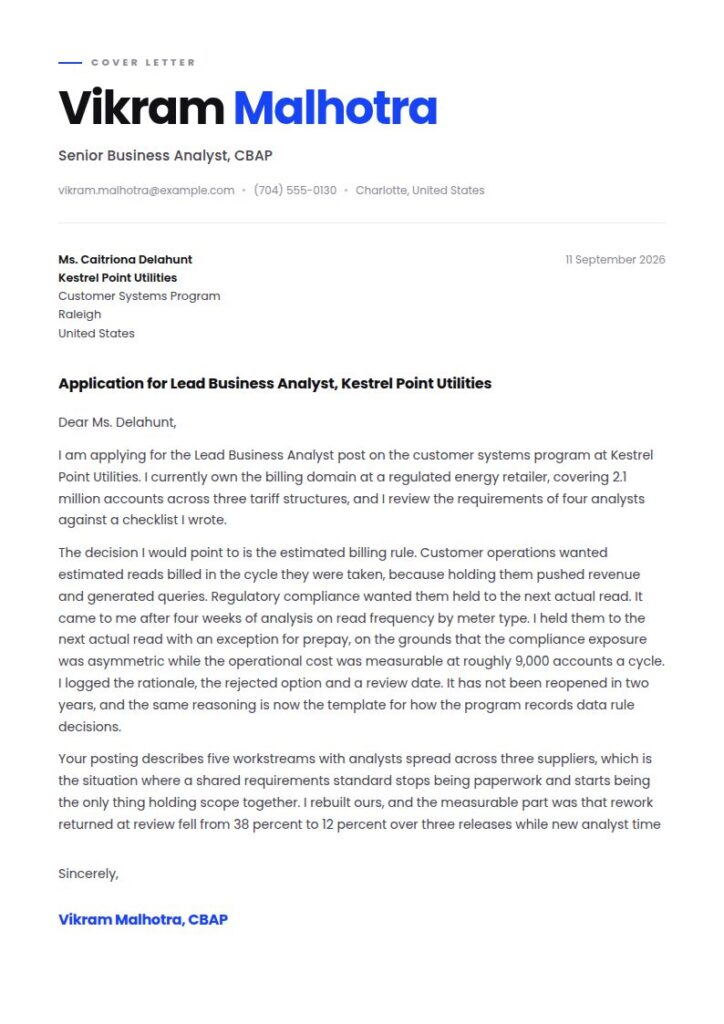
I am applying for the Lead Business Analyst post on the customer systems program at Kestrel Point Utilities. I currently own the billing domain at a regulated energy retailer, covering 2.1 million accounts across three tariff structures, and I review the requirements of four analysts against a checklist I wrote.
The decision I would point to is the estimated billing rule. Customer operations wanted estimated reads billed in the cycle they were taken, because holding them pushed revenue and generated queries. Regulatory compliance wanted them held to the next actual read. It came to me after four weeks of analysis on read frequency by meter type. I held them to the next actual read with an exception for prepay, on the grounds that the compliance exposure was asymmetric while the operational cost was measurable at roughly 9,000 accounts a cycle. I logged the rationale, the rejected option and a review date. It has not been reopened in two years, and the same reasoning is now the template for how the program records data rule decisions.
Your posting describes five workstreams with analysts spread across three suppliers, which is the situation where a shared requirements standard stops being paperwork and starts being the only thing holding scope together. I rebuilt ours, and the measurable part was that rework returned at review fell from 38 percent to 12 percent over three releases while new analyst time to a reviewable requirement fell from nine weeks to four. That is the work I would want to do first.
I hold the CBAP from IIBA and the PMI-PBA, and can give four weeks' notice. Thank you for reading.
Sincerely, Vikram Malhotra, CBAP
Openings that work
| Instead of | Use |
|---|---|
| I am a senior business analyst with over ten years of experience | I own the billing domain at a regulated energy retailer, 2.1 million accounts across three tariff structures |
| I have led numerous large-scale transformation programs | I review the requirements of four analysts against a checklist I wrote |
| I am a trusted advisor skilled at building stakeholder consensus | The estimated billing rule came to me after four weeks of analysis, and I held reads to the next actual read |
| I am excited by the opportunity to join your team | Your posting describes five workstreams with analysts spread across three suppliers |
Writing the decision paragraph
The paragraph has a fixed shape, and it is worth writing it out before you compress it.
| Element | What goes in it |
|---|---|
| The disagreement | Two stakeholder groups, named by function, wanting different things for stated reasons |
| Why it reached you | The analysis you ran, and how long it took |
| The call | What you decided, including the exception if there was one |
| The reason | One clause, not a paragraph: the asymmetry, the cost, the risk |
| What happened | Whether it held, was revisited, or was overturned |
Two rules keep it honest. Name functions, never people, because a named colleague on a job application is a problem for them and a signal about you. Also, if you later revisited the decision, say so; "revisited after twelve months when volumes changed" reads as someone who tracks their own calls, which is rarer than being right.
Open with the domain you own and its scale. Give one decision in full, with the rejected option. Say how many analysts submit work to you and against what standard. Name one real feature of their program, taken from the posting. State your credential and your notice period in the closing line.
Do not list every program you have worked on; the resume does that. Do not write "trusted advisor", "thought leader" or "stakeholder whisperer". Do not name individuals, customers or an unreleased vendor product. Do not claim a governance decision that was actually the sponsor's, because the first interview question is who else was in the room. Do not send the domain-depth letter to a consultancy, which is buying range instead.
Stepping up: the letter when you have not held the title
Plenty of strong senior applications come from people whose title still says business analyst. The letter is where you make that case, because the resume header cannot.
Even so, do not apologize for it and do not overclaim it. Write the responsibilities you already carry in the language of the level you are applying for: the workstream you led rather than supported, the template other analysts use, the decision that came to you even though nobody wrote it down as yours. Then say what you have not done yet. "I have led one workstream and reviewed two analysts' requirements; I have not yet run a review board across a program" is easier to hire than a sentence implying both.
What the step up is actually worth
There is no federal occupational profile for senior business analyst; the Bureau of Labor Statistics measures occupations rather than seniority levels. Most senior analysts are counted as management analysts, whose median annual wage was $101,860 in May 2025, with the lowest 10 percent under $60,640 and the highest 10 percent over $171,640 (BLS Occupational Outlook Handbook, May 2025).
The band beyond it is measured separately. Computer and information systems managers, where a business analysis practice lead is often filed inside a technology organization, had a median of $175,140 in May 2025 with the lowest 10 percent above $107,550, and typical entry is a bachelor's degree plus five years or more of related work experience (BLS Occupational Outlook Handbook, May 2025 and 2025 to 2035 projections).
The letter's job is to move you up inside the first distribution and make the second plausible, and the evidence that does it is accountability for decisions and for other people's output.
Length, format and sending it
In short, one page, four paragraphs, 300 to 400 words. Of course, a senior letter can run slightly longer than a practicing analyst's because the decision paragraph earns its space, but not onto a second page.
PDF unless the portal insists otherwise, named for yourself and the post. Address a named person: a senior file opening "Dear Hiring Team" undercuts the claim that you read things carefully.
Keep the figures identical to your resume. Our senior business analyst resume example is written with the numbers used here, and the business analyst resume example covers the tier below.
Key takeaways
- First, open with the domain you own and its scale, not with your years.
- Then spend the middle of the letter on one decision, told in six sentences.
- Include the rejected option and the reason, or it was not a decision.
- Say whether the decision held, or whether someone revisited or overturned it.
- Next, name how many analysts submit work to you and against what standard.
- Finally, name functions, never individuals, and keep systems and customers off the page.
- If you are stepping up, say what you have carried and what you have not.
Write your senior business analyst cover letter in 10 minutes with our AI cover letter builder.
Senior business analyst cover letter questions, answered
How long should a senior business analyst cover letter be?
One page, four paragraphs, 300 to 400 words. Slightly longer than a practicing analyst's letter, because the decision paragraph needs six sentences to be worth anything, but never two pages.
What if I cannot describe the decision because the program is confidential?
Describe the shape without the subject. "Two functions disagreed on whether a data rule should favor operational cost or regulatory exposure; the analysis took four weeks and I decided for the regulatory position, with one exception" carries the judgment and identifies nothing. Confidentiality handled well is itself a senior signal, so it costs you nothing to say the detail is not mine to publish.
Should I mention the CBAP in the letter?
Once, in the closing line, with the issuing body. It corroborates the experience claim rather than replacing it, since IIBA gates it on 7,500 hours of documented business analysis work in the last ten years (IIBA, accessed September 2026). If the posting names it, mirror the exact name, because a screener may be matching on the string.
How do I write this letter for a consultancy rather than an internal program?
Invert the emphasis. An internal program is buying domain depth, so lead with the domain you own. A consultancy is buying range and speed, so lead with the number of distinct clients, sectors and change types you have carried, and pick a decision made under an unfamiliar domain rather than a deeply known one.
Is it worth applying for a senior role without the title?
Yes, if you can name the four structural things the level is made of: a workstream you led, a domain you own, a standard other analysts write to, and a decision that came to you. Write those plainly, then say which of them you have not done. Panels hire candidates who can describe their own ceiling accurately.