Emre Dalkiran Chief Technology Officer, Claims Software Raleigh, 27607, United States [email protected] · (919) 555-0585
14 September 2026
Mr. Halvard Brekkum Office of the Chief Executive Sableridge Technologies Austin, United States
Application for Chief Technology Officer, Sableridge Technologies
Dear Mr. Brekkum,
I am writing about the Chief Technology Officer role at Sableridge Technologies. I am currently chief technology officer of a claims software company, $190 million of annual recurring revenue across 240 insurer customers, with 142 engineers in 16 teams covering product, platform, security engineering and data. I report to the chief executive and present to the board quarterly.
The decision I would want to be judged on is the one that defined the last four years. We ran 240 per-customer instances, which cost about 11 engineer-weeks a month just to release and turned every cross-customer feature into a 240-times problem. The alternatives were to harden the instance estate or to move onto a third-party claims platform, and I argued against both: the first was buying more of the same cost, and the second would have put our rules engine, which is the thing customers actually pay for, inside someone else's roadmap. So we built one multi-tenant platform and migrated every customer onto it across four years, with no data loss event and one rollback affecting one customer for four hours. The deployable estate went from 240 versions to one, cloud cost per customer fell 38 percent, and monthly release effort dropped from 11 engineer-weeks to under one. The cost was real and I would name it before anyone asks: we ended per-customer schema customization, which four large customers had relied on, and we closed off on-premises deployment, which lost us two prospects in regulated segments.
From your last product release and your documentation, Sableridge looks to be at the point in that same curve where the instance count starts deciding the roadmap rather than the other way round, which is the problem I have spent four years inside. What I have not run is a regulated on-premises product or a company through a public reporting cycle, and if either is central to the next two years you should know that before we talk.
I am not in another process and would prefer this handled discreetly for now. I am available most evenings and can talk through the migration sequencing in detail if it is useful. Thank you for reading.
Sincerely, Emre Dalkiran
Summary
A CTO cover letter is read by a chief executive, a founder or a board member who will decide in four paragraphs whether you make decisions or inherit them. This guide gives you a full adaptable letter built on one architecture decision and its rejected alternative, the engineering organization behind it, the debt you deferred, and the honest line about what you have not run.
CTO cover letter examples by experience level
A CTO cover letter is read by a chief executive, a founder, a board member or an investor, and all four are reading for the same thing: whether you make decisions or inherit them.
The strongest version is not a summary of your career. It is one architectural decision, told properly: what you chose, what you rejected, what the choice closed off, and what happened afterwards in numbers. Four paragraphs is enough for exactly one, so choose carefully.
Guide to a CTO cover letter
This guide and the corresponding CTO cover letter example will cover:
- How to structure the letter, paragraph by paragraph
- Which single decision to build the letter around
- How to size the engineering organization in one sentence
- Why the trade you accepted belongs in the letter
- What has to stay off the page entirely
How to write a CTO cover letter
| Paragraph | Its job | Length |
|---|---|---|
| Opening | The post, the product business, and the size and shape of engineering | 2 to 3 sentences |
| The decision | One architecture choice, its rejected alternative, and what followed | 5 to 6 sentences |
| Fit and gap | One real thing about their technology, and what you have not run | 3 to 4 sentences |
| Close | Discretion, availability, thank you | 2 sentences |
Pick the decision by what it ruled out, not by what it delivered
Most chief technology officers choose the achievement with the largest number attached. That is usually the wrong choice, because the number is the part a reader expects to be flattered.
Choose instead the decision that closed something off. A platform choice that ended per-customer customization. A refusal to build something the sales organization wanted.
A decision with a visible cost cannot have been drifted into: it shows that you set a direction while someone was arguing against it, and lived with the consequence. Add what the consequence was, in one clause, and the paragraph is finished.
A CTO cover letter example you can adapt
Dear Mr. Brekkum,
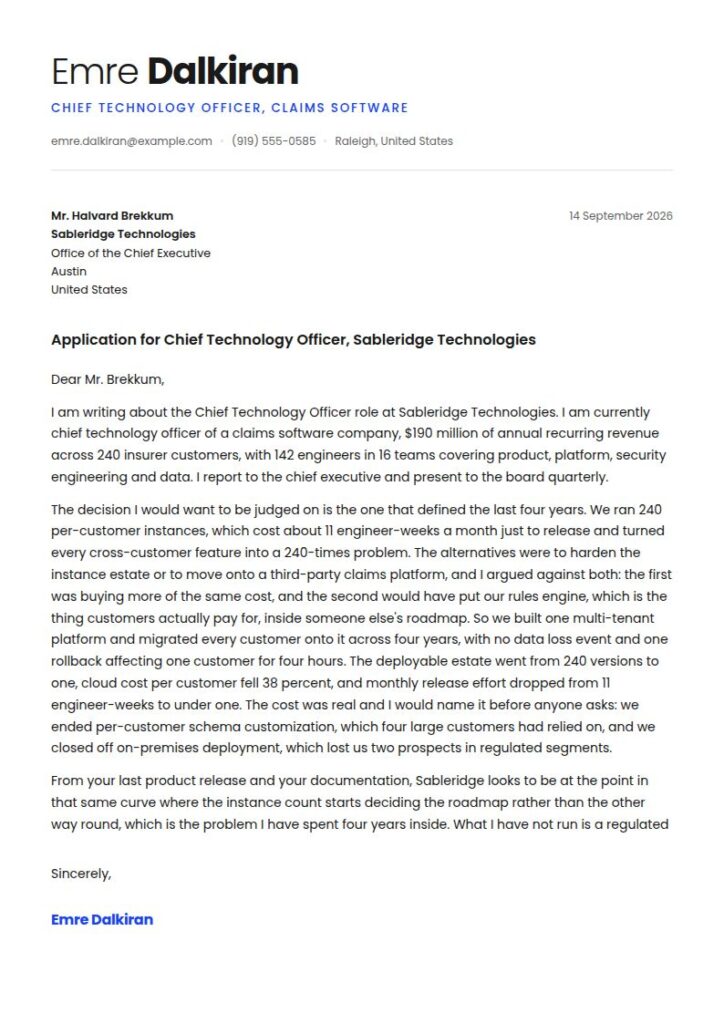
I am writing about the Chief Technology Officer role at Sableridge Technologies. I am currently chief technology officer of a claims software company, $190 million of annual recurring revenue across 240 insurer customers, with 142 engineers in 16 teams covering product, platform, security engineering and data. I report to the chief executive and present to the board quarterly.
The decision I would want to be judged on is the one that defined the last four years. We ran 240 per-customer instances, which cost about 11 engineer-weeks a month just to release and turned every cross-customer feature into a 240-times problem. The alternatives were to harden the instance estate or to move onto a third-party claims platform, and I argued against both: the first was buying more of the same cost, and the second would have put our rules engine, which is the thing customers actually pay for, inside someone else's roadmap. So we built one multi-tenant platform and migrated every customer onto it across four years, with no data loss event and one rollback affecting one customer for four hours. The deployable estate went from 240 versions to one, cloud cost per customer fell 38 percent, and monthly release effort dropped from 11 engineer-weeks to under one. The cost was real and I would name it before anyone asks: we ended per-customer schema customization, which four large customers had relied on, and we closed off on-premises deployment, which lost us two prospects in regulated segments.
From your last product release and your documentation, Sableridge looks to be at the point in that same curve where the instance count starts deciding the roadmap rather than the other way round, which is the problem I have spent four years inside. What I have not run is a regulated on-premises product or a company through a public reporting cycle, and if either is central to the next two years you should know that before we talk.
I am not in another process and would prefer this handled discreetly for now. I am available most evenings and can talk through the migration sequencing in detail if it is useful. Thank you for reading.
Sincerely, Emre Dalkiran
Openings that work
| Instead of | Use |
|---|---|
| I am a seasoned technology leader with deep experience scaling platforms | Chief technology officer of a $190 million ARR claims product, 142 engineers in 16 teams |
| I have driven digital transformation across multiple organizations | We moved 240 customers from per-customer instances onto one multi-tenant platform over four years |
| I am passionate about building high-performing engineering teams | Engineering grew from 34 to 142 with regretted attrition at 6 percent |
| I am confident I can add significant value to your technology function | The cost was ending per-customer schema customization, which four large customers relied on |
Size the engineering organization in one sentence
The reader needs the organization sized, not described, and one sentence does it: headcount, team count, and what the teams cover.
"142 engineers in 16 teams covering product, platform, security engineering and data" carries scale, shape and the fact that you have a platform function, which is the clearest signal of the engineering maturity you have operated at. Add the product-to-platform ratio if there is room.
Then resist everything else. Hiring philosophy, culture and ways of working are interview material that occupies the space where a decision should be.
Say what you have not run
Every chief technology officer has gaps that matter, and in this field a reader can name them: on-premises or air-gapped deployment, hard real-time or embedded systems, regulated data in a jurisdiction you have not worked in, a public company reporting cycle, scale an order of magnitude past yours.
Name the one or two plausibly relevant to their business, in a single sentence, in the third paragraph. It saves both sides a wasted process when the gap is disqualifying, and when it is not, it makes the rest of the letter credible.
Size the product business and the engineering organization in the first paragraph. Build the letter on one architecture decision, its rejected alternative and what it ruled out. Give the migration or delivery result in counts. Name one real thing about their technology from public material. State the one or two things you have not run.
Do not list languages, frameworks or cloud providers. Do not claim a delivery you sponsored as one you led. Do not mention AI without a number attached. Do not put a live vulnerability, an undisclosed incident, a penetration test finding or a customer name on the page. Do not describe yourself as visionary, hands-on or technical.
The occupation is growing fast, and so is the one you hire from
Chief technology officers are counted inside computer and information systems managers, an occupation of 685,800 people in 2025, projected to grow 16 percent and add 108,100 posts by 2035, with about 53,500 openings a year and a median annual wage of $175,140 in May 2025 (BLS Occupational Outlook Handbook, May 2025 wage data and 2025 to 2035 projections).
The organization you would be hiring is published separately and is far larger: software developers, quality assurance analysts and testers numbered 1,905,400 in 2025, projected to grow 10 percent with about 106,100 openings a year, with software developers at a median of $135,980 in May 2025 (BLS, May 2025 wage data and 2025 to 2035 projections).
A fast-growing management occupation means the reader has choices, so a letter of credentials competes against dozens of similar ones and a letter built on a decision does not.
Length, format and sending it
One page, four paragraphs, 300 to 400 words, with the decision paragraph taking nearly half of it. PDF, plain: emre-dalkiran-cto-cover-letter.pdf.
Address the chief executive, the founder or the board member running the search by name. At this level almost every serious approach comes through a person, and an unaddressed letter reads as one sent to five companies the same evening.
Keep the numbers identical to your resume. Our CTO resume example is written with the figures used here.
Key takeaways
- Size the product business and the engineering organization in the first paragraph.
- Build the letter on one architecture decision, not on a career summary.
- Name the alternative you rejected, what the decision ruled out and what it cost.
- Give the result in counts: customers, versions, months, rollbacks, cost per unit.
- Name one real thing about their technology from public material.
- Say what you have not run, in one sentence, in the third paragraph.
- Keep languages, frameworks and undisclosed security detail off the page entirely.
Write your CTO cover letter in 10 minutes with our AI cover letter builder.
CTO cover letter questions, answered
How long should a CTO cover letter be?
One page, four paragraphs, 300 to 400 words. The decision paragraph should take close to half of it, because it is the only part doing work the resume cannot. If the letter runs long, cut the career history before you cut the decision.
Should a CTO cover letter mention specific technologies?
Only where the technology was the decision. "We moved off a per-customer instance model" is a decision; "experienced with Kubernetes, Terraform and Postgres" is a description of the market. A chief executive cannot evaluate a stack list and a technical board member does not need one.
What if my biggest decision did not work?
Then it is probably still the better paragraph, provided you keep the same structure and add what you changed afterwards. A chief technology officer who can describe a wrong call, its cost and the mechanism that came out of the review is more credible than one presenting an unbroken record.
How do I write about AI in a CTO cover letter?
With a number or not at all. Either what your organization does with assistance and what measurably changed, or what shipped in the product and how many customers use it. Every letter in the stack mentions artificial intelligence, so a mention on its own is invisible.
Can I approach a company that is not advertising a CTO role?
Yes, and the same structure works better than a general introduction. Name what you noticed about their technology or their stage, give the one decision from your record that bears on it, and ask for a conversation rather than a job. Say that you are not in a process and would want discretion.