Winifred Vanderkolk Group Chief Operating Officer Columbus, 43215, United States [email protected] · (614) 555-0574
14 September 2026
Ms. Anneke Roosendaal Office of the Chief Executive Netherwood Manufacturing Group Cleveland, United States
Application for Chief Operating Officer, Netherwood Manufacturing Group
Dear Ms. Roosendaal,
I am writing about the Chief Operating Officer post at Netherwood Manufacturing Group. I am currently chief operating officer of a $640 million foodservice distribution group, with nine distribution centers, 2,050 people and six functions reporting to me: warehousing, transport, customer service, procurement operations, safety and continuous improvement. I report to the chief executive and present to the board twice a year.
The piece of that record that seems closest to what you are describing is the move from nine independently run sites to one operating model. When I arrived the sites used different definitions for the same measures, so nothing could be compared and nothing could be fixed once. We standardized eleven core processes, agreed one set of definitions and one weekly review, and left shift patterns and recruitment local. On-time in-full went from 93.1 percent to 98.4 percent, cost to serve from $7.90 a case to $6.05 across four years on 18 percent more volume, and the recordable incident rate from 3.8 to 1.4. When we then acquired a three-site business adding $210 million of revenue, all nine sites were on the same model within 14 months, one overlapping site closed, 240 customer accounts moved without a missed delivery window and 38 of 41 site leaders stayed.
Your last two annual statements describe a plan to move from three plants to five while holding quality, which is the same problem in a different industry: the hard part is not the new site, it is making five sites measurable the same way before you open the fourth. On the division of the role, I would expect to own the plants, supply chain, quality and safety, to share the annual operating plan and the footprint decision with you, and to leave capital allocation, pricing and the customer relationship with you. If your view of the split is different, that is worth an early conversation rather than a late one.
I am not in a process elsewhere and I would want this handled discreetly until it is serious. I can talk any evening this month. Thank you for your time.
Sincerely, Winifred Vanderkolk
Summary
A chief operating officer cover letter is usually read by the person you would report to, which makes it a different document from any other executive letter. This guide gives you a full adaptable letter, the scope sentence that places you in one line, the integration paragraph written in counts and months, and the boundary question worth raising before an interview does.
Chief Operating Officer cover letter examples by experience level
A chief operating officer cover letter is usually read by the one person whose job yours is defined against. Not a recruiter, not a panel: the chief executive, or a search partner writing a note for them the same afternoon.
That changes what the letter does. It is not selling operational credentials in general. It is proposing a specific division of one job between two people, and showing that you have done that division before somewhere comparable.
Guide to a chief operating officer cover letter
This guide and the corresponding chief operating officer cover letter example will cover:
- How to structure the letter, paragraph by paragraph
- The scope sentence that places you before the reader finishes line two
- How to write an integration or expansion in counts and months
- Why the boundary with the chief executive belongs in the letter, not only the interview
- What has to stay off the page entirely
How to write a chief operating officer cover letter
| Paragraph | Its job | Length |
|---|---|---|
| Opening | The post, the scope you run now, and the reporting shape | 2 to 3 sentences |
| Evidence | One structural change to how a company runs, with cost and service numbers | 4 to 5 sentences |
| Fit and boundary | One real thing about their business, and the split you would expect | 3 to 4 sentences |
| Close | Availability, discretion, thank you | 2 sentences |
One sentence of scope, and it is a list of functions
The fastest way to be placed correctly is to name what reports to you rather than what you are responsible for.
"Six functions reporting across nine distribution centers and 2,050 people: warehousing, transport, customer service, procurement operations, safety and continuous improvement" takes eleven seconds to read and tells a chief executive more than a page of description. It also prevents the most common misreading of the title, which is that you ran one function with an inflated name.
Add the cost base and the unit rate in the same breath where you can. A $196 million operating cost base at $6.05 a case delivered is a scope statement, a benchmark and a claim to numeracy at once.
A chief operating officer cover letter example you can adapt
Dear Ms. Roosendaal,
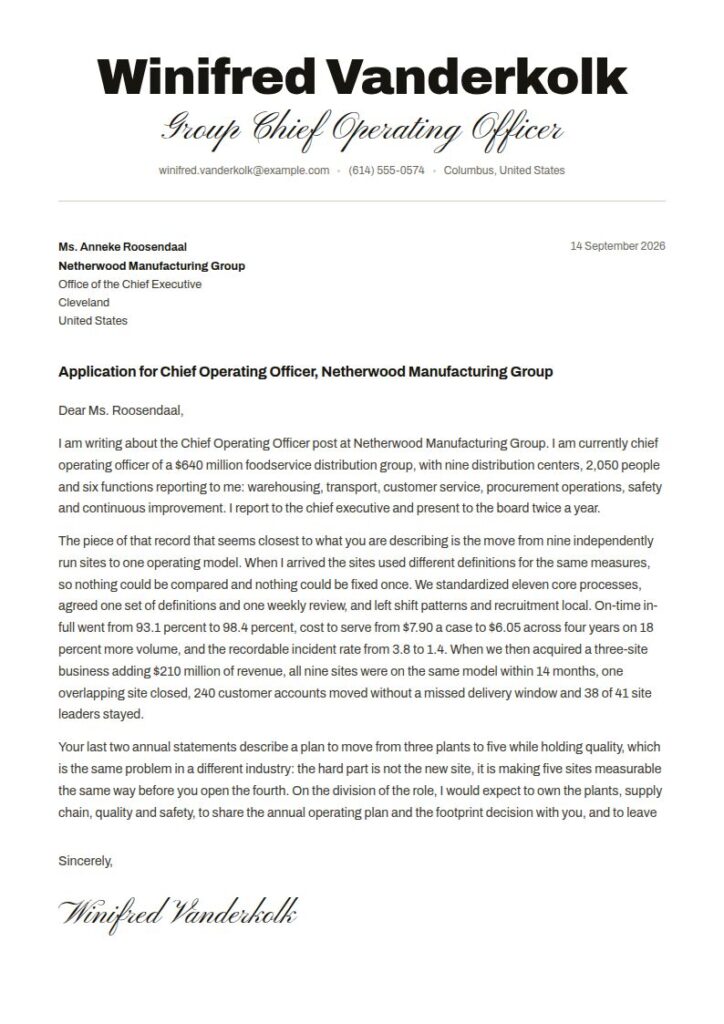
I am writing about the Chief Operating Officer post at Netherwood Manufacturing Group. I am currently chief operating officer of a $640 million foodservice distribution group, with nine distribution centers, 2,050 people and six functions reporting to me: warehousing, transport, customer service, procurement operations, safety and continuous improvement. I report to the chief executive and present to the board twice a year.
The piece of that record that seems closest to what you are describing is the move from nine independently run sites to one operating model. When I arrived the sites used different definitions for the same measures, so nothing could be compared and nothing could be fixed once. We standardized eleven core processes, agreed one set of definitions and one weekly review, and left shift patterns and recruitment local. On-time in-full went from 93.1 percent to 98.4 percent, cost to serve from $7.90 a case to $6.05 across four years on 18 percent more volume, and the recordable incident rate from 3.8 to 1.4. When we then acquired a three-site business adding $210 million of revenue, all nine sites were on the same model within 14 months, one overlapping site closed, 240 customer accounts moved without a missed delivery window and 38 of 41 site leaders stayed.
Your last two annual statements describe a plan to move from three plants to five while holding quality, which is the same problem in a different industry: the hard part is not the new site, it is making five sites measurable the same way before you open the fourth. On the division of the role, I would expect to own the plants, supply chain, quality and safety, to share the annual operating plan and the footprint decision with you, and to leave capital allocation, pricing and the customer relationship with you. If your view of the split is different, that is worth an early conversation rather than a late one.
I am not in a process elsewhere and I would want this handled discreetly until it is serious. I can talk any evening this month. Thank you for your time.
Sincerely, Winifred Vanderkolk
Openings that work
| Instead of | Use |
|---|---|
| I am an accomplished operations executive with a track record of excellence | Chief operating officer of a $640 million distribution group: nine sites, 2,050 people, six functions reporting |
| I have led large-scale transformation programs | We moved nine independently run sites onto one operating model with eleven standardized processes |
| I am passionate about operational excellence | Cost to serve from $7.90 a case to $6.05 over four years, on 18 percent more volume |
| I would welcome the opportunity to discuss the role | On the division of the role, I would expect to own plants, supply chain, quality and safety |
Write the integration or expansion in counts and months
Almost every chief operating officer search is partly about a change of shape: a new site, a new region, a merger, a plant closure, a channel. If you have done one, it is the strongest paragraph you have, and it should read as an operating record rather than a program summary.
| What to give | Example |
|---|---|
| Scale and time | Three acquired sites onto one model in 14 months |
| What closed or opened | One overlapping site closed, its volume absorbed across two others |
| Customers | 240 accounts moved without a missed delivery window |
| People | 38 of 41 site leaders retained through the integration |
| Service through the change | On-time in-full held at 98.1 percent during the 14 months |
The service line is the one that matters most. Anyone can integrate two businesses badly and quickly. An integration with the service measure printed beside it is a claim about competence rather than about effort.
Raise the boundary before the interview does
Every chief operating officer appointment fails or succeeds on where the line sits with the chief executive, and both of you know it. Raising it in the letter is unusual and it works, because it signals that you have run the relationship before rather than only held the title.
Keep it to three clauses: what you would own, what you would share and who holds the pen on it, and what you would leave with them. Then add one sentence inviting correction. A chief executive who reads a different split from the one they had in mind now has something specific to respond to, and that conversation is far better held before a first meeting than discovered in a third.
Give the functions reporting to you and the headcount in the first paragraph. Give one cost measure as a unit rate and one service measure, both with a period. Write the integration in counts and months with service printed beside it. Name one real thing about their business from their own material. Propose the division of the role and invite correction. Say how you want the approach handled.
Do not describe yourself as results-driven, hands-on or a builder of high-performing teams. Do not claim the chief executive's decisions. Do not name a customer, a supplier or an unannounced transaction. Do not give a purchase price, a multiple or a synergy target. Do not send the same letter to a functional vice president search without rewriting the scope sentence. Do not ask for the compensation structure in the first letter.
The title is not published, and the occupations behind it span five to one
There is no Bureau of Labor Statistics profile for chief operating officer. The title is counted inside the top executives group, falling to either general and operations managers or chief executives depending on the company.
General and operations managers had a median annual wage of $105,770 in May 2025, with the lowest 10 percent under $50,090 and the highest 10 percent over $253,390, across 3,599,000 jobs growing 5 percent, or 181,300 posts, through 2035. Chief executives had a median of $213,990, from under $75,700 to over $507,730, across 291,600 jobs growing 3 percent, or 9,300 posts. Annual openings are published only for the group, at about 304,100 (BLS Occupational Outlook Handbook, May 2025 wage data and 2025 to 2035 projections).
Two things follow for your letter. The market is a replacement market, which means the reader is usually reacting to a specific dissatisfaction with how the company currently runs, so a letter built on a structural change lands better than one built on credentials. And because the title spans a five to one pay range, the scope sentence is not decoration; it is the only thing in your first paragraph that tells the reader which job you have actually been doing.
Length, format and sending it
One page, four paragraphs, 300 to 400 words. PDF, plain, no letterhead graphics: winifred-vanderkolk-chief-operating-officer-cover-letter.pdf.
Address the chief executive or the search partner by name. At this level an unaddressed letter is read as one sent to several searches at once, which is usually true and never helps.
Keep every figure identical to your resume. Our chief operating officer resume example uses the same numbers as this letter, so a reader moving between the two never has to stop and reconcile them.
Key takeaways
- Name the functions reporting to you and the headcount in the first paragraph.
- Give one cost measure as a unit rate and one service measure, each with a period.
- Build the letter on one structural change to how a company runs.
- Write the integration or expansion in counts and months, with service printed beside it.
- Name one real thing about their business, from their own material.
- Propose the division of the role with the chief executive and invite correction.
- Keep prices, multiples, synergy targets and counterparties off the page.
- Address a person, keep it to one page, and say how you want the approach handled.
Write your chief operating officer cover letter in 10 minutes with our AI cover letter builder.
Chief operating officer cover letter questions, answered
How long should a chief operating officer cover letter be?
One page, four paragraphs, 300 to 400 words. Slightly longer than a general letter is acceptable here because the scope sentence and the boundary paragraph both need room, but two pages is not. If it will not fit, cut the career history rather than the scope or the boundary.
Is it presumptuous to propose the division of the role?
No, as long as you invite correction in the same breath. The division is the substance of the job, and a chief executive who has just lost or dismissed a chief operating officer is usually thinking about nothing else. What reads badly is announcing a split with no acknowledgment that theirs may differ; what reads well is a clear proposal followed by a sentence saying it is worth discussing early.
What do I write if I have only run a division, not a company?
Write the division accurately and say so plainly in the first sentence. The scope sentence works identically: functions, sites, headcount, cost base, reporting line. Then state what you have not yet held, such as a full network footprint decision or a board relationship. First-time officer candidates are appointed regularly; candidates who blur the distinction are checked and dropped.
Can I mention an acquisition that has not been announced?
No, and it is the fastest way to end a process. Unannounced transactions, live due diligence, a bidder who did not buy, a plant closure that staff have not been told about and anything from a board pack all stay off the page and out of a first conversation. Describe your integration experience using a transaction that has already been announced, or describe the operational work without identifying the company.
Should I ask about compensation in the letter?
Not in the first letter. Ask how the approach will be handled and whether discretion is needed, which is a legitimate and useful thing to raise. Compensation structure, and particularly any incentive design, belongs in the conversation after there is mutual interest, and raising it early costs you the framing of the whole process.