Information Systems Student Casimir Szczepanik
Student Analyst, Capstone Project
[email protected] | (412) 555-0628 | Pittsburgh, United States
Profile
Information systems student with coursework in systems analysis, database design and process modeling, and a capstone built for a live client. Mapped the volunteer intake process at a food bank across 4 handoffs and 19 steps, then wrote 22 requirements with acceptance criteria for a replacement scheduling form, which the client adopted the following term. Work in Visio, SQL and Excel, and hold the Entry Certificate in Business Analysis from IIBA. Looking for a junior business analyst or analyst trainee role.
Work Experience
01/2023 - 05/2023, Student Analyst, Capstone Project, Merrivale University, Information Systems Program, Pittsburgh, United States
- Mapped the volunteer intake process at a community food bank across 4 handoffs and 19 steps, working with the operations manager.
- Wrote 22 requirements with acceptance criteria and a 31-field intake specification for a replacement scheduling form, adopted by the client the following term.
- Carried 3 open questions back to the client rather than assuming answers.
06/2021 - Present, Sales Associate, Penhallow Hardware, Pittsburgh, United States
- Ran the weekly stock count reconciliation for a 3,100-line inventory and wrote the variance note the store manager signed each week.
- Traced a recurring count difference on one product family to a units-of-measure mismatch between the ordering and point of sale systems.
Education
08/2019 - Present, Bachelor of Science, Information Systems, Merrivale University, Pittsburgh, United States
Coursework in Systems Analysis and Design, Database Design and SQL, Business Process Modeling and Technical Writing. Capstone built for a live community client. Expected May 2023.
Skills
As-is process mapping, 70
Requirement writing to a template, 65
Acceptance criteria, 60
SQL select and join queries, 65
Microsoft Visio and Lucidchart, 75
Microsoft Excel including XLOOKUP and pivot tables, 80
Languages
English, native
Polish, intermediate
Certificates
03/2023, Entry Certificate in Business Analysis (ECBA), International Institute of Business Analysis
No eligibility requirement beyond agreeing to the IIBA code of conduct.
Summary
An entry level business analyst resume is a one page document built from the analysis already inside a job nobody called analysis, plus one portfolio artifact you can hand to an interviewer. This guide gives you three adaptable versions, the two realistic routes into a first analyst seat, and current Bureau of Labor Statistics pay and entry requirements for the occupations the job is counted under.
Entry Level Business Analyst resume examples by experience level
In short, an entry level business analyst resume is a one page document with two jobs: find the analysis already buried in the work you have done, and give a hiring manager one artifact they can hold.
In fact, the occupation is open at the door. The Bureau of Labor Statistics lists typical entry for computer systems analysts as a bachelor's degree with no prior work experience and no on-the-job training, and for management analysts a bachelor's degree with less than five years of related experience (Occupational Outlook Handbook, published 27 August 2026). Specifically, neither needs a license or a credential.
So the screen is not qualification. It is whether a delivery lead believes you could write something their developers and testers could build from.
Resume guide for an entry level business analyst resume
To that end, this guide and the corresponding entry level business analyst resume example will cover:
- To begin with, how to write an entry level business analyst resume, section by section
- Then, how to find the analysis inside a job with a different name
- Three adaptable summaries: student, analysis under another title, first analyst seat
- Also, one portfolio artifact, how to build it and how to sanitize it
- The two realistic routes into a first analyst seat
How to write an entry level business analyst resume
Overall, five blocks: contact header, summary, the analysis you have already done, a portfolio artifact, and tools with education. One page, because two reads as padding at this stage.
The order is deliberate. Your job titles are not going to help you, so the analysis goes above the employment history until one of them contains the word analyst.
| Section | What it is answering | Where it goes |
|---|---|---|
| Analysis already done | Has this person taken a messy process apart and written it down? | Under the summary, while your titles do not say analyst |
| Portfolio artifact | Could they produce a document a developer could build from? | Its own two-line block |
| Experience | Have they been relied on, and do they know a real operation? | Complete and short, written for transfer |
| Tools and education | Which software, at what depth, plus the entry credential | Last, with issuing bodies |
There are two routes in, and they need different resumes
Almost nobody is hired into a first analyst seat from outside with no related history. Two routes actually work.
The internal route is the common one. You already work at the organization, in operations, service, finance or administration, you know a process better than the people who will build its replacement, and a project needs somebody who understands the current state. Lead with the domain and the process knowledge, because that is what makes you cheaper to hire than a trained analyst who has never seen the work.
The adjacent route is the other. You hold a junior seat with analysis inside it: a reporting or data role, a service desk role where you triage and specify defects, a project administrator role, a testing role. Lead with the artifacts, because you already produce documents and the gap is scope rather than skill.
Work out which route you are on before you write a line; the two files emphasize opposite things and a blend reads as neither.
Run the file through the ATS resume checker before you apply, since these postings attract very high volumes and are parsed into fields before a person opens them.
Choosing the best resume format for an entry level business analyst resume
Reverse chronological, single column, one page. However, many guides push the functional format on career changers, and it fails here for one reason: a reader wants to know which operation you have sat inside, and a skills-first layout removes exactly that. Instead, what you can reorder is the blocks. Therefore, put the analysis above the employment history, and keep the history complete, short and dated.
Include your contact information
| ✅ Right | ❌ Wrong |
|---|---|
| Casimir Szczepanik | Casimir Szczepanik |
| Student Financial Services Coordinator, moving into business analysis | Aspiring business analyst seeking an opportunity |
| Mapped the 31-step financial aid disbursement process, ECBA certified | Analytical thinker with strong problem-solving skills |
| (412) 555-0628, [email protected], Pittsburgh, PA | (412) 555-0628, [email protected] |
Above all, the second and third lines are where you win the file. One process, one number, one credential, and the reader knows what you have done rather than what you hope to do.
Make use of a summary
Three or four lines: where you sit now, the process you know in detail with a number attached, the artifact you can show, and the role you want. No objective statement.
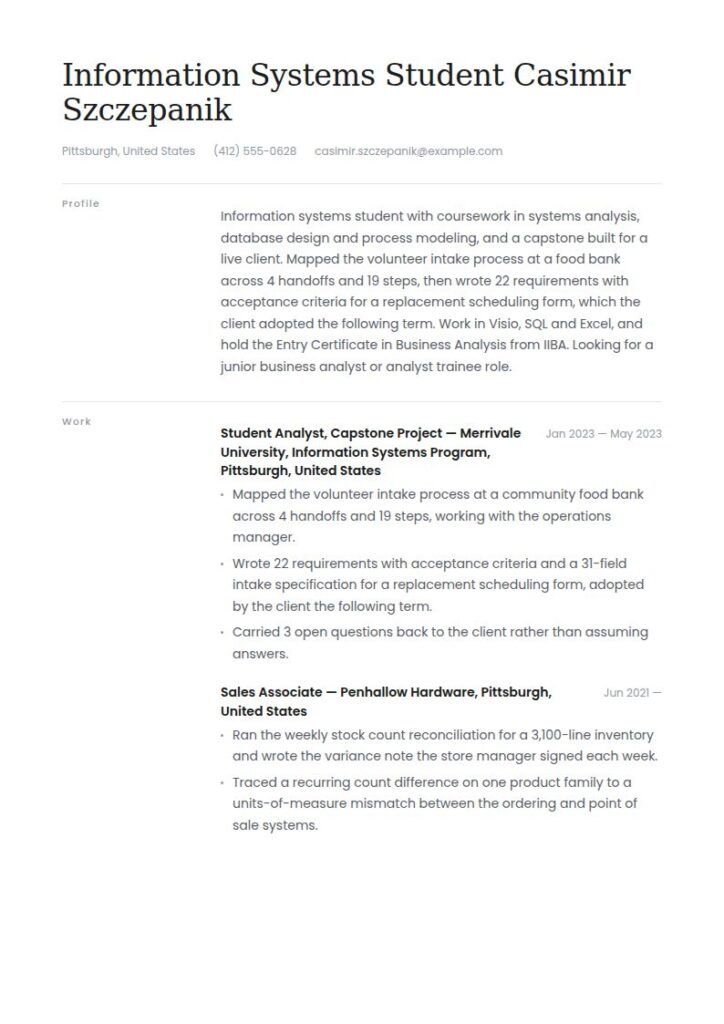
Information systems student with coursework in systems analysis, database design and process modeling, and a capstone built for a live client. Mapped the volunteer intake process at a food bank across 4 handoffs and 19 steps, then wrote 22 requirements with acceptance criteria for a replacement scheduling form, which the client adopted the following term. Work in Visio, SQL and Excel, and hold the Entry Certificate in Business Analysis from IIBA. Looking for a junior business analyst or analyst trainee role.
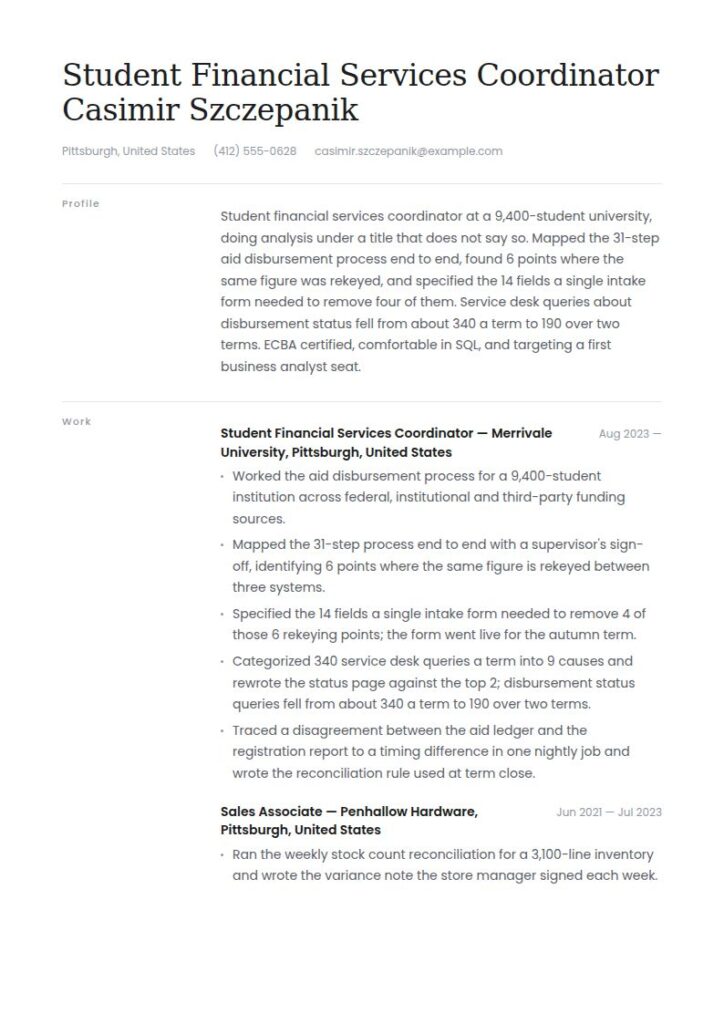
Student financial services coordinator at a 9,400-student university, doing analysis under a title that does not say so. Mapped the 31-step aid disbursement process end to end, found 6 points where the same figure was rekeyed, and specified the 14 fields a single intake form needed to remove four of them. Service desk queries about disbursement status fell from about 340 a term to 190 over two terms. ECBA certified, comfortable in SQL, and targeting a first business analyst seat.
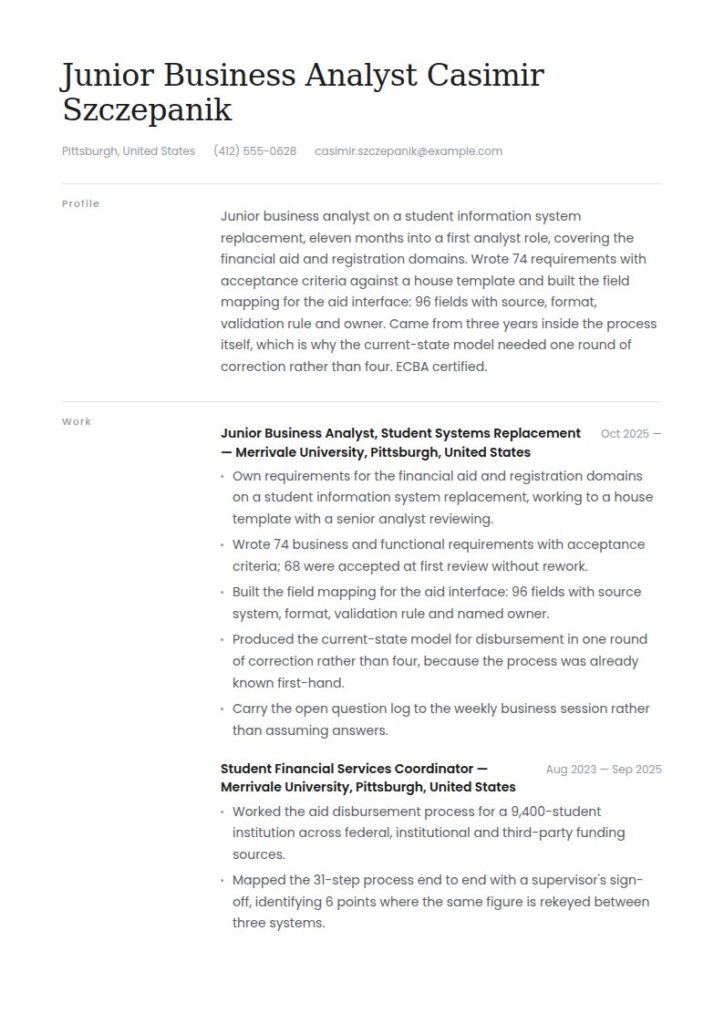
Junior business analyst on a student information system replacement, eleven months into a first analyst role, covering the financial aid and registration domains. Wrote 74 requirements with acceptance criteria against a house template and built the field mapping for the aid interface: 96 fields with source, format, validation rule and owner. Came from three years inside the process itself, which is why the current-state model needed one round of correction rather than four. ECBA certified.
Right vs wrong: the same entry level business analyst summary, twice
| ✅ Right | ❌ Wrong |
|---|---|
| Mapped the 31-step aid disbursement process and found 6 points where the same figure was rekeyed. | Experience analyzing business processes and identifying improvement opportunities. |
| Specified the 14 fields a single intake form needed; service desk queries fell from about 340 a term to 190. | Collaborated with stakeholders to gather requirements and improve efficiency. |
| ECBA certified, comfortable in SQL, targeting a first business analyst seat. | Strong analytical and communication skills with a passion for problem solving. |
On one hand, the left column names a process, a count and a change. On the other hand, someone who has never seen a process map could have written the right column, which is the suspicion an entry level file has to defeat.
Outline the analysis inside a job that was not called analysis
Most people writing this resume have already done business analysis. They filled in a form that did not fit, wrote the workaround down, explained the process to a new starter, found why two reports disagreed, or said which twelve fields the spreadsheet actually needed. All of that is the job. The trick is to name the analytical act rather than the duty.
| Instead of | Use |
|---|---|
| Processed student financial aid applications | Worked the 31-step aid disbursement process daily, which is where the current-state map came from |
| Answered questions from students and staff | Categorized 340 service desk queries a term into 9 causes; the top 2 were 61 percent of them |
| Helped fix a reporting problem | Traced a disagreement between the aid ledger and the registration report to a timing difference in one nightly job, and wrote the reconciliation rule used at term close |
| Suggested process improvements | Specified the 14 fields a single intake form needed to remove 4 of the 6 rekeying points in disbursement |
| Trained new staff on the system | Wrote the 9-page guide new coordinators are onboarded with, including 4 exception paths nobody had documented |
| Retail job while studying | Ran the weekly stock count reconciliation for a 3,100-line inventory and wrote the variance note the store manager signed |
Student Financial Services Coordinator, Merrivale University, Pittsburgh, PA, August 2023 to Present
Work the aid disbursement process for a 9,400-student institution across federal, institutional and third-party funding sources.
Mapped the 31-step process end to end with a supervisor's sign-off, identifying 6 points where the same figure is rekeyed between three systems.
Specified the 14 fields a single intake form needed to remove 4 of those 6 rekeying points; the form went live for the autumn term.
Categorized 340 service desk queries a term into 9 causes, then rewrote the status page against the top 2. Disbursement status queries fell from about 340 a term to 190 over two terms.
Traced a recurring disagreement between the aid ledger and the registration report to a timing difference in one nightly job, and wrote the reconciliation rule used at term close.
Sales Associate, Penhallow Hardware, Pittsburgh, PA, June 2021 to July 2023
Ran the weekly stock count reconciliation for a 3,100-line inventory and wrote the variance note the store manager signed each week.
Build one portfolio artifact you can hand over in the interview
Indeed, every entry level analyst resume makes the same claim and none can prove it: that the applicant can produce a document somebody could build from. However, there is one way to settle it, which is to have built one.
Not a folder. In other words, one artifact, done properly, that you can print, send in advance or put on the table. The version that works is small and complete rather than large and partial.
What it contains. A current-state process model of something real, with the handoffs marked. A short set of requirements drawn from it, ten to twenty-five is plenty, each written to one template with acceptance criteria. A field list for whatever they imply: name, source, format, mandatory or not, validation rule. In addition, two or three open questions you would have asked the business, because a reader who sees those knows you understand that analysts negotiate requirements rather than collect them.
Where to find and how to sanitize your artifact
Where to get the subject. First choice is your own job, sanitized. Second is a volunteer or community organization that will let you map something in exchange for the output, which also gives you a named client. Third is a published process: a state license application, a university admissions flow, a public benefits claim. What is not defensible is the fictional e-commerce checkout from a course, because every other candidate has the same one.
How to sanitize it. Remove employer names, product names, student or customer data and internal file paths, and describe systems by function: "the aid ledger", "the registration system". Ask your manager before anything leaves the building, and if the answer is no, rebuild the same shape against a public process. A candidate who brought confidential material to an interview impresses nobody.
How it appears on the resume. Two lines, as below. Not an attachment, not a drive link, not a QR code.
Portfolio: current-state process model, requirement set and field list for a volunteer intake process at a community food bank, built with the operations manager and adopted the following term. 4 handoffs, 19 steps, 22 requirements with acceptance criteria, a 31-field intake specification and 3 open questions carried to the client. Available on request or at interview.
Second artifact, coursework: as-is and to-be models for a course registration flow, 24 steps, written for a systems analysis course. Labeled as coursework, because it was.
How the requirements are written: one sentence of need, the rule, and acceptance criteria stated as conditions a tester can check. The template is the same across both, which is the point.
Business analyst portfolio rules for interviews
Three things make this block work rather than backfire. Label coursework as coursework, because a reader discounts academic work anyway and marking it honestly buys the assumption that everything unmarked is real.
Bring it, and offer it once. Candidates who talk about a portfolio and cannot produce it lose more than candidates who never mentioned one. Also, be ready for pushback: the interviewer will pick one requirement and push on it, which is the whole purpose. Know why you wrote it that way, what you would change, and which open question is still open.
The one analysis credential you can hold with no experience
Business analysis credentials are gated on documented hours, which is the problem at this stage. One is not.
The International Institute of Business Analysis states of its Entry Certificate in Business Analysis that there are no specific eligibility requirements to sit the exam, and that candidates need only agree to "IIBA's Code of Ethical Conduct and Professional Standards and the IIBA Certification and Recertification Terms and Conditions" (IIBA, accessed 14 September 2026). It is the entry tier of the same ladder practicing analysts climb, which is what gives it meaning on a page.
The tier above is not open to you yet. The Certification of Capability in Business Analysis requires "Two to three years of work experience in the last seven years (3,750 hours)", 21 professional development hours in the last four years and two professional references (IIBA, accessed 14 September 2026).
So hold the entry certificate with its issuing body and year, and spend the rest of the page on the process you know and the artifact you built, because no credential substitutes for those.
Build a snapshot of your key skills
For skills, similarly, eight to twelve entries in three groups: analysis, data and tools. List nothing you could not answer two questions about, because the interviewer will open on the least plausible entry.
Analysis: As-is process mapping, handoff and exception identification, requirement writing to a template, acceptance criteria, root cause categorization, structured interviewing, open question tracking
Data: SQL select and join queries for validation, field mapping and data dictionaries, reconciliation between two sources, Excel to an advanced standard including XLOOKUP and pivot tables
Tools: Microsoft Visio, Lucidchart, Jira and Confluence, SharePoint, Power BI at reader level, Microsoft Dynamics 365 Business Central at classroom level
Moreover, mark classroom-level and reader-level items as such. It costs nothing and it makes every unmarked claim credible.
List your education and certifications
Degree, institution and year, then the coursework that maps to the work, then the credential with its issuing body and year.
Bachelor of Science, Information Systems, Merrivale University, Pittsburgh, PA, 2023
Relevant coursework: Systems Analysis and Design, Database Design and SQL, Business Process Modeling, Statistics for Business, Technical Writing
Certifications: Entry Certificate in Business Analysis (ECBA), International Institute of Business Analysis, 2025. BPMN 2.0 process modeling, 16 hours, 2025.
Working toward the 3,750 documented hours the next IIBA tier requires, currently at roughly 1,100.
Keep the coursework line while you are within about eighteen months of graduating, and a grade point average only if it is 3.5 or above.
Choose the right layout and design
In general, one column, 11 or 12 point, a single page, and nothing decorative: no photograph, no icons, no rating bars. After all, a five-segment rating beside "requirements elicitation" is an unsourced claim on a document whose argument is that you write precise, testable statements.
Name one process you know in detail, with its step count and handoffs. Write the analytical act rather than the duty. Build one artifact and say it is available at interview. Label coursework as coursework. Name software at the honest depth you use it. Say which route you are on. Keep it to one page.
Do not open with an objective statement. Do not write "gathered requirements" when you mean that you attended a meeting. Do not bring anything containing employer, student or customer data to an interview. Do not claim a credential you are studying for next to your name. Do not use a fictional course project as your main artifact. Do not leave a retail job off the page; a gap reads worse than a till.
Entry level business analyst job market and outlook
The Bureau of Labor Statistics publishes no profile for business analyst, and none for entry level anything, because the Handbook covers occupations rather than titles or career stages. Meanwhile, BLS counts a first analyst job in one of two published occupations, and the interesting column is not the wage.
| Measure | Management analysts | Computer systems analysts |
|---|---|---|
| Jobs, 2025 | 1,077,100 | 544,400 |
| Projected jobs, 2035 | 1,186,300 | 587,200 |
| Projected change, 2025 to 2035 | 10 percent, much faster than average | 8 percent, much faster than average |
| Projected annual openings | About 94,100 | About 32,900 |
| Typical entry-level education | Bachelor's degree | Bachelor's degree |
| Work experience in a related occupation | Less than 5 years | None |
| On-the-job training | None | None |
| Median annual wage, May 2025 | $101,860 | $105,850 |
| Lowest 10 percent, May 2025 | Less than $60,640 | Less than $67,340 |
Source: U.S. Bureau of Labor Statistics, Occupational Outlook Handbook, May 2025 wage data and 2025 to 2035 projections, published 27 August 2026.
Business analyst entry requirements and employers
Read the experience row first. Computer systems analysts, the occupation covering analysts who work on systems and applications, lists no prior work experience as typical for entry. Management analysts, covering process and operations work, lists less than five years. If you are applying with nothing, the systems side is the published open door, which argues for putting SQL, field mapping and interface work on your page rather than process improvement alone.
In particular, where the jobs sit tells you where to apply. Among management analysts, 33 percent are in professional, scientific and technical services and 18 percent in government excluding education and hospitals; among computer systems analysts, 23 percent are in computer systems design and related services and 13 percent in finance and insurance (BLS Occupational Outlook Handbook, May 2025). Consulting and government run structured entry intakes on fixed calendars, which is worth knowing in September rather than in May.
The graduate market moved slightly upward this cycle: employers surveyed by the National Association of Colleges and Employers expected to hire 5.6 percent more new graduates from the Class of 2026 than the year before (NACE Job Outlook 2026 Spring Update, 185 respondents, 27 April 2026).
What salary you can expect in a first business analyst role
No federal wage exists for entry level, so the bottom decile of each occupation is the honest place to reason from. The lowest 10 percent of management analysts earned less than $60,640 in May 2025 against an occupation median of $101,860, and the lowest 10 percent of computer systems analysts earned less than $67,340 against a median of $105,850 (BLS Occupational Outlook Handbook, May 2025). A first analyst seat normally sits at or a little above those lower figures, because both medians include people with a decade of domain ownership behind them.
Two things move the number early. The first is which occupation your employer codes you into: the systems side starts higher at the bottom decile by roughly $6,700, and it is also the side with no experience requirement listed. The second, meanwhile, is the domain you arrive with. Someone who knows how aid disbursement, claims intake or clinical scheduling actually works is not interchangeable with a graduate who knows none of them, and that is the argument the top third of your page should be making.
Key takeaways for an entry level business analyst resume
- Decide which route you are on, internal or adjacent, before writing a line.
- Put the analysis above your employment history while your titles say something else.
- Name the analytical act, not the duty: mapped, traced, categorized, specified.
- Firstly, give one process with its step count, its handoffs and one number that moved.
- Secondly, build one artifact, sanitize it, label coursework honestly, and bring it.
- Also hold the entry certificate, because it has no experience requirement at all.
- Put SQL and field mapping on the page if you want the systems side of the market.
- Finally, one page, and nothing you could not defend for five minutes.
Build your entry level business analyst resume in 15 minutes with our AI resume builder.
Related business and management resume examples
- Business analyst resume
- Senior business analyst resume
- Entry level project management resume
- Project coordinator resume
- Project manager resume
- Business intelligence resume
- Product owner resume
- Supply chain analyst resume
- Internal auditor resume
- Consultant resume
- Customer success resume
- Business management resume
Pair it with a matching entry level business analyst cover letter.
Entry level business analyst resume questions, answered
What do I put on a business analyst resume with no analyst experience?
The analysis already inside your jobs. A process you know step by step, a disagreement between two reports that you traced, a form you specified fields for, queries you categorized by cause, a guide you wrote for new starters. Name the analytical act and attach a count, then add the entry certificate and one artifact you built deliberately.
Do I need a certification to get a first business analyst job?
No, and only one is available to you. The entry certificate from IIBA has no eligibility requirement beyond agreeing to the code of conduct (IIBA, accessed 14 September 2026), while the next tier requires 3,750 documented hours. Hold the first and skip the rest.
Is it easier to move into business analysis from inside my current employer?
Usually, yes, and it is the route most first analyst seats are filled through. You know a process a project needs documented, and you cost less to bring across than an outside hire who has to learn it. The practical move is to volunteer for the current-state work on a project that is already funded, then write it up the moment it is finished rather than two years later.
What should my portfolio artifact be if I cannot use work material?
A published process: a state license application, a university admissions flow, a public benefits claim. Map the current state from the published guidance, write fifteen to twenty-five requirements with acceptance criteria, add a field list and three open questions. It is defensible, it is not confidential, and it is not the fictional checkout every course produces.
Should I aim at business analyst or business systems analyst postings?
Read the responsibilities rather than the title, because the two are counted in different federal occupations and priced differently. Systems and interface work sits with computer systems analysts, which lists no prior work experience as typical for entry (BLS Occupational Outlook Handbook, published 27 August 2026), so it is often the more open door for a first job. Our [business analyst resume example](/resume/business-analyst/) covers the boundary in detail.
How long should an entry level business analyst resume be?
One page, until you have a year in a role whose title contains the word analyst. If it feels thin, the fix is a more specific process or a better artifact, not more lines. A second page of coursework reads as evidence that the first ran out of facts.