Casimir Szczepanik Student Financial Services Coordinator, ECBA Pittsburgh, 15206, United States [email protected] · (412) 555-0628
14 September 2026
Mr. Gideon Oduya Operations Change Brookmere Financial Group Pittsburgh, United States
Application for Junior Business Analyst, Brookmere Financial Group
Dear Mr. Oduya,
I am applying for the Junior Business Analyst post in the operations change team at Brookmere Financial Group. I currently coordinate student financial services at a 9,400-student university, which is not an analyst title, but the work underneath it has been analysis for about two years.
The process I know best is aid disbursement. I mapped it end to end last year, with my supervisor's sign-off on the finished model: 31 steps, three systems, and 6 points where the same figure is rekeyed by hand. Rather than propose a new system, I specified the 14 fields a single intake form would need to remove four of those six, and wrote acceptance criteria for each of them so the form could be tested rather than argued about. It went live for the autumn term. Separately, I categorized a term of service desk queries into 9 causes, rewrote the status page against the top two, and disbursement status queries fell from about 340 a term to 190 over the following two terms.
Your posting mentions the reconciliation work between the settlement and client reporting systems. The last thing I did before applying was trace a disagreement between our aid ledger and the registration report to a timing difference in one nightly job, and write the reconciliation rule the team now runs at term close, so that shape of problem is familiar even though the domain is not. I can bring a sanitized process model, requirement set and field list from a volunteer intake project I built for a food bank, if that would be useful at interview.
I hold the Entry Certificate in Business Analysis from IIBA and work in SQL, Visio and Excel daily. I can start with four weeks' notice. Thank you for your time.
Sincerely, Casimir Szczepanik
Summary
An entry level business analyst cover letter names one process you already know step by step, what you found when you took it apart, and one artifact you can bring to the interview. This guide gives you a full adaptable letter, the openings that work when your job title says something else, and how to mention a portfolio without overselling it.
Entry Level Business Analyst cover letter examples by experience level
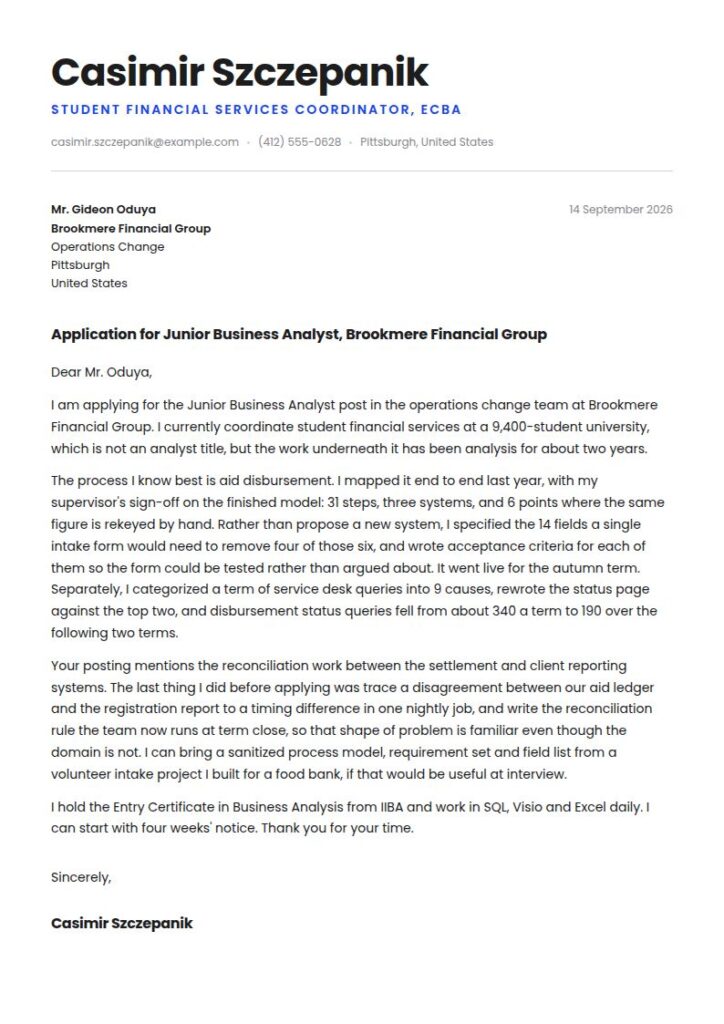
An entry level business analyst cover letter is a one-page letter naming one process you already know step by step, what you found when you took it apart, and one document you built that they can read.
It works because the screen at this stage is narrow. Nobody doubts you are analytical; everybody in the folder says so. What a delivery lead does not know is whether you have turned a real process into something a developer could build from, and a letter can answer that in four sentences.
Guide to an entry level business analyst cover letter
This guide and the corresponding entry level business analyst cover letter example will cover:
- How to structure the letter, paragraph by paragraph
- Why one process beats a list of transferable skills
- How to mention a portfolio artifact without overselling it
- What to write on the internal route and on the adjacent route
- The closings that get a first-seat file into an interview
How to write an entry level business analyst cover letter
| Paragraph | Its job | Length |
|---|---|---|
| Opening | The post, where you sit now, and the process you are about to describe | 2 to 3 sentences |
| Evidence | The process: how you took it apart, what you found, what you wrote | 5 to 6 sentences |
| Fit | Something specific about their change, and the artifact you can show | 3 to 4 sentences |
| Close | Credential, availability, thank you | 2 sentences |
Lead with a process, not with transferable skills
The standard entry level letter argues by analogy: I am organized, I am curious, I like solving problems, and those qualities transfer. Every letter in the folder makes that argument and none of it can be checked.
Lead with one process instead. Name it, give it a step count, say what you found when you looked properly, and say what you wrote as a result. "The aid disbursement process runs to 31 steps and rekeys the same figure at 6 points between three systems; I specified the 14 fields a single intake form needed to remove four of them" is a sentence only somebody who did the work can write. Then say what happened, with a period attached.
An entry level business analyst cover letter example you can adapt
Dear Mr. Oduya,
I am applying for the Junior Business Analyst post in the operations change team at Brookmere Financial Group. I currently coordinate student financial services at a 9,400-student university, which is not an analyst title, but the work underneath it has been analysis for about two years.
The process I know best is aid disbursement. I mapped it end to end last year, with my supervisor's sign-off on the finished model: 31 steps, three systems, and 6 points where the same figure is rekeyed by hand. Rather than propose a new system, I specified the 14 fields a single intake form would need to remove four of those six, and wrote acceptance criteria for each of them so the form could be tested rather than argued about. It went live for the autumn term. Separately, I categorized a term of service desk queries into 9 causes, rewrote the status page against the top two, and disbursement status queries fell from about 340 a term to 190 over the following two terms.
Your posting mentions the reconciliation work between the settlement and client reporting systems. The last thing I did before applying was trace a disagreement between our aid ledger and the registration report to a timing difference in one nightly job, and write the reconciliation rule the team now runs at term close, so that shape of problem is familiar even though the domain is not. I can bring a sanitized process model, requirement set and field list from a volunteer intake project I built for a food bank, if that would be useful at interview.
I hold the Entry Certificate in Business Analysis from IIBA and work in SQL, Visio and Excel daily. I can start with four weeks' notice. Thank you for your time.
Sincerely, Casimir Szczepanik
Openings that work
| Instead of | Use |
|---|---|
| I am an aspiring business analyst with strong analytical skills | I coordinate student financial services, which is not an analyst title, but the work underneath it has been analysis for two years |
| I am writing to express my interest in the junior business analyst role | I am applying for the Junior Business Analyst post in the operations change team |
| I have experience gathering requirements from stakeholders | I mapped a 31-step process and found 6 points where the same figure is rekeyed between three systems |
| I recently completed a business analysis certification | I hold the ECBA, and the process below is what I did before I sat it |
Writing the process you know better than the people replacing it
Most first analyst seats are filled internally, and the reason is not loyalty. Somebody has funded a project to replace a process, and the current state has to be documented by a person who has worked it. That is the argument your letter is making, inside your employer or outside it.
So write the process at the level of detail only a practitioner has. The step count. The handoffs. The exception paths nobody documented. The point where two systems disagree and somebody reconciles it by hand every Friday. Those are the proof that you were in the work rather than near it.
On the adjacent route, arriving from a reporting, testing, service desk or project administration seat, make the same move with your artifacts: say what those documents were and who used them.
Name one process with its step count and its handoffs. Say what you found, in a number. Say what you wrote as a result and what happened to it. Name one specific thing in their posting or their published work. Offer the artifact once, and have it ready. Close with the credential and its issuing body.
Do not open with an objective or with a list of personal qualities. Do not write "gathered requirements" about a meeting you attended. Do not attach a portfolio uninvited, and never attach anything containing employer, student or customer data. Do not claim a credential you are still studying for. Do not name an individual colleague, student or customer anywhere in the letter.
Mentioning the portfolio artifact without overselling it
One sentence, near the end, offering it. That is all. The artifact only helps if the interviewer asks for it, and it damages you if they ask and it is thinner than the letter implied. Say what it is in eight words, say it is sanitized, and stop: "a sanitized process model, requirement set and field list from a volunteer intake project."
Then be ready for the only question that matters, which is why you wrote one of the requirements the way you did. Bring the version with your open questions still in it, because a candidate who can say "I never got an answer on what happens when a volunteer withdraws after being scheduled" is demonstrating the habit the job is built on.
The entry credential exists and the next one does not apply to you
The International Institute of Business Analysis states of its Entry Certificate in Business Analysis that there are no specific eligibility requirements to sit the exam, and that candidates need only agree to "IIBA's Code of Ethical Conduct and Professional Standards and the IIBA Certification and Recertification Terms and Conditions" (IIBA, accessed 14 September 2026). It is the only tier available to somebody with no documented hours.
The next tier, the Certification of Capability in Business Analysis, requires "Two to three years of work experience in the last seven years (3,750 hours)", 21 professional development hours in the last four years and two professional references (IIBA, accessed 14 September 2026). Naming that pathway and where you stand on it beats any adjective as a closing line.
The market is open at the entry point. The Bureau of Labor Statistics lists typical entry for computer systems analysts as a bachelor's degree with no prior work experience and no on-the-job training, against a median annual wage of $105,850 in May 2025 and about 32,900 openings a year (Occupational Outlook Handbook, May 2025 wage data and 2025 to 2035 projections).
Length, format and sending it
One page, four paragraphs, 250 to 400 words. PDF unless the portal says otherwise, named for yourself and the post: casimir-szczepanik-business-analyst-cover-letter.pdf.
Address a person. Change and transformation teams publish their leads on nearly every corporate site, and a letter this specific paired with "Dear Hiring Team" reads as a template with the details swapped.
Keep the process in the letter identical to the one on your resume, including the counts. Our entry level business analyst resume example is built on the same process used here.
Key takeaways
- Lead with one process, its step count and its handoffs.
- Say what you found, as a number a reader can hold.
- Say what you wrote and what happened to it, with a period attached.
- Name one specific thing from their posting or their published work.
- Offer the artifact in one sentence, say it is sanitized, and have it ready.
- Say which route you are on: inside the process, or adjacent to it.
- Close with the credential, the issuing body and your notice period.
Write your entry level business analyst cover letter in 10 minutes with our AI cover letter builder.
Entry level business analyst cover letter questions, answered
How long should an entry level business analyst cover letter be?
One page, four paragraphs, 250 to 400 words. At this stage the letter carries more weight than the resume, because a resume line cannot explain a process in enough detail to be believed, but it still should not run over.
What do I write if I have never held an analyst title?
Write the process you know best under whatever title you had: the step count, the handoffs, the exception paths, the reconciliation somebody does by hand. Then what you wrote as a result. That is business analysis regardless of the badge.
Should I attach my portfolio to the application?
No. Offer it in one sentence and bring it. An unrequested attachment often does not reach the reader, and anything containing employer, student or customer data should never leave the building at all. Sanitize first, offer second, produce it when asked.
Do I mention the ECBA in the opening line?
No. Put it in the closing sentence with the issuing body. It has no eligibility requirement beyond agreeing to IIBA's code of conduct (IIBA, accessed 14 September 2026), so it proves study rather than practice, and the most valuable line on the page should carry the process instead.
Is it worth applying outside my own employer for a first analyst role?
Yes, but weight your effort. The internal route fills most first seats, because the employer is buying process knowledge it would otherwise have to teach. Outside, aim at the systems side of the market, where the Bureau of Labor Statistics lists no prior work experience as typical for entry (Occupational Outlook Handbook, published 27 August 2026), and say which domain you bring with you.