Thandeka Nkosi Chief Information Officer Atlanta, 30312, United States [email protected] · (404) 555-0322
11 September 2026
Ms. Anneliese Strandberg Chief Executive Officer Glenmara Health Network Charlotte, United States
Application for Chief Information Officer, Glenmara Health Network
Dear Ms. Strandberg,
I am writing about the chief information officer role at Glenmara Health Network. I run a $64 million technology portfolio for a listed health services group of 9,400 people across 42 sites, currently split 55 percent run and 45 percent change against 74 percent run when I arrived in 2022. Your published strategy describes an estate assembled through acquisition and a clinical systems program that has been rescoped twice, which is close to the position I was hired into.
The decision I would point to is one I stopped. Fourteen months into a $22 million platform replacement, the program failed its second gate: the integration work had grown faster than the delivery, and the case no longer held. I recommended stopping it, wrote off $6.8 million with the board's approval, and redirected the remaining $15 million into integration and identity instead. That was the right trade. Within a year we had closed 71 percent of the open high-severity findings from the 2022 external assessment, delivered clinician single sign-on across all 42 sites, and taken the application estate from 312 to 214 with only 6 systems left past vendor end of support.
On risk and suppliers: tested recovery for our two tier one clinical systems is now under 4 hours against 26 when I arrived, and it is tested twice a year rather than documented once. I own 96 supplier contracts worth $41 million a year and renegotiated the three largest in 2024 on exit and data portability terms rather than on unit price, because the previous renewal had locked the group in for five years. I report to the board risk committee quarterly and am the named executive accountable for cybersecurity risk in our disclosures.
What I would want to see first at Glenmara is the run and change split by business unit and the list of systems past vendor support, because those two documents usually explain why a program has been rescoped twice. Thank you for your time.
Sincerely, Thandeka Nkosi
Summary
A CIO cover letter is a one page letter about money, risk and suppliers rather than about technology. It names the portfolio you run and how it splits between run and change, the estate you inherited, your tested resilience position, and the program you delivered or stopped. This guide gives you a full adaptable letter, openings that work, and the security detail that must stay off the page.
CIO cover letter examples by experience level
A CIO cover letter is a one page letter that argues about money rather than technology.
Almost every chief information officer letter says the same three things: digital transformation, business alignment, innovation. None tells a chief executive what the candidate controls. The letter that works names a portfolio, says how it splits between running the company and changing it, and connects that to the problem the hiring organization has.
Guide to a CIO cover letter
This guide and the corresponding CIO cover letter example will cover:
- Why the first sentence should contain a dollar figure and a percentage
- How to structure the letter, paragraph by paragraph
- A full adaptable letter you can rework
- Openings that work, and the four that do not
- How much to say about security, and what must stay off the page
How to write a CIO cover letter
| Paragraph | Its job | Length |
|---|---|---|
| Opening | The role, your portfolio and its split, and the problem they have described | 3 to 4 sentences |
| Evidence | One decision about money: what you delivered, stopped or retired, and what it bought | 5 to 6 sentences |
| Risk and suppliers | Tested resilience, findings closed, the contract book, the committee you report to | 3 to 4 sentences |
| Close | What you would want to see first, and a thank you | 2 sentences |
No architecture, no platform lists, no methodology: those are interview material.
Put a dollar figure and a percentage in the first sentence
"I run a $64 million technology portfolio at 55 percent run and 45 percent change, against 74 percent run when I arrived" does more in one sentence than three paragraphs of transformation language.
It tells a chief executive the size of job you hold, whether you are trusted with change money, and that you can move a ratio. It also shows that you treat technology as an allocation problem, the mental model a chief executive shares.
A CIO cover letter example you can adapt
Dear Ms. Strandberg,
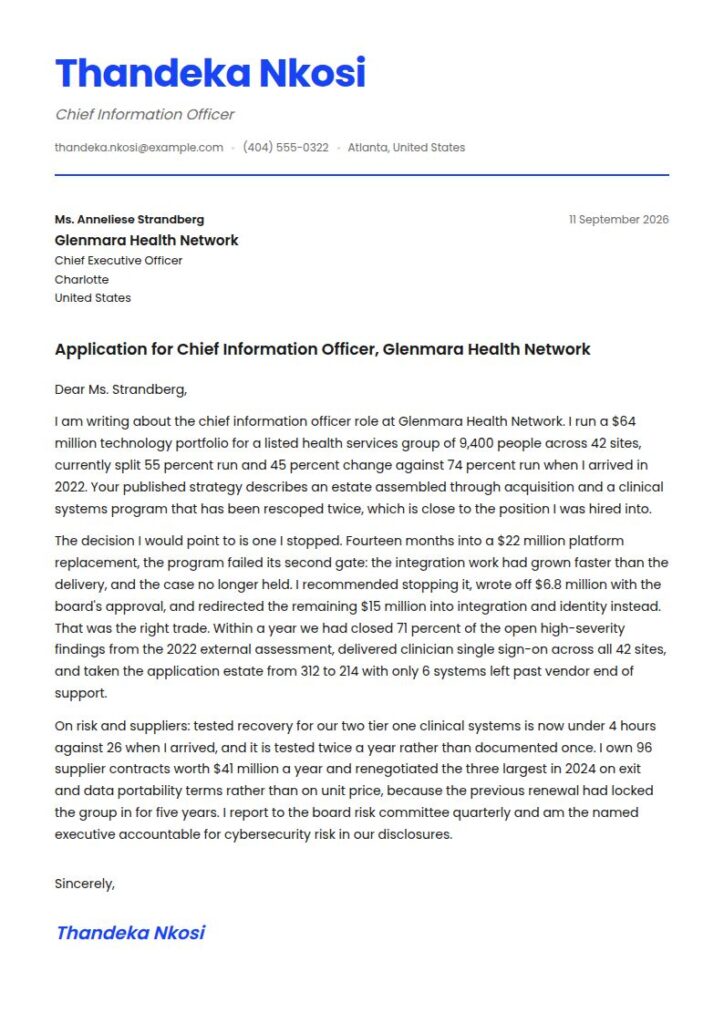
I am writing about the chief information officer role at Glenmara Health Network. I run a $64 million technology portfolio for a listed health services group of 9,400 people across 42 sites, currently split 55 percent run and 45 percent change against 74 percent run when I arrived in 2022. Your published strategy describes an estate assembled through acquisition and a clinical systems program that has been rescoped twice, which is close to the position I was hired into.
The decision I would point to is one I stopped. Fourteen months into a $22 million platform replacement, the program failed its second gate: the integration work had grown faster than the delivery, and the case no longer held. I recommended stopping it, wrote off $6.8 million with the board's approval, and redirected the remaining $15 million into integration and identity instead. That was the right trade. Within a year we had closed 71 percent of the open high-severity findings from the 2022 external assessment, delivered clinician single sign-on across all 42 sites, and taken the application estate from 312 to 214 with only 6 systems left past vendor end of support.
On risk and suppliers: tested recovery for our two tier one clinical systems is now under 4 hours against 26 when I arrived, and it is tested twice a year rather than documented once. I own 96 supplier contracts worth $41 million a year and renegotiated the three largest in 2024 on exit and data portability terms rather than on unit price, because the previous renewal had locked the group in for five years. I report to the board risk committee quarterly and am the named executive accountable for cybersecurity risk in our disclosures.
What I would want to see first at Glenmara is the run and change split by business unit and the list of systems past vendor support, because those two documents usually explain why a program has been rescoped twice. Thank you for your time.
Sincerely, Thandeka Nkosi
Openings that work
| Instead of | Use |
|---|---|
| I am writing to express my interest in the CIO position | I am writing about the chief information officer role at Glenmara Health Network |
| I am a transformational technology leader with a passion for innovation | I run a $64 million portfolio at 55 percent run and 45 percent change, against 74 percent on arrival |
| I have extensive experience across cloud, data and cybersecurity | I own 96 supplier contracts worth $41 million a year and renegotiated the three largest in 2024 |
| I am excited by your digital transformation journey | Your strategy describes an estate assembled through acquisition and a program rescoped twice |
The right column can be tested in an interview. The left column cannot.
Writing about what you stopped
The strongest paragraph in a chief information officer letter is usually about a program that did not finish.
Technology leadership is judged on delivery, so candidates write only about delivery, and every letter reads as an unbroken run of successful programs. Any chief executive who has funded technology knows that distribution is false.
Write it in five parts: the commitment, the gate, what the gate found, the write-off and who approved it, and where the money went instead. The last part turns a cancellation into a decision, and it is what a board is hoping to buy.
Open with the portfolio value and the run and change split, including the split on arrival. Name the problem their organization has described in public and the nearest one you have handled. Give one decision about money, with what it bought, and state tested recovery times, findings closed and the committee you report risk to.
Do not open with transformation, innovation or alignment. Do not list platforms; a letter has no room and they separate nobody. Do not publish live vulnerabilities, unremediated findings, control architecture or an undisclosed incident. Do not name a security supplier whose engagement is not public. Do not claim a program you sponsored as one you delivered.
A fast-growing occupation with a very wide seniority range
The title sits inside computer and information systems managers, where the Handbook also reports chief technology officers and management information systems directors. The occupation held 685,800 jobs in 2025 and is projected to reach 793,900 by 2035, growth of 16 percent and 108,100 jobs, with about 53,500 openings a year (BLS Occupational Outlook Handbook, 2025 to 2035 projections). That is much faster than average and far faster than top executives at 5 percent.
The median annual wage was $175,140 in May 2025, with the lowest 10 percent under $107,550 and the highest 10 percent over $297,510 (BLS, May 2025). The spread reflects seniority rather than industry: across the five largest employing industries the medians run only from $176,950 in management of companies and enterprises to $200,510 in information (BLS, May 2025).
That is the practical argument for a portfolio number in your first sentence: the occupation contains help desk managers and the chief information officers of listed groups, and the title alone does not say which you are. The published wage also covers straight-time gross pay and excludes year-end bonuses, profit-sharing and stock bonuses (BLS, Occupational Employment and Wage Statistics survey documentation, accessed 13 September 2026), so no package figure can be read out of it.
Length, format and sending it
One page, four paragraphs, 300 to 450 words. PDF, named for yourself and the role: thandeka-nkosi-glenmara-cio-letter.pdf. Address a named person: the chief executive, the chief financial officer, the chair of the risk committee or the search partner running the process.
Keep the figures identical to your resume. Our CIO resume example is written with the numbers used in this letter, and a reader who finds two different portfolio values across two of your documents stops reading rather than asking.
Key takeaways
- Put a dollar figure and a run and change percentage in the first sentence.
- Name the problem their organization has described publicly, and the nearest one you have handled.
- Give one decision about money, including where the money went.
- Write about what you stopped, and who approved the write-off.
- Give tested recovery times, not documented objectives.
- State the contract book and what you renegotiated, and on what terms.
- Name the committee you report technology risk to, and keep the letter to one page.
Write your CIO cover letter in 10 minutes with our AI cover letter builder.
CIO cover letter questions, answered
Should a CIO cover letter mention specific technologies?
Only where the product is the point, such as the enterprise system you replaced. A letter has room for one story, and every candidate in the folder has worked with roughly the same tools. The portfolio, the estate and the decisions are what separate you.
How do I write the letter if my portfolio is mostly run cost?
Honestly, and it is a stronger letter than you expect. Give the split, what is causing it, and what you have done about it: applications retired, contracts consolidated, the case you put to the board. A candidate who omits the number is assumed to be hiding a worse one.
How much should I say about a security incident?
Nothing about one that has not been disclosed, and no detail about live vulnerabilities or unremediated findings at any employer. Write your posture and your record instead: tested recovery times, the proportion of high-severity findings closed and over what period, the assessment regime, the committee you report to. That is checkable, it is safe, and it says more than an anecdote would.
I am moving from IT director to CIO. What changes in the letter?
The unit of account. A director writes about services, projects and teams; a chief information officer writes about money, risk and suppliers. Without portfolio numbers of your own, use what you controlled, name the parts you did not, and give one spending decision you made. A stated boundary convinces more than a letter implying scope you did not hold.
Who should a CIO cover letter be addressed to?
The chief executive where the role reports to them, the chief financial officer where it reports through finance, and the search partner where a firm is running the process. The reporting line is usually in the job description, and naming the right person signals that you read it.