Zsofia Vaszary Senior Consultant, Health Operations Cleveland, 44113, United States [email protected] · (216) 555-0503
14 September 2026
Ms. Dagmara Ostrowicz Health Operations Practice Wexcombe Partners Columbus, United States
Application for Senior Consultant, Health Operations Practice, Wexcombe Partners
Dear Ms. Ostrowicz,
I am applying for the Senior Consultant post in the health operations practice at Wexcombe Partners. I came into consulting from three years running patient access and the revenue cycle floor of a 480-bed hospital, and I have since worked both ends of the firm-size range: two years at a nine-person provider operations boutique and three in the health practice of a 1,400-person technology consultancy. Wexcombe sits between the two, and that is why I am writing to you rather than to a larger firm.
The work I would most want to bring is the operational side of system delivery, which is where the two halves of my record meet. On one revenue cycle implementation I owned the workstream that had to keep a department running while the system changed underneath it: 40 interviews across a 260-person department, a rebuilt scheduling data set of 1.1 million appointment records, and a finding that the backlog sat in 6 clinics rather than across all 34. I presented that in the weekly client session myself rather than handing it up for somebody senior to deliver, and that is the part of the job I want more of.
Your practice takes assignments of eight weeks to nine months with teams of three or four and does not staff outside provider operations. That is the shape I am most useful in, because a short assignment with a small team is where an industry background stops being a biography and starts being useful on day two. I would also bring the recruiting work with me: I have run 60 case interviews in three years, most of them with candidates crossing in from industry, and a practice that hires from that route needs people who can read those candidates properly.
I hold a Master of Health Administration and the Certified Management Consultant designation, and my Epic Resolute Hospital Billing certification means I can work inside a client's own reporting without a week of orientation. I can start with six weeks of notice. Thank you for your time.
Sincerely, Zsofia Vaszary, CMC
Summary
A consulting cover letter says which kind of firm you are writing to, why that kind rather than another, and what you could be put in front of a client to do. This guide gives you a full adaptable letter, what changes between a boutique and a large practice, and how to write the crossing into consulting from industry or back out of it.
Consulting cover letter examples by experience level
A consulting cover letter is a one-page letter that answers a question the resume cannot: why this firm, out of the several hundred that would describe themselves the same way.
That question is not sentimental. A partner reading applications is deciding whether you understand what their firm actually sells, because somebody who has confused a nine-person specialist practice with a global technology consultancy will also misjudge a client. The letter is where you prove you have not.
Guide to a consulting cover letter
This guide and the corresponding consulting cover letter example will cover:
- How to structure the letter, paragraph by paragraph
- Why the kind of firm belongs in the first two sentences
- One piece of work, described so it carries the whole letter
- What changes when you are crossing in from industry or going back out
- The openings that read as targeted rather than circulated
How to write a consulting cover letter
| Paragraph | Its job | Length |
|---|---|---|
| Opening | The post, the kind of firm, and why that kind | 2 to 3 sentences |
| Evidence | One piece of work you owned, with the part that was yours | 4 to 5 sentences |
| Fit | Something specific about their practice and what you would bring to it | 3 to 4 sentences |
| Close | Credentials, notice period, thank you | 2 sentences |
Name the firm type in the first two sentences, then justify it
Almost every consulting letter opens by admiring the firm. The reader has seen forty of those this month and skips to the second paragraph.
Open instead with a placement. "I am applying for the Senior Consultant post in your health operations practice, and I am writing to a specialist firm deliberately rather than to a larger one" is unusual enough to be read twice.
Then give the reason in one clause. Depth over breadth, client contact earlier, longer implementations, a method you want to work inside, a sector the firm will not staff you away from. Any of those is a real reason. "I have always admired your culture" is not, and the reader knows which one they are holding.
A consulting cover letter example you can adapt
Dear Ms. Ostrowicz,
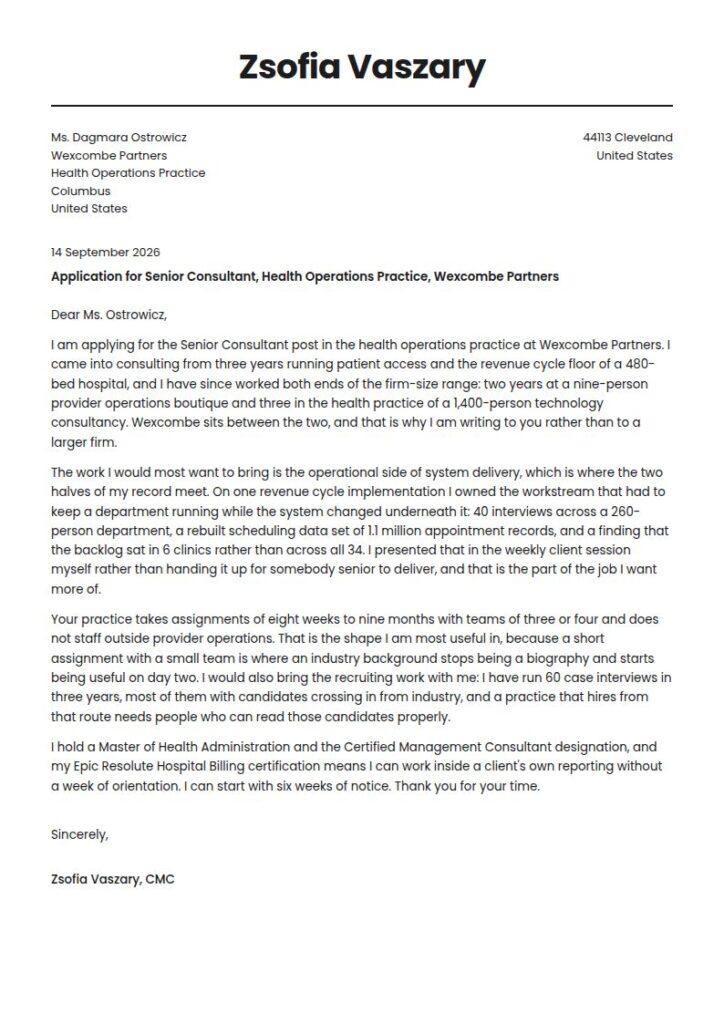
I am applying for the Senior Consultant post in the health operations practice at Wexcombe Partners. I came into consulting from three years running patient access and the revenue cycle floor of a 480-bed hospital, and I have since worked both ends of the firm-size range: two years at a nine-person provider operations boutique and three in the health practice of a 1,400-person technology consultancy. Wexcombe sits between the two, and that is why I am writing to you rather than to a larger firm.
The work I would most want to bring is the operational side of system delivery, which is where the two halves of my record meet. On one revenue cycle implementation I owned the workstream that had to keep a department running while the system changed underneath it: 40 interviews across a 260-person department, a rebuilt scheduling data set of 1.1 million appointment records, and a finding that the backlog sat in 6 clinics rather than across all 34. I presented that in the weekly client session myself rather than handing it up for somebody senior to deliver, and that is the part of the job I want more of.
Your practice takes assignments of eight weeks to nine months with teams of three or four and does not staff outside provider operations. That is the shape I am most useful in, because a short assignment with a small team is where an industry background stops being a biography and starts being useful on day two. I would also bring the recruiting work with me: I have run 60 case interviews in three years, most of them with candidates crossing in from industry, and a practice that hires from that route needs people who can read those candidates properly.
I hold a Master of Health Administration and the Certified Management Consultant designation, and my Epic Resolute Hospital Billing certification means I can work inside a client's own reporting without a week of orientation. I can start with six weeks of notice. Thank you for your time.
Sincerely, Zsofia Vaszary, CMC
Openings that work
| Instead of | Use |
|---|---|
| I have long admired your firm's reputation for excellence | I am writing to a specialist practice deliberately rather than to a larger firm |
| I am writing to express my interest in a consulting position | I am applying for the Senior Consultant post in your health operations practice |
| I have strong analytical and problem-solving skills | I rebuilt a scheduling data set of 1.1 million records and found the backlog sat in 6 clinics |
| I am a fast learner who thrives in fast-paced environments | I came into consulting from three years running patient access at a 480-bed hospital |
Every line on the right makes a claim that could be wrong, which is what makes it worth reading. The left column cannot be wrong, and that is exactly the problem with it.
Say which kind of firm you are writing to
Five kinds of firm use the same word and want different letters.
| Firm type | What the letter has to establish |
|---|---|
| Strategy | That you can structure an unfamiliar problem out loud, and that you are ready for the case |
| Operations and implementation | That you have stood in an operation and changed how work was done |
| Technology and systems | That you own a functional side of a delivery, not only the analysis around it |
| Boutique and specialist | That you can be alone with a client, and that your sector depth is real |
| Independent and contract | That you have delivered a scoped piece of work without supervision |
Pick one per application and write the whole letter to it. A letter that hedges between two of them is a letter that has not made the decision the reader is paid to make on your behalf.
The letter is what earns you the case, so write in the shape the case is scored in
Consulting hiring runs through a case interview, and its criteria are published. Cornell University Career Development describes a consulting case interview as "a simulated business problem presented during the interview process" and lists what interviewers assess: structured thinking and logical decomposition, quantitative and analytical ability, business judgment and creativity, communication clarity and persuasiveness, and flexibility or adaptability when new information is introduced (Cornell University Career Development, 24 October 2025). Career Services at the College of Natural Sciences, University of Texas at Austin describes the same format as "a job interview technique commonly used by consulting firms, investment banking, and tech firms" (accessed 14 September 2026).
Your evidence paragraph can carry four of those five before anybody schedules a case. Name the problem and how you broke it apart. Give one number you built rather than received. Say what judgment you made when the data was ambiguous. And say that you presented it yourself.
There is room to write these letters into: management analysts had about 94,100 projected annual openings and computer systems analysts about 32,900, on 2025 to 2035 projections (U.S. Bureau of Labor Statistics, Occupational Outlook Handbook, published 27 August 2026).
What to write when you are crossing in, or crossing back out
The two moves look symmetrical and are not.
Coming in from industry, the doubt is about pace and ambiguity. Answer it with a piece of work you did without a settled brief, in a part of your own employer you did not know well. The Bureau of Labor Statistics is on your side on the substance: "organizations that specialize in certain fields typically try to hire candidates who have experience in those areas" (Occupational Outlook Handbook, management analysts, published 27 August 2026). Your industry is the reason a practice will read the letter at all, so open with it rather than apologizing for it.
Going back out to industry, the doubt reverses. Have you ever owned a result past the recommendation. Answer with something you stayed for: an implementation you saw through, a process still running as you designed it, a team who kept doing it after the assignment closed. Name a number the client confirmed rather than one you modeled.
Neither letter should present the move as a life decision. Present it as a fit, with a reason specific enough to be checked.
Name the kind of firm and the practice in the first two sentences. Give one reason for that kind rather than another. Describe one piece of work and say which part was yours. Name something concrete about their practice: assignment length, team size, the sectors they refuse. State your sector depth as what you could be staffed into. Put the notice period in the close.
Do not open by admiring the firm. Do not name a client, a client's system or a client's executive. Do not list four sectors as evidence of range. Do not write the same letter to a nine-person boutique and a global practice. Do not claim a result the client owned. Do not send a letter with no firm-specific sentence in it.
Length, format and sending it
One page, four paragraphs, 250 to 400 words, PDF unless the portal asks otherwise, named for yourself and the post.
Address a person. At a boutique that is usually a founding partner and the name is on the site. At a large firm it may be a practice lead or a recruiting manager, and either is better than a salutation to nobody.
Keep every figure identical to your resume, because a partner who notices two versions of the same number stops reading for content and starts reading for accuracy. Our consulting resume example uses the same record as the letter above, and the free ATS checker will read the file before a person does.
Key takeaways
- Name the kind of firm in the first two sentences and give one reason for it.
- Spend the second paragraph on one piece of work, not four.
- Say which part of that work was yours and whether you presented it yourself.
- Name something concrete about their practice: assignment length, team size, sector rules.
- Write the crossing you are making, in or out, as a fit rather than a life decision.
- Pre-evidence what the case tests: structure, a number, a judgment, a delivery.
- One page, a named recipient, figures matching the resume.
Write your consulting cover letter in 10 minutes with our AI cover letter builder.
Consulting cover letter questions, answered
How long should a consulting cover letter be?
One page, four paragraphs, 250 to 400 words. Firms screen experienced-hire applications in batches and the letter is read after the resume, usually for one thing only: whether you understand what this firm sells. That judgment is made in the first two sentences, so length buys you nothing.
Do consulting firms actually read cover letters?
Some ask for one and some do not, and it is worth writing a good one either way, because the same two sentences become your answer to the first question of every interview. Where there is no letter field, fold the argument into a target line at the top of the resume.
What do I write to a boutique that I would not write to a large firm?
To a boutique: that you can be alone with a client, that your sector depth is genuine, and that you know their assignments are short and their teams small. To a large firm: that you can work inside a method, that you have delivered part of something long, and that you understand a workstream is not the whole assignment. Sending either letter to the other kind of firm is the most common unforced error in this field.
How do I write about work I cannot describe?
Describe the client by shape rather than name, and the problem by type. "A 480-bed hospital system, three campuses, single revenue cycle" carries more information than a brand name and creates no exposure. If the specific work is restricted, describe the method and the scale and leave the finding out; a reader in this field knows why.
Should I mention the case interview in my letter?
Not directly. Mentioning it reads as anxiety about a stage you have not reached. What you can do is write the letter in the shape the case is scored in: a problem broken into parts, one number you built yourself, a judgment call with the reason attached, and a recommendation you delivered. That is the same demonstration, made a week early and without saying so.