Reynaldo Tejeda Owner and Operator, Hardware and Garden Retail Boise, 83704, United States [email protected] · (208) 555-0552
14 September 2026
Ms. Cordelia Hollobone Store Operations Meriwether Home Stores Boise, United States
Application for Multi-Unit Operations Manager, Meriwether Home Stores
Dear Ms. Hollobone,
I am applying for the Multi-Unit Operations Manager post at Meriwether Home Stores. For eleven years I have owned and run Copperline Hardware and Garden Supply in Boise: two stores, $4.6 million of revenue, 19 year-round employees and 7 seasonal. The business is under contract to a regional buyer and closes in November, so I am moving into an operations role rather than opening anything else.
The part of the record that seems most relevant to a multi-unit role is what happened when I stopped running one store and started running two. I hired a store manager for the second location in month four rather than covering it myself, rebuilt the buying so both stores ordered against one range of 6,400 lines instead of two, and recovered the fit-out in 26 months out of trading cash. Across that period gross margin held at 34 percent through two supplier price cycles, and days sales outstanding on 260 contractor accounts came down from 47 to 29 after I put a written credit policy and a 60-day stop in place. I met payroll every two weeks for eleven years.
I have read your last two store openings in the trade press and I can see you are pushing the contractor side of the business, which is the half I know best and the half that is hardest to serve from a standard retail schedule. What I have not done is work inside a chain: I have never run a store against somebody else's planogram, never used an enterprise merchandising system, and never had a district manager. I would expect the first three months to be mostly learning those.
Everything on my resume can be checked without a reference call: the company registration and standing are on the state business register, and my accountant, my insurance broker and my commercial banker have all worked with the business for years and are happy to speak with you. I can start once the sale closes in November. Thank you for reading this.
Sincerely, Reynaldo Tejeda
Summary
A small business owner cover letter has two jobs a normal letter does not: it has to size a business the reader has never heard of, and it has to say what happens to that business if you are hired. This guide gives you a full adaptable letter, the openings that work, the evidence that stands in for a reference call, and the honest paragraph about what you have never done.
Small Business Owner cover letter examples by experience level
A small business owner cover letter is a one-page letter that sizes a business the reader has never heard of, shows that it was managed rather than merely owned, and answers the question the reader will not ask out loud: what happens to your company if we hire you?
Those three jobs are specific to owner-operators. A candidate leaving an employer does not have to explain what happens to their employer. You do, and a letter that leaves it hanging invites the reader to assume you will be running two things at once.
Guide to a small business owner cover letter
This guide and the corresponding small business owner cover letter example will cover:
- How to structure the letter, paragraph by paragraph
- How to size a business the reader has never heard of, in one sentence
- Why what happens to the business belongs in the first paragraph
- The evidence that stands in for a reference call
- The honest paragraph about what you have never done, and why it helps
How to write a small business owner cover letter
| Paragraph | Its job | Length |
|---|---|---|
| Opening | The post, the business in numbers, and what happens to it now | 3 sentences |
| Evidence | Two or three results with a before, an after and a period | 4 to 5 sentences |
| Fit | Something real about their business, plus what you have not done | 3 to 4 sentences |
| Close | Verification, availability, thank you | 2 sentences |
Size the business in one sentence, then move on
An owner's instinct is to describe the business. The reader needs it sized, which is a different thing and takes one line.
Four figures do it: what it sells, revenue, headcount and years trading. "Eleven years running an independent hardware and garden supply business in Boise, two stores, $4.6 million of revenue and 19 year-round staff" is enough for a reader to place you against their own operation immediately.
Then stop. The history of how you opened, the story about the first winter and the description of your customers all belong to an interview. Sizing is a sentence, not a paragraph, and every extra line costs you one of the four you have.
A small business owner cover letter example you can adapt
Dear Ms. Hollobone,
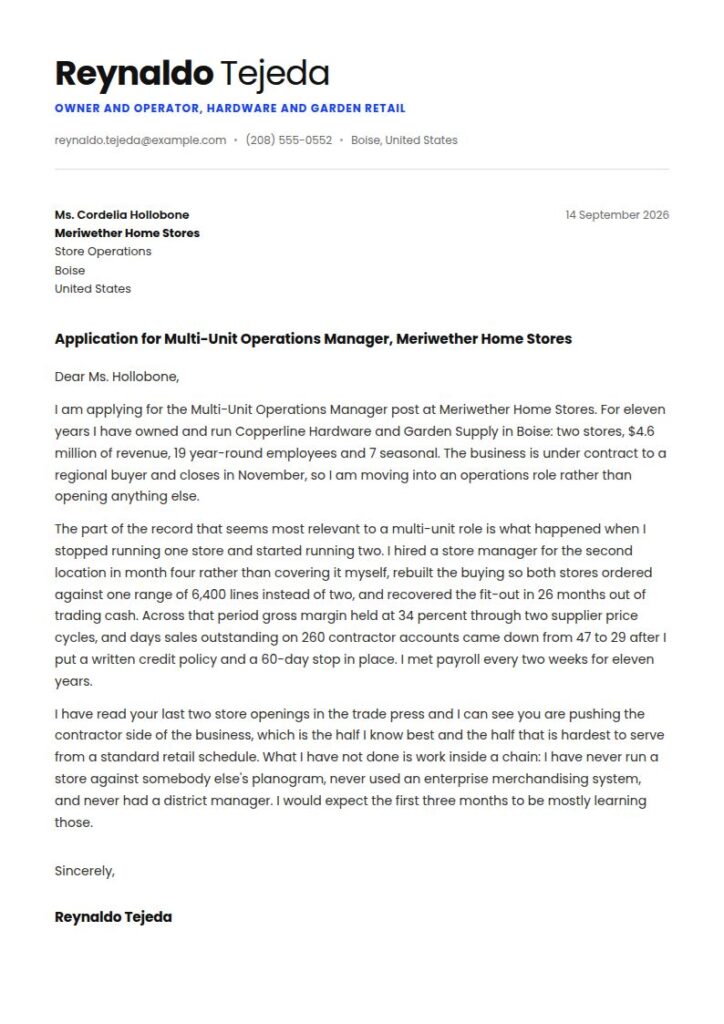
I am applying for the Multi-Unit Operations Manager post at Meriwether Home Stores. For eleven years I have owned and run Copperline Hardware and Garden Supply in Boise: two stores, $4.6 million of revenue, 19 year-round employees and 7 seasonal. The business is under contract to a regional buyer and closes in November, so I am moving into an operations role rather than opening anything else.
The part of the record that seems most relevant to a multi-unit role is what happened when I stopped running one store and started running two. I hired a store manager for the second location in month four rather than covering it myself, rebuilt the buying so both stores ordered against one range of 6,400 lines instead of two, and recovered the fit-out in 26 months out of trading cash. Across that period gross margin held at 34 percent through two supplier price cycles, and days sales outstanding on 260 contractor accounts came down from 47 to 29 after I put a written credit policy and a 60-day stop in place. I met payroll every two weeks for eleven years.
I have read your last two store openings in the trade press and I can see you are pushing the contractor side of the business, which is the half I know best and the half that is hardest to serve from a standard retail schedule. What I have not done is work inside a chain: I have never run a store against somebody else's planogram, never used an enterprise merchandising system, and never had a district manager. I would expect the first three months to be mostly learning those.
Everything on my resume can be checked without a reference call: the company registration and standing are on the state business register, and my accountant, my insurance broker and my commercial banker have all worked with the business for years and are happy to speak with you. I can start once the sale closes in November. Thank you for reading this.
Sincerely, Reynaldo Tejeda
Openings that work
| Instead of | Use |
|---|---|
| As a passionate small business owner with over a decade of experience | Eleven years running a two-store hardware and garden business: $4.6 million, 19 staff |
| I am writing to express my interest in this operations position | I am applying for the Multi-Unit Operations Manager post, and the business is under contract and closes in November |
| I have successfully grown my business year over year | Gross margin held at 34 percent through two supplier price cycles; the second store paid back its fit-out in 26 months |
| I am looking for a new challenge | I am moving into an operations role rather than opening anything else |
Say what happens to the business
This is the paragraph owner-operators leave out, and it is the one the reader most wants.
There are only four honest answers, and each takes a clause. The business is sold or under contract, with a date. It is closing, with a date. Somebody else is running it day to day and you hold it passively. Or it continues and you will run it in the evenings, which is a real answer but you should expect it to cost you the job unless the employer says otherwise first.
Put whichever it is in the first paragraph, with the date. A reader who has to wait until the interview to find out will spend the interview on it rather than on you, and some readers will not get that far.
Size the business in one sentence with revenue, headcount and years. Say what happens to it, with a date. Give two or three numbers with a before, an after and a period. Name one real thing about the employer, taken from their own material. State plainly what you have never done. Offer the accountant, the broker and the banker as verification.
Do not call yourself an entrepreneur, a self-starter or a natural leader. Do not tell the founding story. Do not use the business letterhead, the business logo or the business email address. Do not put net profit, a valuation or the sale price in the letter. Do not imply you ran systems and processes the business never had. Do not leave the future of the business unmentioned.
What counts as evidence when nobody can give you a reference
A reference call is the mechanism the reader normally uses, and it is not available to them. Replace it with two things: numbers that hang together, and counterparties who are not your friends.
| Kind of evidence | What it looks like in a sentence |
|---|---|
| Cash discipline | Met payroll every two weeks for eleven years, with the credit line back at zero by September in both peak years |
| Margin | Gross margin held between 33 and 35 percent through two supplier price cycles |
| Collections | Days sales outstanding on 260 contractor accounts from 47 to 29 after a written credit policy |
| Range and stock | Cut the range from 9,200 lines to 6,400 and moved stock turns from 2.9 to 4.4 |
| People | Hired 24 people in eleven years and promoted 4 of the 5 current supervisors from the floor |
| Independent parties | Accountant, insurance broker and commercial banker, each with years of history with the business |
The last row is worth as much as the rest together. Three professionals who have watched your business through a decade of renewals, claims and year-ends can tell an employer more than a former line manager can, and hardly any owner thinks to offer them.
Most of the businesses you are compared with never employed anyone
The Small Business Administration's Office of Advocacy counts 36,207,130 small businesses in the United States, of which 17.7 percent, or 6,395,635 firms, have paid employees and 82.3 percent, or 29,811,495, have none (SBA Office of Advocacy, Frequently Asked Questions About Small Business, 3 February 2026).
Survival is the other half of the picture. Of the 677,876 private sector establishments that opened in the year ended March 2015, 34.7 percent were still operating in March 2025 (U.S. Bureau of Labor Statistics, Business Employment Dynamics, survival of private sector establishments by opening year, data through March 2025).
Both figures are arguments for putting plain numbers in your first paragraph. A reader who sees "owner" pictures the common case, which is a business with no employees that did not last ten years. If yours had a payroll, a workers compensation policy and a decade of trading behind it, one sentence separates you from the picture in their head, and no adjective will.
Length, format and sending it
One page, four paragraphs, 250 to 400 words. PDF unless the portal asks otherwise, named for yourself and the post: reynaldo-tejeda-multi-unit-operations-manager-cover-letter.pdf.
Use a plain personal letterhead with your name, a personal email address and a mobile number. No business logo, no trading name in the header, no tagline. Address a named person; for an operations role that is usually a director of store operations or a regional manager, and both are normally findable.
Keep the numbers identical to the ones on your resume. Our small business owner resume example is written with the same figures used here, which is what lets a reader move between the two documents without stopping.
Key takeaways
- Size the business in one sentence: what it sells, revenue, headcount, years.
- Say what happens to the business, with a date, in the first paragraph.
- Give two or three results with a before, an after and a period.
- Name one real thing about the employer, taken from their own material.
- Say plainly what you have never done, such as working inside a chain.
- Offer the accountant, broker and banker as verification instead of a reference.
- Keep profit, valuations and sale prices off the page entirely.
- Write from a personal address on plain letterhead, not from the business.
Write your small business owner cover letter in 10 minutes with our AI cover letter builder.
Small business owner cover letter questions, answered
How long should a small business owner cover letter be?
One page, four paragraphs, 250 to 400 words. The temptation is to use the letter to explain a decade of self-employment in full, and it makes the document worse. Size the business, give two or three numbers, say what happens to it, and leave the rest for a conversation you are more likely to get because the letter was short.
Should I admit I have never worked in a large company?
Yes, in one sentence, in the third paragraph. Readers are already wondering, and a candidate who names the gap is easier to trust than one who writes around it. Say what specifically you have not done: no chain systems, no district manager, no planogram, no matrix reporting. Then say what you would expect to spend the first three months learning. That is a far stronger paragraph than any claim of adaptability.
Do I mention that I might go back to running my own business one day?
No. It is the reader's main unspoken worry and there is nothing to gain by confirming it. Say what you want now, in the present tense, and keep the letter on the job being filled. If the subject comes up in an interview, answer it there.
Can I use my business letterhead and email address?
No to both. Use a plain personal letterhead and a personal email address. Sending an application from the business domain tells the reader you have not separated the two, and it means their reply lands in an inbox other people can open. The same applies to the phone number: give your mobile, not the shop line.
What if my business is small and the job is at a large company?
Lead with functions and discipline rather than size, and let the numbers be whatever they are. A person who has personally held buying, scheduling, payroll, collections and compliance for eight years has done work that most candidates at the same level have only ever done one slice of. Do not inflate the scale; inflated revenue is the single easiest claim to catch, and an honest small number with a strong margin story reads better than a vague large one.