Fionnuala Brannagh Founder and Chief Executive Portland, 97214, United States [email protected] · (503) 555-0429
11 September 2026
Ms. Marit Stanwick Vice President of Operations Kirkwall Food Group Seattle, United States
Application for Director of Operations, Kirkwall Food Group
Dear Ms. Stanwick,
I am applying for the Director of Operations post at Kirkwall Food Group. For the last three years I have run a commercial kitchen equipment maintenance business I founded, now at $11.6 million of revenue, 62 employees and 480 sites under contract across Oregon and Washington. I am not looking to start anything else. The company is stable under a general manager, and I would rather run a larger operation with a balance sheet behind it than keep building one from scratch.
The work closest to your posting is field service operations. When I started, every job was dispatched on paper and our response time on a priority call averaged six and a half hours, which was losing us renewals. I replaced the ticketing with a dispatch and scheduling system, rebuilt the technician zones around site density rather than seniority, and changed the van stock list so that the twelve most common parts were always on board. Response time came down to two hours and fifty minutes and first-visit fix rate went from 61 percent to 79 percent. Over the same period I built the team from 4 to 62, including 9 apprentices recruited through a community college program, and held gross margin between 34 and 37 percent through two price cycles.
I should be honest about what does not transfer. I have never worked inside a matrix organization, I have never had a budget approved by someone else, and the largest team I have managed directly is eleven. What I do bring is a full profit and loss, a payroll I have signed personally every fortnight, an OSHA-recordable rate of 1.9 in a trade that injures people, and a previous company I wound down in 2023 where I returned capital to investors, paid every supplier and placed eleven of fourteen staff before we closed the door.
Both companies are on the Oregon state business register with their formation and dissolution dates, and I can provide audited accounts and references from two former investors and two current customers. I can start within eight weeks. Thank you for your time.
Sincerely, Fionnuala Brannagh
Summary
An entrepreneur cover letter has one job a normal letter does not: it has to explain why someone who ran their own company wants to work for yours. This guide gives you a full adaptable letter, the paragraph that answers the flight-risk question, how to write a business that closed in two sentences, and what to do when your numbers cannot be verified by a former employer.
Entrepreneur cover letter examples by experience level
An entrepreneur cover letter is a one-page letter that answers a question no other applicant has to answer: why does someone who has been the boss want to stop being the boss?
Get that wrong and nothing else in the letter is read. Hiring managers who have been burned once by a founder who left after eight months to start something new will screen the next one out on the resume alone, and a letter is your only chance to get in front of that.
The good news is that the answer is usually straightforward and you probably already know it. You want a bigger commercial problem than your own company can give you, or you want to stop carrying the payroll risk, or the part of the job you were best at had shrunk to a tenth of your week. Any of those, written plainly, does the work.
Guide to an entrepreneur cover letter
This guide and the corresponding entrepreneur cover letter example will cover:
- How to structure the letter, paragraph by paragraph
- The paragraph that answers the flight-risk question, and where to put it
- How to write a business that closed, in two sentences
- What to do about numbers that no former employer can confirm
- The openings that work, and the founder phrases that get letters discarded
How to write an entrepreneur cover letter
| Paragraph | Its job | Length |
|---|---|---|
| Opening | The role, what you built in figures, and why you are moving | 3 to 4 sentences |
| Evidence | One operating problem you solved, in the language of the job | 4 to 5 sentences |
| Fit | What transfers, what does not, and what you would need to learn | 3 to 4 sentences |
| Close | Verification, availability, thank you | 2 sentences |
Answer the flight-risk question in the first paragraph, not the last
Most founder letters leave the reason for leaving to the end, or leave it out entirely. By then the reader has already decided.
Put it in the opening, phrased as a preference rather than a retreat: "I am not looking to start anything else. I want to run a larger operation than I can build myself, with a supply chain and a balance sheet behind it."
Two things make that sentence work. It says what you want rather than what you are escaping, and it is specific enough to be checked in an interview. A vague "seeking new challenges" confirms the suspicion; a concrete preference relieves it.
The same paragraph should carry your scale figures, because the reader is simultaneously wondering whether your company was a real business or a side project. Revenue, headcount and years settle that in one clause.
An entrepreneur cover letter example you can adapt
Dear Ms. Stanwick,
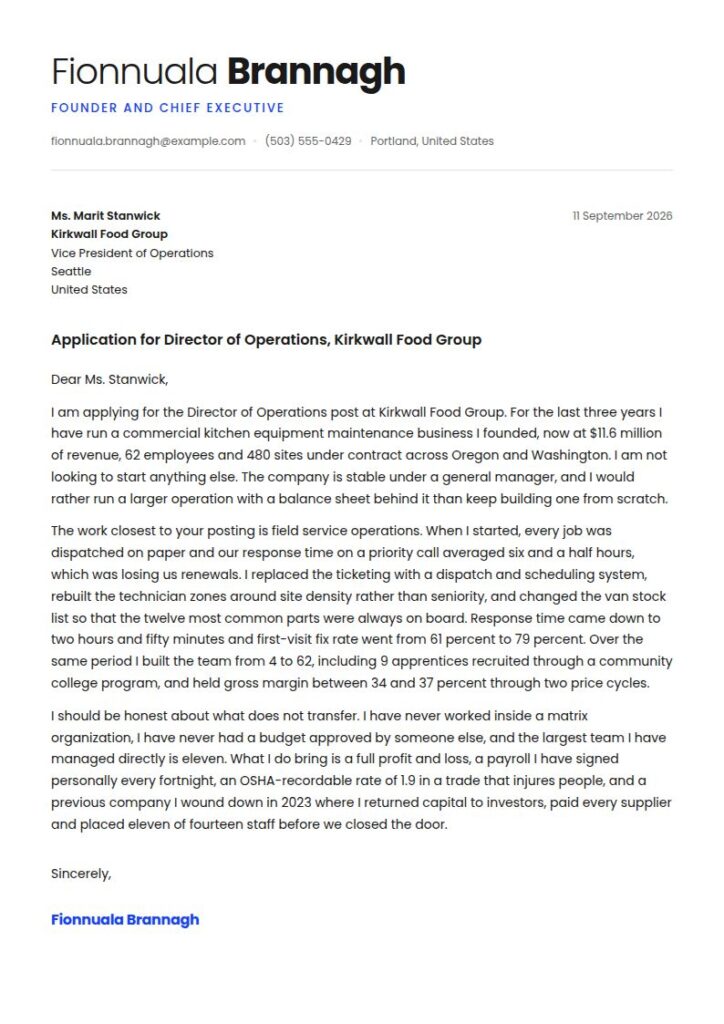
I am applying for the Director of Operations post at Kirkwall Food Group. For the last three years I have run a commercial kitchen equipment maintenance business I founded, now at $11.6 million of revenue, 62 employees and 480 sites under contract across Oregon and Washington. I am not looking to start anything else. The company is stable under a general manager, and I would rather run a larger operation with a balance sheet behind it than keep building one from scratch.
The work closest to your posting is field service operations. When I started, every job was dispatched on paper and our response time on a priority call averaged six and a half hours, which was losing us renewals. I replaced the ticketing with a dispatch and scheduling system, rebuilt the technician zones around site density rather than seniority, and changed the van stock list so that the twelve most common parts were always on board. Response time came down to two hours and fifty minutes and first-visit fix rate went from 61 percent to 79 percent. Over the same period I built the team from 4 to 62, including 9 apprentices recruited through a community college program, and held gross margin between 34 and 37 percent through two price cycles.
I should be honest about what does not transfer. I have never worked inside a matrix organization, I have never had a budget approved by someone else, and the largest team I have managed directly is eleven. What I do bring is a full profit and loss, a payroll I have signed personally every fortnight, an OSHA-recordable rate of 1.9 in a trade that injures people, and a previous company I wound down in 2023 where I returned capital to investors, paid every supplier and placed eleven of fourteen staff before we closed the door.
Both companies are on the Oregon state business register with their formation and dissolution dates, and I can provide audited accounts and references from two former investors and two current customers. I can start within eight weeks. Thank you for your time.
Sincerely, Fionnuala Brannagh
Openings that work
| Instead of | Use |
|---|---|
| As a serial entrepreneur with a passion for building businesses | For the last three years I have run a maintenance business I founded, now at $11.6 million of revenue and 62 employees |
| After an incredible journey, I am seeking new challenges | I am not looking to start anything else; I want to run a larger operation with a balance sheet behind it |
| I have worn every hat and thrive in fast-paced environments | Half my week is commercial, a quarter is people, a quarter is finance, and I can give you the numbers for each |
| My last venture concluded due to market conditions | I wound the company down in 2023 after two competitors bundled the same feature set into contracts our customers already held |
Writing the business that closed, in two sentences
You need the closure in the letter, because leaving it out makes the reader find it themselves and assume the worst version. Two sentences is the right length: what happened, and what you did about it.
| Element | What it looks like in a sentence |
|---|---|
| The cause, commercially | Two enterprise competitors bundled the same feature set into contracts our customers already held |
| The decision | I chose to wind down with cash still in the account rather than trade into insolvency |
| The capital | Returned $310,000 to investors |
| The people | Placed 11 of 14 staff before the final day |
| The obligations | Paid every supplier and every final salary in full |
| The lesson, once | I underpriced for two years and never tested whether the market would pay more |
Pick three of those six and stop. A closure described in half a paragraph reads as command of the facts; a closure described in a full page reads as unfinished business.
What to do about numbers nobody can verify
Offer the verification before it is asked for: the state business register, the funding filing, audited accounts, a commercial bank relationship, licensing and insurance certificates, and customer or investor references. Keep every figure in the letter consistent with the resume. Use a personal email address. Name one thing that does not transfer to the job you are applying for.
Do not describe a closure as an exit, or an asset sale as an acquisition. Do not quote a valuation nobody paid. Do not use the words visionary, disruptor or serial entrepreneur. Do not send the letter from your own company domain. Do not spend the letter explaining that entrepreneurs make great employees, which is an argument rather than evidence.
Closing a business is the median outcome, and the reader already knows it
Of the 677,876 private sector establishments that opened in the year ended March 2015, 50.2 percent were still operating five years later and 34.7 percent were still operating ten years on, in March 2025 (U.S. Bureau of Labor Statistics, Business Employment Dynamics, survival of private sector establishments by opening year, data through March 2025).
The scale of the self-employed economy puts that in context: 36,207,130 small businesses, 99.9 percent of all United States businesses, of which 29,811,495 have no employees at all, together employing 62.3 million people or 45.9 percent of the private sector workforce (SBA Office of Advocacy, Frequently Asked Questions About Small Business, February 2026).
Two things follow for a letter. A business that closed is the ordinary result rather than a confession, so write it in a sentence and move on. And a founder who had employees, a payroll and a profit and loss is in a small minority of business owners, which is worth stating as a figure rather than implying with a title.
Length, format and sending it
One page, four paragraphs, 300 to 400 words. Founder letters run slightly longer than average because they carry the reason for leaving as well as the evidence, and that is acceptable; five paragraphs is not.
Address a named person, from a personal email address, and attach a PDF named for yourself and the role. Keep the same figures as your resume, since a mismatch between the two is precisely the kind of thing a reader who already doubts your numbers will notice. Our entrepreneur resume example uses the figures in this letter.
Key takeaways
- Answer the flight-risk question in the opening paragraph, as a preference not an escape.
- Put revenue, headcount and years in the first three sentences.
- Write one operating problem in the language of the job you are applying for.
- Name one thing that does not transfer; it buys credibility for everything else.
- Write the closure in two sentences, with the cause in commercial terms.
- Offer verification before anyone asks: register, accounts, references.
- Send it from a personal address, not your company domain.
Write your entrepreneur cover letter in 10 minutes with our AI cover letter builder.
Entrepreneur cover letter questions, answered
How do I explain why I am leaving my own business?
Say what you want rather than what you are leaving. A larger operation, a specific function you want to go deeper in, or an end to carrying personal financial risk are all credible and checkable. Avoid anything that sounds like exhaustion or like a pause between ventures, because the reader's main fear is that you will leave when your next idea arrives.
Should I mention a business that failed in the cover letter?
Yes, in two sentences, with the commercial cause and what you did about it. A closure you handled well is evidence of judgment under pressure, and it is the part of your history most likely to be discussed in an interview. Hiding it in the letter and having it surface later is the worst of both options.
Can I apply for a senior role straight out of running my own company?
For roles close in scope to what you ran, yes. For roles much larger, expect resistance, and use the letter to name the gap honestly rather than hope it goes unnoticed. Saying "the largest team I have managed directly is eleven" in your own words is far better than having an interviewer discover it in the second round.
How do I sound less like a founder and more like a candidate?
Use the employer's vocabulary, not the vocabulary of building a company. Not traction and runway, but utilization, margin, headcount, service level and safety record. Describe one problem the way an operations director would describe it, with a baseline, a change and a result. The shift in language is what tells a reader you have actually decided to take a job.
What if my business is still running while I apply?
Say so plainly and say who is running it. "The company is stable under a general manager" answers the obvious question about divided attention, and it also explains why you are free to move. If you plan to retain ownership while employed, raise it early in the process rather than at offer stage, because most employers have a policy on it and finding out late costs you the role.