Financial Analyst, FP&A Yasmin Abbasi
Financial Analyst, FP&A
[email protected] | (614) 555-0128 | Columbus, United States
Profile
Financial analyst supporting a $210 million industrial components business, responsible for the monthly operating expense forecast across 6 cost centers and the weekly flash report to the segment controller. Rebuilt the flash from manual workbook consolidation to a query-driven refresh, which moved it from Thursday to Tuesday and cut preparation from 9 hours to under 2. Work daily in Excel, SQL and NetSuite, and hold a bachelor's degree in finance.
Work Experience
06/2025 - Present, Financial Analyst, FP&A, Mereton Industrial Group, Columbus, United States
- Own the monthly operating expense forecast for 6 cost centers inside a $210 million industrial components business.
- Produce the weekly flash report to the segment controller; rebuilt it from manual workbook consolidation to a SQL-backed refresh, moving delivery from Thursday to Tuesday and preparation from 9 hours to under 2.
- Prepare the plan-to-actual operating expense bridge each month and write the variance commentary for the segment pack.
- Maintain the capital request template used for every request above $250,000, including payback, net present value and internal rate of return.
05/2024 - 08/2024, Finance Intern, Corporate Treasury, Halden Freight Systems, Columbus, United States
- Built the daily cash position workbook for 14 bank accounts and reconciled it to the general ledger each morning.
- Supported the rolling 13-week cash forecast and documented the driver assumptions behind each receipts line.
Education
08/2021 - 05/2025, Bachelor of Science in Business Administration, Finance, The Ohio State University, Columbus, United States
Coursework in corporate finance, financial modeling, econometrics and database systems. Treasury case competition finalist, 2024.
Skills
Excel modeling, 80
SQL, 70
Operating expense forecasting, 65
Plan-to-actual variance bridging, 65
NetSuite, 60
Power BI, 60
Management reporting, 70
Languages
English, native
Persian, native
Spanish, intermediate
Certificates
11/2024, Microsoft Office Specialist: Excel Expert, Microsoft
Advanced workbook modeling, data modeling and formula auditing.
Summary
A financial analyst resume is a one to two page document naming the forecast you own, how close it came to actuals, the model you built and who uses it, and the recommendation a decision hung on. This guide gives you three adaptable versions, a forecast block most applicants leave out, and current Bureau of Labor Statistics pay and outlook for the occupation.
Financial Analyst resume examples by experience level
A financial analyst resume is a one to two page document that names the forecast you own, how close that forecast came to what actually happened, the model you built and who uses it, and the decision your analysis moved.
In practice, almost every analyst resume says the same four things: built financial models, performed variance analysis, prepared reports for senior management, supported strategic decision-making. None of those tells the reader what you were accountable for or whether you were any good at it. However, accuracy over time is the evidence in this job, and it is the part most applicants leave off.
Resume guide for a financial analyst resume
To start, this guide and the corresponding financial analyst resume example will cover:
- First, how to write a financial analyst resume, section by section
- Then, why the forecast you own belongs on the page as a named line item
- Also, three adaptable summaries: analyst, senior analyst and FP&A manager
- What to say about a model when you cannot show the model
- Finally, what the job market looks like and what you can expect to earn
How to write a financial analyst resume
Overall, use six sections: contact header, summary, experience, the forecast block, skills and systems, and education with certifications. One page for the first five years, two once you own a plan and a team.
The order matters because the reader is triaging. For example, corporate financial planning and analysis looks for scope first: how big is the business you forecast, and at what grain. By contrast, an investment firm looks for coverage: which sector, which securities, which side of the trade.
| Section | What it is answering | Where it goes |
|---|---|---|
| Summary | What do you forecast, for how large a business, and how accurate are you? | Top, four lines |
| Experience | What did you own, and what changed because of it? | Reverse chronological, numbers in every bullet |
| Forecast and models | Which line items are yours, on what cadence, and who consumes the output? | Its own block after experience |
| Skills and systems | Can you work in our stack from week one? | Grouped, not a keyword wall |
| Education and certifications | Do you clear the credential bar for this seat? | Last, with dates and status |
Name the size of the business you forecast, not the size of your company
"Financial analyst at a Fortune 500 manufacturer" tells a reader nothing about scope. You might be forecasting a $40 million product line or a $4 billion segment, and those are different jobs with different pay bands.
Write the unit you are accountable for: "own the revenue and gross margin forecast for a $340 million industrial components segment, 11 plants, monthly close plus a rolling six-quarter forecast." On the investment side, name the coverage universe instead: "covered 22 North American industrials names, market capitalisations from $400 million to $19 billion." That is a sentence a hiring manager can size.
Run the finished file through the free ATS checker before you submit. Finance recruiting runs through applicant tracking systems that parse your file into fields before anyone opens it.
Choosing the best resume format for a financial analyst resume
Reverse chronological, single column. One page until you have roughly eight years or a team; two pages after that.
In particular, functional formats fail here for a specific reason. After all, hiring managers judge analytical work on progression of scope: the line you forecast this year against the line you forecast three years ago. As a result, a format that hides the sequence hides the only trend the reader wants. If you are moving between corporate financial planning, the buy side and the sell side, keep the timeline and change the emphasis instead.
Include your contact information
| ✅ Right | ❌ Wrong |
|---|---|
| Yasmin Abbasi | Yasmin Abbasi |
| Senior Financial Analyst, FP&A | Finance professional with a passion for numbers |
| FPAC, Association for Financial Professionals | Certified financial expert |
| (614) 555-0128, [email protected], Columbus, OH | (614) 555-0128, [email protected] |
Put the credential in the header only if you hold it. Instead, a charter in progress goes in the education block with its level and date, not next to your name.
Make use of a summary
Next, write four lines: what you forecast and for how large a business, the cadence, one accuracy or impact number, and the systems you work in.
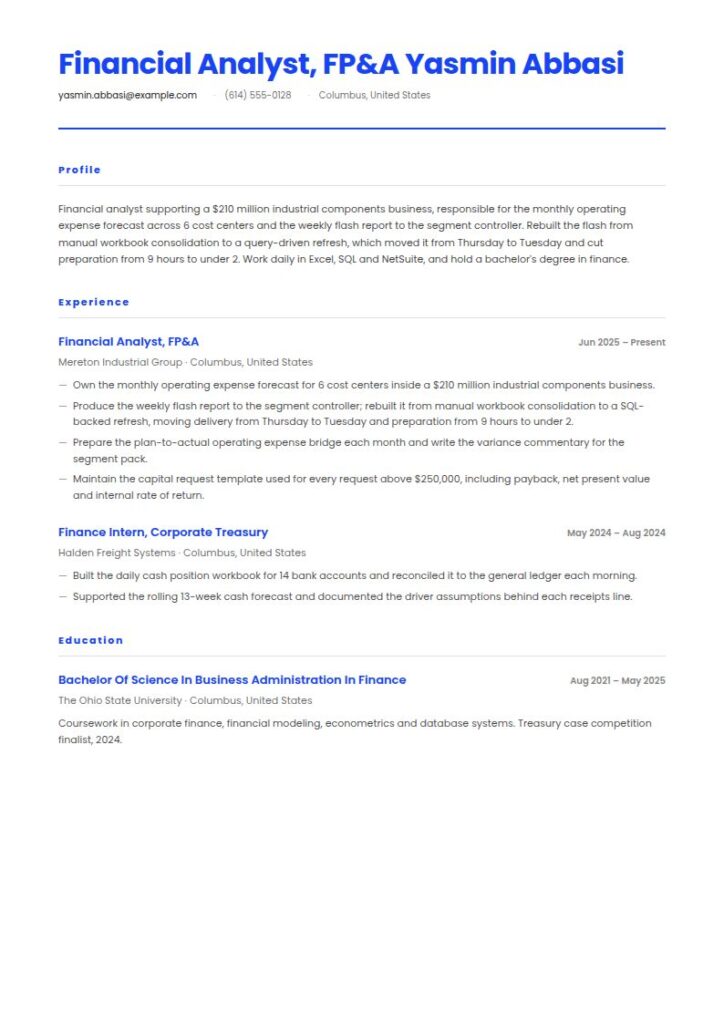
Financial analyst supporting a $210 million industrial components business, responsible for the monthly operating expense forecast across 6 cost centers and the weekly flash report to the segment controller. Rebuilt the flash from manual workbook consolidation to a query-driven refresh, which moved it from Thursday to Tuesday and cut preparation from 9 hours to under 2. Work daily in Excel, SQL and NetSuite, and hold a bachelor's degree in finance.
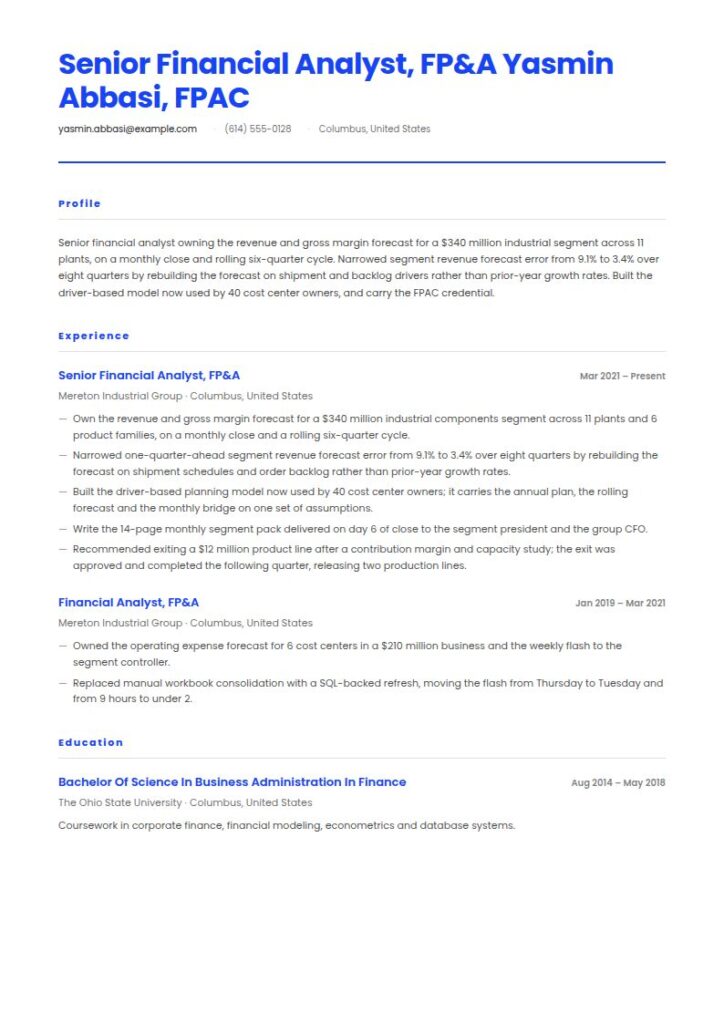
Senior financial analyst owning the revenue and gross margin forecast for a $340 million industrial segment across 11 plants, on a monthly close and rolling six-quarter cycle. Narrowed segment revenue forecast error from 9.1% to 3.4% over eight quarters by rebuilding the forecast on shipment and backlog drivers rather than prior-year growth rates. Built the driver-based model now used by 40 cost center owners, and carry the FPAC credential.
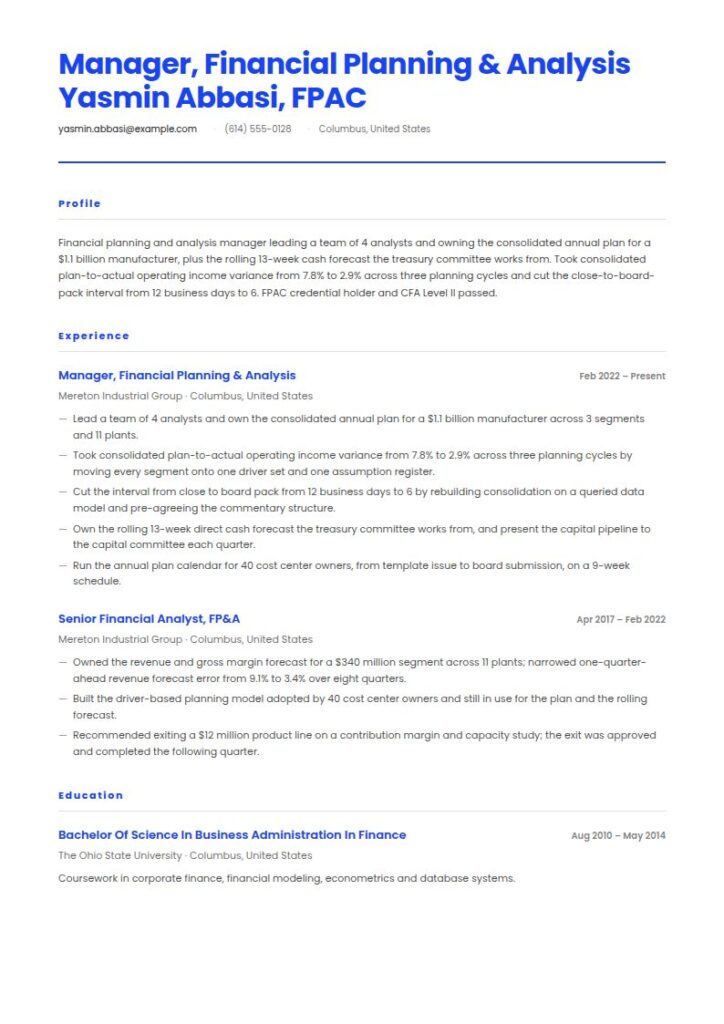
Financial planning and analysis manager leading a team of 4 analysts and owning the consolidated annual plan for a $1.1 billion manufacturer, plus the rolling 13-week cash forecast the treasury committee works from. Took consolidated plan-to-actual operating income variance from 7.8% to 2.9% across three planning cycles and cut the close-to-board-pack interval from 12 business days to 6. FPAC credential holder and CFA Level II passed.
Right vs wrong: the same financial analyst summary, twice
| ✅ Right | ❌ Wrong |
|---|---|
| Owns the revenue and gross margin forecast for a $340 million industrial segment across 11 plants. | Experienced financial analyst with a strong background in financial modeling and analysis. |
| Narrowed segment revenue forecast error from 9.1% to 3.4% over eight quarters. | Consistently delivered accurate forecasts and insightful analysis to stakeholders. |
| Built the driver-based model now used by 40 cost center owners. | Built complex financial models to support strategic decision-making. |
Anyone can check the right column. The left column is the same paragraph every other applicant sent, and a finance hiring manager reading forty of them is looking for the one that can be checked.
Outline your financial analyst experience
Then give employer, title, city, the size of what you supported, and dates. Then four to six bullets. In addition, each one names a deliverable, the scope it covers, and a number.
| Instead of | Use |
|---|---|
| Built financial models to support business decisions | Built the driver-based revenue model for an 11-plant, $340 million segment, now the source for the monthly forecast and the annual plan |
| Performed monthly variance analysis | Own the monthly plan-to-actual bridge for a $340 million segment; narrowed revenue forecast error from 9.1% to 3.4% over eight quarters |
| Prepared reports for senior management | Write the 14-page monthly segment pack read by the segment president and the group CFO, delivered on day 6 of close |
| Supported the annual budgeting process | Ran the annual plan for 40 cost center owners across 11 sites, from template issue to board submission, on a 9-week calendar |
| Improved reporting efficiency | Replaced manual workbook consolidation with a SQL-backed refresh; flash report moved from Thursday to Tuesday and from 9 hours to under 2 |
| Provided recommendations to leadership | Recommended discontinuing a $12 million product line on a contribution margin and capacity analysis; the line was exited the following quarter |
Senior Financial Analyst, Mereton Industrial Group, Columbus, OH, March 2021 to Present
Own the revenue and gross margin forecast for a $340 million industrial components segment across 11 plants, on a monthly close and a rolling six-quarter cycle.
Narrowed segment revenue forecast error from 9.1% to 3.4% over eight quarters by rebuilding the forecast on shipment schedules and order backlog rather than prior-year growth rates.
Built the driver-based planning model used by 40 cost center owners; it now carries the annual plan, the rolling forecast and the monthly bridge on one set of assumptions.
Write the monthly segment pack, 14 pages, delivered on day 6 of close to the segment president and the group CFO.
Recommended exiting a $12 million product line after a contribution margin and capacity study; the exit was approved and completed the following quarter, releasing two production lines.
Put the forecast you own on the page, and say how close you came
In fact, this is the block that separates one analyst resume from every other analyst resume, and almost nobody writes it.
Firms hire analysts to be accountable for a number before anyone knows it. The modeling, the data work and the deck all exist to produce that number and then explain the gap. So put it on the page: what you forecast, at what grain, how often, who consumes it, and how close you have been.
Forecast ownership: Revenue and gross margin, $340 million industrial components segment, 11 plants, 6 product families. Monthly close, rolling six-quarter forecast, annual plan.
Accuracy: Segment revenue forecast error narrowed from 9.1% to 3.4% over eight quarters. Gross margin forecast within 60 basis points for the last five quarters.
Models built and maintained: Driver-based revenue and margin model on shipment and backlog inputs, used by 40 cost center owners. Rolling 13-week direct cash forecast. Capital request model with payback, net present value and internal rate of return, used for every request above $250,000.
Recurring deliverables: Monthly segment pack, 14 pages, day 6 of close. Weekly flash to the segment controller. Quarterly business review deck for the group leadership meeting.
Decisions supported: Exit of a $12 million product line on a contribution margin and capacity study. Consolidation of two distribution sites. Reprice of a product family after a landed cost rebuild.
Three cautions on this block, and they matter more in finance than in most fields.
Above all, only publish numbers that are already public or are yours to publish. Segment revenue at a listed company may be disclosed; a plant-level margin almost certainly is not, and on the buy side positions and holdings are not yours to describe at all. Round to a scale that is honest without being disclosive.
Similarly, never write an accuracy number you cannot reconstruct. That is because interviewers will ask how you measured forecast error, on which line and over which periods. For instance, mean absolute percentage error against the final reported actual, measured one quarter ahead, is a defensible definition; say which one you used.
Likewise, do not claim credit for the decision. "Recommended exiting a $12 million product line; the exit was approved and completed the following quarter" is accurate, and it is stronger than claiming you exited it.
Buy side, sell side and corporate are three different jobs with one title
The Occupational Outlook Handbook groups financial and investment analysts into a single occupation of 377,200 people (BLS Occupational Outlook Handbook, May 2025). Inside it, three quite different jobs share the title, and a resume written for one reads as unfocused to the others.
Corporate financial planning and analysis is accountable for a plan: write scope, cadence and variance. The buy side is accountable for a recommendation that carries money: write coverage universe, thesis and process, never positions. The sell side is accountable for published work and client attention: write names covered, notes and models published, and client marketing.
Build a snapshot of your key skills
Ten to fourteen entries in three groups: analysis, systems and data, and the business skills the job actually turns on. Skip the keyword wall. A finance reader can tell the difference between someone who uses a tool and someone who has listed it.
Analysis and planning: Driver-based forecasting, Rolling forecast design, Plan-to-actual variance bridging, Contribution margin analysis, Capital request appraisal with payback, NPV and IRR, Direct cash forecasting
Systems and data: Excel to an advanced modeling standard, SQL, Power BI, NetSuite, Anaplan, Python for data preparation
Close and control: Monthly close support, Accrual review, Account reconciliation review, Management reporting pack production
Business: Business partnering with plant and commercial leaders, Writing for an executive audience, Presenting to a leadership committee
Be careful with self-rated levels. If your resume says advanced Excel, expect a modeling test; many finance processes include one.
List your education and certifications
Degree, institution and year, then certifications with dates and honest status labels.
Bachelor of Science in Business Administration, Finance, The Ohio State University, Columbus, OH, 2018
Certified Corporate Financial Planning & Analysis Professional (FPAC), Association for Financial Professionals, 2024
CFA Program, CFA Institute: Level II passed, 2025. Candidate for Level III.
Additional training: Financial modeling and valuation coursework, 2022. Power BI data modeling, 2023.
Next, three credential rules for this occupation, each from the body that sets it.
First, the CFA charter is the credential the investment side reads. CFA Institute requires three exams, "at least 4,000 hours of relevant work experience, completed in no fewer than 36 months", and regular membership supported by two to three professional references, and states that it takes three to four years to complete all three levels with a recommended 300 hours of study per level (CFA Institute, accessed September 2026). Write your progress precisely: level passed and year, then candidate status. Therefore, never write "CFA" after your name before the charter is awarded.
Meanwhile, the FPAC credential is the corporate equivalent. The Association for Financial Professionals requires a bachelor's or equivalent degree in any subject, or current enrollment on track to graduate within two years, plus agreement to its Standards of Ethical Conduct, and sets a two-part exam covering financial information and business relationships, then financial projections (AFP, accessed September 2026).
Securities licenses mostly do not apply to corporate analysts. The Handbook states that "The Financial Industry Regulatory Authority (FINRA) is the main licensing organization for the securities industry", that some analyst positions may require licensure, and that because most licenses require employer sponsorship, companies do not expect candidates to hold them before starting (BLS Occupational Outlook Handbook, May 2025). Third, do not pay for a registration nobody asked you to hold.
Choose the right layout and design
Also keep a single column, 10 or 11 point, generous margins, no photograph, no skill bars, no charts. Keep bullets short enough that the figure lands early rather than buried mid-sentence.
Name the size of the business or the coverage universe you are responsible for. Give the cadence: monthly close, rolling forecast, weekly flash. Put one number in every bullet, tied to a named deliverable. State forecast accuracy with a definition you can defend. Name the systems you use daily and be ready to be tested on them. Label credentials by exact status and date.
Do not write "built complex financial models" without saying what the model forecasts and who uses it. Do not publish internal figures that are not disclosed, and never describe holdings or positions. Do not claim a decision you recommended as a decision you made. Do not put "CFA" after your name before the charter is issued. Do not use a two-column template for a finance portal; the parse breaks and your numbers land in the wrong fields.
Financial analyst job market and outlook
In general, it is a growing occupation with strong replacement demand, and a wage that separates sharply by industry.
| Measure | Value |
|---|---|
| Financial analyst jobs, 2025 | 443,100 |
| Projected change, 2025-35 | 7% (much faster than average), +32,000 |
| Projected annual openings | ~29,500 |
| Typical entry-level education | Bachelor's degree |
| Related work experience required | None |
| Median annual wage, May 2025 | $103,570 |
Source: U.S. Bureau of Labor Statistics, Occupational Outlook Handbook, 2025-35 projections and May 2025 wage data.
The occupation splits into two, and one of them pays $14,590 more
The Handbook profile covers two detailed occupations. Financial and investment analysts, 377,200 people, had a median annual wage of $102,740 in May 2025, with the lowest 10 percent under $63,720 and the highest 10 percent over $180,860. Financial risk specialists, 66,000 people, had a median of $117,330, with the lowest 10 percent under $64,820 and the highest 10 percent over $196,110 (BLS Occupational Outlook Handbook, May 2025).
The two groups also sit in different places. Nearly a quarter of financial and investment analysts, 24 percent, work in securities, commodity contracts and other financial investments, followed by professional, scientific and technical services at 14 percent and credit intermediation at 12 percent. Financial risk specialists are concentrated the other way round: 35 percent work in credit intermediation, mostly banks, with 15 percent in securities and 14 percent in insurance (BLS, May 2025).
If your work is modeling credit, market, liquidity or model risk, write it in those words rather than as general analysis. It is a separately measured occupation with a higher median, and being read into the wrong one costs you at the banding stage.
Where the jobs sit, for financial and investment analysts:
| Setting | Share of employment | Median annual wage (May 2025) |
|---|---|---|
| Securities, commodity contracts and other financial investments | 24% | $124,370 |
| Professional, scientific and technical services | 14% | $101,540 |
| Credit intermediation and related activities | 12% | $100,120 |
| Management of companies and enterprises | 11% | $101,760 |
| Insurance carriers and related activities | 6% | $95,830 |
Source: U.S. Bureau of Labor Statistics, Occupational Outlook Handbook, May 2025.
What salary you can expect as a financial analyst
Specifically, the median annual wage for financial analysts was $103,570 as of May 2025 (BLS Occupational Outlook Handbook, May 2025). Within the occupation, for example, financial and investment analysts had a median of $102,740 and financial risk specialists $117,330 in the same cycle.
Indeed, the spread inside the occupation is wide. For financial and investment analysts the lowest 10 percent earned less than $63,720 and the highest 10 percent more than $180,860 (BLS, May 2025). In other words, most of that gap is industry, not negotiation: securities and financial investments paid a median of $124,370 against $95,830 in insurance carriers, a difference of roughly 30 percent for the same nominal title.
One thing worth knowing before you read any pay figure. The Bureau's published wages are "straight-time, gross pay, exclusive of premium pay", including base rate, commissions, incentive pay and production bonuses, and excluding non-production bonuses, overtime and benefits (BLS Occupational Employment and Wage Statistics, accessed September 2026). A discretionary year-end bonus sits outside these numbers, so treat the published median as the reliable floor of the conversation and ask about bonus structure directly.
In short, what a resume can move is which band the reader places you in. Segment or portfolio scope, forecast accuracy you can evidence, ownership of a model other people depend on, and a credential the reader's team recognizes are what change the banding conversation before the offer is built.
Key takeaways for a financial analyst resume
- First, name the size of the business you forecast or the coverage universe you follow, not the size of your employer.
- Then put a forecast block on the page: what you own, the cadence, the consumers and the accuracy.
- Also define any accuracy figure you quote well enough to defend it in the interview.
- In addition, give one number per bullet, attached to a named deliverable.
- Moreover, say what your models do and who uses them, not that they are complex.
- Label credentials by exact status and date, and never write CFA before the charter is issued.
- Finally, keep internal, undisclosed and position-level detail off the page entirely.
Build your financial analyst resume in 15 minutes with our AI resume builder.
Related accounting and finance resume examples
- Accountant resume
- Credit analyst resume
- Finance manager resume
- Finance director resume
- Investment banker resume
- Financial advisor resume
- Private equity resume
- Senior accountant resume
- Auditor resume
- Compliance officer resume
- CPA resume
- Accounting and finance resume
Pair it with a matching financial analyst cover letter.
Financial analyst resume questions, answered
How long should a financial analyst resume be?
One page for your first five to eight years. Two pages once you own a plan, lead analysts, or carry a coverage list long enough to be the point, provided the second page is scope and results rather than a longer skills list.
Do I need a CFA to be a financial analyst?
No. The Handbook lists a bachelor's degree as the typical entry-level education, with no related work experience required (BLS Occupational Outlook Handbook, May 2025). The charter matters most on the investment side, where CFA Institute requires three exams plus at least 4,000 hours of relevant experience completed in no fewer than 36 months (CFA Institute, accessed September 2026). In corporate financial planning and analysis the FPAC credential is read more often, and plenty of strong analysts hold neither.
How do I show forecast accuracy without disclosing internal numbers?
Give the measure and the movement rather than the underlying figures. "Narrowed one-quarter-ahead revenue forecast error from 9.1% to 3.4% over eight quarters" says how good you are without publishing a single actual. Describe the business by approximate size and structure, not by its internal reporting lines.
What should an entry-level financial analyst resume include?
An internship or a first analyst seat written as a job: the business you supported and its approximate size, the recurring deliverable you produced, the systems you worked in, and one measurable improvement you made to a process. Then your degree, any modeling coursework, and exam progress with dates.
Should I list Excel, SQL and Python separately?
Yes, and only if you can be tested on them. Finance interviews commonly include a modeling exercise or a data task, so a self-rating you cannot back is a liability rather than a keyword win.
How do I move from accounting into a financial analyst role?
Reframe the same work around forward-looking ownership. Close and reporting experience is valuable in financial planning and analysis, but the resume has to show forecasting, variance explanation and business partnering rather than only the close calendar. Add one forward-looking artefact: a forecast you built, a model you own, or an analysis that changed a decision.