Bookkeeper Rosalind Teasdale
Bookkeeper
[email protected] | (828) 555-0164 | Asheville, United States
Profile
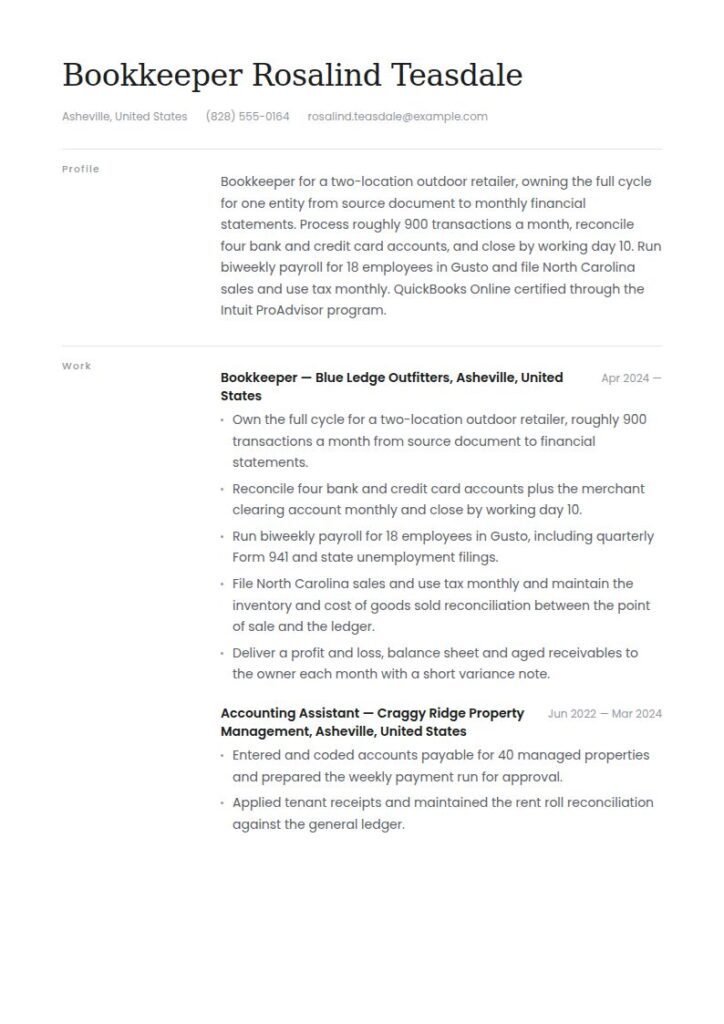
Bookkeeper for a two-location outdoor retailer, owning the full cycle for one entity from source document to monthly financial statements. Process roughly 900 transactions a month, reconcile four bank and credit card accounts, and close by working day 10. Run biweekly payroll for 18 employees in Gusto and file North Carolina sales and use tax monthly. QuickBooks Online certified through the Intuit ProAdvisor program.
Work Experience
04/2024 - Present, Bookkeeper, Blue Ledge Outfitters, Asheville, United States
- Own the full cycle for a two-location outdoor retailer, roughly 900 transactions a month from source document to financial statements.
- Reconcile four bank and credit card accounts plus the merchant clearing account monthly and close by working day 10.
- Run biweekly payroll for 18 employees in Gusto, including quarterly Form 941 and state unemployment filings.
- File North Carolina sales and use tax monthly and maintain the inventory and cost of goods sold reconciliation between the point of sale and the ledger.
- Deliver a profit and loss, balance sheet and aged receivables to the owner each month with a short variance note.
06/2022 - 03/2024, Accounting Assistant, Craggy Ridge Property Management, Asheville, United States
- Entered and coded accounts payable for 40 managed properties and prepared the weekly payment run for approval.
- Applied tenant receipts and maintained the rent roll reconciliation against the general ledger.
Education
08/2016 - 05/2018, Associate of Applied Science, Accounting, Asheville-Buncombe Technical Community College, Asheville, United States
Coursework in financial accounting, payroll accounting, business taxation and accounting software applications.
Skills
QuickBooks Online, 85
Bank and credit card reconciliation, 85
Accounts payable and receivable, 80
Payroll processing in Gusto, 75
Sales and use tax filing, 70
Inventory and cost of goods sold reconciliation, 70
Microsoft Excel, pivot tables and XLOOKUP, 70
Languages
English, native
Certificates
05/2024, QuickBooks Online ProAdvisor, Intuit
Core certification, renewed annually.
Summary
A bookkeeper resume is a one to two page document naming the entities whose books you own, the transaction volume behind them, the close you run and the payroll and sales tax filings you are responsible for. This guide gives you three adaptable versions, a client and entity table that no competing resume will have, and current Bureau of Labor Statistics pay and outlook.
Bookkeeper resume examples by experience level
A bookkeeper resume is a one to two page document naming the sets of books you own, what runs through them, and the calendar you keep to.
That word "own" is the difference. A clerk works inside a finance function somebody else runs. A bookkeeper usually is the finance function, for one small business or for a list of clients, and is often the only person in the building who could explain why the bank balance and the ledger disagree.
So the hiring question is not really about skills. It is about capacity: how many entities, how much volume, how complex, on what software, closing when. Very few bookkeeper resumes answer any of it.
Resume guide for a bookkeeper resume
This guide and the corresponding bookkeeper resume example will cover:
- How to write a bookkeeper resume, section by section
- The client and entity table that tells an employer your capacity at a glance
- Three adaptable summaries: first books, multi-client and practice owner
- How to describe client work without putting a client on the page
- What the job market looks like and what you can expect to earn
How to write a bookkeeper resume
Six blocks: contact header, summary, client and entity table, experience, software, and education and certifications. One page for a single-entity bookkeeper, two once you are carrying a client list worth listing.
| Section | What it is answering | Where it goes |
|---|---|---|
| Client and entity table | How many sets of books can this person carry, and how complex? | Directly under the summary |
| Experience | What do they actually own, from source document to financial statement? | Reverse chronological, with volume |
| Software | Will they need retraining on our stack? | Named products and the editions |
| Filings | Can they be trusted with payroll tax and sales tax deadlines? | Inside experience, with the cadence stated |
Own the close, do not just mention it
"Performed month-end close" appears on almost every bookkeeper resume and tells a reader nothing, because it covers everything from ticking someone else's checklist to being the only person who can produce a balance sheet that ties.
Write the close as a commitment instead. Which working day the books are closed by. How many bank and credit card accounts you reconcile to get there. What you deliver: a profit and loss, a balance sheet, an aged receivables report, a variance note for the owner.
"Close 14 client entities by working day 10 with 31 bank and card accounts reconciled, delivering a profit and loss, balance sheet and aged receivables to each owner" is a sentence no competing resume will match, and every clause is checkable.
Run the file through the free ATS checker first. Bookkeeper listings from firms and outsourced providers are usually filtered on software names, so it matters that yours survive the parse.
Choosing the best resume format for a bookkeeper resume
Reverse chronological, single column. Two pages is legitimate here in a way it is not for most clerical accounting roles, because a multi-client bookkeeper has more to declare: entities, industries, software, filings.
If you have been self-employed or contracting, list your practice as an employer with a start date and treat the client list as scope rather than as separate jobs. Eleven one-line "jobs" reads as instability. The same eleven entities as the scope of one practice reads as a book of business.
Include your contact information
| ✅ Right | ❌ Wrong |
|---|---|
| Rosalind Teasdale | Rosalind Teasdale |
| Bookkeeper, 14 client entities, QuickBooks Online and Xero | Experienced bookkeeping professional |
| AIPB Certified Bookkeeper | Accounting and finance expert |
| (828) 555-0164, [email protected], Asheville, NC | (828) 555-0164, [email protected] |
The second line does the work. Entity count plus software is the fastest answer to the two questions a firm actually has, and it sits above the fold.
Make use of a summary
Four lines: how many sets of books, what volume, what you close and file, and the software you run it on.
Bookkeeper for a two-location outdoor retailer, owning the full cycle for one entity from source document to monthly financial statements. Process roughly 900 transactions a month, reconcile four bank and credit card accounts, and close by working day 10. Run biweekly payroll for 18 employees in Gusto and file North Carolina sales and use tax monthly. QuickBooks Online certified through the Intuit ProAdvisor program.
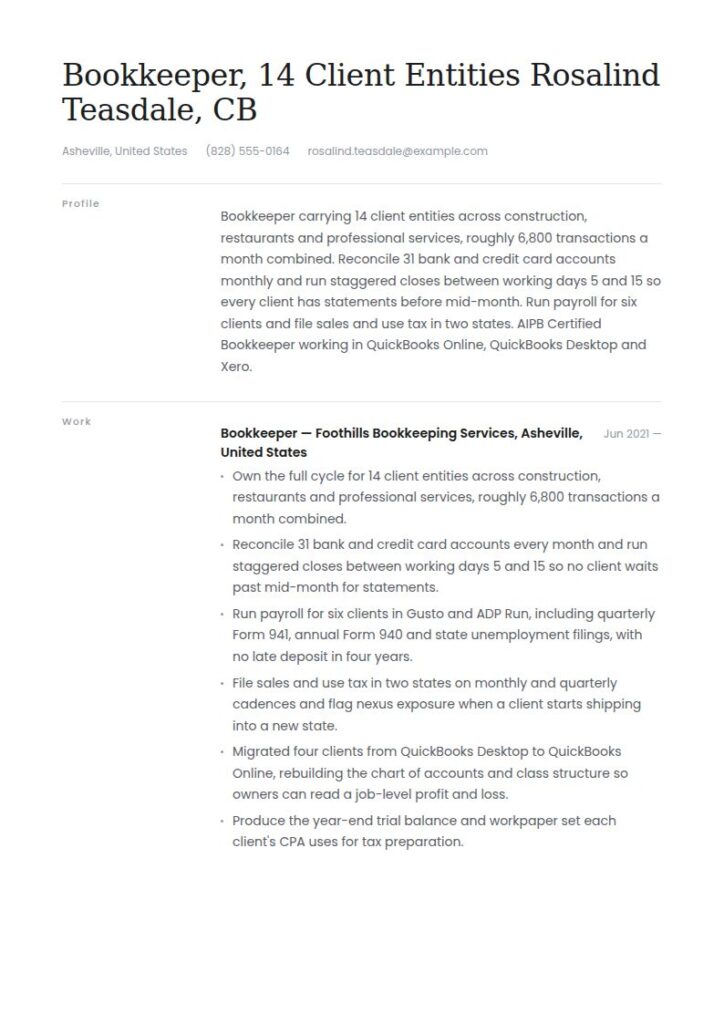
Bookkeeper carrying 14 client entities across construction, restaurants and professional services, roughly 6,800 transactions a month combined. Reconcile 31 bank and credit card accounts monthly and run staggered closes between working days 5 and 15 so every client has statements before mid-month. Run payroll for six clients and file sales and use tax in two states. AIPB Certified Bookkeeper working in QuickBooks Online, QuickBooks Desktop and Xero.
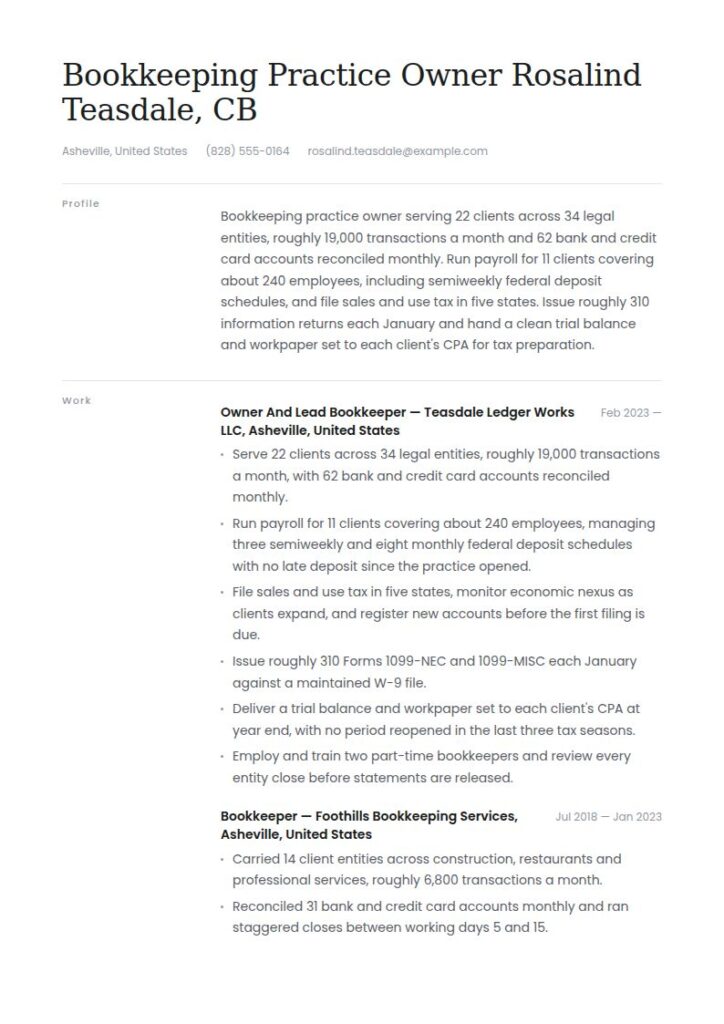
Bookkeeping practice owner serving 22 clients across 34 legal entities, roughly 19,000 transactions a month and 62 bank and credit card accounts reconciled monthly. Run payroll for 11 clients covering about 240 employees, including semiweekly federal deposit schedules, and file sales and use tax in five states. Issue roughly 310 information returns each January and hand a clean trial balance and workpaper set to each client's CPA for tax preparation.
Right vs wrong: the same bookkeeper summary, twice
| ✅ Right | ❌ Wrong |
|---|---|
| Carrying 14 client entities, roughly 6,800 transactions a month combined. | Experienced bookkeeper with a strong client focus. |
| Reconcile 31 bank and credit card accounts monthly and close between working days 5 and 15. | Responsible for month-end close and account reconciliation. |
| Run payroll for six clients and file sales and use tax in two states. | Handle payroll and tax filings as required. |
The right column lets a firm decide in ten seconds whether you can take their book. The left makes them ask, and most will not bother.
Outline your bookkeeper experience
Employer or practice, what it does, the scope you carried, and dates. Then bullets moving from routine to ownership, each with a number or a cadence.
| Instead of | Use |
|---|---|
| Maintained accurate financial records | Owned the general ledger for 14 client entities, roughly 6,800 transactions a month |
| Performed bank reconciliations | Reconciled 31 bank and credit card accounts monthly, with no unreconciled item carried past one cycle |
| Processed payroll | Ran payroll for six clients in Gusto and ADP Run, including quarterly Form 941 and annual Form 940 |
| Handled sales tax | Filed sales and use tax in two states on monthly and quarterly cadences, tracking nexus as clients added states |
| Prepared financial statements | Delivered a profit and loss, balance sheet and aged receivables to each owner by working day 15 |
| Worked with the company CPA | Produced the year-end trial balance and workpaper set the CPA used for tax preparation, with no reopened periods |
Bookkeeper, Foothills Bookkeeping Services, Asheville, NC, June 2021 to Present
Own the full cycle for 14 client entities across construction, restaurants and professional services, roughly 6,800 transactions a month combined.
Reconcile 31 bank and credit card accounts every month and run staggered closes between working days 5 and 15 so no client waits past mid-month for statements.
Run payroll for six clients in Gusto and ADP Run, including quarterly Form 941, annual Form 940 and state unemployment filings, with no late deposit in four years.
File sales and use tax in two states on monthly and quarterly cadences and flag nexus exposure when a client starts shipping into a new state.
Migrated four clients from QuickBooks Desktop to QuickBooks Online, rebuilding the chart of accounts and class structure so owners can read a job-level profit and loss, and produce the year-end trial balance and workpaper set each client's CPA uses for tax preparation.
Build a client and entity table: how many sets of books, on what software, closing when
This is the block that makes a bookkeeper resume unanswerable by the competition, and it exists on almost none of them. A firm hiring a bookkeeper is buying capacity, and needs to know what you can carry before it cares what you know. Put your book on the page as a table, described by industry and size and never by name.
Entities: 14 across 9 clients. Construction and trades (4), full-service restaurants (3), professional services (4), retail (2), nonprofit (1)
Volume: roughly 6,800 transactions a month combined, from 120 to 1,400 per entity
Reconciliation: 31 bank and credit card accounts plus 3 merchant clearing accounts, monthly
Close: staggered working days 5 to 15; every client has a profit and loss, balance sheet and aged receivables before mid-month
Payroll: 6 clients, 3 semiweekly federal depositors and 3 monthly, run in Gusto and ADP Run
Filings: sales and use tax in 2 states, quarterly Form 941 and annual Form 940, roughly 190 information returns each January
Software: QuickBooks Online (9 entities), QuickBooks Desktop Enterprise (3), Xero (2), Bill.com, Dext, Gusto, ADP Run
Three things make this work. Entity count separated from client count, because a client with four LLCs is four sets of books and a firm reading your resume knows it. A volume range rather than a single number, because it shows you know the difference between a quiet entity and a busy one. Close days stated as working days, which is how every accounting firm schedules and is immediately legible to them.
Your deposit schedule says your payroll size without naming a client
Federal payroll deposit frequency is set by rule, not by choice. Under IRS Topic no. 757, an employer that reported $50,000 or less in employment taxes during the lookback period is a monthly schedule depositor, and one that reported more than $50,000 is a semiweekly schedule depositor. Accumulate $100,000 or more of taxes on any day in a deposit period and the deposit is due the next business day (IRS, last reviewed 5 September 2026).
That lets you state your payroll scale precisely without disclosing a single client's numbers. "Three semiweekly depositors and three monthly" tells a firm the size band you work at and that you know which rule applies to whom, which is exactly what goes wrong when a bookkeeper moves up from small clients.
The same trick works elsewhere. Multi-state sales tax, multi-entity consolidation, inventory and job costing, and accrual rather than cash basis are all scope markers a reader can size you by, and none require identifying anyone.
Everything in that table describes your capacity and none of it identifies anybody, which is the point. Client names, client revenue, client payroll totals, client balances and client tax positions do not belong on a resume, in a portfolio or in a cover letter, even when the engagement has ended. Most bookkeeping engagement letters carry a confidentiality clause, and a firm reading a resume that names clients is reading how you will treat theirs.
Build a snapshot of your key skills
Ten to fourteen entries in three groups: the cycle, the filings, and the software. Name editions, not categories.
Full cycle: Accounts payable and receivable, Bank and credit card reconciliation, Merchant and clearing account reconciliation, Month-end close, Accrual and cash basis, Job costing, Inventory and cost of goods sold, Fixed asset schedules
Payroll and filings: Payroll processing, Federal deposit schedules, Form 941 and Form 940, State unemployment, Sales and use tax, Nexus tracking, Forms 1099-NEC and 1099-MISC, W-9 collection
Software: QuickBooks Online, QuickBooks Desktop Enterprise, Xero, Sage 50, Gusto, ADP Run, Bill.com, Dext, Avalara, Microsoft Excel including pivot tables and XLOOKUP
Software is not a footnote in this occupation, it is a filter. A firm running Xero will not shortlist a QuickBooks-only bookkeeper unless nothing better arrives.
List your education and certifications
Bookkeeping is not a licensed occupation. No state board issues a bookkeeper's license, and BLS gives typical entry-level education as some college but no degree, with moderate-term on-the-job training (Occupational Outlook Handbook, published 27 August 2026). The credentials that exist are voluntary, and worth having precisely because so few applicants bother.
The Certified Bookkeeper designation from the American Institute of Professional Bookkeepers requires two years of full-time bookkeeping experience or 3,000 hours part-time or freelance, which may be completed before or after the exam with three years allowed from passing, plus a four-part national certification exam and signing the AIPB Code of Ethics (AIPB, accessed September 2026). The National Association of Certified Public Bookkeepers issues a Certified Public Bookkeeper license requiring agreement to its professional code of conduct and 24 hours of continuing professional education a year from the year after licensure (NACPB, accessed September 2026).
Certified Bookkeeper (CB), American Institute of Professional Bookkeepers, 2022
QuickBooks Online Advanced ProAdvisor, Intuit, current through 2026
Xero Advisor Certified, Xero, 2023
Associate of Applied Science, Accounting, Asheville-Buncombe Technical Community College, Asheville, NC, 2018
One caution about titles. Do not describe yourself as an accountant, a CPA or a public accountant if you are not one. Several states restrict those titles, and a bookkeeper who claims one has created a problem much larger than the job application. "Bookkeeper" and "Certified Bookkeeper" are accurate, defensible and, to a firm that knows the difference, entirely respectable.
Choose the right layout and design
Single column, 11 or 12 point, clear headings, no photograph. The client and entity table is the one place worth a little structure, and even there a plain two-column block inside a single-column page parses better than anything decorative.
Give an entity count and a client count separately. Give transaction volume with a range. State close days as working days. Name the exact software and editions, and say which migrations you have run. State payroll frequency and deposit schedule type. Say which filings you own and on what cadence. List your practice as one employer if you are self-employed.
Do not name a client, or give revenue, payroll or balances that identify one. Do not write "performed month-end close" with nothing attached. Do not list software you last opened in 2019 without saying so. Do not call yourself an accountant or a CPA if you are not one. Do not split a client list into eleven separate job entries. Do not claim you handle tax returns if what you do is prepare the workpapers a CPA files from.
Bookkeeper job market and outlook
A very large occupation in measured decline, with an enormous replacement flow underneath it.
| Measure | Value |
|---|---|
| Bookkeeping, accounting and auditing clerk jobs, 2025 | 1,532,400 |
| Projected change, 2025-35 | -6% (decline), -85,600 |
| Projected annual openings | About 144,100 |
| Typical entry-level education | Some college, no degree |
| Median annual wage, May 2025 | $50,670 |
Source: U.S. Bureau of Labor Statistics, Occupational Outlook Handbook, 2025-35 projections and May 2025 wage data, published 27 August 2026.
BLS publishes no separate profile for bookkeepers. The figures cover bookkeeping, accounting and auditing clerks together, and the projected decline is attributed to software automating many of the tasks the occupation used to consist of.
The demand side is 36 million businesses that cannot afford a controller
The U.S. Small Business Administration's Office of Advocacy counted 36.2 million small businesses in its 2025 Small Business Profiles, accounting for almost 46 percent of private sector employment (SBA Office of Advocacy, 30 June 2025).
Almost none will ever employ a controller. What they have instead is a bookkeeper, in-house or outsourced, and an annual relationship with a CPA. That is the structural reason the occupation keeps hiring 144,100 people a year while shrinking by 85,600 over a decade (BLS, published 27 August 2026).
It also tells you what to write. What automation removes is transaction coding and data capture. What a 12-person construction company still cannot buy from software is judgment: whether that deposit is revenue or a customer advance, whether the card charge is an expense or an owner draw, whether the new state creates a filing obligation. Write the judgment.
What salary you can expect as a bookkeeper
The median annual wage for bookkeeping, accounting and auditing clerks was $50,670 in May 2025, or $24.36 an hour. The lowest 10 percent earned less than $36,000 and the highest 10 percent more than $74,550 (BLS, May 2025).
Industry moves this more than most people expect:
| Industry | Median annual wage (May 2025) |
|---|---|
| Construction | $54,890 |
| Professional, scientific and technical services | $51,880 |
| Wholesale trade | $50,660 |
| Healthcare and social assistance | $49,860 |
| Retail trade | $45,830 |
Source: U.S. Bureau of Labor Statistics, Occupational Outlook Handbook, May 2025.
That is a $9,060 gap between the top and bottom industries on the same list of duties, and it is not random. Construction bookkeeping carries job costing, progress billing, retainage, certified payroll and lien waivers, which is more work than reconciling a retail point of sale.
So write the complexity you carry rather than the hours you work. Multi-entity, multi-state, accrual basis, inventory, job costing and payroll ownership move you up the range. So does a client list, because a bookkeeper who can absorb another entity without a new hire is worth more to a firm than one who cannot.
Key takeaways for a bookkeeper resume
- Put entity count and client count on the page, counted separately.
- Give transaction volume as a range, and reconciliation counts as a number.
- State your close as a working day, not as "month-end close".
- Name every software package and edition, and say what you have migrated.
- Say which payroll and tax filings you own, and on what cadence.
- Use the deposit schedule to state your payroll scale without naming a client.
- Never name a client or put client financial detail on the page.
- Do not call yourself an accountant or a CPA unless you are one.
Build your bookkeeper resume in 15 minutes with our AI resume builder.
Related accounting and finance resume examples
- Accountant resume
- Accounting assistant resume
- Accounts payable resume
- Accounts receivable resume
- Payroll specialist resume
- Payroll manager resume
- Tax preparer resume
- Tax accountant resume
- Staff accountant resume
- Auditing clerk resume
- Accounting entry-level resume
- Accounting and finance resume
Pair it with a matching bookkeeper cover letter.
Bookkeeper resume questions, answered
Do I need a certification to work as a bookkeeper?
No. Bookkeeping is not licensed and BLS gives typical entry-level education as some college but no degree. One is still worth holding because so few candidates have any. The AIPB Certified Bookkeeper designation requires two years of full-time experience or 3,000 hours part-time, a four-part national exam and signing its Code of Ethics (AIPB, accessed September 2026); the NACPB Certified Public Bookkeeper license requires 24 hours of continuing education a year (NACPB, accessed September 2026). A software certification such as an Intuit ProAdvisor credential is a different thing and belongs on its own line.
How do I show client work without naming clients?
Describe each entity by industry, size band and what it required. "Four construction and trades entities, 120 to 1,400 transactions a month, with job costing and certified payroll" carries more useful information than a company name and discloses nothing. Keep client revenue, payroll totals, balances and tax positions off the page entirely.
Should I list QuickBooks on a bookkeeper resume?
Yes, and be specific about which one. QuickBooks Online and QuickBooks Desktop Enterprise are different products with different workflows, and a firm hiring for one will not assume the other. Name any migration you have run between them, and include the peripheral tools, because Bill.com, Dext, Gusto and Avalara appear in listings as often as the ledger itself.
What is the difference between a bookkeeper and an accountant?
Roughly, recording against interpreting. A bookkeeper records transactions, reconciles accounts and produces the statements. An accountant interprets them, applies accounting standards to judgment calls, prepares filings and advises on the result. They are separate BLS occupations with a median wage gap of about $33,000: $50,670 for clerks against $83,680 for accountants and auditors in May 2025. The boundary blurs in a small business where one person does both, which is why your resume should say which parts you actually owned.
How long should a bookkeeper resume be if I carry twenty clients?
Two pages, and put the client and entity table on page one. A long client list is the reason two pages are justified, but only if it is presented as scope rather than as twenty separate jobs. Anything past two pages starts working against you, so compress the earliest roles to a single line each.
What do I put on a bookkeeper resume if I have been self-employed?
List your practice as one employer with a start date and treat the clients as its scope. Give the entity count, the volume, the industries, the software and the filings, then add something showing continuity, such as average client tenure or the number of tax seasons you have handed workpapers to a CPA. Self-employment reads as a gap only when the resume fails to describe it as a business.