Rosalind Teasdale Bookkeeper, AIPB Certified Bookkeeper Asheville, 28801, United States [email protected] · (828) 555-0164
11 September 2026
Mr. Nathaniel Sturdivant Owner Sawtooth Timber Frame Company Asheville, United States
Application for Bookkeeper, Sawtooth Timber Frame Company
Dear Mr. Sturdivant,
I am applying for the bookkeeper position at Sawtooth Timber Frame. I currently carry 14 client entities across construction, restaurants and professional services in QuickBooks Online, QuickBooks Desktop and Xero, about 6,800 transactions a month combined, and I close every one of them between working days 5 and 15 so no owner is waiting past mid-month for statements.
Four of those entities are construction and trades businesses, which is the part of my book that most resembles yours. For those clients I run job costing so each project carries its own labor, materials and subcontractor costs, handle progress billing and retainage receivable, and keep the certified payroll and lien waiver paperwork in order rather than assembled in a panic when a general contractor asks. I also run payroll for six clients across Gusto and ADP Run, including quarterly Form 941 and annual Form 940, and there has not been a late federal deposit on my watch in four years.
A timber frame shop has a specific problem I would want to get to first, which is the gap between when material is bought for a job and when the job is billed. If that is currently running through a single cost of goods sold account, the profit on any individual frame is invisible until the year is over. I would rebuild the chart of accounts and the job structure so you can see margin by project while the project is still open, which is the change my construction clients have valued most.
I am an AIPB Certified Bookkeeper and a QuickBooks Online Advanced ProAdvisor, and I can pick up your books at the start of a month so the first close is clean. Thank you for considering my application.
Sincerely, Rosalind Teasdale
Summary
A bookkeeper cover letter tells the reader how many sets of books you carry, what software you run them on, and what day of the month they will have their statements. This guide gives you a full adaptable letter, what changes when the reader is a business owner rather than an accounting firm, and how to describe client work without putting a client on the page.
Bookkeeper cover letter examples by experience level
A bookkeeper cover letter is a one page letter telling the reader how many sets of books you carry, on what software, and what day of the month they will have their numbers.
Who the reader is changes the letter. An accounting firm reads your entity count as a capacity figure. A small business owner has probably never hired a bookkeeper before, is a little embarrassed about the state of the books, and mostly wants to know whether this will stop being their problem.
Guide to a bookkeeper cover letter
This guide and the corresponding bookkeeper cover letter example will cover:
- How to structure the letter, paragraph by paragraph
- Why the entity count and the software belong in the opening
- What changes when the reader is an owner rather than an accounting firm
- How to write about clients without naming one
- The openings that get a bookkeeper interviewed
How to write a bookkeeper cover letter
| Paragraph | Its job | Length |
|---|---|---|
| Opening | The post, how many sets of books you carry, on what software | 2 to 3 sentences |
| Evidence | One close, one filing responsibility, one number with a period | 4 to 5 sentences |
| Fit | Something specific about their business and what you would take on | 3 to 4 sentences |
| Close | Certification, availability, thank you | 2 sentences |
Lead with capacity and software, in that order
The two questions behind every bookkeeper hire are whether you can carry the work and whether you already know the system it lives in. Answer both in the first three lines and the rest gets read properly.
"I currently carry 14 client entities across construction, restaurants and professional services, in QuickBooks Online, QuickBooks Desktop and Xero" gives a capacity figure, an industry match and three software names a filter is probably looking for.
Then give the close. Not "I perform month-end close", which everyone writes, but the working day the statements land. An owner who has been waiting until the twenty-fifth for last month's numbers will read that sentence twice.
A bookkeeper cover letter example you can adapt
Dear Mr. Sturdivant,
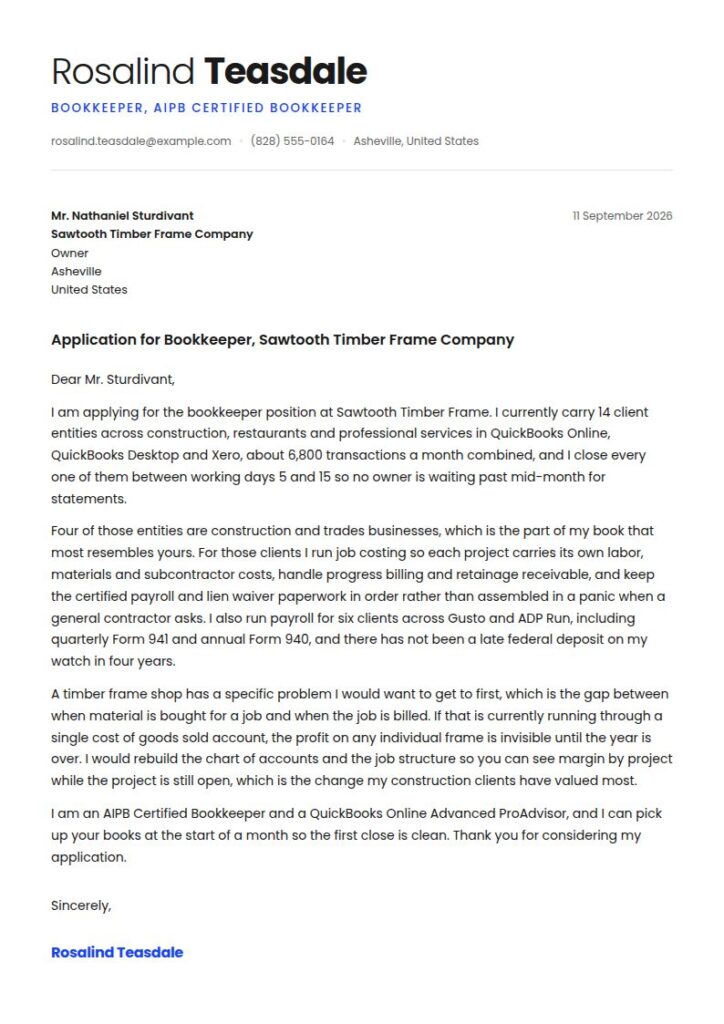
I am applying for the bookkeeper position at Sawtooth Timber Frame. I currently carry 14 client entities across construction, restaurants and professional services in QuickBooks Online, QuickBooks Desktop and Xero, about 6,800 transactions a month combined, and I close every one of them between working days 5 and 15 so no owner is waiting past mid-month for statements.
Four of those entities are construction and trades businesses, which is the part of my book that most resembles yours. For those clients I run job costing so each project carries its own labor, materials and subcontractor costs, handle progress billing and retainage receivable, and keep the certified payroll and lien waiver paperwork in order rather than assembled in a panic when a general contractor asks. I also run payroll for six clients across Gusto and ADP Run, including quarterly Form 941 and annual Form 940, and there has not been a late federal deposit on my watch in four years.
A timber frame shop has a specific problem I would want to get to first, which is the gap between when material is bought for a job and when the job is billed. If that is currently running through a single cost of goods sold account, the profit on any individual frame is invisible until the year is over. I would rebuild the chart of accounts and the job structure so you can see margin by project while the project is still open, which is the change my construction clients have valued most.
I am an AIPB Certified Bookkeeper and a QuickBooks Online Advanced ProAdvisor, and I can pick up your books at the start of a month so the first close is clean. Thank you for considering my application.
Sincerely, Rosalind Teasdale
Openings that work
| Instead of | Use |
|---|---|
| I am an experienced bookkeeper seeking a new opportunity | I carry 14 client entities in QuickBooks Online, QuickBooks Desktop and Xero |
| I have strong attention to detail and organizational skills | I close every entity between working days 5 and 15 |
| I am proficient in accounting software and payroll | I run payroll for six clients in Gusto and ADP Run, with no late federal deposit in four years |
| I would love to help your business grow | Four of my entities are construction and trades, which is the part of my book that resembles yours |
What to say when the reader is the business owner
An accounting firm reads your letter as a capacity assessment. A business owner reads it as relief, or does not.
Owners rarely ask for technical accounting. What they ask, in the words they actually use, is whether payroll will be right, whether the sales tax is filed, and whether they can stop doing this on Sunday nights. Write to those.
| What the owner is asking | The sentence that answers it |
|---|---|
| When do I get my numbers? | Statements by working day 10, every month |
| Will payroll be right? | Payroll for six clients, no late federal deposit in four years |
| Is the tax filed? | Sales and use tax in two states, on monthly and quarterly cadences |
| Can I see whether a job made money? | Job costing so margin is visible while the project is still open |
| What happens at tax time? | A trial balance and workpaper set handed to your CPA, no reopened periods |
| Do I have to explain our system to you? | QuickBooks Online, QuickBooks Desktop and Xero, plus Bill.com and Dext |
The demand behind the job is 36 million businesses
The U.S. Small Business Administration's Office of Advocacy counted 36.2 million small businesses in the United States in its 2025 Small Business Profiles, accounting for almost 46 percent of private sector employment (SBA Office of Advocacy, 30 June 2025). Almost none will ever employ a controller, so the bookkeeper is the finance function.
At the same time BLS projects employment of bookkeeping, accounting and auditing clerks to fall 6 percent from 2025 to 2035, a loss of 85,600 positions, while still projecting about 144,100 openings a year, almost all replacement (BLS Occupational Outlook Handbook, published 27 August 2026).
The letter that wins in that market is not the one claiming to be thorough. It is the one that shows judgment: knowing that a deposit is a customer advance rather than revenue, that a new state creates a filing obligation, that a card charge is an owner draw. Software does the coding now. Write about the decisions.
Writing about clients without naming them
Give entity counts, industries and size bands: four construction and trades entities, 120 to 1,400 transactions a month. Give your own close days, reconciliation counts and filing cadences. Name the software and the peripheral tools. Say what you would look at first in their business, based on what you have seen in that industry.
Do not name a client, present or former. Do not quote a client's revenue, payroll cost, bank balance or tax position. Do not attach a redacted sample set of books. Do not describe a client's dispute with a vendor, a lender or a tax authority. Do not imply you are an accountant or a CPA if you are not, since several states restrict those titles.
Most bookkeeping engagement letters carry a confidentiality clause, and the owner reading yours is working out what you will say about them in two years. Describing a client by industry and size is not coyness; it is the answer.
Length, format and sending it
One page, four paragraphs, 250 to 400 words. PDF, named for yourself and the role: rosalind-teasdale-bookkeeper-cover-letter.pdf.
Address a person. For a small business the owner's name is on the website or the state registration; for a firm it is the practice manager or a partner.
Use the same numbers as your resume. Our bookkeeper resume example is written around the entity count, close days and filings used in the letter above, and a reader who checks one against the other should find no daylight.
Key takeaways
- Open with entity count and software, in that order.
- Give the close as a working day, not as "month-end close".
- Name the filings you own and the cadence they run on.
- Match one industry in your book to the reader's business, and say so.
- Offer one concrete first change, based on what that industry usually gets wrong.
- Write to what an owner actually worries about, not to accounting theory.
- Never name a client or quote a client's numbers.
- One page, named recipient, numbers identical to your resume.
Write your bookkeeper cover letter in 10 minutes with our AI cover letter builder.
Bookkeeper cover letter questions, answered
How long should a bookkeeper cover letter be?
One page, four paragraphs, 250 to 400 words. The reader is usually either a busy owner or a practice manager with a stack of applications, and neither wants a page of adjectives. Four specific numbers will do more than four paragraphs of description.
Should the letter be different for an accounting firm and for a small business?
Yes, substantially. A firm is buying capacity, so lead with entity count, volume, software and the closes you can carry alongside your existing book. An owner is buying relief, so lead with when they get their statements, who handles payroll and tax, and what you would fix first. The facts are the same; the order and the vocabulary are not.
What do I write if I have only ever kept books for one company?
Write that one company properly: the transaction volume, the accounts you reconcile, the working day you close by, the payroll you run, the filings you own, the statements you produce, and the handoff to the CPA at year end. Depth in one set of books is a real qualification and beats a vague claim to have worked with many clients.
Do I mention my certification in the cover letter?
Yes, in the final paragraph, with the issuing body named. The AIPB Certified Bookkeeper designation requires two years of full-time experience or 3,000 hours part-time, a four-part national exam and a signed Code of Ethics (AIPB, accessed September 2026), which most readers do not know, so spell it out rather than using the acronym alone.
Can I say I will save them money?
Only if you name the mechanism. "I will save you money" is unverifiable and reads as sales copy. "Job costing so you can see margin by project while the project is still open" is a specific change with a specific consequence, and the owner can judge what it is worth. Describe the change, not the outcome you are promising.