Sylvie Dufresne Personal Banker, Consumer and Small Business Providence, 02906, United States [email protected] · (401) 555-0129
11 September 2026
Mr. Rutger Voorhees Business Banking Group Seekonk Point Bank Providence, United States
Application for Small Business Banker, Seekonk Point Bank
Dear Mr. Voorhees,
I am applying for the Small Business Banker post at Seekonk Point Bank. At Blackstone Mill Savings Bank I carry 480 households holding $62 million in deposit balances, 61 of them small business operating relationships opened in the last year, and the book is up $8.4 million net new against a $6 million target.
The work I would most want to bring over is how that small business share was built. Our branch had been treating business owners as consumer clients with a second account, so I rebuilt the discovery conversation around the operating cycle: receivables timing, payroll dates, deposit mix and card acceptance. Over two years the small business relationships in my book went from 14 to 61, the analyzed account conversations produced 12 merchant services placements, and attrition in the top 60 relationships held at 3 percent.
Seekonk Point's business banking group is the part of your bank I would be joining, and the two branch markets it covers are the ones I already work. I open operating and analyzed accounts, unsecured personal lending to my authority, cards and merchant services myself. Residential mortgage applications I take at the desk and hand to underwriting, and investment conversations I refer to a licensed representative.
I am a federally registered mortgage loan originator under the SAFE Act, hold unsecured lending authority to $25,000, and my Bank Secrecy Act training is current for 2026. I can start on four weeks' notice. Thank you for your time.
Sincerely, Sylvie Dufresne
Summary
A banker cover letter says which kind of banker you are, how large a book you carry, which products you can open yourself and where the rest of the conversation goes. This guide gives you a full adaptable letter, the openings that work, what you may and may not disclose about your clients, and how the letter changes for a small business desk.
Banker cover letter examples by experience level
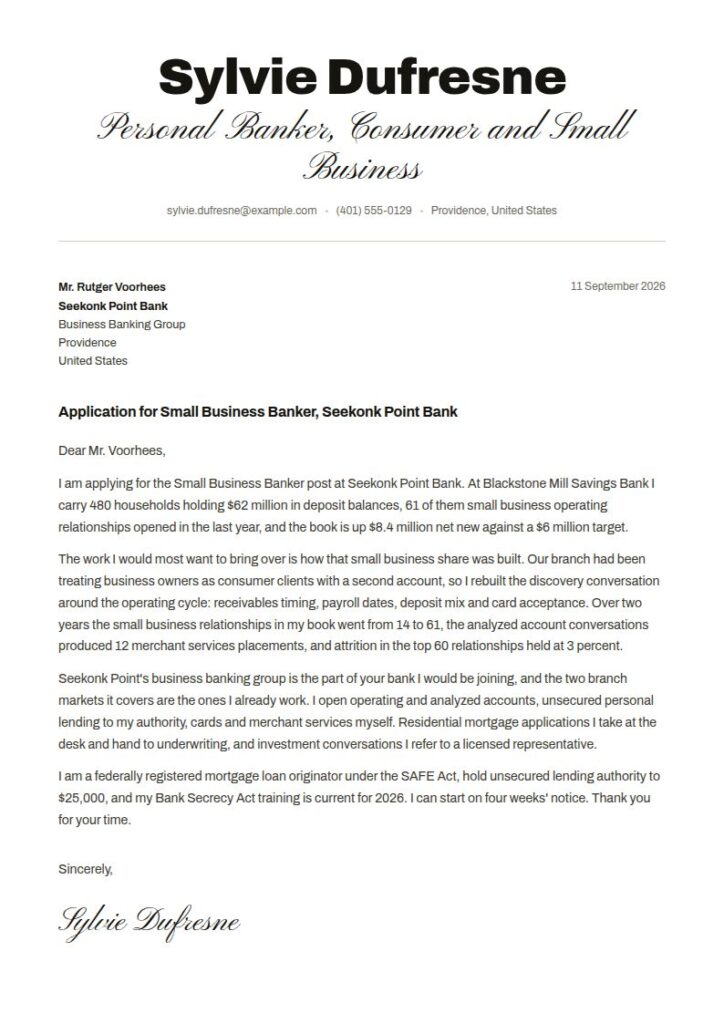
A banker cover letter is a one page letter that tells a hiring manager which of the several jobs called "banker" you actually hold, how big the book is, and what happens when a conversation passes your authority.
It has to do that work because the title will not. A branch desk opening consumer accounts and a small business banker carrying a hundred and twenty commercial relationships can hold the same job title at two banks a mile apart. If your letter does not say which one you are, the reader assumes the smaller one.
Guide to a banker cover letter
This guide and the corresponding banker cover letter example will cover:
- How to structure the letter, paragraph by paragraph
- Why the book belongs in the first three sentences
- What you can and cannot say about clients and production numbers
- How the letter changes for a small business or private client desk
- The openings that get a banker file read to the end
How to write a banker cover letter
| Paragraph | Its job | Length |
|---|---|---|
| Opening | The role, your segment, your book in relationships and balances | 2 to 3 sentences |
| Evidence | One relationship result with a number and a period of time | 4 to 5 sentences |
| Fit | Something specific about their bank, and the product set you bring | 3 to 4 sentences |
| Close | Registrations, lending authority, availability, thank you | 2 sentences |
Lead with the book, not with the years
"Five years of banking experience" tells a hiring manager nothing they can price. Five years at a supermarket branch desk and five years carrying a small business book are different candidates.
Open with what you carry: "I carry 480 households holding $62 million in deposit balances, up $8.4 million net new in the last 12 months." That is one sentence and it fixes your segment, your scale and your direction at once.
Then say what leaves your desk. A reader wants to know if a mortgage conversation stops with you or goes to a lending team, and whether an investment conversation needs a licensed representative. Saying so plainly is a sign of experience, not a limitation.
A banker cover letter example you can adapt
Dear Mr. Voorhees,
I am applying for the Small Business Banker post at Seekonk Point Bank. At Blackstone Mill Savings Bank I carry 480 households holding $62 million in deposit balances, 61 of them small business operating relationships opened in the last year, and the book is up $8.4 million net new against a $6 million target.
The work I would most want to bring over is how that small business share was built. Our branch had been treating business owners as consumer clients with a second account, so I rebuilt the discovery conversation around the operating cycle: receivables timing, payroll dates, deposit mix and card acceptance. Over two years the small business relationships in my book went from 14 to 61, the analyzed account conversations produced 12 merchant services placements, and attrition in the top 60 relationships held at 3 percent.
Seekonk Point's business banking group is the part of your bank I would be joining, and the two branch markets it covers are the ones I already work. I open operating and analyzed accounts, unsecured personal lending to my authority, cards and merchant services myself. Residential mortgage applications I take at the desk and hand to underwriting, and investment conversations I refer to a licensed representative.
I am a federally registered mortgage loan originator under the SAFE Act, hold unsecured lending authority to $25,000, and my Bank Secrecy Act training is current for 2026. I can start on four weeks' notice. Thank you for your time.
Sincerely, Sylvie Dufresne
Openings that work
| Instead of | Use |
|---|---|
| I have over five years of experience in the banking industry | I carry 480 households holding $62 million in deposit balances, up $8.4 million net new this year |
| I am writing to express my interest in the banker position | I am applying for the Small Business Banker post, and I already work the two markets it covers |
| I have a proven track record of exceeding sales goals | The small business relationships in my book went from 14 to 61 over two years |
| I pride myself on building lasting client relationships | Attrition in my top 60 relationships held at 3 percent last year |
| I am familiar with a wide range of banking products | I open operating and analyzed accounts, cards and merchant services; mortgage goes to underwriting |
What counts as evidence in a banker letter
Banks measure bankers differently, so use whichever of these your bank actually tracks. Any one of them, written with a number and a period, beats a paragraph of adjectives.
| Kind of evidence | What it looks like in a sentence |
|---|---|
| Book size | 480 households holding $62 million in deposit balances, average relationship $129,000 |
| Growth | Up $8.4 million net new in 12 months against a $6 million target |
| Segment shift | Small business relationships in the book went from 14 to 61 over two years |
| Product placement | 61 operating accounts and 12 merchant services relationships opened last year |
| Referral pipeline | 88 mortgage referrals, 34 funded for $9.6 million; 46 investment referrals, 19 accounts opened |
| Retention | Attrition in the top 60 relationships held at 3 percent |
| Development | Trained six bankers on the discovery conversation now used market-wide |
What never appears: a client's name, an account number, an individual balance, or anything exported from a bank system. Aggregate production about your own book is normally disclosable; a client list is not, and bringing one to an interview is the fastest way to fail it.
When the desk is small business or private client
Name the segment in your first sentence and match it to the posting. For a small business desk, write the operating cycle work: receivables timing, payroll, deposit mix, card acceptance and analyzed account structuring. For a private client desk, write relationship depth and retention rather than account counts. State your lending authority as a dollar figure, and say what you refer above it. Say whether you are federally registered under the SAFE Act and whether you hold securities registrations.
Do not describe an inherited book as one you built; say which part is which. Do not promise to bring clients with you, which reads as a liability rather than an asset and may breach your agreement. Do not claim a product you have referred rather than placed. Do not use a generic letter for a bank whose segments you have not read. Do not run past one page.
Where the same conversation is paid differently
There is no Occupational Outlook Handbook profile for "banker"; the work is split across published occupations. Securities, commodities and financial services sales agents, where most branch financial services sales work sits, had a median annual wage of $78,660 in May 2025, with 54 percent of employment in credit intermediation, where the median was $61,720 (BLS Occupational Outlook Handbook, May 2025).
Loan officers had a median of $76,690 in the same cycle and are projected to grow 1 percent between 2025 and 2035, with about 17,100 openings a year. Personal financial advisors had a median of $105,070, with the credit intermediation median at $96,010 and the securities and investments median at $120,870 (BLS Occupational Outlook Handbook, May 2025 and 2025 to 2035 projections).
The gap between those numbers is the gap between referring business and keeping it. That is the reason a banker letter should state registrations and authority explicitly: they are how a hiring manager decides which band you belong in, and they will not guess upward.
Length, format and sending it
One page, four paragraphs, 250 to 400 words. PDF unless the portal asks otherwise, named for yourself and the role: sylvie-dufresne-small-business-banker-cover-letter.pdf.
Address a named person where you can. Bank market and branch leadership is usually published, and a named greeting on a letter that already names the segment reads as a candidate who chose this desk.
Keep every figure identical to the ones on your resume. Our banker resume example uses the same book, the same growth number and the same referral volume as the letter here.
Key takeaways
- Say which kind of banker you are in the first sentence, because the title will not.
- Open with the book: relationships, balances and net new growth over a stated period.
- Give one relationship result with a before, an after and a time frame.
- Name what you open yourself and what you refer, as two separate statements.
- State your SAFE Act registration status and your lending authority as a number.
- Never name a client, and never offer to bring a book with you.
- Keep every figure the same as your resume, and keep it to one page.
Write your banker cover letter in 10 minutes with our AI cover letter builder.
Banker cover letter questions, answered
How long should a banker cover letter be?
One page, four paragraphs, 250 to 400 words. Hiring managers in retail banking read these in batches alongside a structured application, and length is not read as effort.
Can I put my production numbers in a cover letter?
Your own aggregate numbers are normally fine: balances under management, net new growth, accounts opened by product family, referral counts and funded volume. What is not fine is anything identifying a client, and nothing exported from a bank system should leave it. If your employment agreement restricts disclosure of internal sales data, use ranges and percentages instead of exact figures. Never offer to bring clients with you; it signals to the reader that you would do the same to them.
Should I say I am not securities licensed?
Yes, if it is true and relevant to the posting. A hiring manager is working out where the boundary of your desk sits, and a candidate who states it plainly reads as experienced. FINRA is the main licensing organization for the securities industry and employers usually sponsor registration after hire (BLS Occupational Outlook Handbook), so an unregistered candidate applying for a role that needs registration should say they are ready to take it rather than leave the question open.
What do I write with no banking experience at all?
Write the work that maps. Cash accountability, identification checking, a sales or service book you were measured on, and any consultative conversation where you had to ask questions before recommending something. Then be explicit about what you know you will need: Bank Secrecy Act training in the first week, SAFE Act registration if the desk takes mortgage applications, and a background and credit check as part of hiring. Bankers are frequently hired out of the teller line, retail management and insurance, and the letter that names the gap and the plan beats the letter that hopes nobody notices.
How do I write the letter if I inherited my book rather than built it?
Split it. Say what you were handed, say what it is now, and say what you did in between. "Took over a book of 390 households at $51 million and grew it to 480 households at $62 million over two years by working the small business segment" is a stronger sentence than either number alone, and it is the sentence a hiring manager is trying to reconstruct anyway.