Simone Attia Consumer Compliance Officer, CRCM Jersey City, 07302, United States [email protected] · (201) 555-0136
11 September 2026
Ms. Natalia Kirsanova Chief Risk Officer Harbor Bend Bancorp Newark, United States
Application for Compliance Officer, Harbor Bend Bancorp
Dear Ms. Kirsanova,
I am applying for the Compliance Officer post at Harbor Bend Bancorp. I currently own Regulations B, C, E, X, Z and DD plus UDAAP at a $4.2 billion FDIC supervised bank, in the second line, reporting to the chief risk officer with a quarterly line to the board audit committee.
The piece of work I would put forward is the testing plan. When I arrived, reviews were ad hoc and mostly reactive. I built a risk-based annual plan of 18 tests on documented samples of 25 to 60 files, each with a written scope, population, sample rationale and conclusion, so that a finding could be defended rather than argued about. Last year it raised 46 findings with 89 percent closed inside their agreed date, and repeat findings across the whole population fell from 34 percent to 9 percent over three years. The HMDA work was the clearest case: a field-level scrub found errors in 4 percent of sampled entries, and the rebuilt process has filed two annual registers since with no resubmission.
One test also produced a lending pattern the business had recorded as three isolated exceptions. I raised it, the business disagreed, and I escalated it to the chief risk officer and then the audit committee, where it was accepted and remediated. I mention it because it is the part of this job that cannot be shown by a certificate.
I hold the CRCM and CAMS designations and am current on both. I would be glad to talk about where your compliance management system sits today and what you want tested first. Thank you for your time.
Sincerely, Simone Attia, CRCM
Summary
A compliance officer cover letter names the regulations you own, the testing you ran against them, what the testing found, and the issue you escalated when the business did not want to hear it. This guide gives you a full adaptable letter, the openings that work, and the disclosure line that keeps confidential supervisory information off the page.
Compliance Officer cover letter examples by experience level
A compliance officer cover letter is a one page letter that proves you have done the work rather than described it. Which rules you own, what you tested, what the testing found, and what you did when the answer was unwelcome.
In practice, the phrase that sinks these letters is "ensured compliance". It appears in almost every application, nobody can check it, and a hiring manager who has read forty of them is looking for the candidate who wrote a sample size instead.
Guide to a compliance officer cover letter
Specifically, this guide and the corresponding compliance officer cover letter example will cover:
- First, how to structure the letter, paragraph by paragraph
- Then, why the regulation inventory belongs in the first two sentences
- Finally, how to write an escalation without naming anyone
- What you may and may not say about an examination
- What to write when you are moving into compliance from the first line
How to write a compliance officer cover letter
| Paragraph | Its job | Length |
|---|---|---|
| Opening | The post, your line, the rules you own, the institution's scale | 2 to 3 sentences |
| Evidence | One test, its scope, what it found, what changed | 4 to 5 sentences |
| Fit | Their regulator, product set or program stage, and what you would take on | 3 to 4 sentences |
| Close | Credential, availability, thank you | 2 sentences |
Lead with scope and scale, not with values
The first two sentences have to answer three questions: which line of defense you sat in, which regulations you owned, and how big the institution was. A second line compliance officer at a $4.2 billion bank and a first line compliance coordinator at a credit union both use the job title accurately, and the reader cannot tell them apart until you say.
So open with something like: "I own Regulations B, C, E, X, Z and DD plus UDAAP at a $4.2 billion FDIC supervised bank, in the second line, reporting to the chief risk officer with a quarterly line to the audit committee." One sentence, and it has placed you exactly.
Everything about integrity and independence is better demonstrated than asserted. The escalation paragraph does that work, so the opening does not have to.
A compliance officer cover letter example you can adapt
Dear Ms. Kirsanova,
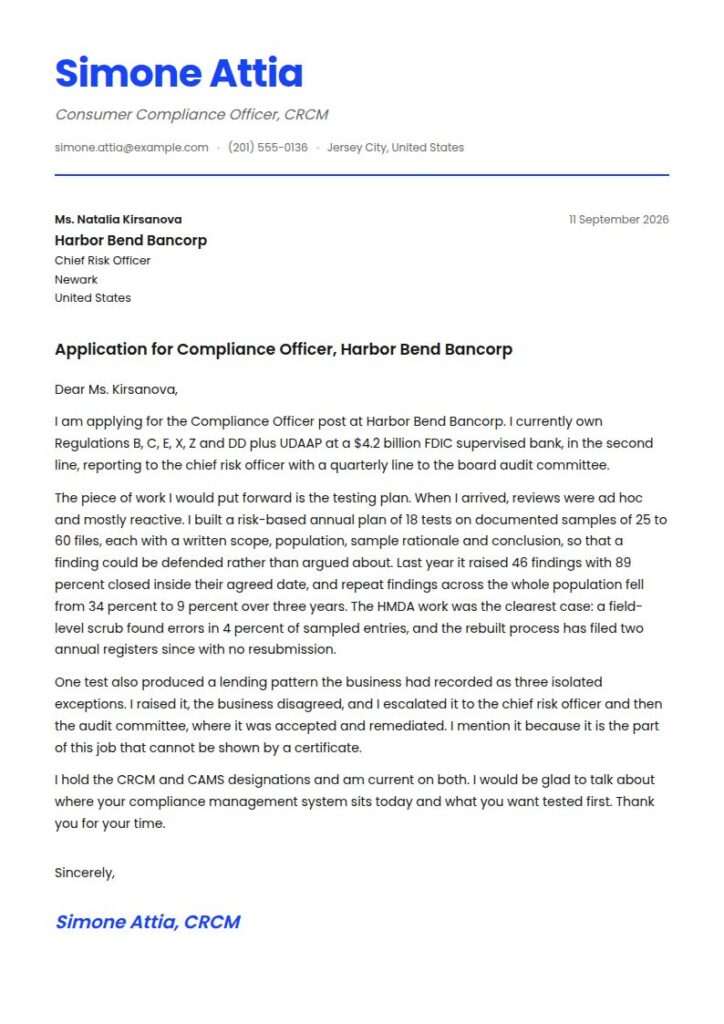
I am applying for the Compliance Officer post at Harbor Bend Bancorp. I currently own Regulations B, C, E, X, Z and DD plus UDAAP at a $4.2 billion FDIC supervised bank, in the second line, reporting to the chief risk officer with a quarterly line to the board audit committee.
The piece of work I would put forward is the testing plan. When I arrived, reviews were ad hoc and mostly reactive. I built a risk-based annual plan of 18 tests on documented samples of 25 to 60 files, each with a written scope, population, sample rationale and conclusion, so that a finding could be defended rather than argued about. Last year it raised 46 findings with 89 percent closed inside their agreed date, and repeat findings across the whole population fell from 34 percent to 9 percent over three years. The HMDA work was the clearest case: a field-level scrub found errors in 4 percent of sampled entries, and the rebuilt process has filed two annual registers since with no resubmission.
One test also produced a lending pattern the business had recorded as three isolated exceptions. I raised it, the business disagreed, and I escalated it to the chief risk officer and then the audit committee, where it was accepted and remediated. I mention it because it is the part of this job that cannot be shown by a certificate.
I hold the CRCM and CAMS designations and am current on both. I would be glad to talk about where your compliance management system sits today and what you want tested first. Thank you for your time.
Sincerely, Simone Attia, CRCM
Openings that work
| Instead of | Use |
|---|---|
| I am a compliance professional with strong ethics and attention to detail | I own Regulations B, C, E, X, Z and DD plus UDAAP at a $4.2 billion FDIC supervised bank |
| I have extensive experience ensuring regulatory compliance | I run 18 risk-based tests a year on documented samples of 25 to 60 files |
| I am skilled at identifying and mitigating compliance risk | 46 findings raised last year, 89 percent closed inside their agreed date |
| I work closely with business units to promote a culture of compliance | Repeat findings fell from 34 percent of the population to 9 percent over three years |
What you may and may not say about an examination
In fact, this is the line that separates a careful compliance candidate from an unsafe one, and hiring managers watch for it.
You may write the fact of an examination, your role in it, and what the institution changed afterwards. However, you may not write the rating, the matters requiring attention, or any content of a supervisory report; examination reports and their component ratings are confidential supervisory information, which the agencies treat as undisclosable.
The exception, however, is the Community Reinvestment Act. Indeed, the FFIEC states that the written CRA performance evaluation "is public information and can be obtained through the institution or its supervisory agency", and the four ratings are outstanding, satisfactory, needs to improve and substantial noncompliance (FFIEC, accessed September 2026). As a result, a public CRA rating can go in a letter. Nothing else from an examination can.
Name the regulations you own and the institution's asset size and primary regulator. Say which line of defense you sat in and who you reported to. Give one test with its scope, sample and finding. Report findings closed on time and the repeat rate. Include one escalation, described as a control failure rather than a case. Say which certification you hold and that you are current.
Do not write "ensured compliance" anywhere. Do not disclose an examination rating, a matter requiring attention or any report content. Do not name a customer, an account, a suspicious activity report or an investigation subject. Do not name the colleague or the business line you escalated against. Do not claim a rule you advised on as one you owned. Do not send a letter with no institution name in it.
Writing the escalation paragraph
In addition, every compliance interview arrives at the same question: tell me about a time the business disagreed with you. Answering it in the letter, in three sentences, is therefore unusual enough that a hiring manager remembers it.
| Write | Do not write |
|---|---|
| What the testing found, stated as a pattern | The customer, the account or the transaction |
| That the business disputed it, and on what grounds | The name or title of the person who disputed it |
| Where you escalated it and what was decided | The examination or audit content that followed |
| What changed in the control afterwards | A claim that you were vindicated |
If your escalation ended with the business overruling you, it is still usable. Write what you raised, where you took it, and what they decided, then stop. Similarly, a candidate who describes the business overruling them without bitterness is demonstrating the judgment the job needs.
The control that finds most fraud is the one people forget to write about
The Association of Certified Fraud Examiners studied 2,402 occupational fraud cases across 143 countries and territories for its 2026 report, involving more than $3.4 billion in losses and a median loss of $104,000 per case. Tips were the most common detection method, at 43 percent of cases (ACFE, Occupational Fraud 2026: A Report to the Nations, May 2026).
The CFPB's Supervision and Examination Manual treats consumer complaint response as one of the four components of a compliance program, alongside policies and procedures, training, and monitoring and audit, under board and management oversight (CFPB, accessed September 2026).
If you own the complaint or whistleblower channel, put it in the letter with numbers: volume, response time, how many items were substantiated and what they changed. Most candidates treat that work as administration, which is why saying otherwise lands.
Moving into compliance from the first line
If you are coming from operations, lending, quality control or a complaint queue, the letter has to do the translation, and the honest version works better than the ambitious one.
Name the regulations your process already sat under, give the volumes you checked and the error rates you found, and say plainly that it was monitoring rather than independent testing. The gap between the two is sampling method and documentation, not subject knowledge, and a hiring manager would rather hear that from you than discover it.
Then say what you are doing about the credential. The American Bankers Association requires either three years of US compliance experience plus two qualifying training options within five years, or six or more years within the last ten with three in the last five, before you can sit the CRCM exam (ABA, accessed September 2026).
Length, format and sending it
One page, four paragraphs, 250 to 400 words. PDF unless the portal specifies otherwise, named for yourself and the post: simone-attia-compliance-officer-cover-letter.pdf.
Use the same figures as your resume. Our compliance officer resume example is written with the numbers used here.
Key takeaways
- First, open with your line of defense, the regulations you own and the institution's scale.
- Then give one test with its scope, sample size and what it found.
- Next, report findings closed on time and the repeat finding rate.
- Also, include one escalation, and describe it as a control failure, never as a case.
- Above all, keep every piece of confidential supervisory information off the page.
- In addition, name the certification you hold, or the eligibility route you are on.
- Finally, never write "ensured compliance", and never address the letter to nobody.
Write your compliance officer cover letter in 10 minutes with our AI cover letter builder.
Compliance officer cover letter questions, answered
How long should a compliance officer cover letter be?
One page, four paragraphs, 250 to 400 words. The persuasion comes from the specificity of one test and one escalation, not from covering every regulation you have met.
Should I really put an escalation in the cover letter?
Yes, in three sentences. The interview will reach the question anyway, and answering it unprompted demonstrates the independence every other letter merely claims. Describe the pattern, the disagreement and the decision, and name nobody.
Can I say my bank passed its last examination?
No. Examination ratings and report content are confidential supervisory information. You can say an examination took place, what your role in it was, and what the institution changed afterwards. The one publishable exception is the Community Reinvestment Act performance evaluation, which the FFIEC states "is public information and can be obtained through the institution or its supervisory agency" (FFIEC, accessed September 2026).
How do I write this letter without banking experience?
Name the rules your industry runs under and write the same structure: what you owned, what you tested, what you found, what changed. Healthcare privacy, export controls, safety and environmental regulation and data protection all use monitoring, testing, findings and remediation. Then be explicit about what you would have to learn, since a candidate who maps their own gap will not overclaim on the job either.
Do I need the CRCM before I apply?
Not before you apply, but say where you stand. The ABA route is either three years of US compliance experience plus two qualifying training options within five years, or six or more years within the last ten with three in the last five, plus the exam (ABA, accessed September 2026). Naming your route beats leaving the reader to guess.