Sinead Falconer Audit Senior, CPA (Colorado) Denver, 80205, United States [email protected] · (303) 555-0135
11 September 2026
Ms. Odile Marchbanks Internal Audit Thornhurst Manufacturing Group Denver, United States
Application for Senior Internal Auditor, Thornhurst Manufacturing Group
Dear Ms. Marchbanks,
I am applying for the Senior Internal Auditor post at Thornhurst Manufacturing Group. I am currently an audit senior at a mid-size public accounting firm, running fieldwork on six engagements a year in construction and wholesale distribution with revenues between $40 million and $310 million, and I hold a CPA license issued by the Colorado State Board of Accountancy.
The part of my work that translates most directly is the testing itself. I own revenue and cutoff, inventory including observation and costing, and the going concern assessment, and I plan the sampling on populations of up to 26,000 items, documenting why a given sample size is sufficient and reconciling every sample back to the population total. Over the last year that testing produced 14 control deficiencies, three of which the engagement partner elevated to significant deficiencies. Most of them sat in the purchase to pay cycle, and each was written up with condition, criteria, cause, effect and a recommendation the client could actually act on. I also review the workpapers of two to four associates on each engagement, and four engagements in five are accepted at manager level on the first pass.
Your posting describes a plan built around procurement, inventory and IT general controls, and the first two are where I have spent most of my last three seasons. I would want to start on inventory, because multi-site counts and costing are where I have found the most in external work and they tend to be where a manufacturer carries the most estimate risk. I would also expect to spend early time reading your risk assessment rather than proposing changes to it.
I hold a CPA license, I am working through the Certified Internal Auditor exams, and I can start with four weeks' notice. Thank you for your time.
Sincerely, Sinead Falconer, CPA
Summary
An auditor cover letter says which audit you do, how big the engagements were, which areas you owned, and what your testing actually found. This guide gives you a full adaptable letter, the openings that work, how the letter changes when you move between external and internal audit, and the confidentiality rule that decides whether the letter survives review.
Auditor cover letter examples by experience level
An auditor cover letter is a one-page letter that answers four questions: which audit you do, how big the work was, which areas you owned, and what you found when you tested them.
In practice, the person reading it is staffing something. For example, an audit manager is filling a slot on engagements the firm has already scheduled; an internal audit director is filling a gap in a plan the audit committee has already approved. Both of them want to know within a paragraph whether they can put you on the work, and neither of them is looking for enthusiasm.
Guide to an auditor cover letter
Specifically, this guide and the corresponding auditor cover letter example will cover:
- First, how to structure the letter, paragraph by paragraph
- Why the size and industry of your engagements belong in the first paragraph
- What counts as evidence when everything you did is confidential
- How the letter changes when you move between external and internal audit
- Then, the openings that keep a reader on a strong file to the end
How to write an auditor cover letter
| Paragraph | Its job | Length |
|---|---|---|
| Opening | The post, the audit you do, the size and industries of your engagements | 2 to 3 sentences |
| Evidence | One area you owned, one piece of testing, one thing it found | 4 to 6 sentences |
| Fit | Something specific about their function, and what you would take on first | 3 to 4 sentences |
| Close | License and credential, availability, thank you | 2 sentences |
Size the work in the first two lines
The single most useful sentence in an audit cover letter is the one that says how big the jobs were.
"Six engagements a year in construction and wholesale distribution, revenues between $40 million and $310 million" tells a manager your scale, your industries and your likely chargeable profile in one clause. It also identifies nobody, which is the other half of the job.
Compare it with "experience auditing a range of clients across multiple industries", which is what most letters open with and which supports no staffing decision at all. If you are internal, size the work the other way: the number of engagements in the plan, the processes covered, and who the function reports to.
An auditor cover letter example you can adapt
Dear Ms. Marchbanks,
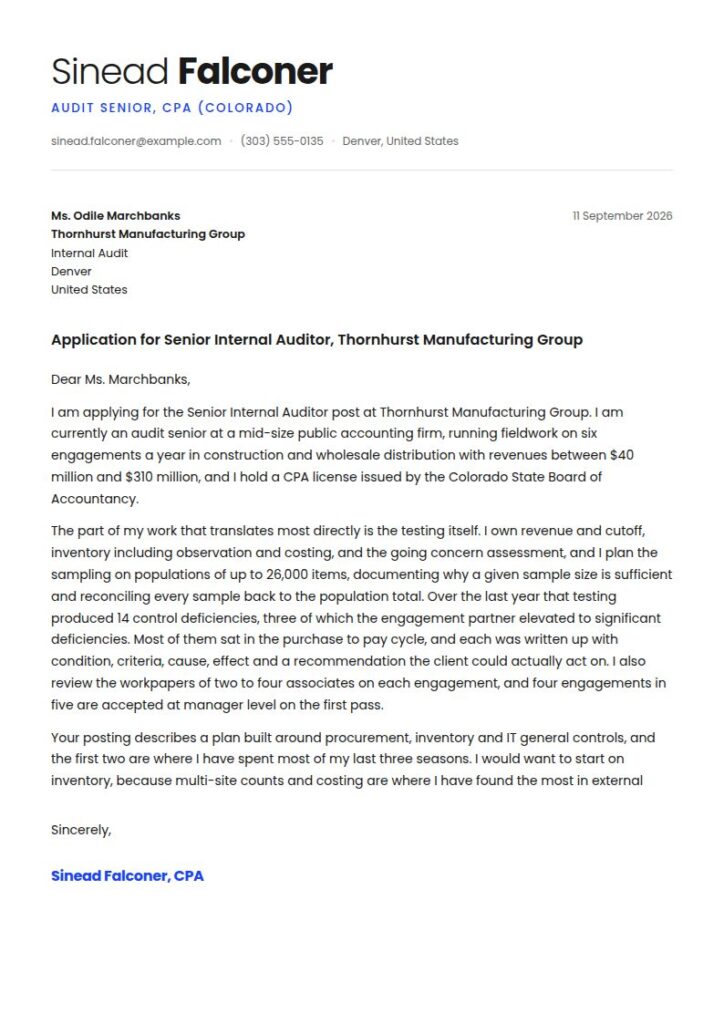
I am applying for the Senior Internal Auditor post at Thornhurst Manufacturing Group. I am currently an audit senior at a mid-size public accounting firm, running fieldwork on six engagements a year in construction and wholesale distribution with revenues between $40 million and $310 million, and I hold a CPA license issued by the Colorado State Board of Accountancy.
The part of my work that translates most directly is the testing itself. I own revenue and cutoff, inventory including observation and costing, and the going concern assessment, and I plan the sampling on populations of up to 26,000 items, documenting why a given sample size is sufficient and reconciling every sample back to the population total. Over the last year that testing produced 14 control deficiencies, three of which the engagement partner elevated to significant deficiencies. Most of them sat in the purchase to pay cycle, and each was written up with condition, criteria, cause, effect and a recommendation the client could actually act on. I also review the workpapers of two to four associates on each engagement, and four engagements in five are accepted at manager level on the first pass.
Your posting describes a plan built around procurement, inventory and IT general controls, and the first two are where I have spent most of my last three seasons. I would want to start on inventory, because multi-site counts and costing are where I have found the most in external work and they tend to be where a manufacturer carries the most estimate risk. I would also expect to spend early time reading your risk assessment rather than proposing changes to it.
I hold a CPA license, I am working through the Certified Internal Auditor exams, and I can start with four weeks' notice. Thank you for your time.
Sincerely, Sinead Falconer, CPA
Openings that work
| Instead of | Use |
|---|---|
| I am writing to express my interest in the auditor position | I am applying for the Senior Internal Auditor post, and I currently run fieldwork on six engagements a year |
| I have experience auditing clients across a range of industries | Construction and wholesale distribution, revenues between $40 million and $310 million, two of them multi-site |
| I have strong knowledge of auditing standards and internal controls | I own revenue, inventory and going concern, and plan sampling on populations up to 26,000 items |
| I am detail oriented and a strong team player | Fourteen control deficiencies raised last year, three elevated to significant deficiencies by the partner |
External to internal, and internal to external
The letter is where you either explain a move between the two audits or leave the reader to guess.
First, moving from external to internal, the translation runs one way: engagements become processes, opinions become recommendations, and the audit committee replaces the shareholder as the reader you are ultimately writing for. Say which processes you have touched, say that you understand the annual plan is approved rather than invented, and name the IIA Global Internal Audit Standards, which took effect on 9 January 2025 and are organized into five domains and 15 principles (The IIA, 16 January 2025).
Moving from internal to external, by contrast, the translation runs the other way: a plan becomes a set of testable populations, and a recommendation becomes evidence supporting a conclusion. Above all, the two things an audit manager will want to see are that you can scope from a risk assessment to a sample, and that you can document the basis for what you concluded.
Say in the first paragraph whether you are an external or an internal auditor. Give the size band and the industries. Name the areas you owned. Give one number from your own testing, with the period attached. Say what you would want to start on and why. Name the license or credential and the body that issued it.
Do not name a client, an audited entity or an engagement. Do not quote a materiality figure or a client balance. Do not write "a Fortune 500 manufacturer in the Denver area", which identifies a company as surely as naming it. Do not describe a finding that could be traced. Do not lead with how much you value integrity; every letter in the folder does.
What counts as evidence in an audit cover letter
Almost everything an auditor does is somebody else's confidential information. That is not a reason to write a letter with no content in it; it is a reason to write about your own work rather than theirs.
| Kind of evidence | What it looks like in a sentence |
|---|---|
| Scale | Six engagements a year, $40 million to $310 million in revenue, two multi-site |
| Areas owned | Revenue and cutoff, inventory including observation and costing, going concern |
| Testing design | Sampling planned on populations up to 26,000 items, with the basis for each sample size documented |
| Detection | Fourteen control deficiencies raised in one year, three elevated to significant deficiencies |
| Review | Workpapers of two to four associates reviewed per engagement, four in five accepted first pass |
| Improvement | Rebuilt the annual risk assessment, moving two-thirds of audit hours onto the highest residual risk processes |
Every row describes the writer. None of them describes an audited organization, which is exactly the test an audit manager applies while reading.
What has to stay out of the letter
One short list, and it is worth checking the letter against it before you send.
No client or entity names. Also, leave out any revenue, margin, balance, adjustment or materiality figure belonging to somebody you audited. No finding described specifically enough to identify the organization it concerned. Likewise, leave out any detail about an investigation, a restatement or a material weakness. No combination of industry, size and geography narrow enough that a reader could work out who you mean.
However, this is not caution for its own sake. A letter that leaks is read as a preview of what you will do with the next employer's information, and in assurance that is the whole of the product.
Documentation quality is what the inspectors look at
Reporting on its 2024 inspections of firms that audit public companies, the Public Company Accounting Oversight Board said the aggregate Part I.A deficiency rate across all inspected firms fell to 39 percent in 2024 from 46 percent in 2023, and that the rate for the four largest US firms fell to 20 percent from 26 percent (PCAOB, 31 March 2025).
A Part I.A deficiency means the file did not show sufficient appropriate evidence for the opinion. It is, in practice, a documentation verdict.
That is why a sentence about how you chose a sample size and reconciled it to the population is worth more in an audit letter than any adjective. It is the thing the reader answers for, and a candidate who volunteers it unprompted is unusual.
Length, format and sending it
In short, one page, four paragraphs, 250 to 400 words. PDF unless the portal says otherwise, named for yourself and the post: sinead-falconer-senior-internal-auditor-cover-letter.pdf.
Address a named person. In practice, audit leadership is usually findable, and "Dear Hiring Manager" on an otherwise precise letter reads as a file sent to twelve firms.
Use the same numbers as your resume so the two agree, and make sure the license line matches exactly. Our auditor resume example is written with the figures used here.
Key takeaways
- Say in the first paragraph whether you are an external or an internal auditor.
- Then size the work: engagements, industries, revenue band, or plan and processes.
- Next, name the areas you owned, and put the judgmental ones first.
- Give one number from your own testing with the period attached.
- Explain a move between the two audits rather than leaving the reader to guess.
- Also, keep every client name, figure and traceable finding out of the letter.
- Finally, name the license or credential and the authority that issued it.
Write your auditor cover letter in 10 minutes with our AI cover letter builder.
Auditor cover letter questions, answered
How long should an auditor cover letter be?
One page, four paragraphs, 250 to 400 words. Audit managers read these between engagements and length does not read as effort. If the letter runs long, it is usually because it is explaining the job rather than the writer.
Can I mention the firm I worked at?
Your own employer, yes: that is your work history, not a confidence. Their clients, no. Naming the firm and then describing the engagements by industry and revenue band is the standard, and it is what a reader expects to see.
What do I write if I have only had one busy season?
Write the season as a job. The number of engagements you were staffed on, the industries, the size band, the areas you owned, how many sampling tests you completed, and how often your work was accepted without rework. A first-year associate who can say "nine engagements, cash and accounts payable and the search for unrecorded liabilities, 41 attribute tests, seven files in ten accepted first pass" is a better prospect on paper than a second-year who wrote "assisted with audit procedures".
Should I mention the CPA if I am not licensed yet?
Yes, as exactly what it is. "Two sections of the Uniform CPA Examination passed, Regulation scheduled March 2027, 150 semester hours completed" is a real qualification and an honest one. Never put CPA after your name before a state board has issued the license.
How do I write to an internal audit function I know nothing about?
Read what is public for twenty minutes: the annual report's audit committee section, any risk factors, the posting itself, and anything the company has said about a system implementation or an acquisition. One accurate sentence about what the function is likely to be dealing with is worth more than a paragraph of admiration, and it is the sentence that cannot be reused in the next letter.