Audit Associate Sinead Falconer
Audit Associate
[email protected] | (303) 555-0135 | Denver, United States
Profile
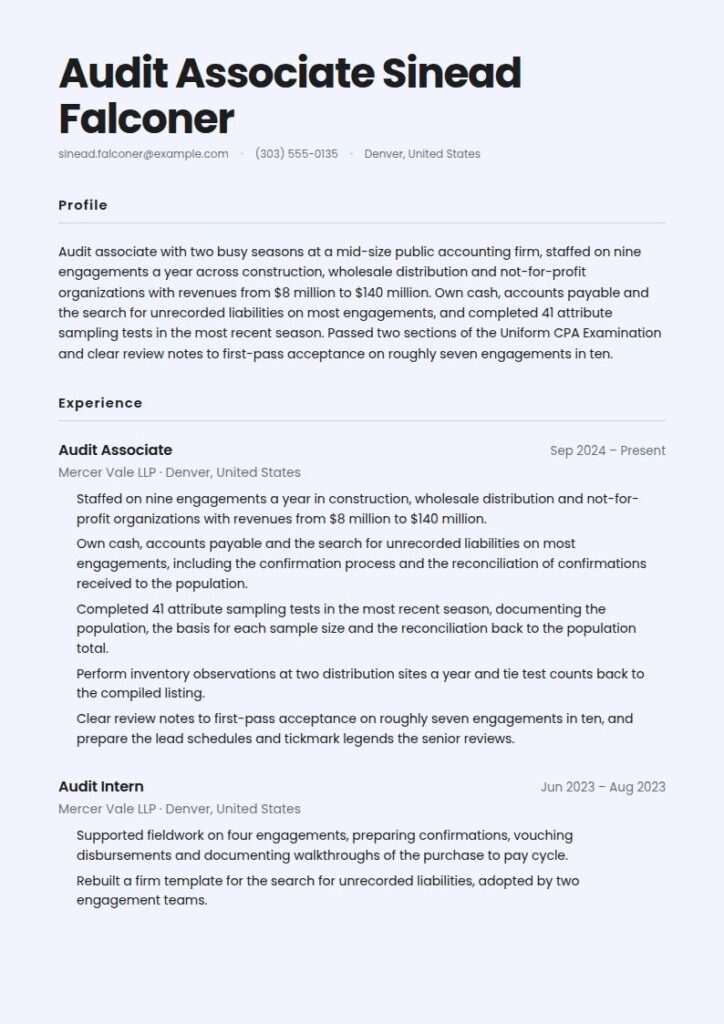
Audit associate with two busy seasons at a mid-size public accounting firm, staffed on nine engagements a year across construction, wholesale distribution and not-for-profit organizations with revenues from $8 million to $140 million. Own cash, accounts payable and the search for unrecorded liabilities on most engagements, and completed 41 attribute sampling tests in the most recent season. Passed two sections of the Uniform CPA Examination and clear review notes to first-pass acceptance on roughly seven engagements in ten.
Work Experience
09/2024 - Present, Audit Associate, Mercer Vale LLP, Denver, United States
- Staffed on nine engagements a year in construction, wholesale distribution and not-for-profit organizations with revenues from $8 million to $140 million.
- Own cash, accounts payable and the search for unrecorded liabilities on most engagements, including the confirmation process and the reconciliation of confirmations received to the population.
- Completed 41 attribute sampling tests in the most recent season, documenting the population, the basis for each sample size and the reconciliation back to the population total.
- Perform inventory observations at two distribution sites a year and tie test counts back to the compiled listing.
- Clear review notes to first-pass acceptance on roughly seven engagements in ten, and prepare the lead schedules and tickmark legends the senior reviews.
06/2023 - 08/2023, Audit Intern, Mercer Vale LLP, Denver, United States
- Supported fieldwork on four engagements, preparing confirmations, vouching disbursements and documenting walkthroughs of the purchase to pay cycle.
- Rebuilt a firm template for the search for unrecorded liabilities, adopted by two engagement teams.
Education
08/2023 - 06/2024, Master of Accountancy, Accountancy, University of Denver, Denver, United States
Coursework in auditing and assurance, advanced financial reporting, fraud examination and accounting information systems. 150 semester hours completed.
08/2019 - 05/2023, Bachelor of Science in Business Administration, Accounting, Colorado State University, Fort Collins, United States
Accounting major with coursework in auditing principles, cost accounting and business law.
Skills
Attribute sampling, 70
Confirmation procedures, 75
Search for unrecorded liabilities, 75
Inventory observation, 65
Workpaper documentation, 80
CaseWare, 70
Microsoft Excel, pivot tables and Power Query, 75
Languages
English, native
Certificates
02/2026, Uniform CPA Examination, Auditing and Attestation and Financial Accounting and Reporting sections passed, Colorado State Board of Accountancy
Two of four sections passed. Regulation scheduled for March 2027. 150 semester hours completed.
Summary
An auditor resume is a one to two page document about assurance: the engagements you were staffed on, the areas you owned, the testing you designed, the workpapers you reviewed and the findings you raised. This guide gives you three adaptable versions, the engagement record that decides these hires, and current Bureau of Labor Statistics pay and outlook.
Auditor resume examples by experience level
An auditor resume is a one to two page document about assurance work: which engagements you were staffed on, which areas you owned inside them, how you decided what to test, whose workpapers you reviewed, and what you found.
Before any of that, the page has to answer one question in its first two lines. Are you an external auditor or an internal auditor? The two jobs share a vocabulary and very little else, and a resume that refuses to pick reads as a person who has not decided either.
It is also a different job from an auditing clerk, who checks figures and postings for accuracy and correct coding inside a process somebody else designed. An auditor decides what evidence would be sufficient, gathers it, and concludes. If your resume could be read as either, the higher-paid reading is the one you lose.
Resume guide for an auditor resume
This guide and the corresponding auditor resume example will cover:
- How to write an auditor resume, section by section
- The external and internal fork, and how the page changes either way
- Three adaptable summaries: associate, senior and internal audit manager
- The engagement record: size, areas owned, sampling, review and findings
- What the job market looks like and what you can expect to earn
How to write an auditor resume
Six blocks: contact header, summary, engagement record, experience, systems and standards, and education and licensure. Pick your side of the fork first, because every later choice follows from it.
| External audit | Internal audit | |
|---|---|---|
| Who employs you | An accounting firm, working across many organizations | The organization you audit |
| What you produce | An opinion on financial statements, or on internal control over financial reporting | Reports to management and to an audit committee |
| The framework you name | Generally accepted auditing standards, or PCAOB standards for public company audits | The IIA Global Internal Audit Standards |
| The credential that helps most | CPA, because signing authority depends on it | Certified Internal Auditor, with CPA common alongside |
| What the resume is sized by | Engagements, client industries and revenue bands | The annual plan, the processes covered and the hours behind them |
BLS describes the two directly. External auditors "review clients' financial statements and inform authorities, investors, and regulators that the statements have been correctly prepared and reported with no material misstatements." Internal auditors are "employed by the organization they are auditing" and "identify ways to improve the processes for finding and eliminating waste, fraud, and other financial risks to the organization." The Handbook names a third strand, IT auditors, who "review controls for their organization's IT systems" (Occupational Outlook Handbook, published 27 August 2026).
| Section | What it is answering | Where it goes |
|---|---|---|
| Engagement record | How big were the jobs, and what did they own on them? | Directly under the summary |
| Experience | What did they test, review and conclude? | Reverse chronological, one number per bullet |
| Systems and standards | Which audit software, which framework, which ERP did they audit inside? | Named, with the framework stated |
| Education and licensure | CPA, CIA, credit hours, or exam progress, dated | Last, explicit rather than implied |
Pick the fork in the header, not in the third paragraph
A reader hiring an audit senior at a firm and a reader hiring an internal audit manager at a manufacturer want opposite evidence, and both decide in about four seconds.
If you are external, the header line carries the level, the industries and the size band: "Audit Senior, construction and wholesale distribution, engagements from $40 million to $310 million in revenue." If you are internal, it carries the plan: "Internal Audit Manager, nine-engagement annual plan, functional reporting to the audit committee."
If you are moving between them, pick the side you are applying to and translate the other deliberately: engagements become processes, and opinions become recommendations somebody had to accept and act on.
Run the finished file through the free ATS checker before you submit. Audit recruiting filters hard on credentials, standards and audit software names, and a two-column template will scramble all three.
Choosing the best resume format for an auditor resume
Reverse chronological, single column, one page for your first two busy seasons and two once you are planning fieldwork or carrying an audit plan. Show promotions inside a firm as separate entries, because associate to senior to manager is the whole story of an audit career and a merged entry hides it. Do not use a functional format: assurance is built on documented sequence, and a resume that removes the sequence is the wrong first impression in the wrong occupation.
Include your contact information
| ✅ Right | ❌ Wrong |
|---|---|
| Sinead Falconer | Sinead Falconer |
| Audit Senior, CPA (Colorado) | Experienced audit professional |
| Construction and wholesale distribution, engagements $40M to $310M revenue | Skilled in GAAS, internal controls and risk assessment |
| (303) 555-0135, [email protected], Denver, CO | (303) 555-0135, [email protected] |
The third line does the work. It states your industries and the size of the jobs you have run before anybody reads a bullet, in a stack where every file claims the same four skills.
Make use of a summary
Four lines: which audit you do, the size and industries of the work, the areas you own, one thing you found or changed.
Audit associate with two busy seasons at a mid-size public accounting firm, staffed on nine engagements a year across construction, wholesale distribution and not-for-profit organizations with revenues from $8 million to $140 million. Own cash, accounts payable and the search for unrecorded liabilities on most engagements, and completed 41 attribute sampling tests in the most recent season. Passed two sections of the Uniform CPA Examination and clear review notes to first-pass acceptance on roughly seven engagements in ten.
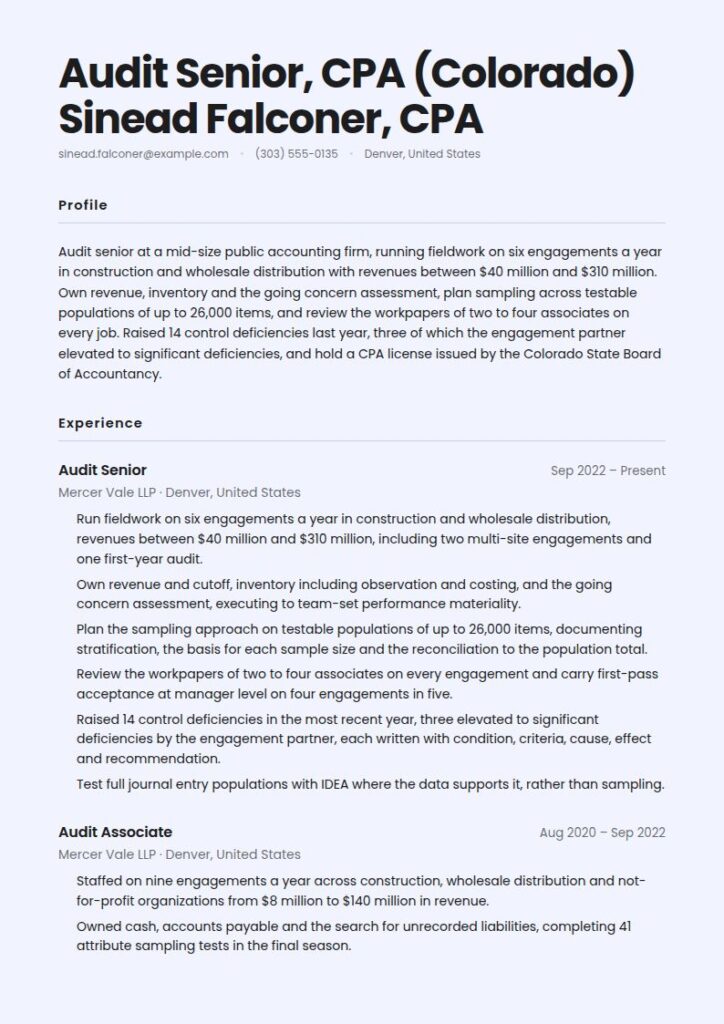
Audit senior at a mid-size public accounting firm, running fieldwork on six engagements a year in construction and wholesale distribution with revenues between $40 million and $310 million. Own revenue, inventory and the going concern assessment, plan sampling across testable populations of up to 26,000 items, and review the workpapers of two to four associates on every job. Raised 14 control deficiencies last year, three of which the engagement partner elevated to significant deficiencies, and hold a CPA license issued by the Colorado State Board of Accountancy.
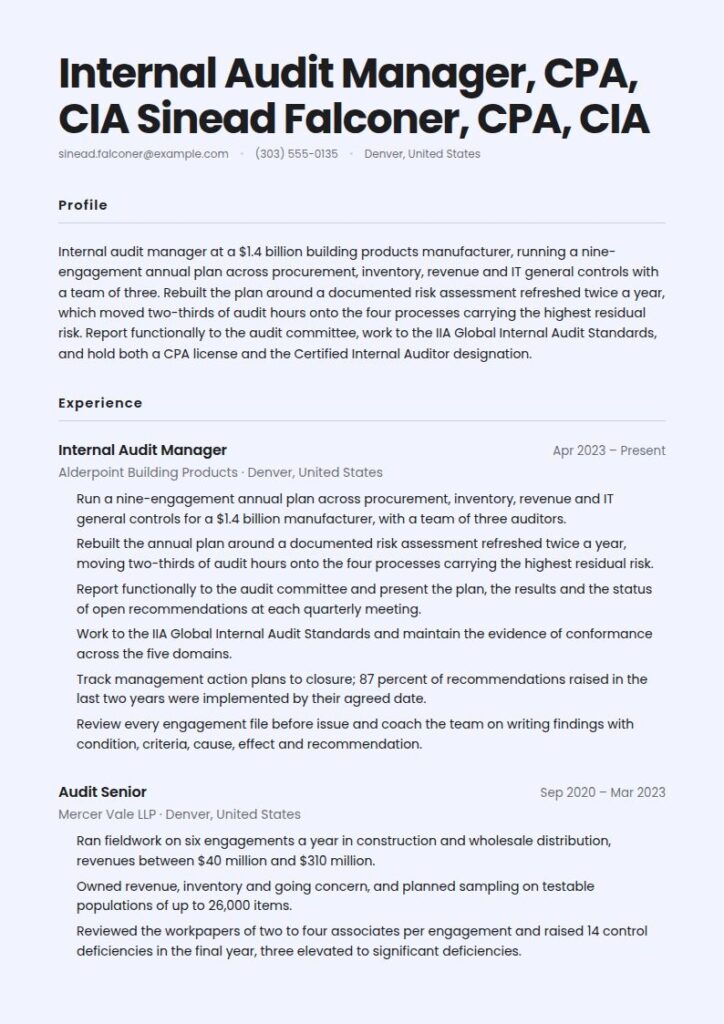
Internal audit manager at a $1.4 billion building products manufacturer, running a nine-engagement annual plan across procurement, inventory, revenue and IT general controls with a team of three. Rebuilt the plan around a documented risk assessment refreshed twice a year, which moved two-thirds of audit hours onto the four processes carrying the highest residual risk. Report functionally to the audit committee, work to the IIA Global Internal Audit Standards, and hold both a CPA license and the Certified Internal Auditor designation.
Right vs wrong: the same auditor summary, twice
| ✅ Right | ❌ Wrong |
|---|---|
| Run fieldwork on six engagements a year, $40M to $310M revenue, construction and wholesale distribution. | Experienced in performing audits for a variety of clients. |
| Own revenue, inventory and going concern; plan sampling on populations up to 26,000 items. | Strong knowledge of auditing standards and internal controls. |
| Raised 14 control deficiencies, three elevated to significant deficiencies by the partner. | Identified opportunities for process improvement. |
The right column can be sized, staffed and interviewed against. The left column is what the other forty files in the stack already said.
Outline your auditor experience
Firm or employer, the industries and size band you worked in, and dates. Then four to six bullets per role, each carrying a number and naming an area, a test or a conclusion.
| Instead of | Use |
|---|---|
| Performed audit procedures | Owned revenue, inventory and going concern on six engagements a year in the $40M to $310M revenue band |
| Tested internal controls | Ran 63 tests of controls over the order to cash and purchase to pay cycles, including 22 attribute samples |
| Reviewed work of staff | Reviewed the workpapers of two to four associates per engagement and cleared review notes before manager review |
| Identified audit findings | Raised 14 control deficiencies in one year, three elevated to significant deficiencies by the engagement partner |
Audit Senior, Mercer Vale LLP, Denver, CO, September 2022 to Present
Run fieldwork on six engagements a year for a mid-size public accounting firm, in construction and wholesale distribution, with revenues between $40 million and $310 million.
Own revenue, inventory and the going concern assessment, and plan the sampling approach on testable populations of up to 26,000 items, including the stratification and the basis for each sample size.
Review the workpapers of two to four associates on every engagement and carry first-pass acceptance at manager level on four engagements in five.
Raised 14 control deficiencies across the last year, three of which the engagement partner elevated to significant deficiencies, each written with condition, cause, effect and recommendation.
Perform the inventory observation on three engagements a year, including two multi-site counts, and trained four incoming associates on what a workpaper has to show before it can be signed off.
Build an engagement record: size, areas owned, sampling and the findings you raised
This is the block that separates an auditor resume from every other accounting resume, and it is missing from almost all of them. Six labeled lines, no prose.
Engagements: 6 a year as senior, 9 a year as associate. Construction and wholesale distribution. Revenue band $40 million to $310 million. Two multi-site, one first-year audit.
Areas owned: revenue and cutoff, inventory including observation and costing, accounts payable and the search for unrecorded liabilities, going concern, and the confirmation process.
Testing: 63 tests of controls across order to cash and purchase to pay. 22 attribute samples. Substantive analytical procedures on gross margin by product line. Full-population testing of the journal entry file with IDEA where the population allowed it.
Sampling approach: populations stratified by value, sample sizes documented against the firm's methodology, every sample reconciled to the population count and total in the workpaper.
Review: workpapers of 2 to 4 associates per engagement, notes cleared before manager review, first-pass acceptance at manager level on 4 engagements in 5.
Findings: 14 control deficiencies raised in the most recent year, 3 elevated to significant deficiencies by the engagement partner, each written with condition, criteria, cause, effect and recommendation.
Size comes first. An engagement count on its own is unreadable; a count with a revenue band and two industries tells a manager whether you have worked at their scale. Use bands, because a band describes you and an exact figure describes somebody else's business.
Areas owned is the part that gets undersold. There is a large difference between having been on an engagement and having owned revenue on it. Name the areas and put the hard ones first: revenue recognition, inventory costing, going concern, estimates, anything with management judgment in it.
Sampling and testing proves you are an auditor rather than a reviewer of other people's schedules. Say how you decided what to test, not only what you tested. The strongest version states the population, the basis of the sample size, and the fact that the sample reconciles to the population, because that is the first thing a reviewer checks and the first thing an inspector checks after them.
Materiality needs one careful sentence. Unless you are a partner you did not set it; you executed to a materiality and a performance materiality the engagement team set, so write it that way. Never publish a materiality figure attached to an identifiable organization.
Review is how a senior proves seniority: the number of preparers, what you review, when notes are cleared, and how often your work is accepted first pass at the level above you.
Findings close the block. Count them, say what happened to them, describe them by type, and leave the organization out.
The client, the finding and the number stay off the page
This is the rule that gets broken most often on audit resumes, and breaking it is the fastest way to lose an offer in a profession built on confidentiality.
Never name a client or an audited entity, never give a client's revenue, margin, balance or adjustment as a figure, and never describe a finding, investigation or restatement alongside enough industry and geography detail to make the organization guessable. The same rule covers internal audit: your employer's control failures are your employer's information, not portfolio material.
What you may write is your own work: engagement counts, industry, a revenue band, areas owned, test counts and sample sizes, deficiencies raised and how many were elevated, and a finding described by type, as "a segregation of duties deficiency in the purchase to pay cycle".
Build a snapshot of your key skills
Twelve to sixteen entries in three groups: audit execution, standards and reporting, and systems. Remove anything true of everyone who has ever been staffed on an engagement.
Audit execution: Risk assessment, Test of controls design, Attribute and monetary unit sampling, Substantive analytical procedures, Inventory observation, Search for unrecorded liabilities, Confirmation procedures, Workpaper review
Standards and reporting: Generally accepted auditing standards, IIA Global Internal Audit Standards, Internal control over financial reporting, Control deficiency evaluation, Audit report and finding writing, Audit committee reporting, Risk and control matrix design
Systems: CaseWare, IDEA, ACL Analytics, SAP S/4HANA and Oracle Fusion Cloud as audited environments, Microsoft Excel including Power Query, Power BI, AuditBoard
Name the audit software and the ERP you audited inside; "audit software" as a phrase matches nothing.
List your education, certifications and license
Licensure is a gate in external audit and a differentiator in internal audit, so it belongs in a labeled block with dates rather than implied by a job title.
BLS records that all states require CPA candidates to complete 150 semester hours of college coursework, 30 more than the usual four-year bachelor's degree, and that CPAs are licensed by their state's Board of Accountancy (Occupational Outlook Handbook, published 27 August 2026). That picture is moving state by state, and the full treatment is on our CPA resume example.
For internal audit, the Certified Internal Auditor is the designation that reads as a commitment. The Institute of Internal Auditors sets a three-part exam and pairs education with experience: a master's degree plus one year of internal audit experience, a bachelor's degree plus two years, and five years by the Internal Audit Practitioner route, with three years from acceptance to complete the requirements (The IIA, accessed 13 September 2026).
Certified Public Accountant, Colorado State Board of Accountancy, license #CO-CPA-0032914, active
Certified Internal Auditor, The Institute of Internal Auditors, 2025
Master of Accountancy, University of Denver, Denver, CO, 2022. 150 semester hours completed.
Bachelor of Science in Business Administration, Accounting, Colorado State University, Fort Collins, CO, 2021
Continuing professional education: current for the reporting period, including audit sampling, fraud risk and information systems controls.
If you are not licensed, write what you hold. "150 semester hours completed, two sections of the Uniform CPA Examination passed, Regulation scheduled for March 2027" is a strong line and an honest one.
Choose the right layout and design
Single column, 11 or 12 point, no graphics, no skills bars. Set the engagement record as labeled lines rather than a paragraph; a manager scans it for the size band and the areas owned and will not read prose to find them.
Say in the header whether you are external or internal. Give engagement counts with an industry and a revenue band. Name the areas you owned, especially the judgmental ones. State how you decided sample sizes and that samples reconcile to the population. Count the deficiencies you raised and say how many were elevated. Name the audit software and the audited ERP. Put the license and its state in the header.
Do not name a client or an audited entity anywhere. Do not publish a client's figures, a materiality amount, or a finding that identifies the organization. Do not claim to have set materiality if you executed to it. Do not describe transaction checking as auditing; that is the auditing clerk job and it pays differently. Do not leave the external and internal question unanswered.
Auditor job market and outlook
BLS publishes no separate profile for auditors; they share the accountants and auditors occupation, so every figure below covers both.
| Measure | Value |
|---|---|
| Accountant and auditor jobs, 2025 | 1,595,200 |
| Projected change, 2025-35 | 5% (faster than average), +79,400 |
| Projected annual openings | About 115,300 |
| Typical entry-level education | Bachelor's degree |
| Median annual wage, May 2025 | $83,680 |
| Lowest 10 percent, May 2025 | Less than $56,020 |
Source: U.S. Bureau of Labor Statistics, Occupational Outlook Handbook, 2025-35 projections and May 2025 wage data, published 27 August 2026.
The fork shows up in the industry table more clearly than anywhere else, so read it as a map of where the two audits live:
| Industry | Share of employment | Median annual wage (May 2025) |
|---|---|---|
| Accounting, tax preparation, bookkeeping and payroll services | 21% | $81,490 |
| Finance and insurance | 8% | $93,290 |
| Government, excluding state and local education and hospitals | 8% | $83,350 |
| Management of companies and enterprises | 6% | $91,940 |
Source: U.S. Bureau of Labor Statistics, Occupational Outlook Handbook, May 2025.
External audit sits almost entirely in the first row, the largest employer in the occupation and the lowest of the four published industry medians. Internal audit sits in the last three: corporate headquarters, banks and insurers, and government. That gap is the arithmetic behind the standard audit career, and it is worth knowing while you write the resume that makes the move.
Documentation quality is inspected, and the numbers are published
The Public Company Accounting Oversight Board inspects registered firms that audit public companies and publishes what it finds. Reporting on its 2024 inspections, the PCAOB said the aggregate Part I.A deficiency rate across all inspected firms fell to 39 percent in 2024 from 46 percent in 2023, that the rate for the four largest US firms fell to 20 percent from 26 percent, and that for the eight annually inspected non-affiliated US firms it held roughly steady at 52 percent (PCAOB, 31 March 2025).
A Part I.A deficiency means the inspectors concluded the firm had not obtained sufficient appropriate evidence to support its opinion. Read from a candidate's side it is a statement about workpapers: whether the file shows what was tested, why that population, why that sample size, and how the conclusion follows. Audit managers hire for that because they are the ones who answer for it.
Internal audit has its own frame of reference. The Institute of Internal Auditors released the Global Internal Audit Standards in January 2024 and they took effect on 9 January 2025, organized into five domains and 15 principles, with all internal audit functions expected to be in conformance (The IIA, 16 January 2025, and The IIA standards page, accessed 13 September 2026). The same announcement put IIA membership above 260,000 globally and more than 200,000 Certified Internal Auditor certifications awarded. Naming the Standards and saying how your function evidences conformance is a better use of two lines than any adjective.
What salary you can expect as an auditor
The median annual wage for accountants and auditors was $83,680 in May 2025, or $40.23 an hour. The lowest 10 percent earned less than $56,020 and the highest 10 percent more than $144,090 (BLS, May 2025).
BLS does not break auditors out from accountants and publishes no separate wage series for external against internal audit, so there is no honest national figure for either and this page will not invent one. Treat the distribution as a range to position yourself inside.
The levers are visible on the page. Licensure, because external signing authority depends on it and many internal audit postings ask for a CPA or a CIA. Industry, because finance and insurance and management of companies pay medians above public accounting. Scale, because a senior running six engagements in the $40 million to $310 million band is doing different work from one running twenty small jobs.
Key takeaways for an auditor resume
- Say in the first two lines whether you are an external or an internal auditor.
- Give engagement counts with an industry and a revenue band, never a client name.
- Name the areas you owned and put the judgmental ones first.
- Show how you decided sample sizes, and say samples reconcile to the population.
- Write materiality as something you executed to, not something you set.
- Count the deficiencies you raised and say how many were elevated.
- State review scope and first-pass acceptance if you are a senior or above.
- Put the CPA or CIA and the issuing authority in the header, or your exam progress.
Build your auditor resume in 15 minutes with our AI resume builder.
Related accounting and finance resume examples
- Internal auditor resume
- Auditing clerk resume
- Accountant resume
- Senior accountant resume
- CPA resume
- Staff accountant resume
- Compliance officer resume
- Tax accountant resume
- Financial analyst resume
- Finance manager resume
- Credit analyst resume
- Accounting and finance resume
Pair it with a matching auditor cover letter.
Auditor resume questions, answered
What is the difference between an auditor and an auditing clerk?
Judgment and conclusion. An auditing clerk checks figures and postings for accuracy and correct coding inside a process someone else designed, which BLS places in the bookkeeping, accounting and auditing clerks occupation at a median wage of $50,670 in May 2025. An auditor designs the testing and reaches a conclusion others rely on, which sits in accountants and auditors at a median of $83,680 (both figures BLS, published 27 August 2026). A resume that describes checking rather than concluding is read as the first job.
Do I need a CPA to work as an auditor?
In external audit it becomes decisive quickly, because signing authority depends on a license and BLS notes that any accountant filing a report with the Securities and Exchange Commission is required to be a licensed CPA (published 27 August 2026). In internal audit it is common but not universal, and the Certified Internal Auditor often does the same work on the page. Write what you hold today and what is scheduled; our [CPA resume example](/resume/cpa/) covers the phrasing at each stage.
How do I describe engagements without naming clients?
By industry, size band and scope. "Six engagements a year in construction and wholesale distribution, revenues from $40 million to $310 million, two multi-site" tells a manager everything they need and identifies nobody. Drop the client name, the exact revenue, the location detail and any finding specific enough to be traced. Managers notice a candidate who does this unprompted, because it is the discipline they need on the job.
Should I put audit findings on my resume?
Your findings, as counts and types, yes. Somebody else's business, no. "Raised 14 control deficiencies, three elevated to significant deficiencies" is your work. "Identified a material weakness in revenue recognition at a regional homebuilder" is guessable, and that is the kind of line that ends an application.
I am moving from external audit into internal audit. What changes?
The unit of work. External experience is described in engagements, opinions and areas; internal audit is described in a plan, processes, risks and recommendations somebody accepted and implemented. Rewrite each bullet so it names a process rather than an engagement, states the risk it addressed, and ends with what management did about it. Then name the IIA Global Internal Audit Standards, because a hiring audit director wants to know you have read the framework you will work to.