Staff Accountant Emiko Yamashita
Staff Accountant
[email protected] | (916) 555-0126 | Sacramento, United States
Profile
Staff accountant in the first year of a food processing company's accounting team, preparing 18 journal entries and 7 balance sheet reconciliations a month across close days 1 to 3 of a six-day close. Responsible for prepaid expenses, the payroll accrual and two bank reconciliations, and prepare 3 of the schedules on the annual audit request list. Items returned by the senior accountant fell from 11 in my first quarter to 4 by the third, after I rebuilt my support files to tie every reconciliation to a system report.
Work Experience
08/2022 - Present, Staff Accountant, Delta Harvest Foods, Sacramento, United States
- Prepare 18 journal entries and 7 balance sheet reconciliations a month on close days 1 to 3 of a six-day close.
- Responsible for prepaid expenses, the payroll accrual, the corporate card clearing account and two operating bank reconciliations.
- Rebuilt my support files so every reconciliation ties to a named system report with reconciling items aged; items returned by the senior accountant fell from 11 in the first quarter to 4 by the third.
- Prepare 3 schedules on the annual audit request list, including prepaid amortisation.
- Write the monthly flux commentary on my assigned accounts for the senior accountant.
06/2021 - 08/2021, Audit Intern, Pinebrook and Tan CPAs, Sacramento, United States
- Prepared confirmations and tie-outs on audit engagements for agricultural processing and light manufacturing clients at a 25-person firm.
- Performed cash and accounts payable search-for-unrecorded-liabilities testing under senior review.
Education
08/2018 - 05/2022, Bachelor of Science, Accountancy, California State University, Sacramento, Sacramento, United States
150 semester hours completed.
Skills
Journal entry preparation, 75
Balance sheet reconciliation, 75
Prepaid and accrual schedules, 70
Bank reconciliation, 80
Support file documentation, 80
Audit schedule preparation, 65
Sage Intacct, 70
Microsoft Excel, XLOOKUP and pivot tables, 80
Languages
English, native
Japanese, native
Certificates
03/2023, FloQast Close Management fundamentals, FloQast
Reconciliation workflow and close checklist administration.
Summary
A staff accountant resume is a one to two page document about assigned work done cleanly: the entries and reconciliations handed to you, the close days you hold, the audit schedules you prepare, and what your reviewer sends back. This guide gives you three adaptable versions, a review record written from the preparer's side, and current Bureau of Labor Statistics pay data.
Staff Accountant resume examples by experience level
A staff accountant resume is a one to two page document about assigned work done cleanly.
That is the honest description of the seat, and writing it honestly is what gets the interview. A staff accountant is the first properly badged accounting job: named entries, named accounts, a slice of the close calendar, and somebody senior checking all of it before it counts. None of that is a criticism, it is the definition of the level, and a resume that tries to sound like a general ledger accountant with fewer accounts reads as a candidate who misunderstood the job.
So write your level precisely. The measure of a good staff accountant is not how much they carry but how little comes back.
Resume guide for a staff accountant resume
This guide and the corresponding staff accountant resume example will cover:
- How to write a staff accountant resume, section by section
- The assignment and review record, written from the preparer's side
- Three adaptable summaries: first year, established, and staff accountant covering a second entity
- What to say about a credential you have not finished
- What the job market looks like and what you can expect to earn
How to write a staff accountant resume
Six blocks: contact header, summary, assignment and review record, experience, systems, and education and credentials. One page for the first two years, two once you carry a second entity or train somebody.
| Section | What it is answering | Where it goes |
|---|---|---|
| Assignment and review record | What was handed to them, and how much of it comes back? | Directly under the summary |
| Experience | What did they prepare, and what did they make easier? | Reverse chronological, one number per bullet |
| Systems | Which ERP and which close tool, and at what depth? | Named products and modules |
| Education and credentials | Degree, credit hours, exam progress with dates | Last, brief, and specific |
Write from the preparer’s side, and say what came back
Each accounting level has a grammar of its own. A senior accountant writes about review; an accounting manager writes about owning the whole close. A staff accountant writes about preparation, and the strongest preparation sentence reports what happened to the work afterwards.
"Prepare 14 balance sheet reconciliations a month for senior review, with about 3 items returned a month, down from 11 in my first quarter" beats any volume figure on its own. It says the work is checked, how good it is, and that it improved, so a controller knows what your first six months would cost them.
Almost nobody has been told their return rate, so ask your reviewer or count it yourself for two months. If it has never been measured, the next best version is a support file standard: every reconciliation ties to the statement or system report behind it, with reconciling items aged and named. A reviewer recognizes that claim instantly.
Run the file through the ATS resume checker before you submit, since ERP and close tool names are a hard filter on these postings.
Choosing the best resume format for a staff accountant resume
Reverse chronological, single column. One page for the first two years, two once you carry a second entity, prepare a long audit list or train somebody.
Keep any earlier accounting support role as its own entry rather than folding it into the staff accountant line. A year in accounts payable or as an accounting assistant is an asset here: it means you know where the subledger data comes from, which is why your accruals beat a graduate hire's.
Include your contact information
| ✅ Right | ❌ Wrong |
|---|---|
| Emiko Yamashita | Emiko Yamashita |
| Staff Accountant, close days 1 to 4 | Accounting professional with GAAP expertise |
| 31 entries and 14 reconciliations a month, Sage Intacct and FloQast | Skilled in journal entries, reconciliations and month-end close |
| (916) 555-0126, [email protected], Sacramento, CA | (916) 555-0126, [email protected] |
The third line is the fastest scope statement available to you. Volume, close position and systems in eleven words, and a controller can place you against their open seat before reading a bullet.
Make use of a summary
Four lines: your close days, the entries and reconciliations assigned to you, one account with judgment in it, and what you improved or what your return rate is.
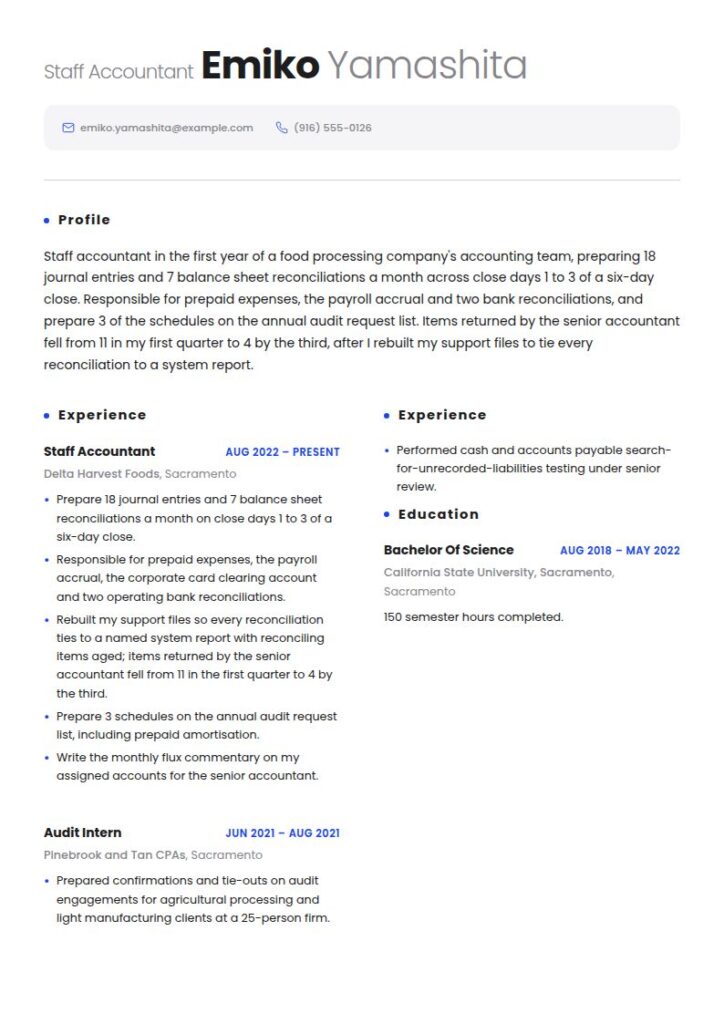
Staff accountant in the first year of a food processing company's accounting team, preparing 18 journal entries and 7 balance sheet reconciliations a month across close days 1 to 3 of a six-day close. Responsible for prepaid expenses, the payroll accrual and two bank reconciliations, and prepare 3 of the schedules on the annual audit request list. Items returned by the senior accountant fell from 11 in my first quarter to 4 by the third, after I rebuilt my support files to tie every reconciliation to a system report.
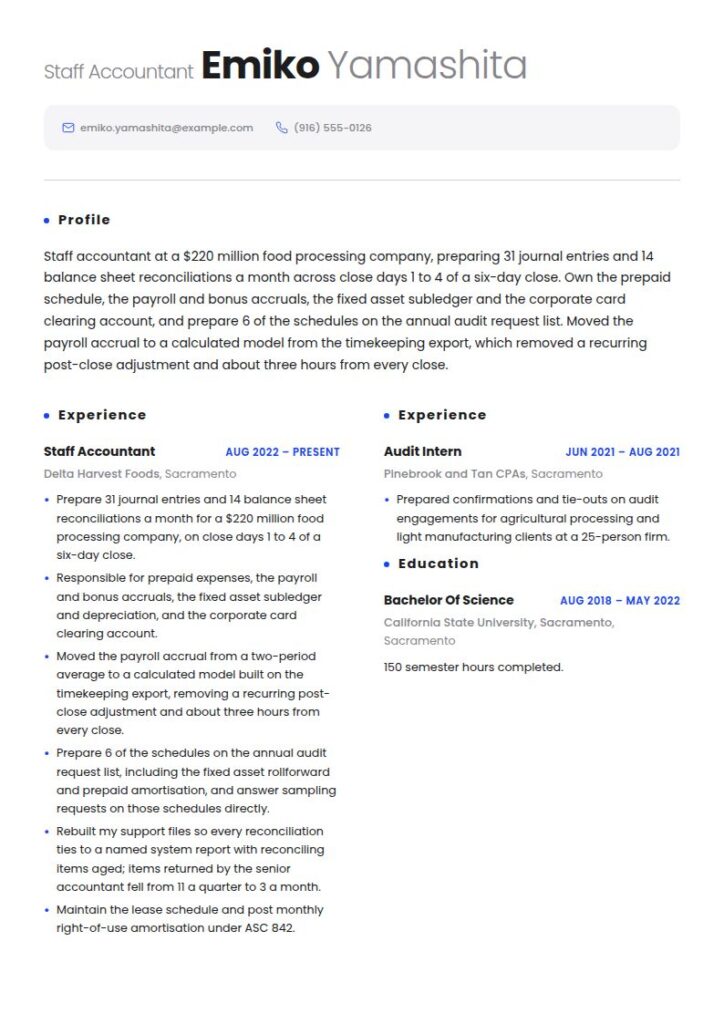
Staff accountant at a $220 million food processing company, preparing 31 journal entries and 14 balance sheet reconciliations a month across close days 1 to 4 of a six-day close. Own the prepaid schedule, the payroll and bonus accruals, the fixed asset subledger and the corporate card clearing account, and prepare 6 of the schedules on the annual audit request list. Moved the payroll accrual to a calculated model from the timekeeping export, which removed a recurring post-close adjustment and about three hours from every close.
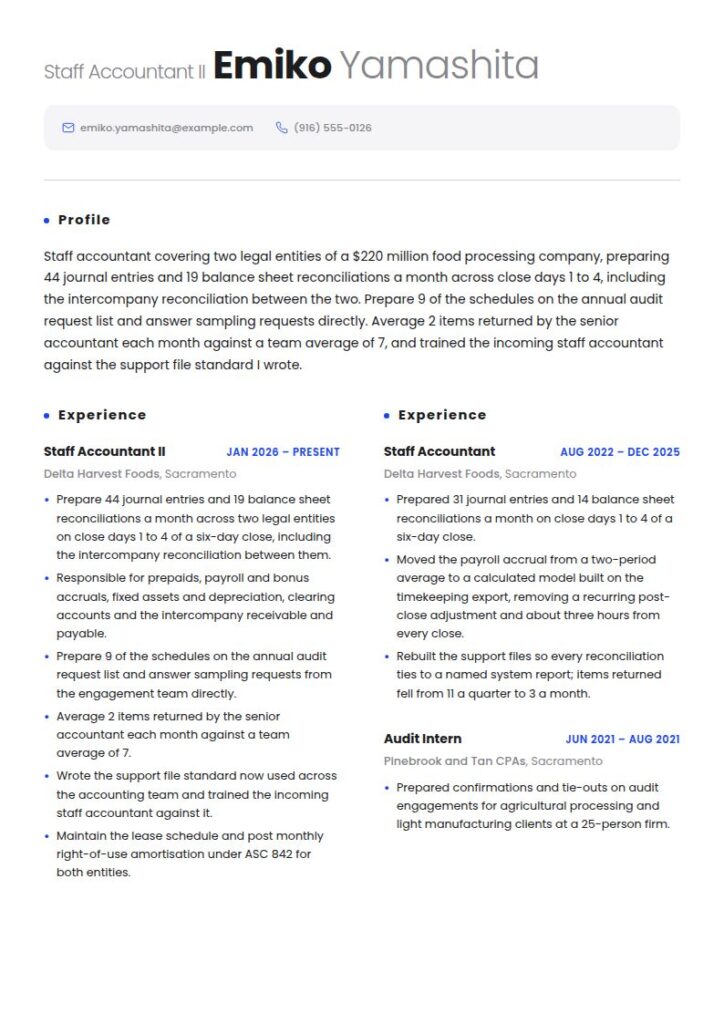
Staff accountant covering two legal entities of a $220 million food processing company, preparing 44 journal entries and 19 balance sheet reconciliations a month across close days 1 to 4, including the intercompany reconciliation between the two. Prepare 9 of the schedules on the annual audit request list and answer sampling requests directly. Average 2 items returned by the senior accountant each month against a team average of 7, and trained the incoming staff accountant against the support file standard I wrote.
Right vs wrong: the same staff accountant summary, twice
| ✅ Right | ❌ Wrong |
|---|---|
| Prepare 31 journal entries and 14 balance sheet reconciliations a month across close days 1 to 4. | Perform month-end close activities including journal entries and reconciliations. |
| Own the prepaid schedule, payroll and bonus accruals, fixed assets and the corporate card clearing account. | Responsible for various balance sheet accounts. |
| Average 2 items returned by the senior accountant a month against a team average of 7. | Recognized for accuracy and attention to detail. |
The right column describes the level accurately and proves quality inside it. The left tries to sound bigger and ends up sounding like nothing, which is the standard way this resume fails.
Outline your staff accountant experience
Employer, what it makes or does, its size, the entities you cover, and dates. Then four or five bullets per role, each with a number, and at least one about something that is different because you were there.
| Instead of | Use |
|---|---|
| Prepared journal entries | Prepare 31 journal entries a month, 22 recurring and 9 manual, on close days 1 to 4 |
| Reconciled balance sheet accounts | Prepare 14 balance sheet reconciliations a month including prepaids, payroll accrual, fixed assets and card clearing |
| Assisted with month-end close | Hold close days 1 to 4 of a six-day close: accruals day 1, prepaids and fixed assets day 2, clearing accounts day 3, reconciliations to the senior day 4 |
| Supported the external audit | Prepare 6 schedules on the annual audit request list, including the fixed asset rollforward and the prepaid amortisation schedule |
| Worked with the senior accountant | Average 3 items returned a month for correction, down from 11 in my first quarter |
| Improved a process | Moved the payroll accrual to a calculated model from the timekeeping export, removing a recurring post-close adjustment |
Staff Accountant, Delta Harvest Foods, Sacramento, CA, August 2022 to Present
Prepare 31 journal entries and 14 balance sheet reconciliations a month for a $220 million food processing company, on close days 1 to 4 of a six-day close.
Responsible for prepaid expenses, the payroll and bonus accruals, the fixed asset subledger and depreciation, and the corporate card clearing account.
Moved the payroll accrual from a two-period average to a calculated model built on the timekeeping export, which removed a recurring post-close adjustment and about three hours from every close.
Prepare 6 of the schedules on the annual audit request list, including the fixed asset rollforward and the prepaid amortisation schedule, and answer sampling requests on those schedules directly.
Rebuilt my support files so every reconciliation ties to a named system report with reconciling items aged; items returned by the senior accountant fell from 11 a quarter to 3 a month.
Wrote the support file standard the incoming staff accountant is trained against.
None of those bullets claims to own the close, sign anything off or conclude on a standard. They claim preparation at a stated volume with a stated quality, plus one improvement. That is what the seat is, and a controller hiring for it is relieved to read so.
Show your assignment list and what happens to your work after you hand it in
Here is the block this page exists for, and it is the mirror image of the one on a senior accountant resume. A senior writes about the work they receive and check. A staff accountant writes about the work they were given and what came back.
Assigned entries: 31 a month, 22 recurring and 9 manual, on close days 1 to 4 of a six-day close.
Assigned reconciliations: 14 balance sheet accounts, monthly. Prepaid expenses, payroll accrual, bonus accrual, fixed assets and accumulated depreciation, corporate card clearing, payroll clearing, two operating bank accounts, customer deposits.
Close days I hold: day 1 accruals and cutoff support. Day 2 prepaids, fixed assets and depreciation. Day 3 clearing accounts and bank reconciliations. Day 4 reconciliation package to the senior accountant.
Audit schedules I prepare: 6 on the annual request list, including the fixed asset rollforward, prepaid amortisation and the accrual substantiation for payroll and bonus.
Support file standard: every reconciliation ties to a named system report or statement, reconciling items are aged and named, and anything over 60 days carries a written explanation.
Review: prepared for the senior accountant. Average 3 items returned a month for correction, down from 11 in my first quarter, and returned before close rather than after.
What I take to my reviewer rather than decide: any accrual estimate changing by more than 20 percent month on month, any asset near the capitalisation threshold, any reconciling item over 90 days, and any cutoff question at quarter end.
The assignment list is a scope statement without an overclaim. It says what was handed to you and by implication what was not, which is the fastest way to be read at the right level. Vagueness gets you screened against seats you cannot hold and seats you are overqualified for.
The return rate is the quality measure this level has. Nobody can evaluate a staff accountant's judgment from a resume, because the judgment is still supervised. What they can evaluate is how clean the work arrives. If yours improved, give the before and the after; an improving preparer is what a senior accountant most wants to hire.
The support file standard travels. Every team has a different reconciliation template and the same underlying expectation: tie to a source, age the open items, explain the old ones. Stating your standard tells a reviewer their first month with you will be quiet.
The escalation line shows judgment without claiming authority. Four specific things you take upstairs proves you know where your competence ends, which is the quality that gets a staff accountant promoted, and it gives the interviewer somewhere to go.
Say what you prepare, not what the team concludes
The commonest overclaim on this resume is the technical one. Somebody maintains a lease schedule and writes that they applied ASC 842. Somebody pulls the data for a revenue memo and writes that they concluded on ASC 606 variable consideration.
Both are found out in the second interview question, and the cost is disproportionate because the underlying work was genuinely good. Maintaining a lease schedule and posting monthly right-of-use amortisation is respectable staff accountant work, worth a line of its own.
The wording that holds up is procedural. "Maintain the lease schedule and post monthly right-of-use amortisation under ASC 842" claims exactly what you did, and so does "prepared the data set supporting the annual revenue recognition memo". To signal ambition, name what you want to move toward rather than inflating what you have already done.
Build a snapshot of your key skills
Twelve to sixteen entries in three groups: the cycle, the systems, and the controls and reporting. Remove anything that is equally true of an accounting assistant.
Cycle: Journal entry preparation, Balance sheet reconciliation, Prepaid and accrual schedules, Fixed assets and depreciation, Bank reconciliation, Clearing account management, Intercompany reconciliation, Audit schedule preparation
Systems: Sage Intacct, NetSuite, FloQast, Microsoft Excel including Power Query, XLOOKUP and pivot tables, ADP Workforce Now reporting, Bill.com
Controls and reporting: US GAAP, Support file documentation, Reconciling item ageing, Monthly flux commentary on assigned accounts, Fixed asset rollforward, Lease schedule maintenance under ASC 842, SOX walkthrough support
Name the close tool as well as the ERP. FloQast and BlackLine say you have worked somewhere with a disciplined reconciliation process, which at this level is a statement about habits rather than software.
List your education and certifications
A bachelor's degree is the typical entry-level education for accountants and auditors, with no related work experience and no on-the-job training recorded for the occupation (Occupational Outlook Handbook, published 27 August 2026). So the degree is the gate and everything after it is optional at this level, which makes this section short.
Bachelor of Science, Accountancy, California State University, Sacramento, Sacramento, CA, 2022. 150 semester hours completed.
Uniform CPA Examination: two of four sections passed, most recent February 2026. Remaining sections scheduled for 2027.
Certifications: Sage Intacct Certified Accounting Associate, Sage, 2024. FloQast Close Management fundamentals, 2023.
Continuing education: Lease accounting refresher, 2025. Fixed asset and capitalisation policy workshop, 2024.
State exam progress with a number and a date, or leave the whole subject out. "Actively pursuing the CPA" has been on resumes for twenty years and reads as nothing; "two of four sections passed, most recent February 2026" reads as a person with a plan. Whether the license is worth pursuing at all, and the 150-hour and pathway rules behind it, is covered in full on our senior accountant resume example and our CPA resume example.
Choose the right layout and design
Single column, 11 or 12 point, no photograph, no graphics. Set the assignment and review record as labeled lines rather than a paragraph, because the reader scans for account names and for the close days.
State your close days as working days and say which are yours. Count your entries and split recurring from manual. Name the accounts you reconcile, especially prepaids, accruals and fixed assets. Say how many audit schedules you prepare. Give a return rate, or a support file standard if nobody measures returns. Name the ERP and the close tool. Put exam progress in numbers with a date.
Do not claim to own the close; you hold days inside it. Do not write "assisted with month-end close" and stop. Do not claim a standard you worked inside but did not conclude on. Do not describe yourself as a senior accountant because the volume feels similar; the difference is review, not size. Do not publish a former employer's unreleased figures, and do not name a client if you came in from public accounting.
Staff accountant job market and outlook
The Bureau of Labor Statistics publishes no separate profile for staff accountants. The title is the first rung inside the accountants and auditors occupation, so the published figures cover everyone from a first-year preparer to a specialist with twenty years in.
| Measure | Value |
|---|---|
| Accountant and auditor jobs, 2025 | 1,595,200 |
| Projected change, 2025-35 | 5% (faster than average), +79,400 |
| Projected annual openings | About 115,300 |
| Typical entry-level education | Bachelor's degree |
| Work experience in a related occupation | None |
| Median annual wage, May 2025 | $83,680 |
| Lowest 10 percent, May 2025 | Less than $56,020 |
Source: U.S. Bureau of Labor Statistics, Occupational Outlook Handbook, 2025-35 projections and May 2025 wage data, published 27 August 2026.
The last row matters most here. The published median covers the whole occupation, including people three promotions above you, so it describes a destination rather than a position. The lowest decile is the better anchor, and the distance between the two is what a staff accountant career is for. The row above it explains the competition: BLS records no related work experience requirement, which is why this is the seat companies fill from graduates and from accounting support roles.
Firms are still hiring at the bottom of the ladder
The AICPA's 2025 Trends report found that public accounting firms hired 11,985 new graduates in 2024, 75 percent of them accounting graduates, and that three quarters of surveyed firms expected to add a similar number of staff or more in the following year, with only 18 percent anticipating lower hiring (AICPA, 27 October 2025).
Set that against the federal projections. About 115,300 openings a year are projected for accountants and auditors against a 2025 employment level of 1,595,200, so the occupation rehires roughly seven percent of itself each year, while net employment grows by only 79,400 across the whole decade (BLS, published 27 August 2026).
Movement at this level is normal and frequent, and you will be compared against candidates who look like you on paper. Two seats with the same title differ in entries, accounts, close days and whether work is reviewed before or after close, and only your resume can say which version you have been doing.
Where these seats concentrate: accounting, tax preparation, bookkeeping and payroll services employs 21 percent of the occupation at a median of $81,490, and management of companies and enterprises 6 percent at $91,940 (BLS, May 2025). The first is public accounting, where most staff accountant titles begin. The second is corporate headquarters, where multi-entity work and the closes that need it sit.
What salary you can expect as a staff accountant
The median annual wage for accountants and auditors was $83,680 in May 2025, or $40.23 an hour, with the lowest 10 percent earning less than $56,020 and the highest 10 percent more than $144,090 (BLS, May 2025).
Because BLS does not break the occupation down by seniority, read that distribution as a range to move through rather than a number to quote. The lower part of it is where the title sits, and three things move you up within a couple of years: a second entity, an account area with real judgment in it such as accruals or fixed assets, and a clean review record that makes a promotion easy to justify. All three can be stated on a resume, which is the point of the assignment and review record, and a title conveys none of them.
Key takeaways for a staff accountant resume
- Write preparation, not ownership; the level is defined by review, not by volume.
- Give your assignment list: entries split recurring and manual, accounts named.
- State the close days you hold, as working days inside a stated close length.
- Say how many audit schedules you prepare and whether you answer sampling directly.
- Give a return rate with a before and an after, or a support file standard instead.
- List four things you escalate rather than decide.
- Name the ERP and the close tool, and claim standards only at the level you applied them.
- Put exam progress in numbers with a date, or leave it off entirely.
Build your staff accountant resume in 15 minutes with our AI resume builder.
Related accounting and finance resume examples
- Accountant resume
- Senior accountant resume
- Accounting entry-level resume
- Accounting assistant resume
- Bookkeeper resume
- Auditor resume
- Internal auditor resume
- Tax accountant resume
- CPA resume
- Finance manager resume
- Accounts payable resume
- Accounting and finance resume
Pair it with a matching staff accountant cover letter.
Staff accountant resume questions, answered
What is the difference between a staff accountant and an accountant?
Mostly scope and review. A staff accountant prepares assigned entries and reconciliations that somebody senior checks before they count. A general ledger accountant owns an account area outright, carries more of the close, and is trusted with estimates rather than supervised on them. The [accountant resume example](/resume/accountant/) is written for that wider seat, and the difference between the two pages is the difference between the two jobs.
How many journal entries should a staff accountant have on their resume?
Whatever your real number is, split between recurring and manual. The split matters more than the total, because manual entries are where the thinking is; 9 manual entries a month reads as more responsibility than 40 recurring ones. Add the reconciliation count and the close days, and the three numbers together place you accurately.
What do I write if nobody reviews my work?
Say so plainly, because it changes what your experience means. In a small company a staff accountant often prepares work that only the controller sees at a summary level, which is broader exposure and less coaching. Write the accounts you handle end to end, what you check your own work against, and how the controller uses your output. Do not invent a review relationship; it is the first thing an interviewer probes.
Should I put my CPA exam progress on a staff accountant resume?
Yes, if it is in numbers with dates. "Two of four sections passed, most recent February 2026, remaining sections scheduled for 2027" tells a hiring manager what your next eighteen months look like. "Pursuing CPA licensure" tells them nothing and has been on resumes for decades. If you have made no exam progress, write the 150 hours if you have them and leave the rest out.
How do I move from accounting assistant to staff accountant on paper?
Translate from processing to preparing. An assistant codes invoices and hands up a subledger; a staff accountant prepares entries and reconciliations for review. On the resume, pull forward anything you already do that belongs to the second list: a reconciliation you prepare, an accrual you calculate, a schedule the accountants use. Then state the degree or the credit hours, because that is usually the actual gate rather than the experience.
How long should a staff accountant resume be?
One page for the first two years. Two once you cover a second entity, prepare a long audit list, or train somebody, and even then keep the earliest roles to a line or two. Nothing at this level justifies more, and a padded second page makes the first look thinner than it is.