Accounting Student Talia Bhardwaj
Inventory Clerk
[email protected] | (602) 555-0138 | Phoenix, United States
Profile
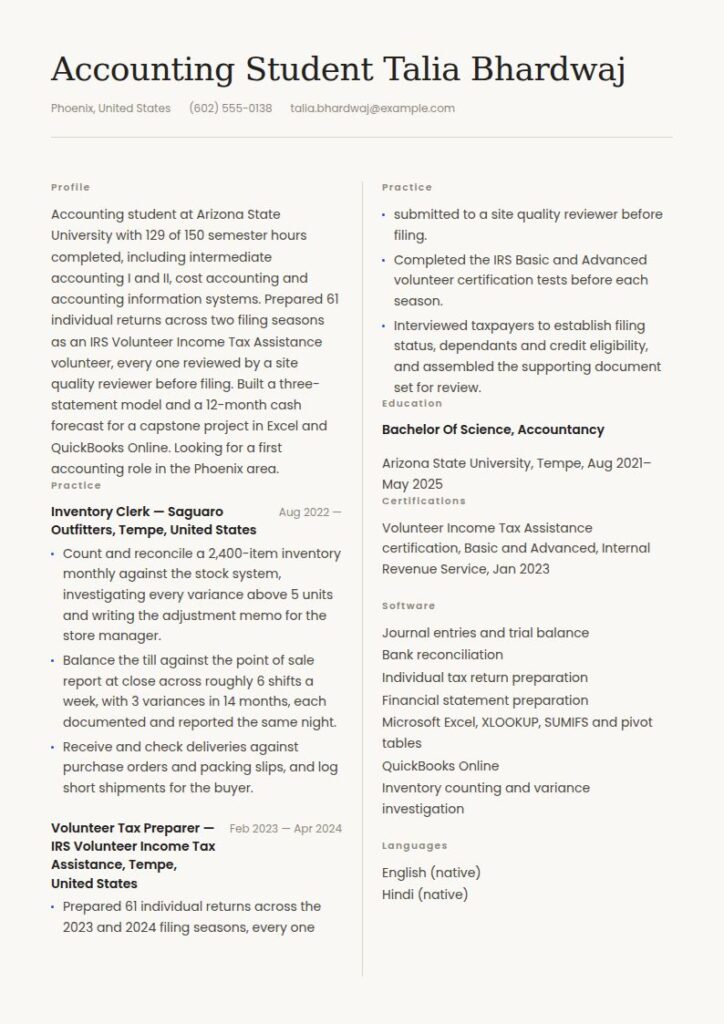
Accounting student at Arizona State University with 129 of 150 semester hours completed, including intermediate accounting I and II, cost accounting and accounting information systems. Prepared 61 individual returns across two filing seasons as an IRS Volunteer Income Tax Assistance volunteer, every one reviewed by a site quality reviewer before filing. Built a three-statement model and a 12-month cash forecast for a capstone project in Excel and QuickBooks Online. Looking for a first accounting role in the Phoenix area.
Work Experience
08/2022 - Present, Inventory Clerk, Saguaro Outfitters, Tempe, United States
- Count and reconcile a 2,400-item inventory monthly against the stock system, investigating every variance above 5 units and writing the adjustment memo for the store manager.
- Balance the till against the point of sale report at close across roughly 6 shifts a week, with 3 variances in 14 months, each documented and reported the same night.
- Receive and check deliveries against purchase orders and packing slips, and log short shipments for the buyer.
02/2023 - 04/2024, Volunteer Tax Preparer, IRS Volunteer Income Tax Assistance, Tempe, United States
- Prepared 61 individual returns across the 2023 and 2024 filing seasons, every one submitted to a site quality reviewer before filing.
- Completed the IRS Basic and Advanced volunteer certification tests before each season.
- Interviewed taxpayers to establish filing status, dependants and credit eligibility, and assembled the supporting document set for review.
Education
08/2021 - Present, Bachelor of Science, Accountancy, Arizona State University, Tempe, United States
129 of 150 semester hours completed. Coursework: Intermediate Accounting I and II, Cost Accounting, Auditing, Individual Taxation, Business Taxation, Accounting Information Systems, Business Analytics.
Skills
Journal entries and trial balance, 65
Bank reconciliation, 65
Individual tax return preparation, 70
Financial statement preparation, 60
Microsoft Excel, XLOOKUP, SUMIFS and pivot tables, 75
QuickBooks Online, 60
Inventory counting and variance investigation, 75
Languages
English, native
Hindi, native
Certificates
01/2023, Volunteer Income Tax Assistance certification, Basic and Advanced, Internal Revenue Service
Recertified before the 2024 filing season.
Summary
An entry level accounting resume is a one page document that proves competence before a work history exists, using credit hours, named coursework, an internship, volunteer tax work and the software you have actually opened. This guide gives you three adaptable versions, an evidence table that makes each claim checkable, and current Bureau of Labor Statistics pay and outlook for the occupations you are applying into.
Entry Level Accounting resume examples by experience level
An entry level accounting resume is a one page document with a difficult job: proving you can do accounting work before anyone has ever paid you to do it.
The occupation is unusually open at the door. The Bureau of Labor Statistics records that accountants and auditors typically need a bachelor's degree, no work experience in a related occupation, and no on-the-job training (Occupational Outlook Handbook, published 27 August 2026). The entry requirement is a degree and nothing else.
Which is the problem, because everyone applying has the same degree. So the resume is not a claim that you are qualified. It is a set of things a hiring manager can check.
Resume guide for an entry level accounting resume
This guide and the corresponding entry level accounting resume example will cover:
- How to write an entry level accounting resume, section by section
- The evidence table that turns coursework into something a reader can check
- Three adaptable summaries: final-year student, graduate with an internship, first job in post
- What your internship is worth, according to the employers who hire from it
- What the market looks like and what you can expect to earn at the bottom of the scale
How to write an entry level accounting resume
Five blocks: contact header, summary, education with credit hours, experience, and systems. One page, because nobody at this level has two pages of accounting to show and padding is visible.
The order differs from a mid-career accounting resume on purpose. Education sits above experience while it is the strongest thing you have, and moves below the day you have twelve months of accounting work behind you.
| Section | What it is answering | Where it goes |
|---|---|---|
| Education and credit hours | Does this person clear the degree gate, and where are they on 150 hours? | Under the summary, while it is your best asset |
| Coursework | Which parts of the job have they touched in a structured way? | Named courses, not a course catalog |
| Experience | Have they worked, been relied on, and met a deadline? | Any paid work, written for transfer |
| Systems | Which software have they actually opened? | Named products, at the honest level of use |
Write the hours, not just the degree
BLS records that all states require CPA candidates to complete 150 semester hours of college coursework, 30 more than a usual four-year bachelor's degree, and that CPAs are licensed by their state's Board of Accountancy (Occupational Outlook Handbook, published 27 August 2026).
A degree title does not say where you are against that number, and the number is the first thing a public accounting firm wants, because it decides whether you can sit the exam on their timetable or theirs plus a year.
So state it: "Bachelor of Science in Accountancy, 129 semester hours completed, 21 remaining toward the 150-hour requirement, evening enrollment beginning January 2027." That is a plan with a date on it, on a page where most competitors wrote the degree title and stopped.
Run the file through the free ATS checker before you submit, since graduate recruiting runs almost entirely through applicant tracking systems and software names are parsed hardest of all.
Choosing the best resume format for an entry level accounting resume
Reverse chronological, single column, one page. The functional format is marketed hard at people with no experience and is the wrong choice here: a recruiter reading one assumes the timeline is being hidden, and a 23-year-old has nothing to hide, so it costs trust for no benefit.
What you can move is the order of the blocks, not their shape. Keep it to one page until you have a year of paid accounting work: four checkable claims beat eleven adjectives, and nobody reaches your second page.
Include your contact information
| ✅ Right | ❌ Wrong |
|---|---|
| Talia Bhardwaj | Talia Bhardwaj |
| Accounting Graduate, 129 of 150 semester hours | Aspiring accounting professional seeking opportunities |
| Tax season internship, regional CPA firm, 102 returns prepared | Hardworking and eager to learn |
| (602) 555-0138, [email protected], Phoenix, AZ | (602) 555-0138, [email protected] |
The second and third lines are the whole trick. Before a bullet has been read, the reader knows where you stand on the hours and that you have prepared returns that went to a reviewer. "Eager to learn" describes every applicant in the stack, including the ones who are not. Use a plain address built from your name; a graduation year in an email address dates you the moment it stops being this year.
Make use of a summary
Three or four lines: where you are academically, the most accounting-adjacent thing you have done with a number on it, the software, and what you are applying for. No objective statement, which says what you want rather than what you offer.
Accounting student at Arizona State University with 129 of 150 semester hours completed, including intermediate accounting I and II, cost accounting and accounting information systems. Prepared 61 individual returns across two filing seasons as an IRS Volunteer Income Tax Assistance volunteer, every one reviewed by a site quality reviewer before filing. Built a three-statement model and a 12-month cash forecast for a capstone project in Excel and QuickBooks Online. Looking for a first accounting role in the Phoenix area.
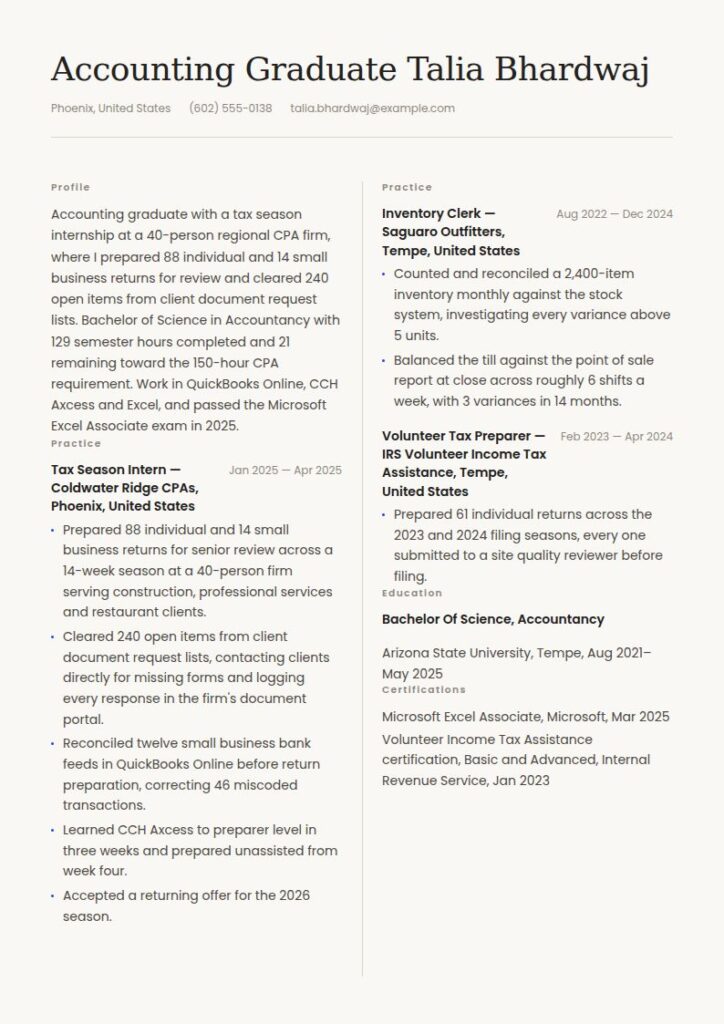
Accounting graduate with a tax season internship at a 40-person regional CPA firm, where I prepared 88 individual and 14 small business returns for review and cleared 240 open items from client document request lists. Bachelor of Science in Accountancy with 129 semester hours completed and 21 remaining toward the 150-hour CPA requirement. Work in QuickBooks Online, CCH Axcess and Excel, and passed the Microsoft Excel Associate exam in 2025.
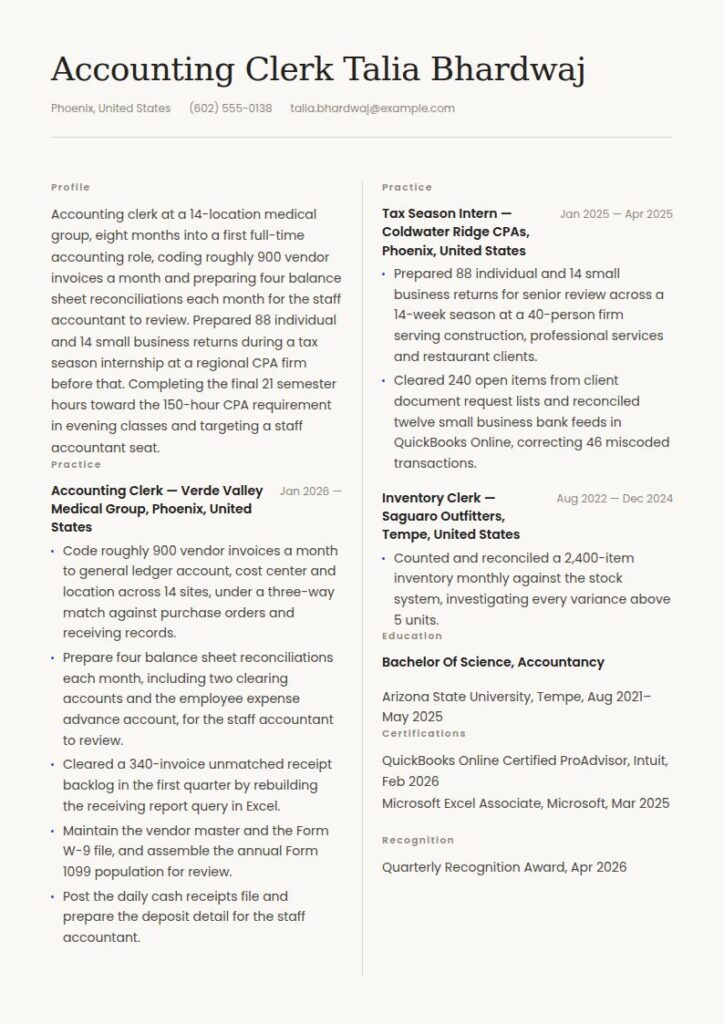
Accounting clerk at a 14-location medical group, eight months into a first full-time accounting role, coding roughly 900 vendor invoices a month and preparing four balance sheet reconciliations each month for the staff accountant to review. Prepared 88 individual and 14 small business returns during a tax season internship at a regional CPA firm before that. Completing the final 21 semester hours toward the 150-hour CPA requirement in evening classes and targeting a staff accountant seat.
Right vs wrong: the same entry level accounting summary, twice
| ✅ Right | ❌ Wrong |
|---|---|
| 129 of 150 semester hours completed, including intermediate accounting I and II and accounting information systems. | Strong academic background in accounting with relevant coursework. |
| Prepared 88 individual and 14 small business returns for review during a tax season internship. | Gained hands-on experience in a professional accounting environment. |
| Work in QuickBooks Online, CCH Axcess and Excel; passed the Microsoft Excel Associate exam in 2025. | Proficient in accounting software and Microsoft Office. |
Every line in the right column is true of everyone. Every line in the left can be checked, and a recruiter who can check two facts in eight seconds reads the rest of the page.
Outline your experience when it is not accounting experience
Most people writing this resume have worked, just in a restaurant, a shop, a warehouse or a campus office. That work belongs on the page, written for what transfers: handling money or goods accurately at volume, following a documented process somebody else checks, and hitting a recurring deadline.
| Instead of | Use |
|---|---|
| Worked as a cashier at a retail store | Balanced a till against the point of sale report at close, 6 shifts a week, with 3 variances over 14 months, each one documented and reported the same night |
| Responsible for inventory | Counted and reconciled a 2,400-item inventory monthly against the stock system and investigated every variance above 5 units |
| Completed an accounting internship | Prepared 88 individual and 14 small business returns for review and cleared 240 open items from client document request lists across a 14-week tax season |
| Group project in accounting class | Built a three-statement model and a 12-month cash forecast for a capstone, presented to a panel of three faculty and two practitioners |
Tax Season Intern, Coldwater Ridge CPAs, Phoenix, AZ, January 2025 to April 2025
Prepared 88 individual and 14 small business returns for senior review across a 14-week season at a 40-person firm serving construction, professional services and restaurant clients.
Cleared 240 open items from client document request lists, contacting clients directly for missing forms and logging every response in the firm's document portal.
Reconciled twelve small business bank feeds in QuickBooks Online before return preparation, correcting 46 miscoded transactions.
Learned CCH Axcess to preparer level in three weeks. Accepted a returning offer for the 2026 season.
Inventory Clerk, Saguaro Outfitters, Tempe, AZ, August 2022 to December 2024
Counted and reconciled a 2,400-item inventory monthly against the stock system, investigated every variance above 5 units, and wrote the adjustment memo for the store manager.
Balanced the till against the point of sale report at close across roughly 6 shifts a week, with 3 variances in 14 months.
Notice what the internship entry does not do. It names no client and quotes no client's figures, describing the firm by size and by the industries it serves instead. That rule applies to everyone who has worked in public accounting, and breaking it as a junior is noticed.
Build an evidence table: the coursework, the internship and the software behind each claim
Here is the block that exists on no other accounting resume, because you need it and a senior accountant does not.
The problem with an entry level accounting resume is not that the claims are weak but that they are unverifiable. "Familiar with accounts payable" could mean a lecture, a homework set, or four months of coding invoices. So build the claim and its evidence into the same line.
Financial reporting: Intermediate Accounting I and II, 6 credit hours. Built a full set of statements from a trial balance including a statement of cash flows by the indirect method for a capstone project.
Cost and audit: Cost Accounting and Auditing, 6 credit hours. Built standard cost variance analysis across four quarters for a simulated manufacturer, and completed a sampling and workpaper exercise on a simulated inventory population of 4,100 items.
Tax: Individual Taxation and Business Taxation, 6 credit hours. Prepared 61 individual returns as an IRS Volunteer Income Tax Assistance volunteer across two filing seasons and 88 individual and 14 small business returns during a tax season internship.
Accounting systems: Accounting Information Systems, 3 credit hours. Configured a chart of accounts and a three-way match workflow in a classroom ERP, and reconciled twelve live bank feeds in QuickBooks Online during an internship.
Spreadsheets: Microsoft Excel Associate, Microsoft, 2025. Built a 12-month cash forecast using XLOOKUP, SUMIFS and a scenario table.
The shape is the point. Claim, credit hours or credential, then the artifact. Each line is falsifiable, which is what makes it worth something.
Split what you did in class from what you did for real. The tax line above does both and separates them. Blurring the two is the most common way this resume loses credibility, because an interviewer will ask and the answer will not match.
Name the software at the level you used it. "QuickBooks Online" alone is indefensible if the truth is one homework assignment, while "reconciled twelve live bank feeds in QuickBooks Online" survives any question. Lines drawn from coursework alone are fine, so long as they say so.
What employers say the internship is actually worth
Reporting on its Job Outlook 2026 survey, the National Association of Colleges and Employers found that when employers choose between two otherwise equally qualified candidates, having completed an internship with their organization or within their industry were the only two attributes they rated as having very much influence (NACE, 9 February 2026).
The conversion figures say the same from the other direction: NACE put the intern conversion rate at 63.1 percent for 2024 to 2025 interns, with 88.3 percent of those offered a job accepting it (NACE, 3 April 2026).
So if you have an internship it is the most valuable block on the page and belongs above everything except education, written as a job with volumes rather than as a line under activities. If you do not have one, the closest substitutes are structured volunteer tax preparation, a campus business office role, a small business bookkeeping job, or a treasurer post with real numbers in it.
Build a snapshot of your key skills
Eight to twelve entries in three groups: the cycle, the systems, and the working skills. List nothing you could not answer two questions about.
Cycle: Journal entries and trial balance, Bank reconciliation, Accounts payable coding and three-way match, Individual tax return preparation, Financial statement preparation, Variance analysis
Systems: QuickBooks Online, CCH Axcess, Microsoft Excel including XLOOKUP, SUMIFS and pivot tables, Microsoft Dynamics 365 Business Central at classroom level
Working skills: Document request tracking, Support file documentation, Working to a review deadline, Client and vendor correspondence
Mark classroom-level items as classroom level, as the systems line above does. It costs nothing, since the reader had already discounted the claim, and it buys the assumption that everything unmarked is real.
List your education and certifications
Education goes near the top of this resume, and it carries four things: the degree, the institution, the semester hours completed, and the named courses that map to the work.
Bachelor of Science in Accountancy, Arizona State University, Tempe, AZ, May 2025. 129 semester hours completed, 21 remaining toward the 150-hour CPA requirement, evening enrollment beginning January 2027.
Relevant coursework: Intermediate Accounting I and II, Cost Accounting, Auditing, Individual Taxation, Business Taxation, Accounting Information Systems, Business Analytics
Certifications: Microsoft Excel Associate, Microsoft, 2025. QuickBooks Online Certified ProAdvisor, Intuit, 2026. IRS Volunteer Income Tax Assistance certification, Basic and Advanced, Internal Revenue Service, 2023.
Volunteer: IRS Volunteer Income Tax Assistance, 2023 and 2024 filing seasons, 61 individual returns prepared for site quality review.
Keep the grade point average only if it is 3.5 or above, and drop it once you have a year of work. Keep the coursework line only while you are within about eighteen months of graduating.
If you are working toward a credential, name it and the body that awards it. The Certified Management Accountant is awarded by the Institute of Management Accountants and is built on two exam parts, Part 1 Financial Planning, Performance, and Analytics and Part 2 Strategic Financial Management (Institute of Management Accountants, accessed 13 September 2026). That precision shows you have read the requirements rather than heard about the letters.
Choose the right layout and design
Single column, 11 or 12 point, one page, no photograph, no graphics, no skill bars. A five-segment rating next to "GAAP" invites a question you do not want asked and means nothing to the reader, since nobody knows what four out of five is.
State your semester hours against 150. Name the courses that map to real tasks. Write your internship as a job, with volumes and a season length. Put a number on non-accounting work. Mark classroom-level software as classroom level, and name only software you have opened. Keep it to one page.
Do not open with an objective statement. Do not write "proficient in accounting software" without naming one. Do not list every course on your transcript. Do not claim GAAP expertise from a textbook. Do not name a client from an internship or quote their figures. Do not leave a genuine non-accounting job off the page because it looks unimpressive; unexplained gaps read worse than retail.
Entry level accounting job market and outlook
The Bureau of Labor Statistics publishes no profile for "entry level accounting", because the Handbook covers occupations rather than career stages. Entry level candidates walk through two published doors, and the two have opposite trajectories.
| Measure | Accountants and auditors | Bookkeeping, accounting and auditing clerks |
|---|---|---|
| Jobs, 2025 | 1,595,200 | 1,532,400 |
| Projected change, 2025-35 | 5% (faster than average), +79,400 | -6% (decline), -85,600 |
| Projected annual openings | About 115,300 | About 144,100 |
| Typical entry-level education | Bachelor's degree | Some college, no degree |
| Work experience required | None | None |
| On-the-job training | None | Moderate-term |
| Median annual wage, May 2025 | $83,680 | $50,670 |
Source: U.S. Bureau of Labor Statistics, Occupational Outlook Handbook, 2025-35 projections and May 2025 wage data, published 27 August 2026.
Read the two columns together, because choosing between them is the most consequential decision of your first year. The clerk door is easier to get through and is contracting: BLS attributes the decline to technological change, noting that software innovations have automated many of the tasks these clerks perform (published 27 August 2026). The accountant door needs the degree and is growing. A clerk job is still often the fastest way into a finance department, but treat it as a door rather than a destination.
More people are entering the pipeline than were two years ago
Accounting undergraduate enrollment grew 7.3 percent year over year in the autumn 2025 semester, against 1.2 percent across all majors, taking total postsecondary accounting enrollment to 313,397 students from 293,759 the year before. One in eight undergraduate business students majored in accounting in autumn 2025, up from one in nine in 2023 (AICPA, 20 January 2026).
Behind that recovery sits a shortfall. 40,817 students earned an accounting bachelor's degree in the 2023 to 2024 academic year, a drop of 3.3 percent, and public accounting firms hired 11,985 new graduates in 2024, 75 percent of them accounting degree holders (AICPA, 27 October 2025). BLS projects about 115,300 openings a year for accountants and auditors to 2035 (published 27 August 2026).
Demand at the entry point is real and the cohorts behind you are getting larger, which makes this a good year to apply and a worse one to wait. It also means the gaps between candidates are small, and the page that wins carries facts somebody can check.
What salary you can expect in an entry level accounting job
BLS publishes no wage for entry level accountants specifically. What it publishes is the distribution for the whole occupation, and the bottom of it is the honest place to reason from.
The lowest 10 percent of accountants and auditors earned less than $56,020 in May 2025 against a median of $83,680 for the occupation as a whole, and for bookkeeping, accounting and auditing clerks the lowest 10 percent earned less than $36,000 against a median of $50,670 (BLS, May 2025). A first accounting job usually sits between those two lower figures, and the degree is most of what separates them.
Two things move that number early and both belong on the resume. The first is the door, since the same person is paid differently as a clerk and as a staff accountant, and the degree plus the credit hours decides which offer is made. The second is industry: among accountants and auditors, finance and insurance paid a median of $93,290 in May 2025 against $81,490 in accounting, tax preparation, bookkeeping and payroll services, which employs 21 percent of the occupation (BLS, May 2025). Public accounting pays the lower median and remains the most common start, because two seasons there is a training program other employers recognize. Make that trade knowingly rather than by default.
Key takeaways for an entry level accounting resume
- Put your semester hours against 150 in the header, not just the degree.
- Write the internship as a job, with volumes and the length of the season.
- Build an evidence table: claim, credit hours or credential, then the artifact.
- Separate classroom work from live work, and say which is which.
- Put numbers on non-accounting jobs: tills balanced, items counted, variances found.
- Name only software you have opened, and mark classroom-level use as such.
- Never name a client or quote their figures from an internship.
- One page, education above experience until you have a year of accounting work.
Build your entry level accounting resume in 15 minutes with our AI resume builder.
Related accounting and finance resume examples
- Accountant resume
- Staff accountant resume
- Accounting assistant resume
- Bookkeeper resume
- Accounts payable resume
- Accounts receivable resume
- Auditing clerk resume
- Tax preparer resume
- Payroll specialist resume
- Financial analyst resume
- CPA resume
- Accounting and finance resume
Pair it with a matching entry level accounting cover letter.
Entry level accounting resume questions, answered
What do I put on an accounting resume with no experience?
Credit hours against 150, named coursework with the artifact you produced in each, any structured volunteer tax work, a campus or treasurer role with real numbers, and every paid job written for what transfers. Four blocks, filling a page honestly, every line verifiable.
Should I include my GPA on an entry level accounting resume?
Include it if it is 3.5 or above and you graduated within the last two years. Below that leave it off, since nobody assumes the worst from an absent GPA and the space is better spent on an internship volume. Remove it once you have twelve months of accounting work.
Is an accounting internship worth more than a part-time accounting job?
Usually yes. Reporting its Job Outlook 2026 survey, NACE found that an internship with the employer's organization or within its industry were the only two attributes employers rated as having very much influence when choosing between equally qualified candidates (NACE, 9 February 2026). A part-time bookkeeping job is still strong evidence and should be written up the same way.
Do I need 150 semester hours to get an entry level accounting job?
No. The 150 hours are a CPA licensure requirement, not a hiring requirement, and BLS records the typical entry-level education for accountants and auditors as a bachelor's degree with no prior work experience (published 27 August 2026). Public accounting firms care because it governs when you can sit the exam, so state where you are and when you finish. Industry employers often never ask.
Should I apply for accounting clerk jobs or hold out for staff accountant?
Apply for both and know the difference. The clerk occupation is projected to decline 6 percent between 2025 and 2035 while still producing about 144,100 openings a year, and accountants and auditors to grow 5 percent with about 115,300 openings a year (BLS, published 27 August 2026). A clerk seat gets you inside a finance department quickly, provided you keep finishing the hours.
How long should an entry level accounting resume be?
One page, until you have a year of paid accounting work. A second page at this stage is coursework padding and the reader stops before reaching it. If the page feels thin, the fix is more specific evidence in the lines you already have, not more lines.