Accounts Receivable Clerk Danielle Vukovich
Accounts Receivable Clerk
[email protected] | (216) 555-0174 | Cleveland, United States
Profile
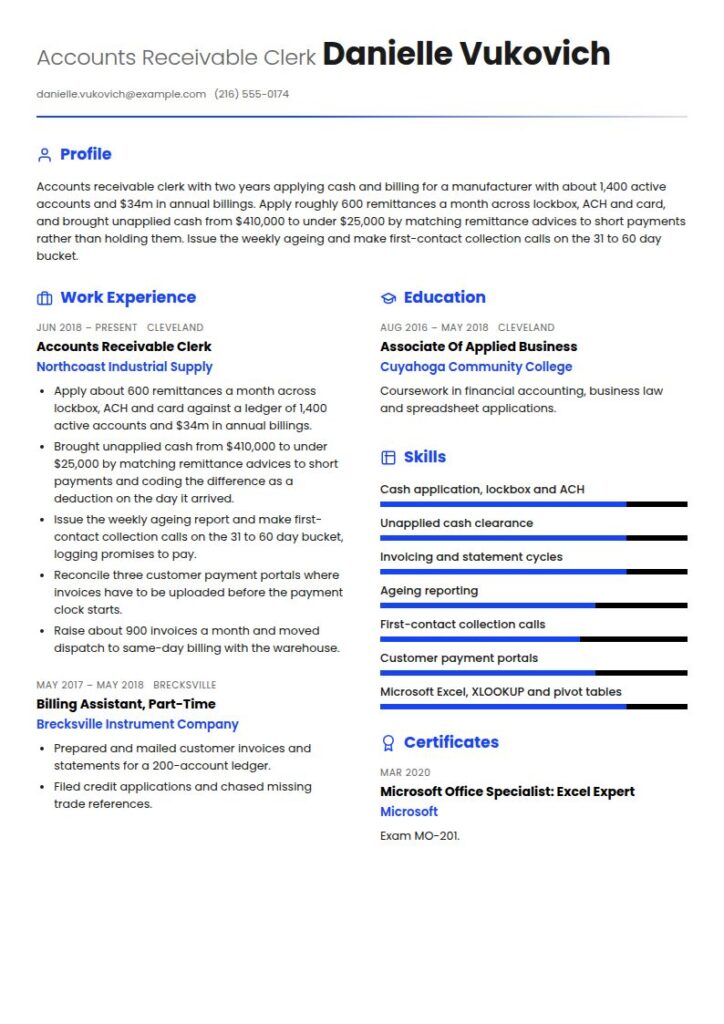
Accounts receivable clerk with two years applying cash and billing for a manufacturer with about 1,400 active accounts and $34m in annual billings. Apply roughly 600 remittances a month across lockbox, ACH and card, and brought unapplied cash from $410,000 to under $25,000 by matching remittance advices to short payments rather than holding them. Issue the weekly ageing and make first-contact collection calls on the 31 to 60 day bucket.
Work Experience
06/2018 - Present, Accounts Receivable Clerk, Northcoast Industrial Supply, Cleveland, United States
- Apply about 600 remittances a month across lockbox, ACH and card against a ledger of 1,400 active accounts and $34m in annual billings.
- Brought unapplied cash from $410,000 to under $25,000 by matching remittance advices to short payments and coding the difference as a deduction on the day it arrived.
- Issue the weekly ageing report and make first-contact collection calls on the 31 to 60 day bucket, logging promises to pay.
- Reconcile three customer payment portals where invoices have to be uploaded before the payment clock starts.
- Raise about 900 invoices a month and moved dispatch to same-day billing with the warehouse.
05/2017 - 05/2018, Billing Assistant, Part-Time, Brecksville Instrument Company, Brecksville, United States
- Prepared and mailed customer invoices and statements for a 200-account ledger.
- Filed credit applications and chased missing trade references.
Education
08/2016 - 05/2018, Associate of Applied Business, Accounting, Cuyahoga Community College, Cleveland, United States
Coursework in financial accounting, business law and spreadsheet applications.
Skills
Cash application, lockbox and ACH, 80
Unapplied cash clearance, 80
Invoicing and statement cycles, 80
Ageing reporting, 70
First-contact collection calls, 65
Customer payment portals, 70
Microsoft Excel, XLOOKUP and pivot tables, 80
Languages
English, native
Croatian, intermediate
Certificates
03/2020, Microsoft Office Specialist: Excel Expert, Microsoft
Exam MO-201.
Summary
An accounts receivable resume is a one to two page document naming the ledger you collect, the days sales outstanding you moved it to, the ageing buckets behind that number, and the disputes and deductions you resolved. This guide gives you three adaptable versions, an ageing walkthrough no competing resume will have, and current Bureau of Labor Statistics pay and outlook.
Accounts Receivable resume examples by experience level
In short, an accounts receivable resume is a one to two page document about money the business has earned that has not arrived yet, and about how long you let it stay that way.
At first, it is tempting to write this job as the mirror image of accounts payable. It is not. However, payables is a controls job where the risk is paying twice; receivables is a persuasion and credit job where the risk is that nobody pays you at all. Nobody in payables has to decide whether to stop shipping to a customer who is 74 days late and represents nine percent of revenue. You do.
Therefore, that decision, and the numbers behind it, is what your resume should consist of.
Resume guide for an accounts receivable resume
To start, this guide and the corresponding accounts receivable resume example will cover:
- First, how to write an accounts receivable resume, section by section
- Then, days sales outstanding and the ageing buckets that explain it
- Also, three adaptable summaries: clerk, specialist and credit and collections lead
- Next, deductions, disputes, credit holds and bad debt, written as evidence
- Finally, what the job market looks like and what you can expect to earn
How to write an accounts receivable resume
Overall, use six sections: contact header, summary, experience, the ageing and collection picture, systems and skills, and education with certifications. In general, one page under five years, two pages once you own credit decisions or a team.
| Section | What it is answering | Where it goes |
|---|---|---|
| Summary | What size ledger, what DSO, what direction is it moving? | Top, four lines |
| Experience | What did you collect that was not being collected? | Reverse chronological, numbers throughout |
| Ageing and collections | Where does the money sit, and what do you do about each bucket? | Its own block |
| Systems | Can this person work our billing and cash application stack? | Named products |
| Certifications | Has anyone tested your credit judgment? | Under education |
Days sales outstanding is the number, and you need both ends of it
Days sales outstanding is roughly the average time between billing and getting paid, and it is the single figure a controller or a treasurer uses to judge a receivables function.
Write it as a movement, not a level: "took DSO from 58 to 41 days over four quarters on a ledger of about $34m in annual billings". A level on its own is unreadable without the industry and the payment terms; a movement with a period and a ledger size is evidence.
If you do not have DSO because nobody calculated it, use the ageing instead: the share of the balance over 90 days, before and after. That is the same argument in a form you can prove.
Run the finished file through the free Rezoom ATS resume checker before you send it, because finance teams at this size parse applications into a system before anybody reads them.
Choosing the best resume format for an accounts receivable resume
Reverse chronological, single column. Collections results take quarters to show up, so a reader is looking for the same person on the same ledger long enough for a trend to mean something.
Skills-based formats fail here because they strip out the thing that matters most: how long you held a portfolio, and what it looked like when you arrived.
Include your contact information
| ✅ Right | ❌ Wrong |
|---|---|
| Danielle Vukovich | Danielle Vukovich |
| Credit and Collections Manager, $34m ledger, DSO 41 days | Results-driven accounting professional |
| Credit Business Associate, National Association of Credit Management | Certified in credit |
| (216) 555-0174, [email protected], Cleveland, OH | (216) 555-0174, [email protected] |
Ledger size and DSO in the header is unusual, and that is exactly why it works. It answers the two questions the reader was going to ask anyway.
Make use of a summary
Then write four lines: portfolio size and account count, DSO or ageing movement, what you did to move it, and the credit or dispute work you own.
Accounts receivable clerk with two years applying cash and billing for a manufacturer with about 1,400 active accounts and $34m in annual billings. Apply roughly 600 remittances a month across lockbox, ACH and card, and brought unapplied cash from $410,000 to under $25,000 by matching remittance advices to short payments rather than holding them. Issue the weekly ageing and make first-contact collection calls on the 31 to 60 day bucket.
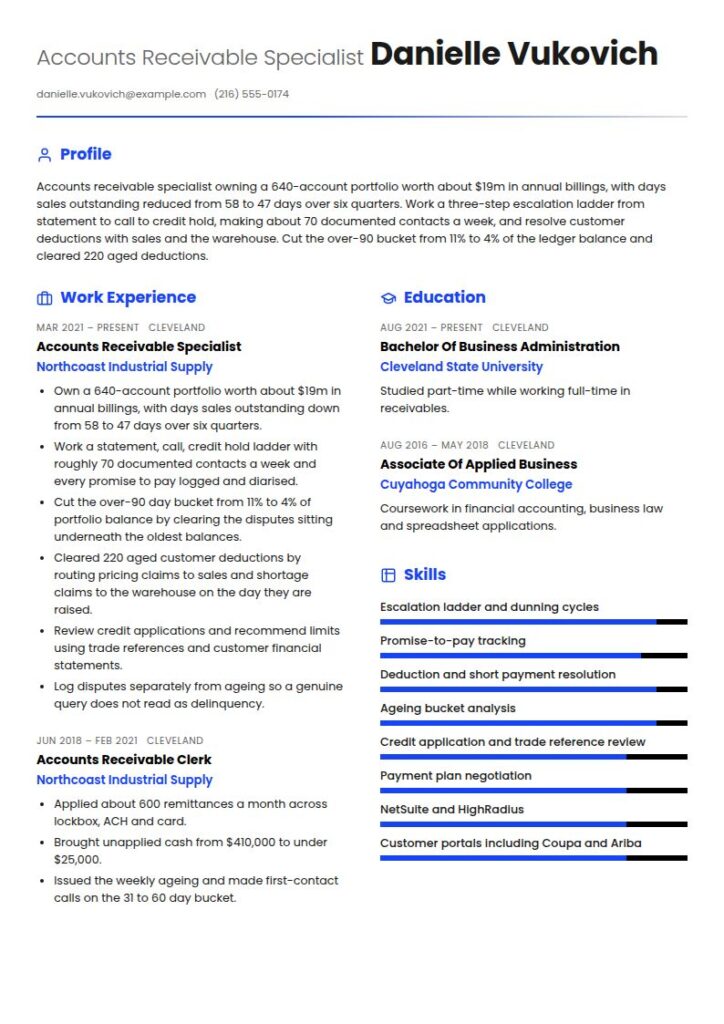
Accounts receivable specialist owning a 640-account portfolio worth about $19m in annual billings, with days sales outstanding reduced from 58 to 47 days over six quarters. Work a three-step escalation ladder from statement to call to credit hold, making about 70 documented contacts a week, and resolve customer deductions with sales and the warehouse. Cut the over-90 bucket from 11% to 4% of the ledger balance and cleared 220 aged deductions.
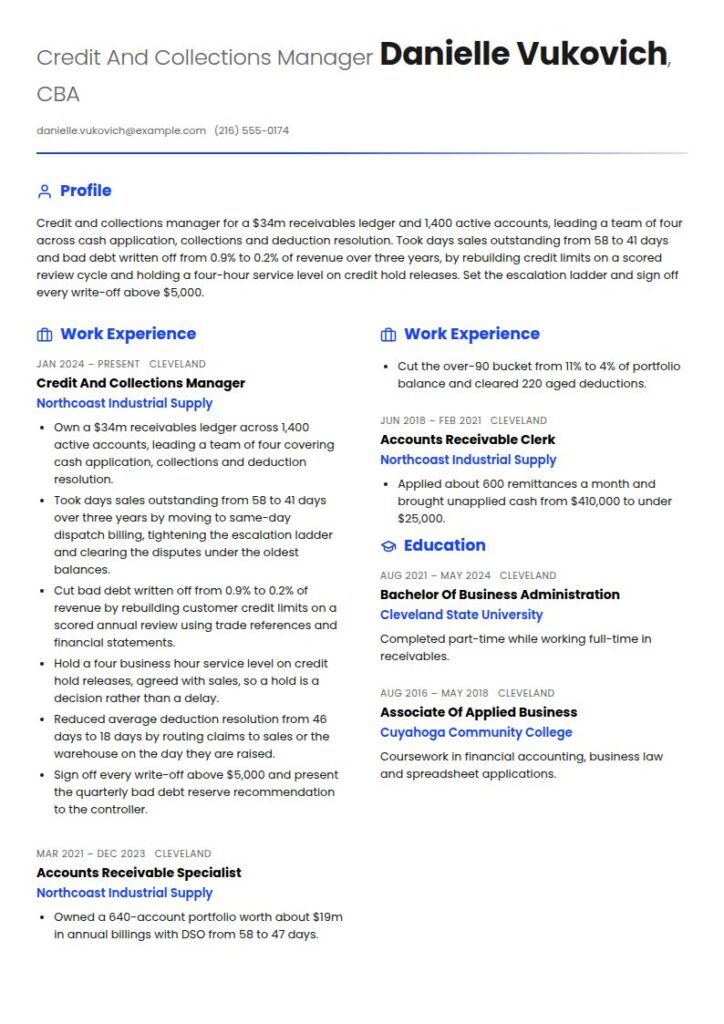
Credit and collections manager for a $34m receivables ledger and 1,400 active accounts, leading a team of four across cash application, collections and deduction resolution. Took days sales outstanding from 58 to 41 days and bad debt written off from 0.9% to 0.2% of revenue over three years, by rebuilding credit limits on a scored review cycle and holding a four-hour service level on credit hold releases. Set the escalation ladder and sign off every write-off above $5,000.
Right vs wrong: the same accounts receivable summary, twice
| ✅ Right | ❌ Wrong |
|---|---|
| Took days sales outstanding from 58 to 41 days on a $34m ledger over three years. | Successfully reduced outstanding receivables and improved cash flow. |
| Cut the over-90 bucket from 11% to 4% of the ledger balance. | Followed up on past-due accounts in a timely manner. |
| Bad debt written off from 0.9% to 0.2% of revenue, with write-offs above $5,000 signed off personally. | Minimized bad debt through effective collections practices. |
The wrong column is not lying. Instead, it is just unfalsifiable, and a finance reader treats unfalsifiable claims as decoration.
Outline your accounts receivable experience
Next, give employer, sector, ledger size, account count, system, and dates. Then four to six bullets with a rate, a day count or a dollar figure in each.
| Instead of | Use |
|---|---|
| Followed up on overdue accounts | Work a 640-account portfolio with about 70 documented contacts a week on a statement, call, hold ladder |
| Reduced aged debt | Cut the over-90 bucket from 11% to 4% of ledger balance over five quarters |
| Applied customer payments | Apply about 600 remittances a month across lockbox, ACH and card at 98% same-day |
| Handled customer queries | Resolve deductions with sales and the warehouse; average resolution down from 46 days to 18 |
| Assisted with credit checks | Rebuilt credit limits on a scored annual review with trade references and financial statements |
| Helped reduce bad debt | Bad debt written off from 0.9% to 0.2% of revenue over three years |
Credit and Collections Manager, Northcoast Industrial Supply, Cleveland, OH, January 2024 to Present
Own a $34m receivables ledger across 1,400 active accounts, leading a team of four covering cash application, collections and deduction resolution.
Took days sales outstanding from 58 to 41 days over three years by moving invoicing to same-day dispatch, tightening the escalation ladder and clearing the disputes that were holding the oldest balances.
Cut bad debt written off from 0.9% to 0.2% of revenue by rebuilding customer credit limits on a scored annual review using trade references and financial statements.
Hold a four business hour service level on credit hold releases, agreed with sales, so that a hold is a decision rather than a delay.
Reduced average deduction resolution from 46 days to 18 by routing pricing claims to sales and shortage claims to the warehouse on the day they are raised.
Sign off every write-off above $5,000 and present the quarterly reserve recommendation to the controller.
Put days sales outstanding and your ageing buckets on the page, with the before and after
In fact, almost every accounts receivable resume describes collections as an activity. The ones that get interviews describe it as a portfolio with a shape, and then show the shape changing.
In practice, four or five lines will do it. First, take the ledger you own, break it into the standard buckets, and say what you do in each one and what happened to the balance.
Portfolio: about $34m in annual billings, 1,400 active accounts, standard terms net 30 with net 45 on three national accounts.
Current and 1 to 30 days: automated statements and a courtesy email at day seven on invoices above $10,000. No call.
31 to 60 days: first documented call, roughly 70 contacts a week across the team, with a promise-to-pay logged and diarised.
61 to 90 days: second call plus a written demand, sales representative copied, and an automatic credit hold recommendation to me.
Over 90 days: my decision only. Payment plan, hold, or referral. This bucket fell from 11% to 3% of the ledger balance over five quarters.
Disputes and deductions: logged separately from ageing so that a genuine query does not read as a slow payer. Average resolution 18 days, down from 46.
That second-to-last line is the one experienced credit people notice. Mixing disputes into the ageing is the most common reason a receivables ledger looks worse than it is, and separating them is a judgment call that tells a reader you have run a real book.
Why collections work holds its value while the headcount falls
Bill and account collectors are a declining occupation: 160,200 jobs in 2025, projected to fall 10 percent and shed 16,700 positions by 2035, with about 11,200 openings a year and a median annual wage of $47,030 in May 2025 (BLS Occupational Outlook Handbook, published 27 August 2026).
Set that against the demand side. The Federal Reserve Banks' 2026 Report on Employer Firms, drawn from 6,525 responses to the Small Business Credit Survey fielded between 3 September and 14 November 2025, found that 56 percent of firms seeking financing did so to cover operating expenses (Fed Small Business, published 3 March 2026). Operating expenses are paid out of collected cash, not billed revenue.
What that tells you about the resume is specific. The routine end of collections, the statement run and the dunning letter, is automated and is where the headcount reduction lands. The negotiated end is not: a payment plan on a customer you intend to keep, a deduction that is half valid, a credit limit that has to move without losing the account. Write from the negotiated end.
Build a snapshot of your key skills
Generally, list twelve to sixteen entries in four groups: collections, credit, cash application and systems.
Collections: Escalation ladder design, Promise-to-pay tracking, Payment plan negotiation, Demand letters, Third-party placement and referral, Statement and dunning cycles
Credit: Credit applications and trade references, Financial statement review, Credit limit setting and scored review, Credit hold release, Personal guarantees and security agreements, Bad debt reserve input
Cash application and disputes: Lockbox and ACH remittance matching, Short payment and deduction coding, Unapplied cash clearance, Chargeback and pricing claim resolution, Customer portal reconciliation
Systems: NetSuite, Oracle, HighRadius, customer payment portals including Coupa and Ariba, Microsoft Excel to XLOOKUP and pivot table level
Customer portals deserve their own line. For example, suppliers now have to upload a large share of commercial receivables into the customer's system before the clock even starts, and a candidate who already knows that is a candidate who will not be surprised in week two.
List your education and certifications
As a rule, an associate degree and experience is a normal route into this work. BLS gives the typical entry-level education for bill and account collectors as a high school diploma or equivalent with moderate-term on-the-job training (BLS Occupational Outlook Handbook, published 27 August 2026), and for bookkeeping, accounting and auditing clerks, the group the Handbook says includes accounts receivable clerks, as some college with no degree.
Bachelor of Business Administration, Finance, Cleveland State University, Cleveland, OH, 2024, completed part-time
Associate of Applied Business, Accounting, Cuyahoga Community College, Cleveland, OH, 2018
Credit Business Associate (CBA), National Association of Credit Management, 2023
Microsoft Office Specialist: Excel Expert, Microsoft, 2020
In addition, the Credit Business Associate is the credential that separates a collections clerk from a credit professional on paper. Specifically, NACM describes it as "an academic-based designation which signals mastery of three business-credit related disciplines", requiring Basic Financial Accounting, Financial Statement Analysis 1 and Business Credit Principles, with a three-hour exam and no minimum work experience requirement at that level (NACM, accessed September 2026). That last detail matters if you are early: it is a credential you can earn before you have the title.
Choose the right layout and design
Also use a single column, 11 or 12 point, plain headings, no photograph, no graphics. That is because your argument is a set of numbers with directions attached, and two-column templates are where parsers lose them.
Give ledger size and account count in the first two lines. Show DSO as a movement with a period attached. Break out the ageing buckets and say what happens in each. Separate disputes from genuine delinquency. Give bad debt as a share of revenue. Name the billing and cash application systems as products. Say what dollar threshold you can approve or write off.
Do not name a customer, an account number, an outstanding balance or a payment plan you negotiated. Do not describe a specific debtor's financial circumstances, even anonymously; it is their confidential information and it was given to your employer, not to you. Do not claim you "recovered" a figure you cannot tie to a ledger. Do not write "reduced aged debt" without the bucket and the period. Do not present a payables resume with the nouns changed.
Accounts receivable job market and outlook
Notably, BLS publishes no separate Occupational Outlook Handbook profile for accounts receivable. Instead, several published occupations share the work, and the Handbook says so in passing: accounting clerks' titles "often reflect the type of accounting they do", with accounts receivable clerk given as one of its two examples (BLS Occupational Outlook Handbook, published 27 August 2026).
Read it against the three occupations the work is actually made of.
| Bracketing occupation | Employment, 2025 | Projected change, 2025 to 2035 | Annual openings | Median annual wage, May 2025 |
|---|---|---|---|---|
| Bookkeeping, accounting and auditing clerks | 1,532,400 | Decline 6 percent, -85,600 | About 144,100 | $50,670 |
| Bill and account collectors | 160,200 | Decline 10 percent, -16,700 | About 11,200 | $47,030 |
| Billing and posting clerks, within financial clerks | 418,000 | Not published separately | Not published separately | $48,500 |
Source: U.S. Bureau of Labor Statistics, Occupational Outlook Handbook, May 2025 wage data and 2025 to 2035 projections, published 27 August 2026.
Where collections work sits matters more than in most office occupations. Business support services, which is the third-party collection agency sector, holds 25 percent of bill and account collector employment, followed by credit intermediation at 21 percent, healthcare and social assistance at 11 percent, professional, scientific and technical services at 8 percent and management of companies at 7 percent (BLS, May 2025).
In particular, that distribution is the single most useful fact for planning a move. For instance, agency collections and in-house commercial receivables are close in skill and far apart in pay, culture and legal exposure, and the ranking below makes the point.
| Setting | Median annual wage, May 2025 |
|---|---|
| Management of companies and enterprises | $50,340 |
| Credit intermediation and related activities | $48,730 |
| Healthcare and social assistance | $48,600 |
| Professional, scientific and technical services | $46,650 |
| Business support services | $38,020 |
Source: U.S. Bureau of Labor Statistics, Occupational Outlook Handbook, May 2025.
Know which side of the consumer line your work sits on
The Fair Debt Collection Practices Act defines a debt as an obligation of a consumer arising out of a transaction for money, property, insurance or services that are "primarily for personal, family, or household purposes". Commercial debt, business to business, is outside that definition.
The Act then defines a debt collector as a person whose principal business is collecting debts, or who "regularly collects or attempts to collect, directly or indirectly, debts owed or due or asserted to be owed or due another", and expressly excludes "any officer or employee of a creditor while, in the name of the creditor, collecting debts for such creditor" (Fair Debt Collection Practices Act, section 803).
Two practical consequences for your resume. First, in-house commercial collections and agency consumer collections are legally different jobs, and a hiring manager in one will read experience in the other carefully. Say which you have done. Second, if your work does touch consumer accounts, the compliance vocabulary is part of your value: validation notices, contact rules, and the fact that state law and your employer's own policy may bind you well beyond the federal floor. Name that training rather than assuming it is understood.
What salary you can expect in accounts receivable
For example, the median annual wage for bill and account collectors was $47,030 in May 2025, or $22.61 an hour, with the lowest 10 percent under $34,400 and the highest 10 percent above $65,580 (BLS, May 2025). By comparison, bookkeeping, accounting and auditing clerks, the bracket that holds most in-house accounts receivable clerk roles, had a median of $50,670 with a top decile above $74,550 (BLS, May 2025).
However, collecting faster does not get you to the top of that range. Instead, you reach it by taking on decisions.
| What moves you up the range | Why an employer pays for it |
|---|---|
| Credit limit setting and credit hold authority | It is a revenue decision, not an admin task |
| Deduction and dispute resolution | The hardest balances to collect are the contested ones |
| Portfolio size and national account exposure | Large accounts carry concentration risk |
| Bad debt reserve input and write-off authority | It touches reported earnings |
| Cash application at scale and unapplied cash control | Bad application creates false delinquency and wastes collection effort |
| Leading a team and owning the escalation ladder | Moves the role from chasing to running a function |
Meanwhile, sector is the other lever, and it works in the opposite direction to intuition. In fact, the agency sector employs the most collectors and pays the least, with a median of $38,020 against $50,340 in management of companies (BLS, May 2025). If you have agency experience and want the in-house pay, translate the work: portfolio value, contacts per week, cure rate, and the judgment calls you were allowed to make.
Key takeaways for an accounts receivable resume
- Above all, lead with ledger size, account count and days sales outstanding.
- Then give DSO as a movement over a stated period, not as a level.
- Also break the ageing into buckets and say what happens in each one.
- Similarly, separate disputes and deductions from genuine delinquency.
- Show bad debt written off as a share of revenue, before and after.
- Finally, name your credit hold and write-off authority in dollars.
- Say whether your collections work is commercial or consumer, and keep customers off the page.
Build your accounts receivable resume in 15 minutes with our AI resume builder.
Related accounting and finance resume examples
- Accounts payable resume
- Credit analyst resume
- Bookkeeper resume
- Auditing clerk resume
- Accounting assistant resume
- Accountant resume
- Staff accountant resume
- Senior accountant resume
- Loan processor resume
- Finance manager resume
- Accounting entry level resume
- Payroll specialist resume
Pair it with a matching accounts receivable cover letter.
Accounts receivable resume questions, answered
How long should an accounts receivable resume be?
One page for your first five years. Two once you hold credit authority, own a reserve recommendation, or lead a team. The second page should be earned by decisions you make, not by listing more duties.
What numbers belong on an accounts receivable resume?
Six: ledger value, active account count, days sales outstanding with a before and after, the over-90 bucket as a share of balance, bad debt written off as a share of revenue, and documented collection contacts per week. Add average deduction resolution days if you own disputes, and your write-off or credit hold authority in dollars.
What if my employer never measured days sales outstanding?
Use the ageing. The share of the ledger balance over 90 days, at the start and at the end of a stated period, makes the same argument from data you can actually produce. You can also give total value collected against total billed for a period, or the value of aged balances cleared.
Is accounts receivable the same as collections?
Overlapping, not identical. Accounts receivable covers billing, cash application, ageing, disputes and collections together; collections is the contact and negotiation part. BLS splits them the same way, publishing bill and account collectors separately from the clerk occupations. If you have done the whole cycle, say so, because a candidate who can apply cash correctly makes fewer wrong collection calls.
Can I name a customer I collected from?
No. Do not name the customer, the balance, the payment plan or anything about their financial position, even with the name removed, if the description would identify them. That information was given to your employer under a commercial relationship. Describe the portfolio, the bucket and the outcome instead.
How is this different from an accounts payable resume?
The metrics have no overlap at all. Payables is written on invoice volume, match exceptions, duplicate payments and discount capture; receivables is written on DSO, ageing buckets, deductions and bad debt. If you are applying for both, write two documents. The [accounts payable resume example](/resume/accounts-payable/) shows the other half of the cycle.