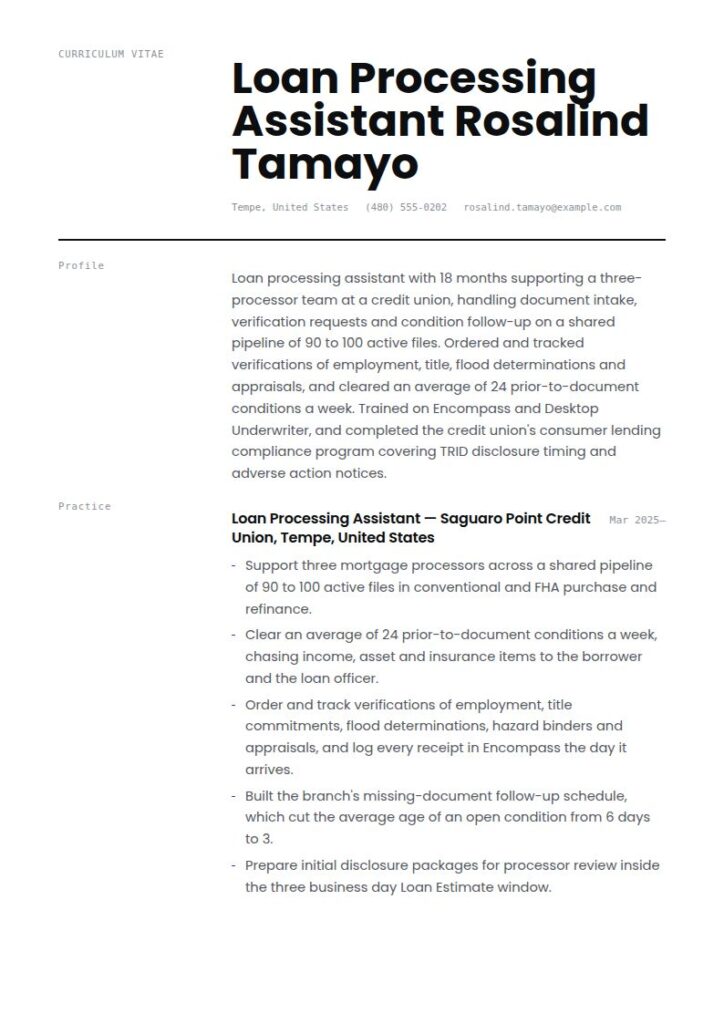
Loan Processing Assistant Rosalind Tamayo
Loan Processing Assistant
[email protected] | (480) 555-0202 | Tempe, United States
Profile
Loan processing assistant with 18 months supporting a three-processor team at a credit union, handling document intake, verification requests and condition follow-up on a shared pipeline of 90 to 100 active files. Ordered and tracked verifications of employment, title, flood determinations and appraisals, and cleared an average of 24 prior-to-document conditions a week. Trained on Encompass and Desktop Underwriter, and completed the credit union's consumer lending compliance program covering TRID disclosure timing and adverse action notices.
Work Experience
03/2025 - Present, Loan Processing Assistant, Saguaro Point Credit Union, Tempe, United States
- Support three mortgage processors across a shared pipeline of 90 to 100 active files in conventional and FHA purchase and refinance.
- Clear an average of 24 prior-to-document conditions a week, chasing income, asset and insurance items to the borrower and the loan officer.
- Order and track verifications of employment, title commitments, flood determinations, hazard binders and appraisals, and log every receipt in Encompass the day it arrives.
- Built the branch's missing-document follow-up schedule, which cut the average age of an open condition from 6 days to 3.
- Prepare initial disclosure packages for processor review inside the three business day Loan Estimate window.
06/2023 - 02/2025, Member Services Representative, Saguaro Point Credit Union, Mesa, United States
- Opened consumer accounts and took consumer loan applications for auto and personal lending, roughly 40 members a week.
- Completed annual Bank Secrecy Act, fair lending and information security training, and referred currency transaction report items to the branch manager.
Education
08/2017 - 05/2019, Associate of Applied Science, Business Administration, Mesa Community College, Mesa, United States
Coursework in business law, accounting principles and consumer finance.
Skills
Encompass file management, 70
Condition tracking and follow-up, 80
Verification ordering (employment, title, flood), 80
Document intake and indexing, 85
TRID disclosure timing, 60
Desktop Underwriter findings review, 55
Borrower and loan officer communication, 80
Languages
English, native
Spanish, native
Certificates
04/2025, Consumer Lending Compliance Program, Saguaro Point Credit Union
TRID disclosure timing, ECOA adverse action notices, fair lending and Bank Secrecy Act basics.
05/2025, Encompass User Fundamentals, ICE Mortgage Technology
Summary
A loan processor resume is a one to two page document built on throughput and accuracy: how many files you carry at once, what you collect and verify, how many conditions you clear, and how often underwriting sends a file back. This guide gives you three adaptable versions, the scope line between processing and originating, and current Bureau of Labor Statistics pay for the bracket.
Loan Processor resume examples by experience level
A loan processor resume is a one to two page document built on the file rather than the sale. In short, it says how many loans you carry at once, what you collect and verify, how many conditions you clear in a week, how long a file takes from submission to clear to close, and how often underwriting sends it back to you.
However, almost every loan processor resume opens with a line about attention to detail. In fact, every processor writes that sentence, and no hiring manager has ever chosen between two candidates on it. They choose on two things: whether you can hold a full pipeline without dropping a file, and whether underwriting trusts what you send them. Yet both of those can be written as numbers.
Resume guide for a loan processor resume
To start, this guide and the corresponding loan processor resume example will cover:
- First, how to write a loan processor resume, section by section
- Then, why pipeline size and turn time belong above every soft skill
- Also, three adaptable summaries: processing assistant, processor and senior processor
- Next, the scope line between processing and originating, and how to write it safely
- Finally, what the market looks like and what you can expect to earn
How to write a loan processor resume
Six blocks: contact header, summary, a pipeline snapshot, experience, systems and skills, then education and certifications. In general, one page for your first three years, two once you carry a full pipeline or lead a team.
The pipeline snapshot sits high because it is the only thing a processing manager needs before they decide whether to read on. After all, capacity is the hiring question in this job.
| Section | What it is answering | Where it goes |
|---|---|---|
| Pipeline snapshot | How many files can this person hold at once, and in what products? | Directly under the summary |
| Experience | What did they collect, verify, clear and submit, and how fast? | Reverse chronological, every bullet counted |
| Systems | Can they work in our loan origination system on day one? | Its own block, products named |
| Education and certifications | Do they clear the employer's baseline? | Last, short |
Write your pipeline number in the first line of the summary
A processing manager staffing a pipeline is doing arithmetic. They have a monthly unit count, a target files-per-processor load, and a number of seats. The resume that answers "how many can you hold" in its first line has answered the only question in the room.
Write it with the shape of the pipeline, not just the size: "35 to 45 active files, conventional and FHA purchase, roughly 60 percent purchase and 40 percent refinance." A processor who carries 40 straightforward conforming refinances and a processor who carries 25 self-employed borrowers with two years of returns each are not doing the same job, and the second one should say so.
Run the finished file through the ATS resume checker before you submit it. Lenders and credit unions parse applications into a system before a person opens them, and a processor's resume is dense with product names and system names that a parser needs to read cleanly.
Choosing the best resume format for a loan processor resume
Reverse chronological. As a rule, one page through your first three years, two pages once you have a lead role, a system implementation, or a training responsibility to describe.
Functional formats are read badly here. In practice, processing is a continuity job: which lender, which products, which investors, which system, for how long. As a result, a layout that hides the sequence reads as a sequence worth hiding, and in lending a gap draws questions that a straight timeline does not.
Include your contact information
| ✅ Right | ❌ Wrong |
|---|---|
| Rosalind Tamayo | Rosalind Tamayo |
| Mortgage Loan Processor, conventional and FHA | Detail-oriented finance professional |
| 35 to 45 active files, Encompass and Desktop Underwriter | Mortgage industry expert |
| (480) 555-0202, [email protected], Tempe, AZ | (480) 555-0202, [email protected] |
Then put three lines under your name: the title, the product set, and the pipeline with the system. That is the whole of the header, and it is enough for a manager to place you.
Make use of a summary
Next, write four sentences: role and products, pipeline size, one throughput or accuracy number, and the systems you run.
Loan processing assistant with 18 months supporting a three-processor team at a credit union, handling document intake, verification requests and condition follow-up on a shared pipeline of 90 to 100 active files. Ordered and tracked verifications of employment, title, flood determinations and appraisals, and cleared an average of 24 prior-to-document conditions a week. Trained on Encompass and Desktop Underwriter, and completed the credit union's consumer lending compliance program covering TRID disclosure timing and adverse action notices.
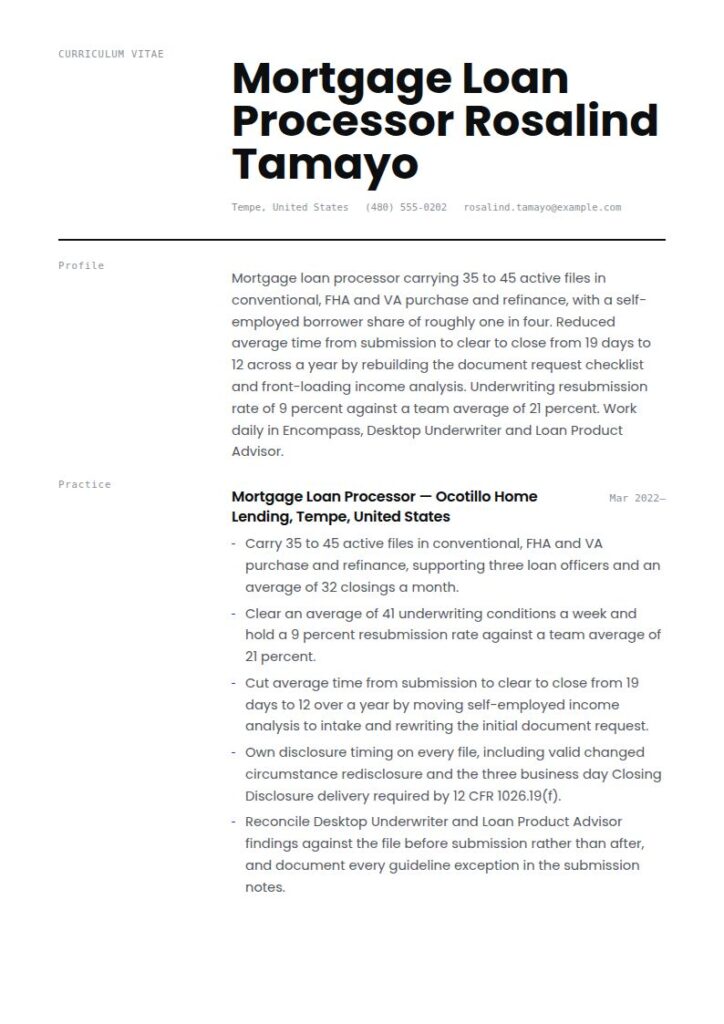
Mortgage loan processor carrying 35 to 45 active files in conventional, FHA and VA purchase and refinance, with a self-employed borrower share of roughly one in four. Reduced average time from submission to clear to close from 19 days to 12 across a year by rebuilding the document request checklist and front-loading income analysis. Underwriting resubmission rate of 9 percent against a team average of 21 percent. Work daily in Encompass, Desktop Underwriter and Loan Product Advisor.
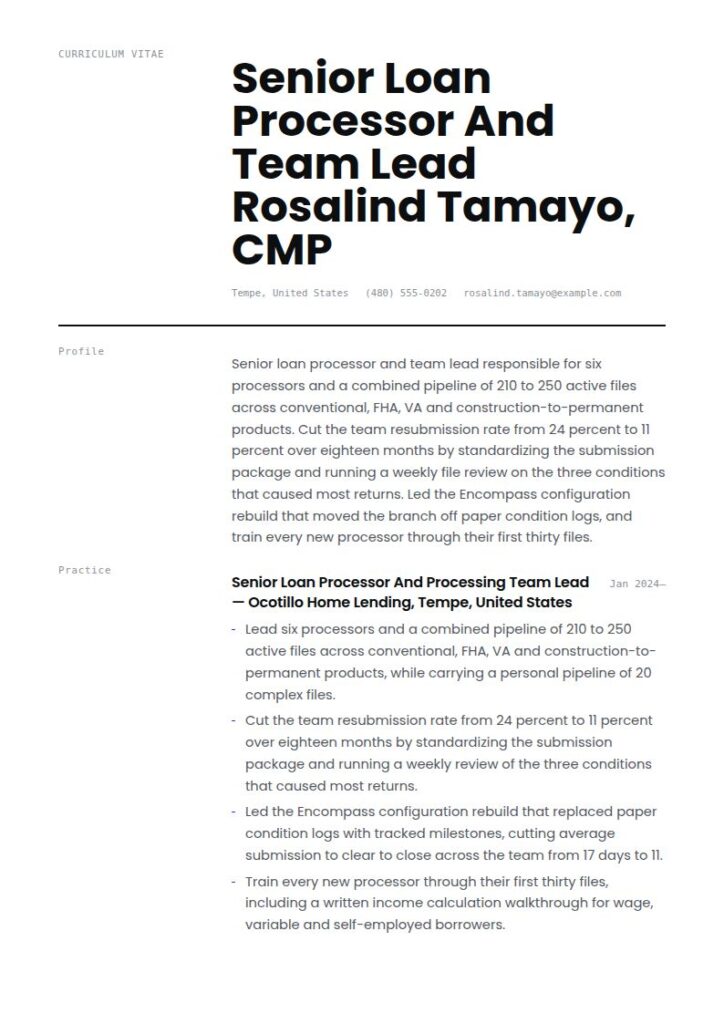
Senior loan processor and team lead responsible for six processors and a combined pipeline of 210 to 250 active files across conventional, FHA, VA and construction-to-permanent products. Cut the team resubmission rate from 24 percent to 11 percent over eighteen months by standardizing the submission package and running a weekly file review on the three conditions that caused most returns. Led the Encompass configuration rebuild that moved the branch off paper condition logs, and train every new processor through their first thirty files.
Right vs wrong: the same loan processor summary, twice
| ✅ Right | ❌ Wrong |
|---|---|
| Carries 35 to 45 active files in conventional, FHA and VA purchase and refinance. | Experienced in processing a wide variety of loan types. |
| Cut submission to clear to close from 19 days to 12 across a year. | Known for fast and efficient file turnaround. |
| Underwriting resubmission rate of 9 percent against a team average of 21 percent. | Extremely detail-oriented with a strong focus on accuracy. |
The right column can be staffed. By contrast, the left column cannot, and the manager reading it is staffing.
Outline your loan processing experience
Lender, city, products, investor set, dates. Then three to five bullets, each one carrying a count, a time, or a rate.
| Instead of | Use |
|---|---|
| Processed residential mortgage loans | Carried 35 to 45 active files in conventional, FHA and VA purchase and refinance |
| Gathered documentation from borrowers | Collected and verified income, asset, title, insurance and flood documentation on roughly 32 closings a month |
| Worked with underwriting to clear conditions | Cleared an average of 41 underwriting conditions a week, with a 9 percent resubmission rate |
| Ensured files were compliant | Owned the disclosure clock on every file: Loan Estimate within three business days of application and Closing Disclosure received three business days before consummation, per 12 CFR 1026.19 |
| Used loan origination software | Encompass daily, plus Desktop Underwriter and Loan Product Advisor findings review and Fannie Mae Day 1 Certainty document validation |
| Helped improve the process | Rebuilt the initial document request so self-employed income items are asked for at intake; submission to clear to close fell from 19 days to 12 |
Mortgage Loan Processor, Ocotillo Home Lending, Tempe, AZ, March 2022 to Present
Carry 35 to 45 active files in conventional, FHA and VA purchase and refinance, with self-employed borrowers on roughly one file in four, supporting three loan officers and an average of 32 closings a month.
Cleared an average of 41 underwriting conditions a week and held a 9 percent resubmission rate against a team average of 21 percent.
Cut average time from submission to clear to close from 19 days to 12 over a year by moving self-employed income analysis to intake and rewriting the initial document request.
Own disclosure timing on every file, including redisclosure on valid changed circumstances and the three business day Closing Disclosure delivery required by 12 CFR 1026.19(f).
Run Encompass, Desktop Underwriter and Loan Product Advisor, and reconcile automated underwriting findings against the file before submission rather than after.
Write the line between processing and originating
Indeed, this is the section that separates a loan processor resume from a loan officer resume, and it is the one most candidates get wrong in the direction that costs them.
Specifically, a processor prepares and documents the file. On the other hand, a loan originator takes the application and offers or negotiates terms. Those are legally distinct roles. Under the SAFE Act rules at 12 CFR 1008.103(b), an individual is a loan originator when, in a commercial context and habitually or repeatedly, they take a residential mortgage loan application and offer or negotiate loan terms for compensation or gain. Taking an application means receiving it "for the purpose of facilitating a decision whether to extend an offer" (12 CFR 1008.103(c)(1)), and offering or negotiating means presenting particular loan terms for consideration or communicating with a borrower to reach a mutual understanding about prospective terms (12 CFR 1008.103(c)(2)).
The exclusions are what protect a processor. For example, an individual who performs "only clerical or support duties" under the supervision of a licensed originator is excluded at 12 CFR 1008.103(e)(3)(i), and so is "An individual who performs only purely administrative or clerical tasks on behalf of a loan originator" at 12 CFR 1008.103(e)(4).
So a resume that says "originated 240 loans" or "quoted rates and structured deals for borrowers" is describing licensed activity. If you are not registered or licensed, that sentence is a problem in a compliance review, and lenders do compliance reviews on their own hires.
Scope: File preparation, documentation and condition clearance under the supervision of licensed originators. Do not take applications, quote rates or negotiate terms.
Products: Conventional conforming, FHA, VA, USDA, and construction-to-permanent. Fannie Mae, Freddie Mac, FHA and VA guideline sets.
Automated underwriting: Desktop Underwriter, Loan Product Advisor. Findings reconciled to the file before submission.
Disclosure control: Initial Loan Estimate timing, valid changed circumstance redisclosure, Closing Disclosure delivery and the three business day waiting period, adverse action referral to the originator.
Systems: Encompass, DocMagic, Optimal Blue rate lock desk entry, county recorder and title portals, IRS income verification transcripts.
One more rule belongs in this block, and it is about what you leave out. Above all, never put a borrower's name, a loan number, a Social Security number, an address or a credit score on a resume, and never tell a real file as an interview story. In other words, that information belongs inside the lender's system and nowhere else. Describe the work by product, volume, process and outcome, which is the level a hiring manager wants anyway.
If you do hold a registration or a license, say which one
Some processors are registered or licensed, usually because they came from origination or because their employer cross-trains. The two credentials are different and are worth distinguishing on the page.
An employee of a bank, credit union or other depository who acts as a mortgage loan originator registers with the Nationwide Multistate Licensing System under 12 CFR 1007.103 and receives a unique identifier. There is no pre-licensure education requirement and no national test for that registration.
An originator at a non-depository lender or broker holds a state license instead, which under the SAFE Act standard published by NMLS means 20 hours of approved pre-licensure education, a score of 75 percent or better on the national test, and 8 hours of continuing education each year (NMLS, accessed September 2026).
If you hold either, put the credential and your unique identifier on the page. If you hold neither, say nothing about it; the absence is normal for a processor, and it is the claim that creates risk.
Build a snapshot of your key skills
Generally, list twelve to fifteen entries in four groups: systems, guidelines, compliance, and the file work itself. Name products, not categories.
Systems: Encompass, DocMagic, Desktop Underwriter, Loan Product Advisor, Optimal Blue, title and county recorder portals
Guidelines: Fannie Mae Selling Guide, Freddie Mac Seller/Servicer Guide, FHA 4000.1 Handbook, VA Lender's Handbook, USDA Guaranteed Housing
File work: Income calculation for wage, variable and self-employed borrowers, asset sourcing and large deposit documentation, title commitment review, flood determination, hazard and mortgage insurance, appraisal review and reconsideration requests
Compliance: TRID disclosure timing and redisclosure, changed circumstance documentation, ECOA adverse action referral, HMDA data entry, fraud and red flag escalation
List your education and certifications
Education is short here. Note, however, that a bachelor's degree is not the standard entry point, and pretending otherwise wastes space that the systems block needs.
Associate of Applied Science, Business Administration, Mesa Community College, Mesa, AZ, 2019
Certifications and training: Certified Mortgage Processor, National Association of Mortgage Processors, 2023. Encompass Administration Essentials, ICE Mortgage Technology, 2024. FHA Underwriting and Documentation, lender-delivered program, 2022. Annual BSA and fair lending training, current.
Continuing education: 12 hours of product and guideline training a year, including Fannie Mae Selling Guide updates and FHA Handbook 4000.1 changes.
Also, annual anti-money laundering and fair lending training is easy to forget. Still, it takes one line, and it tells a hiring manager you have worked inside a real control environment.
Choose the right layout and design
In addition, use a single column, 11 point, no photograph, no skills bars. One or two pages. Keep product names, system names and regulation citations in plain text so a parser reads them as written.
Put the pipeline size and product mix in the first two lines. Give a turn time with a start point and an end point, such as submission to clear to close. State your resubmission or condition return rate if you know it, with the comparison. Name the loan origination system and the automated underwriting engines. Say which agency and investor guideline sets you work to. Keep the disclosure timing language accurate and cite the rule, not a paraphrase.
Do not write that you originated, structured, quoted or negotiated loans if you are not registered or licensed, because that is licensed activity under 12 CFR 1008.103. Do not put any borrower name, loan number, address or credit score on the page. Do not claim a closing volume that belongs to the loan officer rather than to your desk. Do not list "Microsoft Office" above the loan origination system. Do not describe yourself as detail-oriented and leave the numbers out.
Loan processor job market and outlook
Notably, the Bureau of Labor Statistics publishes no Occupational Outlook Handbook profile for loan processor. That is normal: the Handbook covers broad occupations rather than job titles, and processing sits inside a clerical occupation that BLS reports as a group.
Instead, the closest published detailed occupation is loan interviewers and clerks, which BLS reports inside its financial clerks profile. For instance, those workers "Interview applicants and others to get and verify personal and financial information needed to complete loan applications", which is the front half of a processor's job (BLS Occupational Outlook Handbook, financial clerks, May 2025). Meanwhile, loan officers are the step the job leads to, and BLS publishes them separately.
| Bracketing occupation | Employment, 2025 | Projected change, 2025 to 2035 | Annual openings | Median annual wage, May 2025 |
|---|---|---|---|---|
| Loan interviewers and clerks | 169,100 | Reported within financial clerks | Reported within financial clerks | $50,020 |
| Financial clerks, all | 1,144,900 | Decline 4 percent, -45,400 | ~88,000 | $49,990 |
| Loan officers | 283,000 | Growth 1 percent, +3,100 | ~17,100 | $76,690 |
Source: U.S. Bureau of Labor Statistics, Occupational Outlook Handbook, May 2025 wage data and 2025 to 2035 projections.
The clerical half is shrinking and the judgement half is not
BLS projects financial clerk employment to decline 4 percent between 2025 and 2035, a loss of 45,400 jobs, while still producing about 88,000 openings a year from replacement need (BLS Occupational Outlook Handbook, 2025 to 2035 projections). The stated driver is blunt: "Productivity-enhancing technology is expected to limit demand for other clerks, such as payroll and timekeeping clerks, loan interviewers and clerks, brokerage clerks, and insurance claims and policy processing clerks" (BLS, May 2025).
Loan officers, by contrast, are projected to grow 1 percent to 283,000 jobs with about 17,100 openings a year and a May 2025 median of $76,690 (BLS Occupational Outlook Handbook, May 2025 and 2025 to 2035 projections).
Read together, that is a straightforward instruction for your resume. Document collection and data entry are the parts of processing that automation reaches first. Income calculation on a self-employed borrower, a title exception, an appraisal reconsideration, a changed circumstance that has to be documented before redisclosure: those are the parts that hold value, and those are the bullets that should carry your numbers.
Where the work sits: credit intermediation and related activities, which is banks, credit unions and mortgage lenders, employs 16 percent of all financial clerks, behind insurance carriers at 19 percent and healthcare and social assistance at 18 percent (BLS Occupational Outlook Handbook, May 2025). Processing is concentrated in that 16 percent, so your hiring market is narrower than the headline clerical number suggests.
What salary you can expect as a loan processor
Of course, there is no published median for the job title, and quoting one would mean inventing it. Even so, what can be said accurately is where the bracket sits.
Loan interviewers and clerks had a median annual wage of $50,020 in May 2025, and financial clerks overall $49,990, with the lowest 10 percent under $37,440 and the highest 10 percent over $73,760 (BLS Occupational Outlook Handbook, May 2025). By comparison, loan officers, the role most processors move into, had a median of $76,690 in the same cycle, with the highest 10 percent above $153,180 (BLS, May 2025).
Moreover, four things move you inside that range, and all four belong on the resume. To begin with, product complexity matters: jumbo, construction-to-permanent, self-employed income and non-agency files pay above a conforming refinance desk. Pipeline size comes second, since capacity is what a lender is buying. Third is whether you carry conditions to clearance yourself or hand them to a closer. Fourth, and finally, comes system depth, because a processor who can configure Encompass rather than only work in it is doing part of an administrator's job.
Incentives here are usually per file or per closing rather than a share of origination, so the base does most of the work. That is why you should negotiate on pipeline and product mix, and bring the turn time numbers.
Key takeaways for a loan processor resume
- First, put pipeline size and product mix in the first two lines; capacity is the hiring question.
- Give one turn time with a named start and end point, such as submission to clear to close.
- Then state your resubmission or condition return rate, with the comparison that makes it mean something.
- Also name the loan origination system and the automated underwriting engines, not software categories.
- Finally, keep the scope line clean: you prepare and document files, you do not originate them.
- Cite the disclosure rules accurately, because a processor who paraphrases TRID reads as untrained.
- Leave every borrower name, loan number and credit score off the page, permanently.
Build your loan processor resume in 15 minutes with our AI resume builder.
Related accounting and finance resume examples
- Loan officer resume
- Credit analyst resume
- Personal banker resume
- Banker resume
- Bank teller resume
- Bank manager resume
- Compliance officer resume
- Bookkeeper resume
- Accounting assistant resume
- Auditing clerk resume
- Accounts receivable resume
- Accounting and finance resume
Pair it with a matching loan processor cover letter.
Loan processor resume questions, answered
How long should a loan processor resume be?
One page for your first three years. Two pages once you carry a full pipeline across several products, lead or train other processors, or have a system implementation to describe. The second page has to earn itself with counts and turn times, not with a longer list of duties.
What numbers should a loan processor put on a resume?
Five: active files carried, closings a month, conditions cleared in a typical week, time from submission to clear to close, and your resubmission rate. If your employer does not publish a resubmission rate, use the return count instead and say so. A number with a period of time attached reads as evidence; a number on its own reads as decoration.
Do I need an NMLS license to be a loan processor?
Usually not. The SAFE Act rules exclude an individual who performs "only clerical or support duties" under the supervision of a licensed originator, and an individual performing "only purely administrative or clerical tasks on behalf of a loan originator" (12 CFR 1008.103(e)(3)(i) and (e)(4)). Requirements vary by state and by employer, so check the state regulator, but a processor who stays inside that scope is generally not originating.
How do I move from loan processor to loan officer?
Write the origination-adjacent parts of your current job precisely: income analysis, guideline judgement calls, exception packages, and the referral relationships you already service. Then get the credential, which is a registration under 12 CFR 1007.103 if you work for a depository and a state license under the SAFE Act standard if you do not. Loan officers had a May 2025 median of $76,690 against $50,020 for loan interviewers and clerks, so the step is a real one (BLS Occupational Outlook Handbook, May 2025).
What should I write with no mortgage experience?
Write the transferable file work. Title, escrow, insurance, collections, accounts receivable and medical billing all involve collecting documents against a checklist, verifying them against a rule set, and chasing the missing item. Give the volume you handled and the accuracy or turnaround you were measured on, then name the lending training you have completed and the systems you have touched.
Can I mention specific loans I worked on?
Only as a shape, never as a file. Say "self-employed borrower with two years of returns and a partnership K-1, closed in 14 days from submission" and stop there. Borrower names, loan numbers, addresses, account details and credit scores do not belong on a resume or in an interview answer, and a candidate who offers them has told the hiring manager something they did not want to know.