Consumer Loan Officer, NMLS ID 1948220 Rafael Beltran
Consumer Loan Officer
[email protected] | (210) 555-0200 | San Antonio, United States
Profile
Consumer loan officer at a community bank, federally registered as a mortgage loan originator under 12 CFR 1007 with NMLS ID 1948220. Took 340 consumer applications in the past year across auto, personal and home equity lending, funding $9.6 million on 58 percent pull-through, with 41 percent of applications sourced from branch referrals I set up with three retail teams. Handle disclosure timing and adverse action notices on my own files and hold a clean audit record across two internal reviews.
Work Experience
09/2019 - Present, Consumer Loan Officer, Alamo Heights Community Bank, San Antonio, United States
- Take 340 consumer applications a year across auto, personal and home equity lending, funding $9.6 million at 58 percent pull-through.
- Built a branch referral routine with three retail teams that now produces 41 percent of applications, up from 12 percent in my first year.
- Issue disclosures inside the timing rules and refer every declined file for an adverse action notice within the 30 day window at 12 CFR 1002.9(a)(1).
- Registered under 12 CFR 1007.103 and originate a small residential volume under the de minimis exception, four to five loans a year.
- Cleared two internal loan reviews with no documentation or disclosure findings.
07/2018 - 09/2019, Personal Banker, Alamo Heights Community Bank, San Antonio, United States
- Opened deposit accounts and took consumer credit applications for roughly 45 customers a week.
- Completed the bank's credit training program and annual Bank Secrecy Act and fair lending training.
Education
08/2014 - 05/2018, Bachelor of Business Administration, Finance, The University of Texas at San Antonio, San Antonio, United States
Coursework in credit analysis, money and banking, and business law.
Skills
Consumer credit application intake, 80
Income and debt-to-income qualification, 75
Home equity and HELOC products, 70
Branch referral development, 80
ECOA adverse action process, 70
TRID disclosure timing, 60
Encompass and bank core loan system, 70
Languages
English, native
Spanish, native
Certificates
10/2019, Federal Mortgage Loan Originator Registration, Nationwide Multistate Licensing System, under 12 CFR 1007.103, NMLS ID 1948220
Registered as an employee of a depository institution. Unique identifier provided to consumers under 12 CFR 1007.105.
06/2019, Consumer Credit Training Program, Alamo Heights Community Bank
Credit analysis, documentation standards, fair lending and Bank Secrecy Act.
Summary
A loan officer resume is a one to two page document built on the production board: dollars funded, units closed, product mix, pull-through from application to funding, and where the applications came from. This guide gives you three adaptable versions, the registration and licensing split that gates the job, and current Bureau of Labor Statistics pay and outlook.
Loan Officer resume examples by experience level
A loan officer resume is a one to two page document built on the production board. Dollars funded, units closed, what products they were, how many applications became loans, and where those applications came from.
This is one of the few jobs where a hiring manager can check your claim in five minutes. Production is measured, your credential is on a public register, and both of those facts should shape how the page is written. The resume that reads as a sales brochure loses to the one that reads as a production report.
Resume guide for a loan officer resume
This guide and the corresponding loan officer resume example will cover:
- How to write a loan officer resume, section by section
- What belongs on a production board, and how to present it honestly
- Three adaptable summaries: consumer lender, mortgage originator and producing lead
- The difference between a federal registration and a state license, and why it matters
- What the market looks like and what you can expect to earn
How to write a loan officer resume
Six blocks: contact header with your unique identifier, summary, production board, experience, skills and systems, then education, registration and licensing. One page in your first three years, two once you have a multi-year production record or a team.
The unique identifier goes in the header because it is verifiable and because leaving it out looks like an oversight. Your registration or license is a gate, not an achievement, and gates go early.
| Section | What it is answering | Where it goes |
|---|---|---|
| Credential and unique identifier | Can this person legally originate for us, in which states? | Contact header |
| Production board | What did they fund, in what, and how consistently? | Directly under the summary |
| Experience | How did they get the applications, and what happened to them? | Reverse chronological |
| Skills and systems | Can they work our stack and our products from week one? | Its own block |
Put three years of production on the page, not one
One strong year proves a market, not a lender. Three years proves you. Give the annual figures side by side, including the year the market moved against you, because a hiring manager already knows what that year looked like and a resume that quietly omits it invites the question in the interview instead.
Write each year with four numbers: dollars funded, units, purchase share, and pull-through from application to funding. Four numbers times three years fits in a small table and is more persuasive than any paragraph.
If your production dropped, say what you did about it. An originator who moved from refinance to purchase business and rebuilt a referral base is describing the exact skill a sales manager is hiring for.
Run the finished file through the free ATS resume checker before you submit it. Lender recruiting systems parse production numbers and product names into structured fields, and a table that is set as an image disappears entirely.
Choosing the best resume format for a loan officer resume
Reverse chronological, with the production board as a block rather than a section of bullets. One page for your first three years, two once you have a multi-year record, a team, or a book of referral relationships to describe.
Functional formats fail here for a specific reason. Production is annual and it is compared against the market of that year, so a reader needs to see which numbers belong to which twelve months. Strip the dates out and the numbers stop meaning anything.
Include your contact information
| ✅ Right | ❌ Wrong |
|---|---|
| Rafael Beltran | Rafael Beltran |
| Mortgage Loan Originator, NMLS ID 1948220 | Top-producing lending professional |
| Licensed in Texas, New Mexico and Arizona | Licensed mortgage professional |
| (210) 555-0200, [email protected], San Antonio, TX | (210) 555-0200, [email protected] |
Three lines under the name: the role with your unique identifier, the states you are licensed or registered in, and the contact details. A sales manager hiring across a footprint is reading for the second line before anything else.
Make use of a summary
Four sentences: role and credential, annual production, product mix and pull-through, and where the business comes from.
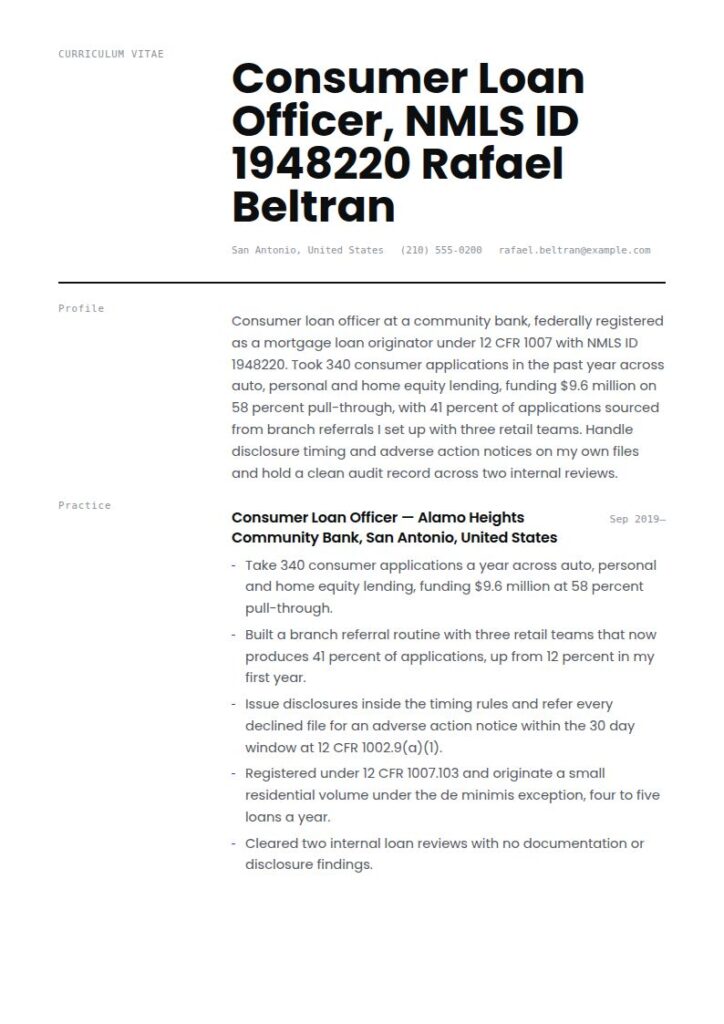
Consumer loan officer at a community bank, federally registered as a mortgage loan originator under 12 CFR 1007 with NMLS ID 1948220. Took 340 consumer applications in the past year across auto, personal and home equity lending, funding $9.6 million on 58 percent pull-through, with 41 percent of applications sourced from branch referrals I set up with three retail teams. Handle disclosure timing and adverse action notices on my own files and hold a clean audit record across two internal reviews.
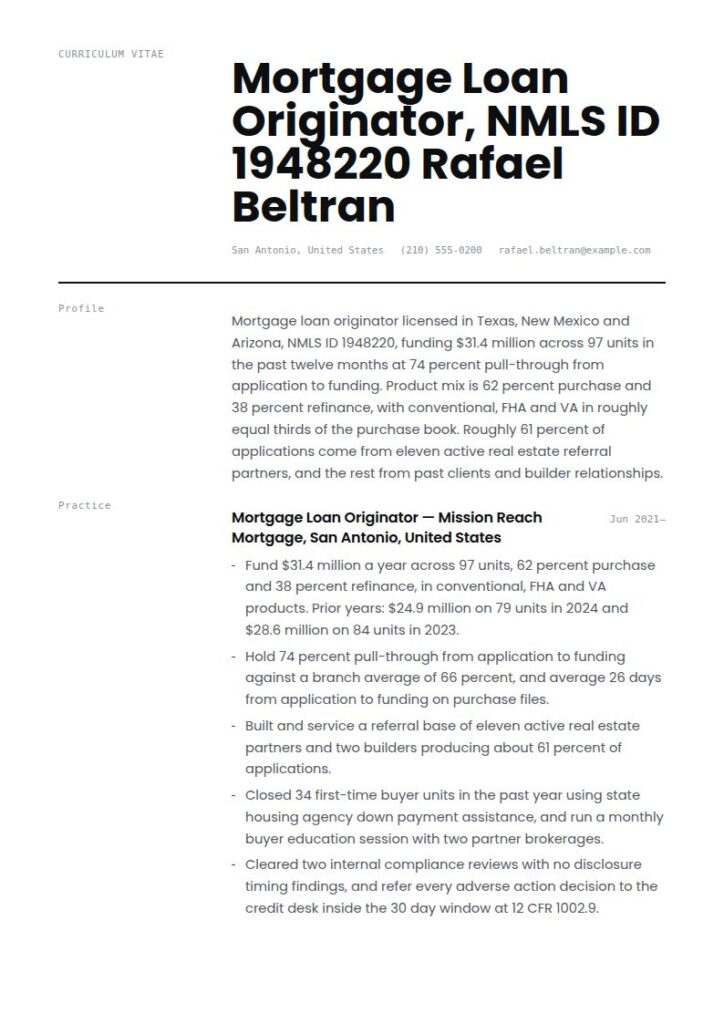
Mortgage loan originator licensed in Texas, New Mexico and Arizona, NMLS ID 1948220, funding $31.4 million across 97 units in the past twelve months at 74 percent pull-through from application to funding. Product mix is 62 percent purchase and 38 percent refinance, with conventional, FHA and VA in roughly equal thirds of the purchase book. Roughly 61 percent of applications come from eleven active real estate referral partners, and the rest from past clients and builder relationships.
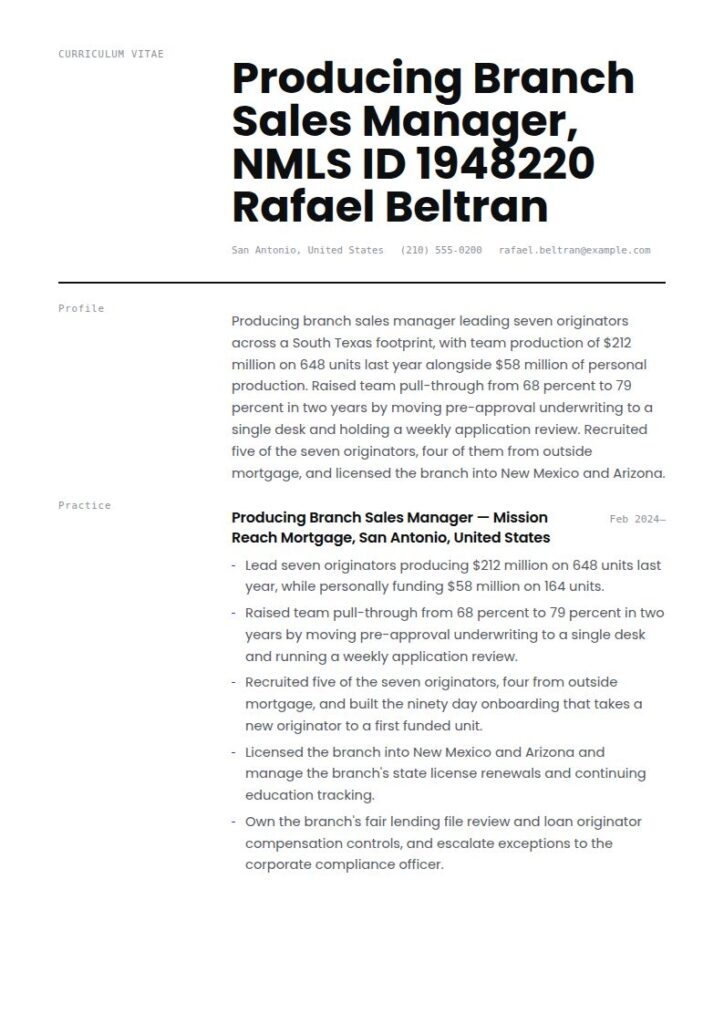
Producing branch sales manager leading seven originators across a South Texas footprint, with team production of $212 million on 648 units last year alongside $58 million of personal production. Raised team pull-through from 68 percent to 79 percent in two years by moving pre-approval underwriting to a single desk and holding a weekly application review. Recruited five of the seven originators, four of them from outside mortgage, and licensed the branch into New Mexico and Arizona.
Right vs wrong: the same loan officer summary, twice
| ✅ Right | ❌ Wrong |
|---|---|
| Funded $31.4 million across 97 units in the past twelve months at 74 percent pull-through. | Consistently exceeded production targets and ranked among the top producers. |
| Mix is 62 percent purchase and 38 percent refinance, conventional, FHA and VA. | Experienced across a full range of mortgage products. |
| 61 percent of applications come from eleven active real estate referral partners. | Built strong relationships throughout the local real estate community. |
The right column can be modeled into a forecast. The left column cannot, and the sales manager reading it is building a forecast.
Outline your lending experience
Lender, city, the states you originated in, products, dates. Then three to five bullets, each carrying a number that a production report would recognize.
| Instead of | Use |
|---|---|
| Originated residential mortgage loans | Funded $31.4 million across 97 units in twelve months, 62 percent purchase |
| Built relationships with real estate agents | Built a referral base of eleven active agent partners producing 61 percent of applications |
| Exceeded sales goals | Held 74 percent pull-through from application to funding against a branch average of 66 percent |
| Guided borrowers through the process | Averaged 26 days from application to funding on purchase files, with pre-approval turned in 24 hours |
| Ensured regulatory compliance | Issued Loan Estimates inside the three business day window at 12 CFR 1026.19(e) and cleared two internal audits with no disclosure findings |
| Worked with first-time buyers | Closed 34 first-time buyer units using state housing agency down payment assistance, 22 of them FHA |
Mortgage Loan Originator, Mission Reach Mortgage, San Antonio, TX, licensed in TX, NM and AZ, June 2021 to Present
Fund $31.4 million a year across 97 units, 62 percent purchase and 38 percent refinance, in conventional, FHA and VA products.
Hold 74 percent pull-through from application to funding against a branch average of 66 percent, and average 26 days from application to funding on purchase files.
Built and service a referral base of eleven active real estate partners and two builders that produces about 61 percent of applications; the remainder comes from past clients and direct enquiries.
Closed 34 first-time buyer units in the past year using state housing agency down payment assistance, and run a monthly buyer education session with two partner brokerages.
Cleared two internal compliance reviews with no disclosure timing findings, and refer every adverse action decision to the credit desk inside the 30 day window at 12 CFR 1002.9.
Write your production board: volume, units, mix and pull-through
This is the block that separates a loan officer resume from every other sales resume, and it is worth building carefully because a sales manager will read it before they read anything else.
Five measures do the work. Dollars funded says the size of the desk. Units says how hard that volume was to produce, because thirty units at $400,000 is a different job from six units at $2 million. Product mix says what you can actually do, since a book that is 90 percent refinance in a falling-rate year proves less than a purchase book. Pull-through, the share of applications that became funded loans, says whether you qualify borrowers properly or spray applications at underwriting. Referral source says whether your production is portable.
Production, last three calendar years, Mission Reach Mortgage, NMLS ID 1948220
2025: $31.4M funded, 97 units, 62 percent purchase, 74 percent pull-through, 26 day average application to funding
2024: $24.9M funded, 79 units, 71 percent purchase, 71 percent pull-through, 29 day average
2023: $28.6M funded, 84 units, 48 percent purchase, 69 percent pull-through, 31 day average
Product split across the period: conventional 44 percent, FHA 29 percent, VA 21 percent, state housing agency and other 6 percent
Referral sources, 2025: eleven active real estate partners 61 percent, past clients and self-generated 24 percent, two builder relationships 11 percent, branch and web leads 4 percent
Two honesty rules make this block work rather than backfire. Report the same measures every year, including the weak one, because selective years are obvious to anyone who has run a sales desk. And say whose numbers they are: personal production, team production, or personal production inside a team you led. A producing manager who blurs the two has created a question that will be asked in the interview and answered badly.
Leave the borrowers out of it entirely. No client names, no property addresses, no loan numbers, no credit scores, and no story about a specific file, however good the story is. Describe the book by product, volume, source and outcome. A referral partner's business name can go on the page only if the relationship is yours to describe and you are not implying an exclusivity you do not have.
Build a snapshot of your key skills
Twelve to fifteen entries in four groups: products and programs, origination systems, the sales mechanics, and compliance. Name products and systems, not adjectives.
Products and programs: Conventional conforming, FHA, VA, USDA Guaranteed Housing, state housing agency down payment assistance, home equity and HELOC, construction-to-permanent, jumbo
Systems: Encompass, Blend point of sale, Optimal Blue pricing and lock desk, Desktop Underwriter, Loan Product Advisor, Salesforce and Total Expert
Origination mechanics: Pre-approval underwriting, income and asset qualification, rate lock strategy, referral partner development, builder and agent co-marketing, past client retention campaigns
Compliance: TRID disclosure timing and redisclosure, ECOA adverse action, fair lending and comparative file review, loan originator compensation rules, HMDA data collection at application
Compliance belongs in the skills block even though it is not a selling point, because the reason lenders lose originators is almost never production. Put the fair lending and disclosure lines in and let them do their quiet work.
List your education, registration and licensing
Credential first, education second. The credential is the gate.
Mortgage Loan Originator license, Texas Department of Savings and Mortgage Lending, NMLS ID 1948220. Also licensed in New Mexico and Arizona. Current on the eight hours of annual continuing education required under the SAFE Act.
Federal registration under 12 CFR 1007.103 held from 2019 to 2021 while employed by a depository institution, under the same NMLS unique identifier.
Bachelor of Business Administration, Finance, The University of Texas at San Antonio, San Antonio, TX, 2018
Training: Certified Mortgage Advisor program, lender-delivered, 2023. VA Lender Training, Department of Veterans Affairs regional loan center, 2022. Annual Bank Secrecy Act, fair lending and loan originator compensation training, current.
Registration and license are two different credentials, and the difference is the job
Every residential mortgage loan originator sits in the Nationwide Multistate Licensing System, but not on the same terms, and a resume that says only "NMLS licensed" is imprecise in a way a lender will notice.
If you originate as an employee of a bank, credit union or other depository, you are federally registered. Regulation G at 12 CFR 1007.103 requires each such employee acting as a mortgage loan originator to register and obtain a unique identifier. There is no pre-licensure education requirement and no national test, though 12 CFR 1007.105 requires the institution to make registrants' identifiers available to consumers and requires you to give yours on request, before acting as an originator, and in your first written communication with a consumer. A de minimis exception at 12 CFR 1007.101(c)(2)(i) covers an employee who originated five or fewer residential mortgage loans in the preceding twelve months.
If you originate for a non-depository lender or a broker, you are state licensed, and the bar is higher. The SAFE Act standard published by NMLS is 20 hours of approved pre-licensure education, made up of 3 hours of federal law and regulations, 3 hours of ethics covering fraud, consumer protection and fair lending, and 2 hours of non-traditional mortgage lending; a score of 75 percent or better on the national test; 8 hours of continuing education each year on the same 3 / 3 / 2 breakdown; fingerprints for an FBI criminal history background check; and authorization for NMLS to obtain a credit report (NMLS, accessed September 2026).
Write which one you hold, in which states, and give the identifier. If you have held both, say so, because the transition from a registered bank role to a licensed non-bank role is a real piece of your history and the identifier stays with you.
Note that commercial, consumer and auto lending officers are not covered by the SAFE Act at all, since it applies to residential mortgage origination. If that is your lane, say what you do hold instead: the bank's internal lending authority, a credit training program, or a commercial credit certification.
Choose the right layout and design
Single column, 11 point, one or two pages, no photograph, no charts. Set the production board as plain lines or a simple table, never as an exported graphic, because recruiting systems cannot read an image and a sales manager cannot paste it into a spreadsheet.
Put your unique identifier and licensed states in the header. Give three years of production, including the weak year. Report dollars, units, mix, pull-through and source together. Say whether the numbers are personal or team. Name your systems and the down payment assistance programs you actually use. Keep one compliance line on the page, since disclosure timing is where originators get into trouble.
Do not write "top producer" without the numbers underneath it. Do not report a rank without the size of the group. Do not claim team production as personal production. Do not put a client name, property address, loan number or credit score on the page. Do not imply an exclusive relationship with a referral partner. Do not use an email address that reads as a marketing brand rather than a person.
Loan officer job market and outlook
A large, slow-growing occupation with steady replacement demand and an unusually wide pay distribution.
| Measure | Value |
|---|---|
| Loan officer jobs, 2025 | 283,000 |
| Projected change, 2025-35 | 1% (slower than average), +3,100 |
| Projected annual openings | ~17,100 |
| Typical entry-level education | Bachelor's degree |
| Median annual wage, May 2025 | $76,690 |
Source: U.S. Bureau of Labor Statistics, Occupational Outlook Handbook, 2025-35 projections and May 2025 wage data.
The spread inside this occupation is the story
Loan officers had a median annual wage of $76,690 in May 2025, but the lowest 10 percent earned less than $39,430 and the highest 10 percent more than $153,180 (BLS Occupational Outlook Handbook, May 2025). That is a range of nearly four to one inside a single occupation, and almost all of it is production and product.
Setting explains part of it. Loan officers working for automobile dealers had a median of $106,000, management of companies and enterprises $79,570, and credit intermediation and related activities, which is banks, credit unions and mortgage lenders and employs 80 percent of the occupation, $76,070 (BLS, May 2025).
Employment is projected to grow just 1 percent between 2025 and 2035, an increase of 3,100 jobs, with about 17,100 openings a year (BLS, 2025 to 2035 projections). So the seats turn over but the occupation is not expanding, which means a hiring decision is nearly always a replacement decision. That is why the production board matters more than the narrative: a sales manager filling a seat is replacing a known number.
Where the jobs sit:
| Setting | Share of employment | Median annual wage (May 2025) |
|---|---|---|
| Credit intermediation and related activities | 80% | $76,070 |
| Management of companies and enterprises | 4% | $79,570 |
| Automobile dealers | 4% | $106,000 |
Source: U.S. Bureau of Labor Statistics, Occupational Outlook Handbook, May 2025.
What salary you can expect as a loan officer
The median annual wage for loan officers was $76,690 as of May 2025, with the lowest 10 percent under $39,430 and the highest 10 percent above $153,180 (BLS Occupational Outlook Handbook, May 2025).
Those figures include base salary and commission, which is why the distribution is so wide. A salaried consumer lender at a community bank and a commissioned mortgage originator with a purchase book are in the same BLS occupation and almost nothing else. Read the median as a midpoint between two different pay models rather than as a typical salary.
What moves you inside the range is production, mix and portability. Volume is obvious. Mix matters because a purchase book survives a rate move and a refinance book does not. Portability matters most of all: an originator whose applications come from eleven relationships they built is buying a stronger position in a compensation conversation than one whose applications come from a branch lobby or a lead vendor, because only the first is coming with them.
Key takeaways for a loan officer resume
- Put your unique identifier and licensed states in the contact header.
- Give three years of production, including the year the market was against you.
- Report dollars, units, product mix, pull-through and referral source together.
- Say plainly whether the numbers are personal, team, or personal inside a team.
- Name whether you are federally registered or state licensed; they are different credentials.
- Keep one compliance line on the page, because disclosure timing is where originators fall over.
- Leave every borrower detail out and never tell a real file as a story.
Build your loan officer resume in 15 minutes with our AI resume builder.
Related accounting and finance resume examples
- Loan processor resume
- Credit analyst resume
- Personal banker resume
- Banker resume
- Bank manager resume
- Bank teller resume
- Compliance officer resume
- Financial advisor resume
- Financial analyst resume
- Finance manager resume
- Investment banker resume
- Accounting and finance resume
Pair it with a matching loan officer cover letter.
Loan officer resume questions, answered
How long should a loan officer resume be?
One page for your first three years. Two once you have a multi-year production record, a team, or a referral book worth describing. The production board earns its space; a longer list of responsibilities does not.
Do I need an NMLS number to be a loan officer?
For residential mortgage origination, yes, in one of two forms. An employee of a depository institution registers federally under 12 CFR 1007.103 and receives a unique identifier with no pre-licensure education or test. An originator at a non-depository lender or broker holds a state license, which under the SAFE Act standard means 20 hours of pre-licensure education, 75 percent or better on the national test, and 8 hours of continuing education a year (NMLS, accessed September 2026). Commercial, consumer and auto lending sit outside the SAFE Act entirely.
What if my production dropped in a bad year?
Put it on the page with the others and add one line about what you changed. Every sales manager in lending has lived through the same years, and a candidate who reports three years honestly is more credible than one who reports a single good one. Silence about a year reads as a number you are hiding.
How do I write a loan officer resume with no origination history?
Write the transferable production. If you came from processing, give the pipeline you carried, the products you know and the guideline judgement you exercised. If you came from retail banking or another sales role, give applications taken, conversion, and where the business came from. Then name the credential you hold or the date you are sitting the test, since an unregistered candidate for a residential role is a no whatever else the page says.
Should I list my ranking inside the company?
Only with the size of the group and the period. "Ranked 4th of 61 originators in 2025" is information. "Top producer" is not, and a reader who has to ask how many people were in the ranking has already discounted it.
Can I name my referral partners on a resume?
Describe the base, not the people. "Eleven active real estate partners producing 61 percent of applications, plus two builder relationships" tells a sales manager what they want to know about portability without naming a firm you cannot speak for. Never suggest an exclusive arrangement, and never list an individual agent or borrower.