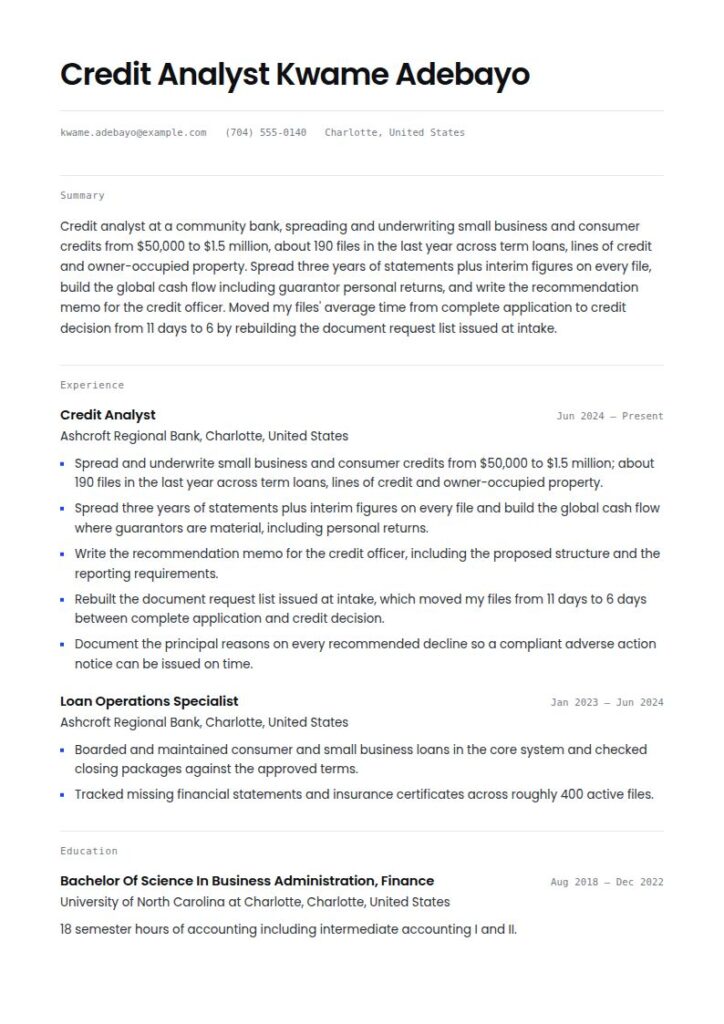
Credit Analyst Kwame Adebayo
Credit Analyst
[email protected] | (704) 555-0140 | Charlotte, United States
Profile
Credit analyst at a community bank, spreading and underwriting small business and consumer credits from $50,000 to $1.5 million, about 190 files in the last year across term loans, lines of credit and owner-occupied property. Spread three years of statements plus interim figures on every file, build the global cash flow including guarantor personal returns, and write the recommendation memo for the credit officer. Moved my files' average time from complete application to credit decision from 11 days to 6 by rebuilding the document request list issued at intake.
Work Experience
06/2024 - Present, Credit Analyst, Ashcroft Regional Bank, Charlotte, United States
- Spread and underwrite small business and consumer credits from $50,000 to $1.5 million; about 190 files in the last year across term loans, lines of credit and owner-occupied property.
- Spread three years of statements plus interim figures on every file and build the global cash flow where guarantors are material, including personal returns.
- Write the recommendation memo for the credit officer, including the proposed structure and the reporting requirements.
- Rebuilt the document request list issued at intake, which moved my files from 11 days to 6 days between complete application and credit decision.
- Document the principal reasons on every recommended decline so a compliant adverse action notice can be issued on time.
01/2023 - 06/2024, Loan Operations Specialist, Ashcroft Regional Bank, Charlotte, United States
- Boarded and maintained consumer and small business loans in the core system and checked closing packages against the approved terms.
- Tracked missing financial statements and insurance certificates across roughly 400 active files.
Education
08/2018 - 12/2022, Bachelor of Science in Business Administration, Finance, University of North Carolina at Charlotte, Charlotte, United States
18 semester hours of accounting including intermediate accounting I and II.
Skills
Statement spreading and normalisation, 80
Global cash flow including guarantors, 75
Debt service coverage testing, 75
Credit memo authorship, 70
Adverse action reason documentation, 75
Excel to a modeling standard, 85
Languages
English, native
French, professional working
Certificates
11/2024, Commercial credit training program, Ashcroft Regional Bank
Accounting and statement analysis, cash flow construction, loan structuring and documentation.
Summary
A credit analyst resume is a one to two page document about decisions: how many credits you underwrite, what you spread, which ratios and covenants you test, the risk rating you recommend, and who approves the memo you write. This guide gives you three adaptable versions, a worked credit from spread to decision, and current Bureau of Labor Statistics and Federal Reserve figures.
Credit Analyst resume examples by experience level
A credit analyst resume is a one to two page document about decisions. How many credits you underwrite in a year, what you spread, which ratios and covenants you actually test, what risk rating you recommend, and who signs the memo you write.
Almost every credit analyst resume says the same four things: analyzed financial statements, prepared credit memoranda, monitored a loan portfolio, assessed risk. None of those tells a credit officer what they need before handing you a file: what size of credit you can underwrite without supervision, and whether your conclusions hold up.
The first fork on this page is commercial against consumer, because they are different jobs with the same title and a resume that does not choose one reads as unfocused to both.
Resume guide for a credit analyst resume
This guide and the corresponding credit analyst resume example will cover:
- How to write a credit analyst resume, section by section
- Commercial against consumer, and how the page changes between them
- Three adaptable summaries, and how to write one credit from spread to decline
- What the job market looks like and what you can expect to earn
How to write a credit analyst resume
Five blocks: contact header, summary, portfolio line, experience, and education with certifications. One page for your first five years, two once you review other analysts' work or carry your own portfolio.
| Section | What it is answering | Where it goes |
|---|---|---|
| Portfolio line | What size and type of credit does this person underwrite, and how many? | Directly under the summary |
| Experience | What did they spread, test, rate, recommend and see approved? | Reverse chronological, one number per bullet |
| Credit record | Can they take a file from spread to decision without supervision? | Its own block after experience |
Say which credit you underwrite before you say anything else
"Credit analyst" covers two occupations and five or six products. State yours in one line and a reader can place you immediately.
On the commercial side, name the product and the exposure band: "commercial and industrial credits and owner-occupied commercial real estate, $2 million to $25 million of exposure, middle market manufacturing and distribution." On the consumer side, name the product and the volume: "consumer instalment and credit card applications, 60 to 80 decisions a week against a scorecard."
Then give the count. Credits underwritten a year, or files decisioned a week, is the throughput figure your next employer staffs against, and almost nobody puts it on the page.
Run the finished file through the ATS resume checker. Bank recruiting filters on product names, systems and credentials, and all three are the first casualties of a two column template.
Choosing the best resume format for a credit analyst resume
Reverse chronological, single column. One page for your first five years; two once you review other analysts, sit on a credit committee or carry a named portfolio.
A functional format fails here for a specific reason. Credit is judged on progression of exposure: the size of credit you were trusted with this year against three years ago, and when your recommendations started going to committee rather than to a single officer. A format that hides that sequence hides the only trend a credit officer looks for.
Include your contact information
| ✅ Right | ❌ Wrong |
|---|---|
| Kwame Adebayo | Kwame Adebayo |
| Senior Credit Analyst, Commercial and Industrial | Finance professional with strong analytical skills |
| $2m to $25m exposures, 74 credits underwritten last year | Experienced in credit risk assessment |
| (704) 555-0140, [email protected], Charlotte, NC | (704) 555-0140, [email protected] |
The third line is the one that gets you read. Exposure band and annual credit count together answer what a hiring credit officer is actually asking: what they could hand you in week two.
Make use of a summary
Four lines: the credit you underwrite and its size band, the annual volume, one thing you own in the process, and one outcome.
Credit analyst at a community bank, spreading and underwriting small business and consumer credits from $50,000 to $1.5 million, about 190 files in the last year across term loans, lines of credit and owner-occupied property. Spread three years of statements plus interim figures on every file, build the global cash flow including guarantor personal returns, and write the recommendation memo for the credit officer. Moved my files' average time from complete application to credit decision from 11 days to 6 by rebuilding the document request list issued at intake.
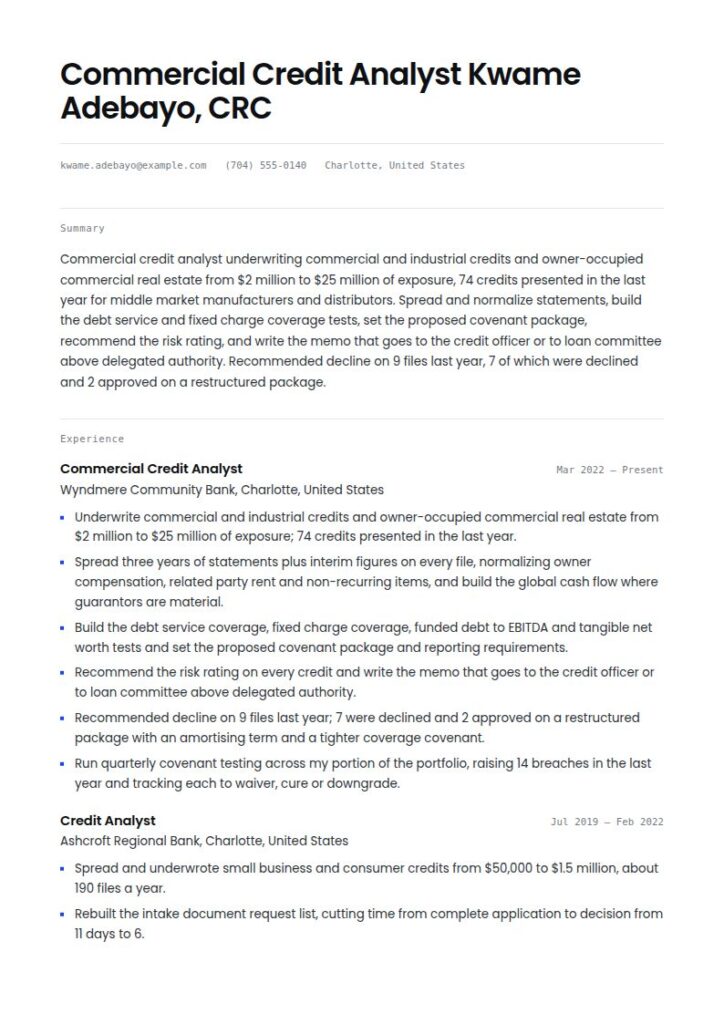
Commercial credit analyst underwriting commercial and industrial credits and owner-occupied commercial real estate from $2 million to $25 million of exposure, 74 credits presented in the last year for middle market manufacturers and distributors. Spread and normalize statements, build the debt service and fixed charge coverage tests, set the proposed covenant package, recommend the risk rating, and write the memo that goes to the credit officer or to loan committee above delegated authority. Recommended decline on 9 files last year, 7 of which were declined and 2 approved on a restructured package.
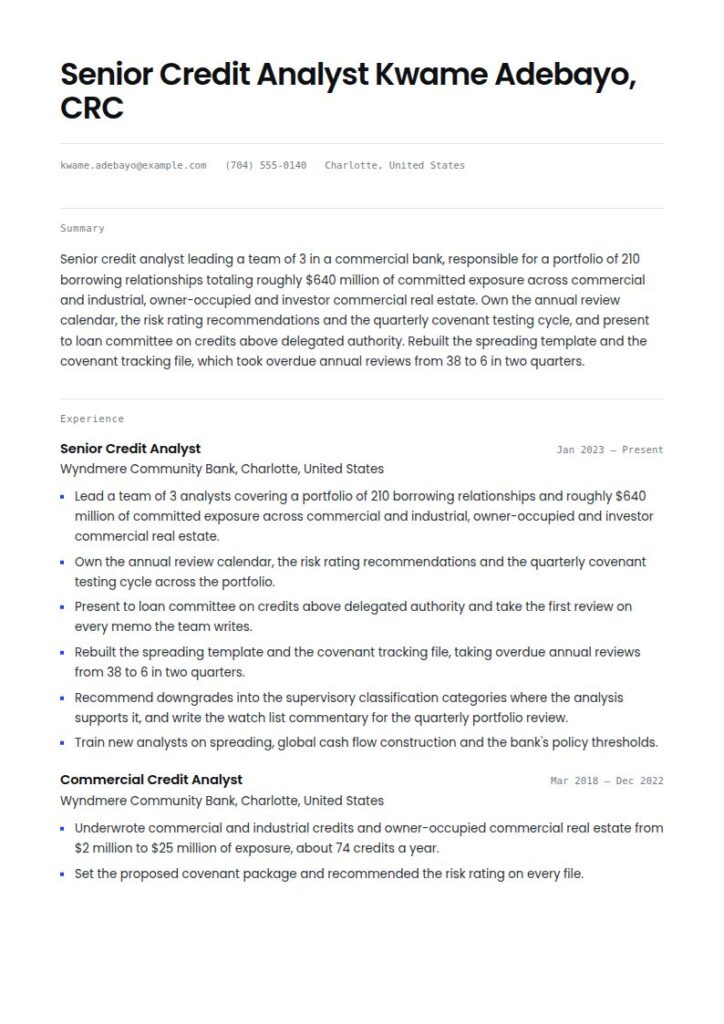
Senior credit analyst leading a team of 3 in a commercial bank, responsible for a portfolio of 210 borrowing relationships totaling roughly $640 million of committed exposure across commercial and industrial, owner-occupied and investor commercial real estate. Own the annual review calendar, the risk rating recommendations and the quarterly covenant testing cycle, and present to loan committee on credits above delegated authority. Rebuilt the spreading template and the covenant tracking file, which took overdue annual reviews from 38 to 6 in two quarters.
Right vs wrong: the same credit analyst summary, twice
| ✅ Right | ❌ Wrong |
|---|---|
| 74 credits presented last year, $2 million to $25 million of exposure, middle market manufacturing and distribution. | Analyzed financial statements and assessed creditworthiness for a portfolio of commercial clients. |
| Set the proposed covenant package and recommend the risk rating on every file. | Prepared credit memoranda and made recommendations to management. |
| Recommended decline on 9 files, 7 declined and 2 approved on a restructured package. | Identified and mitigated credit risk across the loan portfolio. |
The right column describes somebody who decides things. The left column describes somebody who produces documents, which is what a credit officer will assume if you do not say otherwise.
Outline your credit analyst experience
Institution, what it lends and to whom, the size band you cover, and dates. Then four to six bullets per role, each with a number and each naming a product, a test, a rating or an outcome.
| Instead of | Use |
|---|---|
| Analyzed financial statements of borrowers | Spread three years of statements plus interim figures on 74 credits a year, normalizing owner compensation, rent and non-recurring items |
| Prepared credit memoranda | Write the credit memo on every file: the proposed structure, the covenant package and the recommended risk rating |
| Monitored covenant compliance | Run quarterly covenant testing across 210 relationships, raising 14 breaches last year and tracking each to waiver, cure or downgrade |
Commercial Credit Analyst, Wyndmere Community Bank, Charlotte, NC, March 2022 to Present
Underwrite commercial and industrial credits and owner-occupied commercial real estate from $2 million to $25 million of exposure for middle market manufacturers and distributors; 74 credits presented last year.
Spread three years of statements plus interim figures on every file, normalizing owner compensation, rent to related parties and non-recurring items, and build the global cash flow where guarantors are material.
Build the debt service coverage, fixed charge coverage, funded debt to EBITDA and tangible net worth tests, and set the proposed covenant package.
Recommend the risk rating on every credit and write the memo that goes to the credit officer, or to loan committee above delegated authority.
Write one credit from spread to decision, including the one you declined
This block separates a credit analyst resume from a general finance resume, and almost nobody writes it. Take one representative credit and show it end to end in labeled lines, describing the borrower only by industry and size band.
Spread: Three years of reviewed statements plus a nine-month interim for a middle market metal fabricator in the $30 million to $60 million revenue band, normalizing owner compensation, related party rent and a non-recurring insurance recovery. Global cash flow includes two guarantors' personal returns.
Tests: Debt service coverage 1.38x on trailing twelve month cash flow against a 1.25x policy floor; fixed charge coverage 1.19x; funded debt to EBITDA 2.9x; tangible net worth and working capital both trending up; advance rates of 80 percent on eligible receivables and 50 percent on eligible inventory.
Structure and covenants: $8 million revolving line on a monthly borrowing base, $4.5 million amortising term facility, minimum fixed charge coverage of 1.20x tested quarterly, maximum funded debt to EBITDA of 3.50x stepping down annually, quarterly statements.
Rating and recommendation: A pass grade on the bank's internal scale with a watch flag on customer concentration, approved by the senior credit officer within delegated authority.
Declined: Recommended decline on a distribution business where the earnings quality work showed two years of margin supported by a single non-contractual supplier rebate. Taken back as a smaller secured facility with a tighter covenant, which was approved.
Five rules govern that block.
Give the ratios you test, with the policy threshold beside them. A coverage number on its own is decoration; "1.38x against a 1.25x policy floor" shows you know the bank's appetite.
Say what you proposed, not only what you calculated. Covenant levels, testing frequency, reporting requirements, advance rates and amortisation are the analyst's proposals in most shops, and they show judgement rather than arithmetic.
Name the rating and the approver. A recommendation that went to a senior credit officer within delegated authority is a different claim from one that went to loan committee. Describe internal scales generically: a pass grade, a watch flag, a downgrade.
Write the decline. The recommendation not to lend is the most underweighted line on a credit resume. The analyst's value is in the files that should not reach committee and in the restructures that make a marginal credit bankable.
Keep the borrower invisible. Industry, size band and structure are describable. A name, an address, a loan number or a guarantor's personal figures are not.
The regulatory vocabulary sits underneath your internal scale
Every bank runs its own internal risk rating scale, and the grades are not portable. What is common is the supervisory classification layer underneath, and using it correctly signals that you have worked inside an examined institution.
Under the interagency Uniform Agreement on the Classification of Assets, a Substandard asset is "inadequately protected by the current sound worth and paying capacity of the obligor or of the collateral pledged" with a "well-defined weakness or weaknesses that jeopardize the liquidation of the debt". A Doubtful asset has "all the weaknesses inherent in one classified Substandard with the added characteristic that the weaknesses make collection or liquidation in full" highly questionable and improbable. A Loss asset is "considered uncollectible and of such little value that their continuance as bankable assets is not warranted" and "should be promptly charged off" (FDIC, FIL-70-2004, issued jointly by the federal banking agencies).
Two uses for that. Write internal grades generically rather than by number, because "a 5 on our scale" means nothing outside your bank. And if you have recommended a downgrade into the classified categories, say so in the agencies' words: that work is the hardest to learn and the easiest to verify in an interview.
Build a snapshot of your key skills
Twelve to sixteen entries in three groups: analysis, structure and monitoring, and systems. Keep the systems list to things you would be happy to be tested on.
Analysis: Statement spreading and normalisation, Global cash flow including guarantors, Debt service and fixed charge coverage, Funded debt to EBITDA and leverage testing, Borrowing base analysis, Collateral appraisal review, Sensitivity and stress cases
Structure and monitoring: Covenant package design, Advance rates and eligibility criteria, Risk rating recommendation, Annual review calendar ownership, Quarterly covenant testing, Watch list and downgrade recommendations
Systems: Moody's Analytics credit lending solutions, nCino, Excel to a modeling standard, Core banking extracts, Power BI for portfolio reporting
Written: Credit memo authorship, Loan committee presentation, Annual review write-ups
List your education and certifications
Degree with the accounting depth spelled out, then formal credit training, then certifications with dates.
Bachelor of Science in Business Administration, Finance, University of North Carolina at Charlotte, Charlotte, NC, 2019. 18 semester hours of accounting including intermediate accounting I and II.
Credit Risk Certification (CRC), ProSight Financial Association, 2023. Recertification due 2026.
Commercial credit training program, completed 2019: statement analysis, cash flow construction, loan structuring and documentation.
Additional: Moody's Analytics commercial lending coursework, 2021.
Three points about credentials here, each from the body that sets them.
No license gates the job. Unlike a mortgage loan originator, who must hold a Mortgage Loan Originator license with prelicensing courses, a national examination and background and credit checks (BLS Occupational Outlook Handbook, May 2025), a credit analyst needs no registration. Our loan officer resume example covers that regime.
The Credit Risk Certification is the credential most often named in commercial credit postings. Awarded by ProSight Financial Association, it expects "a minimum of three years of credit risk experience" with five recommended, and is examined over 120 scored multiple choice questions across seven content domains including financial assessment, cash flow quality, collateral and problem loan actions. It is valid for three years and requires 45 continuing education credits in that period (ProSight Financial Association, accessed September 2026).
Accounting depth is what gets checked. Write the number of accounting semester hours you hold and name intermediate accounting if you took it, because spreading a statement is an accounting task. The CFA charter appears on the investment side rather than in bank credit; our financial analyst resume example sets out its requirements.
Choose the right layout and design
Single column, 11 or 12 point, no graphics. Set the credit record as labeled lines rather than prose, and spell out the ratio names so a keyword filter finds them.
Say commercial or consumer in the first line, with the product and the exposure band. Give the annual credit count or the weekly decision volume. Name the ratios you test and the policy threshold beside them. State what you proposed: covenants, advance rates, reporting, amortisation. Name the rating you recommended and who approved it.
Do not name a borrower, a guarantor or a loan number, or describe a borrower specifically enough to identify it. Do not put a borrower's revenue, EBITDA or balances on the page. Do not attach a credit memo, a spread or a committee paper as a work sample. Do not claim approval authority you do not hold. Do not write "assessed credit risk" when the ratio, the threshold and the outcome exist.
A declining job title sitting next to a growing one
The Bureau of Labor Statistics counted 64,700 credit analysts in 2025, with employment projected to fall 4 percent to 62,000 by 2035, a decline of 2,800 jobs, and a median annual wage of $83,510 in May 2025 (BLS Occupational Outlook Handbook, Data for Occupations Not Covered in Detail, published 27 August 2026).
Next to it, financial risk specialists, separately measured inside the financial analysts profile, had a median annual wage of $117,330 in May 2025, and 35 percent of them work in credit intermediation and related activities, that is, in banks (BLS Occupational Outlook Handbook, May 2025).
Those two facts are a resume instruction. Scorecard-driven and template-driven credit work is the part of this occupation that is shrinking, while judgement work on structure, covenants, ratings, stress cases and concentration is measured in the occupation next door and pays substantially more. Write the judgement, not the template.
Credit analyst job market and outlook
The Bureau of Labor Statistics publishes no detailed Handbook profile for credit analysts. The occupation appears on the Data for Occupations Not Covered in Detail page, so the figures below are all the current cycle publishes for the title.
| Measure | Value |
|---|---|
| Credit analyst jobs, 2025 | 64,700 |
| Projected employment, 2035 | 62,000 |
| Projected change, 2025-35 | -4% (decline), -2,800 |
| Typical entry-level education | Bachelor's degree |
| Work experience in a related occupation | None |
| Median annual wage, May 2025 | $83,510 |
Source: U.S. Bureau of Labor Statistics, Occupational Outlook Handbook, Data for Occupations Not Covered in Detail, May 2025 wage data and 2025 to 2035 projections, published 27 August 2026.
That table publishes no annual openings and no wage percentiles, so this page quotes neither. Three published occupations bracket the work:
| Adjacent occupation | Employment, 2025 | Projected change, 2025 to 2035 | Annual openings | Median annual wage, May 2025 |
|---|---|---|---|---|
| Loan officers | 283,000 | 1 percent growth, +3,100 | ~17,100 | $76,690 |
| Financial examiners | 70,000 | 9 percent growth, +6,500 | ~4,500 | $94,160 |
| Financial analysts | 443,100 | 7 percent growth, +32,000 | ~29,500 | $103,570 |
Source: U.S. Bureau of Labor Statistics, Occupational Outlook Handbook, May 2025 wage data and 2025 to 2035 projections.
The lending environment behind those numbers is worth a sentence, because interviewers ask. In the July 2026 Senior Loan Officer Opinion Survey, banks reported that standards for commercial and industrial loans were basically unchanged while demand strengthened moderately from large and middle market firms, that standards eased for nonfarm nonresidential and multifamily commercial real estate, and that credit card standards tightened modestly (Federal Reserve Board, released 3 August 2026). Delinquency rates at all commercial banks in the second quarter of 2026 were 1.42 percent on total loans and leases, 1.27 percent on commercial and industrial loans, 1.68 percent on real estate loans and 2.85 percent on credit cards (Federal Reserve Board, released 25 August 2026).
What salary you can expect as a credit analyst
The median annual wage for credit analysts was $83,510 in May 2025 (BLS Occupational Outlook Handbook, Data for Occupations Not Covered in Detail, published 27 August 2026). No wage percentiles are published in the current cycle, so treat the median as the only federal anchor for the title.
The adjacent occupations give the shape of the range. Loan officers had a median of $76,690 and financial analysts $103,570 in the same cycle, and within the financial analysts profile the financial risk specialists group, concentrated in banks, had a median of $117,330 (BLS Occupational Outlook Handbook, May 2025). A credit analyst who moves into portfolio risk, model risk or a financial risk specialist title is moving into a measured occupation with a higher published median.
One caution on any published figure. The Bureau's wages are "straight-time, gross pay, exclusive of premium pay", including base rate, commissions and production bonuses and excluding non-production bonuses, overtime and benefits (BLS Occupational Employment and Wage Statistics, accessed September 2026). A discretionary annual bonus sits outside these numbers.
What a resume moves is the band you are read into: the exposure you underwrite unsupervised, the products you cover, whether you set structure as well as calculate it, and whether your recommendations reach committee.
Key takeaways for a credit analyst resume
- Say commercial or consumer in the first line, with the product and the exposure band.
- Give the annual credit count or the weekly decision volume; it is the throughput figure.
- Name the ratios you test and put the policy threshold beside each one.
- Write what you proposed: covenants, advance rates, reporting, amortisation.
- Name the risk rating you recommended, who approved it, and include at least one decline.
- Use the supervisory classification language correctly, keep internal grades generic, and keep every borrower name, figure and identifiable detail off the page.
Build your credit analyst resume in 15 minutes with our AI resume builder.
Related accounting and finance resume examples
- Loan officer resume
- Financial analyst resume
- Loan processor resume
- Banker resume
- Bank manager resume
- Compliance officer resume
- Finance manager resume
- Accountant resume
- Auditor resume
- Investment banker resume
- Private equity resume
- Accounting and finance resume
Pair it with a matching credit analyst cover letter.
Credit analyst resume questions, answered
How long should a credit analyst resume be?
One page for your first five years. Two once you review other analysts' work, own an annual review calendar or present regularly to loan committee, provided the second page is exposure, structure and outcomes rather than a longer systems list.
Does the Bureau of Labor Statistics publish a credit analyst salary?
Yes, but only a median. Credit analysts appear on the Handbook's Data for Occupations Not Covered in Detail page with 64,700 jobs in 2025, a projected 4 percent decline to 2035 and a median annual wage of $83,510 in May 2025 (published 27 August 2026). No percentiles or annual openings are published, so any percentile figure for the title did not come from the Handbook.
What is the difference between a credit analyst and a loan officer?
Who owns the relationship and who owns the recommendation. A loan officer sources and structures the deal and carries production targets; a credit analyst underwrites it, tests it against policy and recommends a rating and a decision. Most institutions separate the two deliberately. Our [loan officer resume example](/resume/loan-officer/) covers the production side.
How do I show a decline without sounding negative?
Write it as analysis and outcome, not as a refusal. "Recommended decline where the earnings quality work showed two years of margin supported by a non-contractual supplier rebate; restructured as a smaller secured facility with a tighter coverage covenant and approved" shows judgement, an alternative and an outcome. On the consumer side, keep the reasoning aligned with the documented principal reasons for adverse action, since Regulation B requires that a statement of reasons be specific and indicate the principal reasons, and that general references to internal policies are insufficient (12 CFR 1002.9(b)(2)).
What do I write with no credit experience yet?
Write the closest analytical work in the same structure: an accounting or audit role where you analyzed statements, a loan operations role where you saw files, an accounts receivable role where you set customer credit limits, or coursework where you built a spread and a cash flow. Give the volume, the analysis, the criteria and the decision it supported. Then name your accounting semester hours, because that is what a credit training program screens for.
Should I mention Regulation B and adverse action notices?
Yes, if you touch declines, and in one precise line. Regulation B requires a creditor to notify an applicant within 30 days of receiving a completed application of its approval, counteroffer or adverse action, and the written notice must state the action taken and either the specific principal reasons or the applicant's right to request them (12 CFR 1002.9(a)(1)(i) and (a)(2)). Saying that you document decline reasons so a compliant notice can be issued is more useful than a generic claim about regulatory knowledge.