Finance Manager Nikhil Varadarajan
Finance Manager
[email protected] | (317) 555-0196 | Indianapolis, United States
Profile
Finance manager for a $74 million distribution business, promoted from senior analyst, owning the monthly close for two legal entities, the rolling 12 month forecast and the management pack. Took the close from eleven working days to seven by rebuilding the accruals and intercompany routine, and replaced a 40 tab spreadsheet forecast with a planning tool used by nine cost center owners. One analyst reports to me, and I still build the model myself.
Work Experience
03/2025 - Present, Finance Manager, Cardinal Ridge Distribution, Indianapolis, United States
- Own the monthly close for two legal entities at a $74 million distribution business, the rolling 12 month forecast and the management pack.
- Took the close from eleven working days to seven by rebuilding the accruals and intercompany routine and eliminating 14 manual journals.
- Replaced a 40 tab spreadsheet forecast with a planning tool used by nine cost center owners, with headcount driven from a single source.
- One analyst reports to me; I still build and maintain the forecast model directly.
- Prepare the quarterly audit schedules and act as the first point of contact for the external audit fieldwork.
06/2022 - 02/2025, Senior Financial Analyst, Cardinal Ridge Distribution, Indianapolis, United States
- Built the monthly management pack and the gross margin bridge for two entities and 18 cost centers.
- Ran the annual budget input process with nine cost center owners and consolidated it for the finance director.
- Rebuilt the freight and warehousing cost model, which cut the monthly variance-to-forecast on distribution cost from 9 percent to 3 percent.
07/2019 - 05/2022, Financial Analyst, Cardinal Ridge Distribution, Indianapolis, United States
- Prepared the monthly flash, cost center reporting and 47 balance sheet reconciliations under review.
Education
08/2015 - 05/2019, Bachelor of Science, Accounting, Indiana University, Bloomington, United States
Accounting major with a minor in operations management. Two summers in a manufacturing controller's office preparing statutory audit schedules.
Skills
Monthly close and reconciliation, 85
Rolling 12 month forecasting, 80
Management pack design, 75
Cost center and headcount planning, 75
Gross margin bridge, 80
NetSuite, 85
Workday Adaptive Planning, 70
Advanced Excel and Power Query, 90
Audit schedule preparation, 75
Languages
English, native
Tamil, native
Hindi, intermediate
Certificates
05/2024, Certified Management Accountant, Institute of Management Accountants
Active. 30 hours of continuing professional education reported annually, at least two in ethics.
Summary
A finance manager resume is a two page document about a cycle: the close you own, the budget and forecast you run, the reporting pack you publish and to whose deadline, the people who report to you, and the controls that hold it together. This guide gives you three adaptable versions, a calendar block almost nobody writes, and current Bureau of Labor Statistics pay and outlook for financial managers.
Finance Manager resume examples by experience level
A finance manager resume is a two page document about a cycle. Something closes every month, something gets forecast every month, and a pack lands on somebody's desk on a fixed day whether the numbers are ready or not. You run that. You also still open the model, because a finance manager who cannot rebuild the file when the analyst is on leave is not a finance manager anyone wants.
Most finance manager resumes describe the job as a list of nouns: budgeting, forecasting, variance analysis, month-end close, business partnering, reporting. Every candidate in the folder wrote the same list, and none of it says how big the company is, how many working days the close takes, who reads the output, or how many people you have.
Resume guide for a finance manager resume
This guide and the corresponding finance manager resume example will cover:
- How to write a finance manager resume, section by section
- Why the calendar is the strongest block on the page and almost nobody writes it
- Three adaptable summaries: first-time manager, finance manager and senior finance manager
- How to size the scope you run so a reader can compare it with their own
- Current Bureau of Labor Statistics pay, outlook and industry medians for financial managers
How to write a finance manager resume
Six blocks: contact header, summary, the operating rhythm block, experience, skills and systems, education and certifications. Two pages is normal from the second management role onward.
The operating rhythm block sits directly under the summary, because it answers the question a hiring finance director has first: what does this person actually produce, on what day, for whom, and with how many people?
| Section | What it is answering | Where it goes |
|---|---|---|
| Operating rhythm | What lands, when, for whom, and with what headcount? | Directly under the summary |
| Experience | What changed in the cycle under you, in numbers and days? | Reverse chronological, two roles deep |
| Skills and systems | Which ERP, which planning tool, which reporting layer? | Grouped block, named products |
| Education and certifications | Degree, CMA or CPA, and the accounting grounding | Last block, brief |
Size the scope before you describe the work
Every reader of a finance manager resume is trying to work out whether you have run something the size of the thing they are hiring for. Give them the numbers to do it in one line: revenue or spend under your cycle, entities or cost centers, headcount reporting to you, and the systems it runs on.
"Own the monthly close, forecast and management pack for a $240 million manufacturer across three legal entities and 41 cost centers, with four analysts" is instantly comparable. "Responsible for budgeting, forecasting and reporting" is not comparable with anything.
Then give the movement. A close that went from eleven working days to five, a forecast that went from quarterly to monthly rolling, a pack that shrank from 52 pages to 14 and started being read: those are the sentences that separate a finance manager from a senior analyst with a better title.
Run the finished file through the ATS resume checker before you apply. Corporate recruiting systems read the file into structured fields before a person opens it, and a two column finance template is exactly what breaks.
Choosing the best resume format for a finance manager resume
Reverse chronological, two pages. The argument is progression: analyst, senior analyst, manager, and what grew at each step. A format that hides the sequence hides the argument, and finance hiring managers are unusually literal readers of dates. Go two roles deep with detail and give everything earlier a single line. An eleven year career does not need the first ERP implementation written out, but it does need to be visible that you were on one.
Include your contact information
| ✅ Right | ❌ Wrong |
|---|---|
| Nikhil Varadarajan, CMA | Nikhil Varadarajan |
| Finance Manager, $240M manufacturer, 3 entities, 4 analysts | Finance professional with strong analytical skills |
| Close on working day 5, monthly rolling forecast, board pack owner | Budgeting, forecasting and reporting expert |
| (317) 555-0196, [email protected], Indianapolis, IN | (317) 555-0196, [email protected] |
Three lines and the reader has sized you: company scale, structure, headcount and cadence. A finance director with a $180 million business to staff now knows whether to keep reading.
Make use of a summary
Four lines: the scope you run, the cadence, one number that moved, and the team.
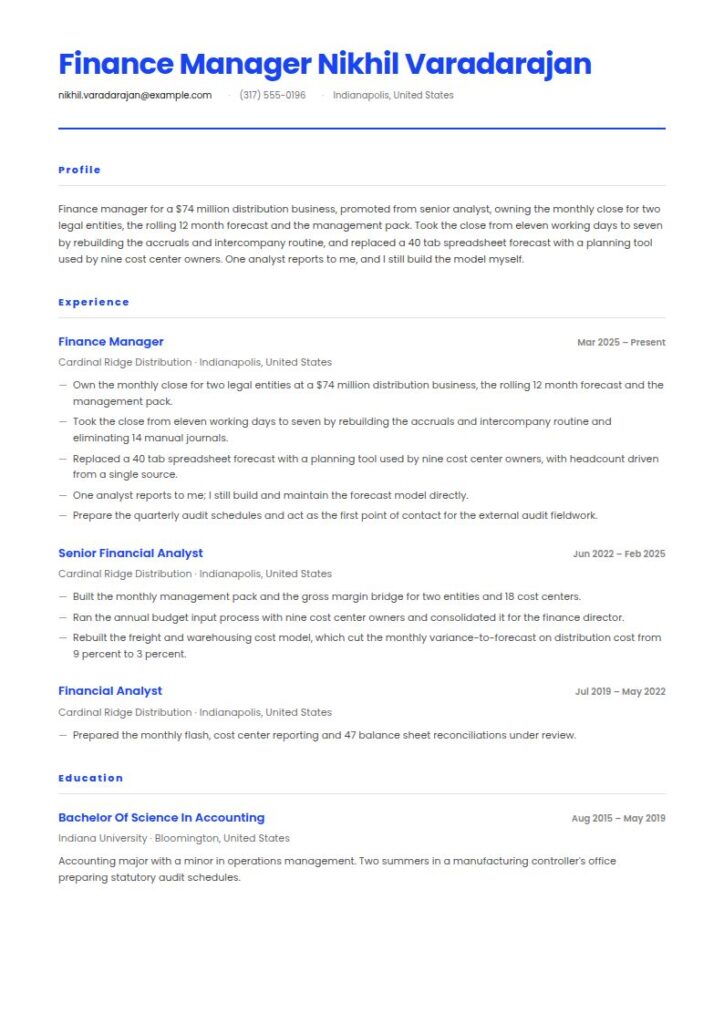
Finance manager for a $74 million distribution business, promoted from senior analyst, owning the monthly close for two legal entities, the rolling 12 month forecast and the management pack. Took the close from eleven working days to seven by rebuilding the accruals and intercompany routine, and replaced a 40 tab spreadsheet forecast with a planning tool used by nine cost center owners. One analyst reports to me, and I still build the model myself.
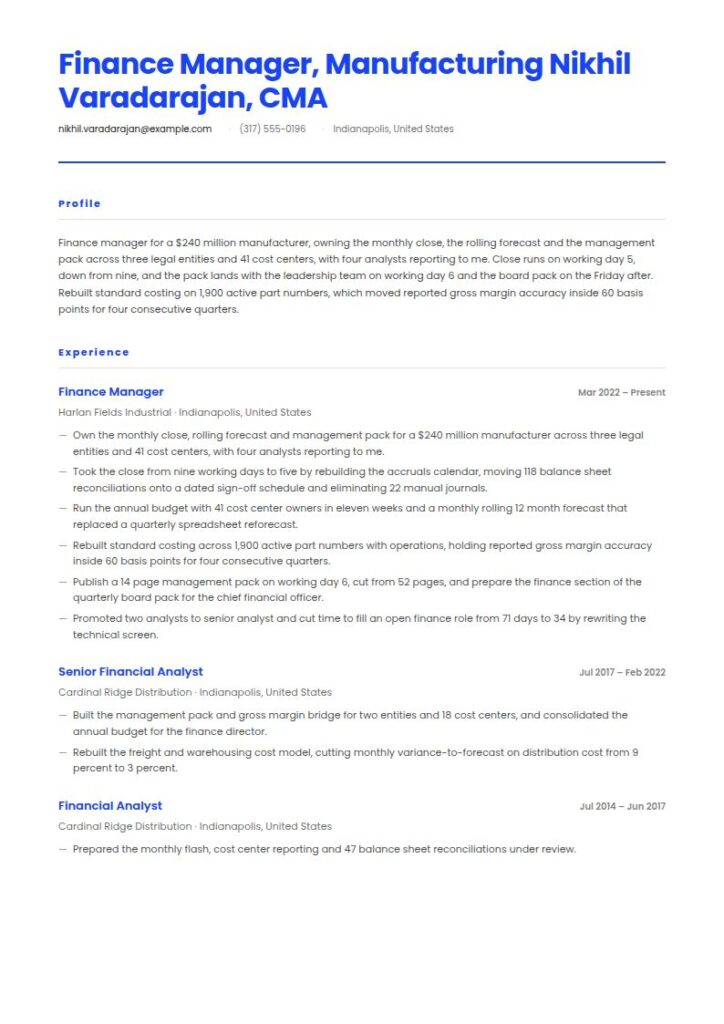
Finance manager for a $240 million manufacturer, owning the monthly close, the rolling forecast and the management pack across three legal entities and 41 cost centers, with four analysts reporting to me. Close runs on working day 5, down from nine, and the pack lands with the leadership team on working day 6 and the board pack on the Friday after. Rebuilt standard costing on 1,900 active part numbers, which moved reported gross margin accuracy inside 60 basis points for four consecutive quarters.
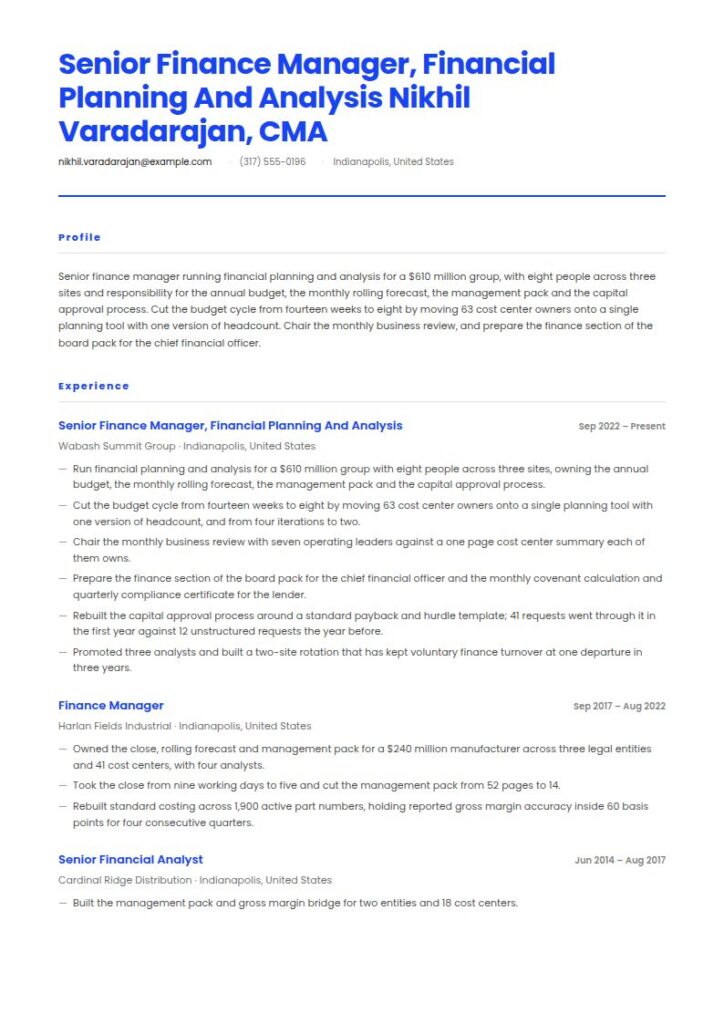
Senior finance manager running financial planning and analysis for a $610 million group, with eight people across three sites and responsibility for the annual budget, the monthly rolling forecast, the management pack and the capital approval process. Cut the budget cycle from fourteen weeks to eight by moving 63 cost center owners onto a single planning tool with one version of headcount. Chair the monthly business review, and prepare the finance section of the board pack for the chief financial officer.
Right vs wrong: the same finance manager summary, twice
| ✅ Right | ❌ Wrong |
|---|---|
| Own the close, forecast and pack for a $240 million manufacturer across three entities and 41 cost centers. | Responsible for all aspects of financial planning and reporting. |
| Close runs on working day 5, down from nine; pack lands on working day 6. | Consistently delivered accurate and timely financial reporting. |
| Four analysts report to me; rebuilt standard costing on 1,900 part numbers. | Led a high performing finance team and drove process improvements. |
The right column can be compared with the job being filled. The left column can be written by anyone who has been near a finance function.
Outline your experience
Company, sector, revenue or spend, city, dates, then four to six bullets for the current role and two or three for the one before. Days, entities, cost centers, headcount, dollars and the before and after of anything you changed.
| Instead of | Use |
|---|---|
| Managed the month-end close process | Own the close for three legal entities on working day 5, down from nine, with 118 reconciliations under a sign-off calendar |
| Prepared budgets and forecasts | Run the annual budget with 41 cost center owners and a monthly rolling 12 month forecast in a single planning tool |
| Produced management reporting | Publish a 14 page management pack on working day 6 and the finance section of the board pack quarterly |
| Led a team of finance professionals | Four analysts report to me; promoted two to senior analyst and cut open-role time to fill from 71 days to 34 |
| Drove process improvements and efficiencies | Rebuilt standard costing on 1,900 active part numbers, holding reported gross margin inside 60 basis points for four quarters |
| Partnered with the business | Run a monthly review with six operating leaders against a one page cost center summary they each own |
Finance Manager, Harlan Fields Industrial, Indianapolis, IN, March 2022 to Present
Own the monthly close, the rolling forecast and the management pack for a $240 million manufacturer across three legal entities and 41 cost centers, with four analysts reporting to me.
Took the close from nine working days to five by rebuilding the accruals calendar, moving 118 balance sheet reconciliations onto a dated sign-off schedule and killing 22 manual journals.
Run the annual budget with 41 cost center owners in eleven weeks, and a monthly rolling 12 month forecast that replaced a quarterly reforecast built in spreadsheets.
Rebuilt standard costing across 1,900 active part numbers with operations, which moved reported gross margin accuracy inside 60 basis points for four consecutive quarters.
Publish a 14 page management pack on working day 6, cut from 52 pages, and prepare the finance section of the quarterly board pack for the chief financial officer.
Promoted two analysts to senior analyst and cut time to fill an open finance role from 71 days to 34 by rewriting the technical screen.
Write your operating rhythm: every deliverable, its working day and who reads it
This is the block that does not appear on other finance manager resumes, and it is the one a hiring finance director reads twice.
A finance function is a calendar. Every month the same things are due on the same days to the same people, and the whole job is whether they land, whether they are right, and whether anybody acts on them. Almost every finance manager resume compresses that into "month-end close and reporting" and leaves the reader to guess the scale. Write it as deliverables instead: what, when, for whom. Six lines tell a reader more than the rest of the page.
Close: three legal entities, working day 5, down from nine. 118 balance sheet reconciliations on a dated sign-off calendar, 22 manual journals eliminated, intercompany matched before the ledger closes
Flash and pack: revenue and margin flash on working day 2 to the leadership team, 14 page management pack on working day 6, cut from 52 pages, with a one page cost center summary each operating leader owns
Forecast: monthly rolling 12 month forecast in a single planning tool, 41 cost center owners inputting, headcount driven from one source, capital and cash flow updated in the same pass
Budget: annual cycle in eleven weeks from target setting to board approval, down from sixteen, with two full iterations rather than four
Board and lenders: finance section of the quarterly board pack, monthly covenant calculation and the quarterly compliance certificate to the lender
Team and controls: four analysts, two promoted to senior analyst; delegation of authority refreshed with purchase order thresholds; preparer and reviewer separated on every reconciliation over $50,000
Six lines, and every one of them is checkable. A finance director reading it can tell within a minute whether you have run a cycle the size of theirs, whether you have ever shortened one, and whether you have carried a covenant, which is the part that keeps them awake.
Name the systems, and say which one you implemented
Finance managers are hired partly for the ramp. A company running the same enterprise system you already know will have you productive months earlier than one that does not, and the hiring manager is pricing that.
Name them properly and split them by what you did. "Used" is an ERP you report out of; "implemented" or "migrated" is a project with a cutover date, a data migration and a period where the numbers had to tie both ways. Write the second as its own bullet with dates, scope and what broke, because implementation experience is scarce and it transfers.
Do the same for the planning tool, the consolidation layer and the reporting front end. "SAP S/4HANA (implemented, 3 entities, 2024 cutover), Workday Adaptive Planning (owner), Power BI (built the margin pack)" answers a question the interview would otherwise spend twenty minutes on.
Build a snapshot of your key skills
Twelve to fifteen entries in three groups: the cycle, the analysis, and the systems. Keep the systems line specific, and keep the cycle line in the language your industry uses.
The cycle: Monthly close and reconciliation sign-off, Rolling 12 month forecasting, Annual budget management, Management pack design, Board pack preparation, Covenant calculation and lender reporting
Analysis: Standard costing and variance analysis, Gross margin bridge, Cost center and headcount planning, Capital appraisal and payback, Working capital and cash conversion, Pricing and contribution review
Systems and controls: SAP S/4HANA, NetSuite, Workday Adaptive Planning, Power BI, Advanced Excel and Power Query, Delegation of authority and approval thresholds, Preparer and reviewer separation, Audit schedule preparation
Be honest about depth. If you ran reports out of a system somebody else configured, write "reporting", not "implementation". Finance interviews test the systems line hard: it is the cheapest claim on the page to make and the easiest to check.
List your education and certifications
A bachelor's degree is the typical entry-level education for financial managers, and the Bureau of Labor Statistics Occupational Outlook Handbook also lists five years or more of related work experience as typical, naming accountant, securities sales agent and financial analyst as the occupations people arrive from. Show that route rather than hiding it.
Certified Management Accountant, Institute of Management Accountants, 2021, active. 30 hours of continuing professional education reported annually, including two hours of ethics.
Bachelor of Science, Accounting, Indiana University, Bloomington, IN, 2014
SAP S/4HANA finance configuration training, 2023, completed before the three entity cutover
Progression: financial analyst, senior financial analyst, finance manager
Earlier grounding: two years in general ledger accounting, including the statutory audit schedules
The CMA is the credential built for this job rather than for public accounting. The Institute of Management Accountants requires active IMA membership, a bachelor's degree from an accredited college or university or a related professional certification, both parts of the exam, and "two continuous years of professional experience in management accounting or financial management", which may be completed before passing or within seven years afterwards; certificants then report 30 hours of continuing education a year with at least two hours in ethics (IMA, accessed 13 September 2026).
Choose the right layout and design
Single column, 11 or 12 point, clear headings, no photograph, no charts and no skill bars. Two pages, with the operating rhythm block high on page one. Save as PDF unless the portal says otherwise: nikhil-varadarajan-finance-manager-resume.pdf.
Size the scope in the header line: revenue or spend, entities or cost centers, headcount. Give the close in working days, with the before and after. Say who reads each deliverable. Name the ERP, the planning tool and the reporting layer, and split what you implemented from what you used. Put a number on the team: reports, promotions, time to fill. State whether you carry a covenant calculation.
Do not write a noun list of finance activities; every other applicant wrote the same one. Do not claim an implementation you only reported out of. Do not put unpublished company financials, customer names or contract values in the file; aggregate and describe scale instead. Do not present a cycle you inherited at five working days as one you shortened. Do not pad to three pages.
Finance manager job market and outlook
Finance managers sit inside financial managers, the occupation the Bureau of Labor Statistics uses for the whole management layer of a finance function. The Handbook publishes no separate profile for the title "finance manager", and the profile it does publish is wide: it explicitly covers controllers, treasurers and finance officers, credit managers, cash managers, risk managers and insurance managers.
That width is why the profile should be read as a band and the two feeder occupations read alongside it. Most finance managers arrive from one of them.
| Occupation | Employment, 2025 | Projected change, 2025 to 2035 | Annual openings | Median annual wage, May 2025 |
|---|---|---|---|---|
| Financial managers | 879,700 | 10 percent growth, +84,900 | About 65,600 | $166,570 |
| Financial analysts | 443,100 | 7 percent growth, +32,000 | About 29,500 | $103,570 |
| Accountants and auditors | 1,595,200 | 5 percent growth, +79,400 | About 115,300 | $83,680 |
Source: U.S. Bureau of Labor Statistics, Occupational Outlook Handbook, May 2025 wage data and 2025 to 2035 projections.
The one occupation where the Handbook prints an experience requirement
Financial managers is one of the few Handbook profiles whose Quick Facts table carries a work experience line at all. It lists a bachelor's degree as the typical entry-level education and "5 years or more" of related work experience, and the profile says financial managers typically need "a bachelor's degree and 5 years or more of experience in another business or financial occupation, such as an accountant, securities sales agent, or financial analyst" (BLS Occupational Outlook Handbook, published 27 August 2026).
Read that as a hiring instruction rather than a statistic. The occupation is entered laterally, from a named technical job, and the resume that reads best is the one where the technical grounding is still visible: the ledger years, the audit schedules, the model you built before you managed anyone.
It also explains the volume: about 65,600 financial manager openings a year over the decade, against 115,300 for accountants and auditors (BLS, 2025 to 2035 projections). The management layer is fed by a much larger pool, and what distinguishes candidates inside it is scope and cadence, not another year of technical depth.
What salary you can expect as a finance manager
Financial managers had a median annual wage of $166,570 as of May 2025, with the lowest 10 percent under $94,310 and the highest 10 percent over $323,270 (BLS Occupational Outlook Handbook, May 2025). Read that as the band for a whole management layer, not as a finance manager salary. The same occupation contains group controllers and corporate treasurers, and a first-time finance manager sits well below the middle of it.
Industry is the largest visible mover. Among financial managers, the median was $174,170 in professional, scientific and technical services, $172,340 in management of companies and enterprises, $169,980 in finance and insurance, $164,400 in manufacturing and $139,810 in government (BLS, May 2025). Employment is spread accordingly: 32 percent in finance and insurance, 14 percent in professional, scientific and technical services, 10 percent in management of companies, 6 percent in government and 5 percent in manufacturing (BLS, May 2025).
Be careful with what the published figure covers. The federal wage survey measures straight-time gross pay and includes commissions and production bonuses, while excluding non-production bonuses, overtime and the employer cost of benefits (BLS, Occupational Employment and Wage Statistics survey documentation). An annual discretionary bonus, which is a normal part of a finance manager package, falls outside it, and no federal source publishes a bonus figure for this occupation. Treat the median as base plus regular incentive, and do not build an expectation on anything you cannot cite.
Key takeaways for a finance manager resume
- Size the scope in the header line: revenue or spend, entities or cost centers, headcount.
- Write the operating rhythm as deliverables with working days and named readers.
- Give the close in days, with the before and after, and say what you changed to get there.
- Name the ERP, planning tool and reporting layer, and split implemented from used.
- Keep the technical grounding visible; the occupation is entered laterally from it.
- Put a number on the team: reports, promotions, time to fill.
- Keep unpublished company financials and customer names out of the file entirely.
Build your finance manager resume in 15 minutes with our AI resume builder.
Related accounting and finance resume examples
- Finance director resume
- Financial analyst resume
- Accountant resume
- Senior accountant resume
- Staff accountant resume
- Auditor resume
- Internal auditor resume
- Payroll manager resume
- Accounts payable resume
- Accounts receivable resume
- Credit analyst resume
- Compliance officer resume
Pair it with a matching finance manager cover letter.
Finance manager resume questions, answered
How long should a finance manager resume be?
Two pages from the second management role onward. One page only if you are moving into your first manager title and the scope is genuinely small. The operating rhythm block, two roles in detail and a named systems line do not fit on one page without losing the numbers that make them useful.
What is the difference between a finance manager and a financial analyst on a resume?
Scope and cadence, not technical depth. An analyst owns models and analyses; a finance manager owns a calendar, a set of deliverables with named readers, a control environment and usually people. If your resume reads as a list of analyses, it reads as an analyst resume with a manager title on it. Write what lands, when, for whom, and who reports to you.
Do I need a CPA or a CMA to be a finance manager?
Neither is required, and plenty of finance managers hold neither. The CMA is the credential aimed at this work: the Institute of Management Accountants requires active membership, a bachelor's degree or a related professional certification, both exam parts, and "two continuous years of professional experience in management accounting or financial management" (IMA, accessed 13 September 2026). A CPA carries more weight where the role sits close to technical accounting and the audit. If you hold either, put it beside your name; if you hold neither, put the scope and the cadence there instead.
How do I show results when finance does not have its own revenue number?
Use the measures the function produces. Working days to close. Number of manual journals eliminated. Reconciliations under a sign-off calendar. Budget cycle length. Pack length and who now reads it. Forecast cadence changed from quarterly to monthly. Audit adjustments. Time to fill an open role. Each of those is a result, each has a before and an after, and none of them requires quoting a company financial you should not be publishing.
Can I put company financials on my resume?
Only what is already public, and only at the level of scale. Revenue size, entity count, cost center count and headcount are fine, and are usually approximate anyway. Margins, unpublished results, customer names, contract values and anything from a board pack are not, whether or not you still work there. If even revenue is sensitive, write "a mid-sized manufacturer" with the entity and cost center counts; the shape is what the reader needs.
I am moving from public accounting into a finance manager role. How should I write it?
Translate the audit years into the cycle. You have seen more closes than most finance managers ever will, from the outside: write the number of audits, the sizes and sectors of the clients, the areas you owned, and the findings you raised and saw remediated. Then be explicit about the gap, usually forecasting and business partnering rather than technical accounting. Finance functions hire out of audit constantly; what fails is an audit resume submitted untranslated.