Senior Accountant Aisha Mwendwa
Senior Accountant
[email protected] | (612) 555-0147 | Minneapolis, United States
Profile
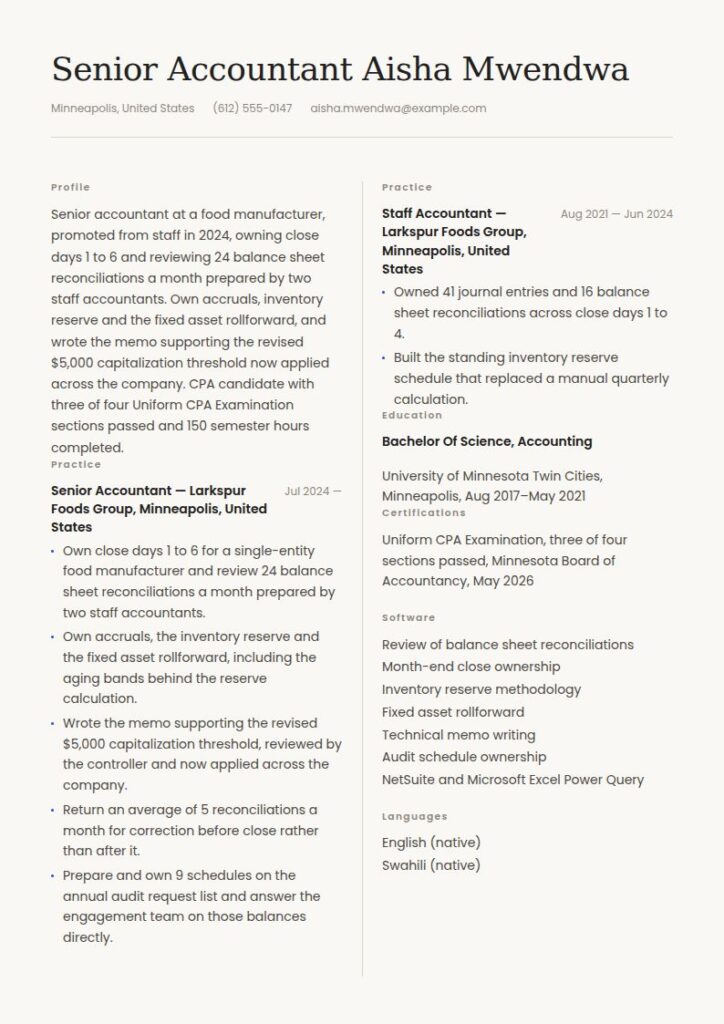
Senior accountant at a food manufacturer, promoted from staff in 2024, owning close days 1 to 6 and reviewing 24 balance sheet reconciliations a month prepared by two staff accountants. Own accruals, inventory reserve and the fixed asset rollforward, and wrote the memo supporting the revised $5,000 capitalization threshold now applied across the company. CPA candidate with three of four Uniform CPA Examination sections passed and 150 semester hours completed.
Work Experience
07/2024 - Present, Senior Accountant, Larkspur Foods Group, Minneapolis, United States
- Own close days 1 to 6 for a single-entity food manufacturer and review 24 balance sheet reconciliations a month prepared by two staff accountants.
- Own accruals, the inventory reserve and the fixed asset rollforward, including the aging bands behind the reserve calculation.
- Wrote the memo supporting the revised $5,000 capitalization threshold, reviewed by the controller and now applied across the company.
- Return an average of 5 reconciliations a month for correction before close rather than after it.
- Prepare and own 9 schedules on the annual audit request list and answer the engagement team on those balances directly.
08/2021 - 06/2024, Staff Accountant, Larkspur Foods Group, Minneapolis, United States
- Owned 41 journal entries and 16 balance sheet reconciliations across close days 1 to 4.
- Built the standing inventory reserve schedule that replaced a manual quarterly calculation.
Education
08/2017 - 05/2021, Bachelor of Science, Accounting, University of Minnesota Twin Cities, Minneapolis, United States
150 semester hours completed, meeting the Minnesota education requirement to sit for the Uniform CPA Examination.
Skills
Review of balance sheet reconciliations, 80
Month-end close ownership, 85
Inventory reserve methodology, 80
Fixed asset rollforward, 85
Technical memo writing, 70
Audit schedule ownership, 80
NetSuite and Microsoft Excel Power Query, 85
Languages
English, native
Swahili, native
Certificates
05/2026, Uniform CPA Examination, three of four sections passed, Minnesota Board of Accountancy
Final section scheduled March 2027. 150 semester hours completed.
Summary
A senior accountant resume is a two page document about review rather than preparation: whose work you check, what you have concluded in writing, and the close you own end to end. This guide gives you three adaptable versions, the review and technical block that separates a senior from a staff accountant, and the current state of CPA licensure from BLS, AICPA and NASBA.
Senior Accountant resume examples by experience level
A senior accountant resume is a two page document about review rather than preparation. That is the whole promotion. A staff accountant is judged on whether their own work is right. A senior accountant is judged on whether somebody else's work is right, whether the close lands without the controller intervening, and whether the positions taken on the awkward questions will still look defensible in an audit eighteen months later.
Most senior accountant resumes do not reflect that. They are staff accountant resumes with bigger numbers in them. The bullets still describe things the writer did with their own hands, and a controller hiring a senior is looking for what they took responsibility for when somebody else's hands were on the work.
Resume guide for a senior accountant resume
This guide and the corresponding senior accountant resume example will cover:
- How to write a senior accountant resume, section by section
- The review and technical block that separates a senior from a staff accountant
- Three adaptable summaries: newly promoted, established senior and assistant controller
- Where CPA licensure actually bites, and what to write if you do not hold one
- What the job market looks like and what you can expect to earn
How to write a senior accountant resume
Six blocks: contact header, summary, review and technical record, experience, systems, and education and licensure. Two pages is normal here; one page usually undersells.
| Section | What it is answering | Where it goes |
|---|---|---|
| Review and technical record | Whose work do they review, and what have they concluded in writing? | Directly under the summary |
| Experience | What did they own end to end, and what did they change? | Reverse chronological, two pages |
| Systems | Which ERP, which close tools, and did they implement or inherit? | Named, with the distinction stated |
| Education and licensure | CPA, credit hours, or exam progress, dated | Last, explicit rather than implied |
Change the grammar of your bullets from did to owned
Count how many bullets on your current resume begin with something you personally performed. If it is most of them, you have written a staff accountant resume with senior volumes in it.
A senior's bullets live in three other grammars. Review: whose work you check, at what volume, and what your review catches. Conclusion: the position you took, the standard it sits under, and who relied on it. Ownership: the close, the account area, the audit relationship, the process you redesigned and what it cost.
"Reviewed 58 balance sheet reconciliations and 140 journal entries a month prepared by three accountants, returning an average of 9 a month for correction before close" says something no volume figure can. It is a claim about accountability, which is what is being hired.
Run the file through the free ATS checker first, because this level is filtered hard on ERP names, credentials and standards.
Choosing the best resume format for a senior accountant resume
Reverse chronological, single column, two pages. Show the progression from staff to senior explicitly, even inside one employer, because that promotion is evidence and a merged entry hides it. If you have moved between public accounting and industry, keep both and label engagements by industry and size rather than by client. Auditors who moved into industry know what a schedule has to survive, which is worth making visible.
Include your contact information
| ✅ Right | ❌ Wrong |
|---|---|
| Aisha Mwendwa | Aisha Mwendwa |
| Senior Accountant, CPA (Minnesota) | Senior accounting professional |
| Review 58 reconciliations monthly, own a 6-day close across two entities | Expert in GAAP, close management and financial reporting |
| (612) 555-0147, [email protected], Minneapolis, MN | (612) 555-0147, [email protected] |
Put the state on the license line. CPA licenses are issued by state boards of accountancy, so "CPA" alone leaves a question that two words answer.
Make use of a summary
Four lines: what you own, whose work you review, one technical position you documented, one thing you changed.
Senior accountant at a food manufacturer, promoted from staff in 2024, owning close days 1 to 6 and reviewing 24 balance sheet reconciliations a month prepared by two staff accountants. Own accruals, inventory reserve and the fixed asset rollforward, and wrote the memo supporting the revised $5,000 capitalization threshold now applied across the company. CPA candidate with three of four Uniform CPA Examination sections passed and 150 semester hours completed.
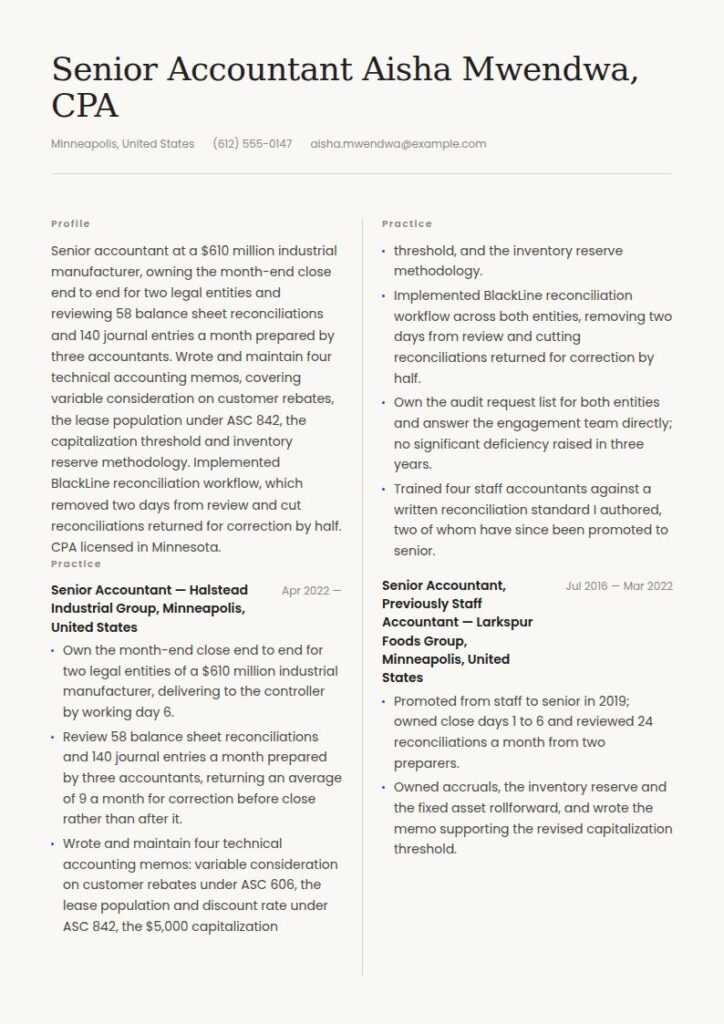
Senior accountant at a $610 million industrial manufacturer, owning the month-end close end to end for two legal entities and reviewing 58 balance sheet reconciliations and 140 journal entries a month prepared by three accountants. Wrote and maintain four technical accounting memos, covering variable consideration on customer rebates, the lease population under ASC 842, the capitalization threshold and inventory reserve methodology. Implemented BlackLine reconciliation workflow, which removed two days from review and cut reconciliations returned for correction by half. CPA licensed in Minnesota.
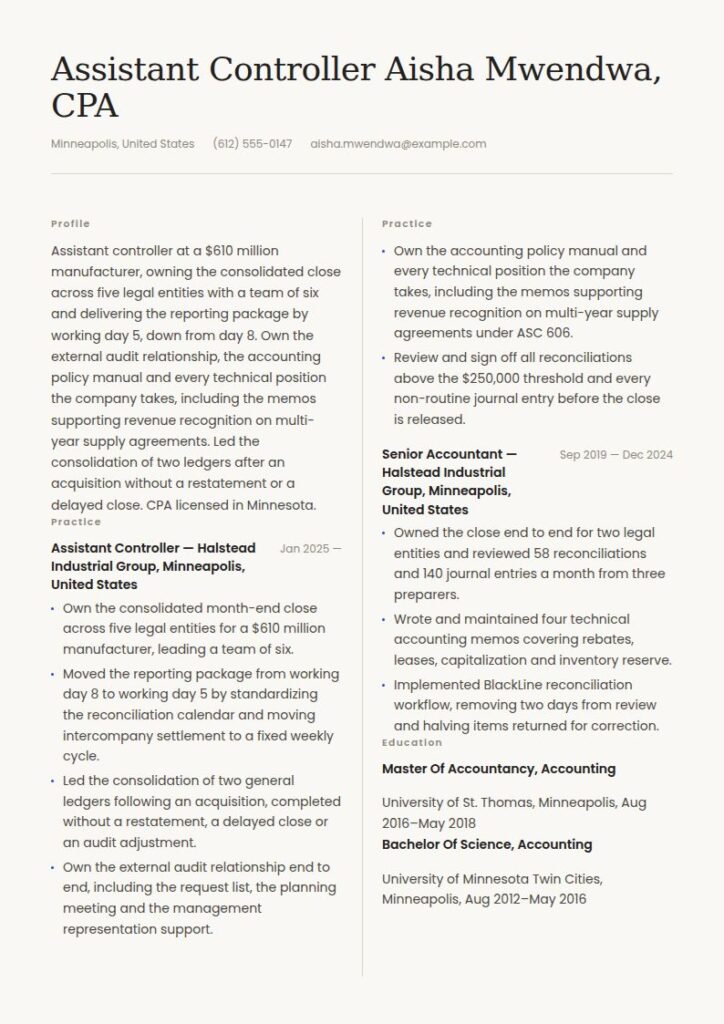
Assistant controller at a $610 million manufacturer, owning the consolidated close across five legal entities with a team of six and delivering the reporting package by working day 5, down from day 8. Own the external audit relationship, the accounting policy manual and every technical position the company takes, including the memos supporting revenue recognition on multi-year supply agreements. Led the consolidation of two ledgers after an acquisition without a restatement or a delayed close. CPA licensed in Minnesota.
Right vs wrong: the same senior accountant summary, twice
| ✅ Right | ❌ Wrong |
|---|---|
| Review 58 reconciliations and 140 entries a month prepared by three accountants. | Responsible for oversight of the month-end close process. |
| Wrote and maintain four technical accounting memos, including ASC 842 lease population and rebate variable consideration. | Strong technical accounting knowledge and GAAP expertise. |
| Implemented BlackLine workflow, removing two days from review and halving reconciliations returned for correction. | Identified and implemented process improvements. |
The left column is a set of responsibilities somebody can verify. The right is a set of adjectives every applicant at this level has also written.
Outline your senior accountant experience
Employer, what it does, its size, the entities you covered, and dates. Then five or six bullets per recent role, at least two of them about other people's work or about a decision rather than your own preparation.
| Instead of | Use |
|---|---|
| Oversaw month-end close | Own the close end to end for two legal entities, delivering to the controller by working day 6 |
| Reviewed the work of junior accountants | Review 58 reconciliations and 140 entries a month from three preparers, returning about 9 for correction before close |
| Ensured compliance with GAAP | Wrote the memo concluding on variable consideration for customer rebates under ASC 606, reviewed by our auditors without adjustment |
| Assisted with the annual audit | Own the audit request list and the engagement team relationship, with no significant deficiency raised in three years |
| Implemented process improvements | Implemented BlackLine reconciliation workflow, removing two days from review and halving items returned for correction |
| Mentored junior staff | Trained four staff accountants, two of whom now hold senior roles, using a written reconciliation standard I authored |
Senior Accountant, Halstead Industrial Group, Minneapolis, MN, April 2022 to Present
Own the month-end close end to end for two legal entities of a $610 million industrial manufacturer, delivering to the controller by working day 6.
Review 58 balance sheet reconciliations and 140 journal entries a month prepared by three accountants, returning an average of 9 a month for correction before close rather than after it.
Wrote and maintain four technical accounting memos: variable consideration on customer rebates under ASC 606, the lease population and discount rate under ASC 842, the $5,000 capitalization threshold, and the inventory reserve methodology.
Implemented BlackLine reconciliation workflow across both entities, which removed two days from review and cut reconciliations returned for correction by half.
Own the audit request list for my entities and answer the engagement team directly; no significant deficiency has been raised in three years.
Trained four staff accountants against a written reconciliation standard I authored, two of whom have since been promoted to senior.
Show what you review and what you have concluded in writing
This is the block that makes a senior accountant resume a senior accountant resume, and it is where most applicants lose ground to someone with identical experience.
Review scope: 3 preparers, 58 balance sheet reconciliations and 140 journal entries a month across two legal entities. Average 9 items returned for correction each month, pre-close rather than post-close.
Close ownership: days 1 to 6, end to end for two entities, including the flux package and the balance sheet review with the controller.
Technical positions documented: variable consideration on customer rebates under ASC 606. Lease population, discount rate and short-term exemption under ASC 842. The $5,000 capitalization threshold. Inventory reserve methodology and the aging bands behind it.
Audit: own the request list for both entities and answer the engagement team directly. No significant deficiency in three years.
Process changed: implemented BlackLine reconciliation workflow, removing two days from review and halving items returned for correction.
People developed: 4 staff accountants trained against a written reconciliation standard I authored; 2 promoted to senior.
Review scope is the most useful thing on the page and the most commonly omitted. Give the number of preparers, the volume, and what your review catches, because "reviewed junior work" cannot be sized. The return rate is the honest metric: it says your review is real, and saying corrections happen before close rather than after says it is timely.
Technical positions documented is the second. A senior accountant is the first person in the chain expected to conclude rather than compute. Name the position, the standard, and what happened to it: reviewed by the auditors without adjustment, adopted as policy, applied across five entities. Do not list standards you merely worked inside.
Process changed completes it. Any accountant can describe what they do; a senior can describe what is different now, and the strongest version has a cost attached: days of close, hours of review, or errors that stopped happening.
Write the memo down before you write the resume
If you have taken technical positions but never wrote them up, you cannot evidence the most valuable thing you have done, and you will struggle again in the interview.
Keep a one page record for each: the facts, the standard, the alternatives considered, the conclusion and who approved it. It takes an hour, it is what you will be asked about, and it protects the company, which is why controllers respond well to a candidate who does it as a habit.
A documented position is worth far more than a mentioned one. "Familiar with ASC 606" is a sentence about reading. "Concluded on variable consideration for customer rebates under ASC 606; position reviewed by our auditors without adjustment" is a sentence about responsibility.
Build a snapshot of your key skills
Twelve to sixteen entries in three groups: ownership and review, technical and reporting, and systems. Remove anything a staff accountant could also write.
Ownership and review: Close ownership across multiple entities, Review of journal entries and reconciliations, Balance sheet review, Flux and variance analysis, Audit request list ownership, Staff training and development
Technical and reporting: US GAAP, Revenue recognition under ASC 606, Leases under ASC 842, Inventory reserve methodology, Capitalization policy, Consolidation and intercompany elimination, Technical memo writing, Internal control documentation
Systems: SAP S/4HANA, NetSuite, BlackLine, FloQast, Hyperion Financial Management, Microsoft Excel including Power Query, Power BI
Say which systems you implemented rather than inherited. Implementation experience at this level is unusual and is the line a controller planning a migration stops on.
List your education and certifications
This is where licensure belongs, because senior accountant is the level where it starts to bite. Postings below this rarely ask for a CPA; postings above it very often require one.
Stated plainly: the CPA is a state license, not a national one. BLS records that all states require CPA candidates to complete 150 semester hours of college coursework, 30 more than a usual four-year bachelor's degree, and that CPAs are licensed by their state's Board of Accountancy (Occupational Outlook Handbook, published 27 August 2026).
That picture is changing, state by state. On 14 May 2025 the AICPA and NASBA approved model legislation revising the Uniform Accountancy Act to recognize three pathways to licensure: a post-baccalaureate degree with an accounting concentration plus one year of experience; a bachelor's degree with an accounting concentration plus 30 credits plus one year of experience; and a new pathway of a bachelor's degree with an accounting concentration plus two years of experience, all three with the Uniform CPA Examination. Individual states must enact legislation or adopt rules before candidates can use the additional pathway, and state boards of accountancy retain oversight and disciplinary authority over licensees (AICPA and NASBA, 14 May 2025).
The instruction is short. Do not assume the rule you learned in school still applies, and do not assume a neighboring state's rule applies to yours. Check your own board before planning around it.
Certified Public Accountant, Minnesota Board of Accountancy, license #MN-CPA-0428617, active through 2027
Master of Accountancy, University of St. Thomas, Minneapolis, MN, 2018
Bachelor of Science, Accounting, University of Minnesota Twin Cities, Minneapolis, MN, 2016. 150 semester hours completed.
Continuing professional education: 40 hours annually, including revenue recognition, lease accounting and ethics.
If you are not licensed, write what you have rather than leaving a silence. "150 semester hours completed, three of four Uniform CPA Examination sections passed, final section scheduled March 2027" is a strong line, and so is a Certified Management Accountant credential from the Institute of Management Accountants or a Certified Internal Auditor credential from the Institute of Internal Auditors, either of which reads as serious in industry roles where a CPA is preferred rather than required.
Fewer people are entering the license pipeline
The AICPA's 2025 Trends report counted 28,082 new candidates entering the CPA Examination pipeline in 2024, against 42,626 in 2023, and 40,817 accounting bachelor's degrees awarded in the 2023 to 2024 academic year, a drop of 3.3 percent (AICPA, 27 October 2025). Against that, BLS projects about 115,300 openings a year for accountants and auditors over the decade to 2035 (Occupational Outlook Handbook, published 27 August 2026).
Two consequences. If you hold a license, it is worth more than it was five years ago and belongs in your header rather than the bottom of page two. If you do not, industry employers are not in a position to be fussy, so lead with scope and review responsibility and keep the credential line honest and brief.
Choose the right layout and design
Single column, 11 or 12 point, two pages, no graphics. Set the review and technical record as labeled lines rather than prose, and keep the license line in the header.
State how many preparers you review and at what volume. Give a return rate and say whether corrections happen before or after close. Name the technical positions you concluded on, with the standard and what happened to the conclusion. Say which entities and which close days you own end to end. Distinguish systems you implemented from systems you used. Put the license and the state in the header. Show the staff to senior promotion as two entries.
Do not write a staff accountant resume with bigger numbers. Do not claim a standard you worked inside but did not conclude on. Do not hide a missing license behind vagueness; state your hours and exam progress instead. Do not name a client from a public accounting role. Do not publish a former employer's unreleased results. Do not compress two pages of real scope onto one page to satisfy a rule that does not apply at this level.
Senior accountant job market and outlook
BLS publishes no separate profile for senior accountants. The role is a rung inside the accountants and auditors occupation, so the figures below cover everyone from first-year staff to specialists.
| Measure | Value |
|---|---|
| Accountant and auditor jobs, 2025 | 1,595,200 |
| Projected change, 2025-35 | 5% (faster than average), +79,400 |
| Projected annual openings | About 115,300 |
| Typical entry-level education | Bachelor's degree |
| Median annual wage, May 2025 | $83,680 |
| Highest 10 percent, May 2025 | More than $144,090 |
Source: U.S. Bureau of Labor Statistics, Occupational Outlook Handbook, 2025-35 projections and May 2025 wage data, published 27 August 2026.
The useful reading for a senior is in the last two rows. The median of $83,680 covers everybody including first-year staff, so it is a floor to reason from rather than a target. The top decile above $144,090 is where controller-track roles, licensed specialists and large-company seniors sit, and the distance between the two is the career the resume is written for.
Where the senior roles concentrate:
| Industry | Share of employment | Median annual wage (May 2025) |
|---|---|---|
| Accounting, tax preparation, bookkeeping and payroll services | 21% | $81,490 |
| Finance and insurance | 8% | $93,290 |
| Management of companies and enterprises | 6% | $91,940 |
| Government, excluding state and local education and hospitals | 8% | $83,350 |
Source: U.S. Bureau of Labor Statistics, Occupational Outlook Handbook, May 2025.
Finance and insurance and management of companies are the two highest-paying industries on that list and together employ roughly one in seven accountants. Management of companies is where corporate headquarters sit, and that is where multi-entity consolidation, technical memos and real review responsibility concentrate. If your resume already describes that work, weight those listings.
What salary you can expect as a senior accountant
The median annual wage for accountants and auditors was $83,680 in May 2025. The lowest 10 percent earned less than $56,020 and the highest 10 percent more than $144,090 (BLS, May 2025).
Because BLS does not break the occupation out by seniority, treat that distribution as a range you position yourself inside rather than a number describing you. What moves a senior upward is fairly consistent: a license, multi-entity or consolidation responsibility, review accountability over named preparers, technical positions you own, and industry.
The resume lever is the middle two. Entity count and review scope are what a compensation conversation turns on, they are entirely within your control to state clearly, and a job title conveys neither.
Key takeaways for a senior accountant resume
- Write review, not preparation; count your bullets and rebalance them.
- State how many preparers you review, at what volume, and what you return.
- Say whether corrections happen before close or after it.
- Name the technical positions you concluded on and what happened to them.
- Give the close you own end to end, by entity and by working day.
- Distinguish systems you implemented from systems you used.
- Put the license and the state in the header, or your hours and exam progress.
- Two pages, with the staff to senior promotion shown as two entries.
Build your senior accountant resume in 15 minutes with our AI resume builder.
Related accounting and finance resume examples
- Accountant resume
- Staff accountant resume
- CPA resume
- Auditor resume
- Tax accountant resume
- Finance manager resume
- Finance director resume
- Financial analyst resume
- Compliance officer resume
- Payroll manager resume
- Bookkeeper resume
- Accounting and finance resume
Pair it with a matching senior accountant cover letter.
Senior accountant resume questions, answered
Do I need a CPA to be a senior accountant?
Usually not in industry, where it is more often listed as preferred. It matters much more in public accounting, where signing authority depends on it, and at controller level and above, where many postings treat it as a hard requirement. BLS records that all states require 150 semester hours and that CPAs are licensed by their state's Board of Accountancy (published 27 August 2026), and on 14 May 2025 the AICPA and NASBA added a bachelor's-plus-two-years-experience pathway to their model legislation that each state has to enact separately. Check your own board, not a summary of somebody else's.
How do I show review work when the output is somebody else's entry?
Count it. The number of preparers, the reconciliations and entries you review each month, how many you return, and whether the return happens before close or after. Then add the durable part: the written standard you authored, the training you delivered, or the preparers who have since been promoted. Review is invisible unless you measure it, which is why measuring it works.
What is the difference between an accountant resume and a senior accountant resume?
The grammar of the bullets. An accountant resume describes work performed: entries owned, accounts reconciled, schedules prepared. A senior accountant resume describes work reviewed, positions concluded, closes owned, processes changed. Volume alone does not make the jump, which is why an accountant resume with big numbers still reads as staff-level to a controller.
Should I list the technical memos I wrote?
Yes, by subject and standard, never with the employer's confidential facts in them. "Concluded on variable consideration for customer rebates under ASC 606" names the position without disclosing the programs, the customers or the amounts. If a memo was reviewed by external auditors without adjustment, say so in four words: independent corroboration is rare on a resume.
How many people should a senior accountant say they train?
Say the real number and what you gave them. Two accountants trained against a written reconciliation standard beats "mentored junior staff" whatever the count, because the standard is the durable artifact. If any have been promoted, that is the strongest version available and it takes one clause.
How long should a senior accountant resume be?
Two pages. One page at this level usually means review scope, technical positions or entity coverage have been cut, and those are exactly what distinguish you from a staff accountant with a long tenure. Keep the earliest roles to a line or two and spend the space on the last two positions.