Staff Accountant Daniel Paik
Staff Accountant
[email protected] | (614) 555-0192 | Columbus, United States
Profile
Staff accountant with two years in a building products manufacturer, owning 34 journal entries and 11 balance sheet reconciliations across the first four days of a five-day close. Responsible for prepaid amortization, payroll accruals and the corporate credit card clearing account, and prepare six of the schedules requested by the external auditors each year. Rebuilt the prepaid schedule in NetSuite so amortization posts from a single recurring entry, removing about four hours from every close.
Work Experience
06/2024 - Present, Staff Accountant, Meridian Building Products, Columbus, United States
- Own 34 journal entries and 11 balance sheet reconciliations across close days 1 to 4 of a five-day close.
- Responsible for prepaid amortization, payroll accruals and the corporate credit card clearing account, including the monthly clearing to zero.
- Rebuilt the prepaid schedule in NetSuite so amortization posts from a single recurring entry, removing about four hours from every close.
- Prepare six of the schedules on the annual audit request list and pull supporting documentation for sampling requests.
- Write the flux commentary on my accounts for the controller each month.
06/2023 - 05/2024, Accounts Payable Specialist, Meridian Building Products, Columbus, United States
- Processed roughly 1,100 vendor invoices a month under a three-way match and prepared the weekly payment run.
- Maintained the vendor master and the W-9 file, and prepared the annual Form 1099 population.
Education
08/2019 - 05/2023, Bachelor of Science in Business Administration, Accounting, The Ohio State University, Columbus, United States
150 semester hours completed, including 30 hours of accounting coursework.
Skills
Journal entry preparation, 80
Balance sheet reconciliation, 80
Prepaid and accrual schedules, 75
Month-end close support, 75
Audit schedule preparation, 65
NetSuite, 80
Microsoft Excel, pivot tables and XLOOKUP, 80
Languages
English, native
Korean, native
Certificates
09/2024, NetSuite Financial User, Oracle NetSuite
Core financials and reporting.
04/2026, Certified Management Accountant, Part 1 passed, Institute of Management Accountants
Part 2 scheduled for January 2027.
Summary
An accountant resume is a one to two page document showing where you sit in the month-end close, which accounts you reconcile and which schedules you prepare for the audit. This guide gives you three adaptable versions, a close map that almost no competing resume includes, and current Bureau of Labor Statistics pay and outlook for accountants and auditors.
Accountant resume examples by experience level
An accountant resume is a one to two page document showing where you sit in the month-end close, which accounts you are responsible for, and what you hand the auditors in the spring.
It is a difficult resume to write, because the job is invisible from outside. Everyone knows what an accountant does in outline, and nobody can tell from a job title whether you post four entries a month or own half the balance sheet. So the resume has one job: make the scope visible, with numbers rather than adjectives.
Resume guide for an accountant resume
This guide and the corresponding accountant resume example will cover:
- How to write an accountant resume, section by section
- The close map: the days you own, the accounts you reconcile, the schedules you prepare
- Three adaptable summaries: staff accountant, general ledger accountant and accounting manager
- Where judgment belongs on the page, and how to write it without overclaiming
- What the job market looks like and what you can expect to earn
How to write an accountant resume
Six blocks: contact header, summary, close and reconciliation map, experience, systems, and education and certifications. One page for the first three or four years, two once you own a material part of a close.
| Section | What it is answering | Where it goes |
|---|---|---|
| Close and reconciliation map | How much of a close does this person actually carry? | Directly under the summary |
| Experience | What did they own, and what changed because of them? | Reverse chronological, one number per bullet |
| Systems | Which ERP and which close tools? | Named products and modules |
| Education and certifications | Degree, credit hours, and anything in progress | Last, brief, with dates |
Scope, then judgment, then improvement
Almost every weak accountant resume is a list of processes: prepared journal entries, reconciled accounts, assisted with month-end close, supported the annual audit. Those sentences are true of everyone in the occupation, which is why they do not help. Rewrite each at three levels. Scope is the volume and the boundary: how many entries, which accounts, what balances, how many entities. Judgment is the decision inside the work: the accrual estimate you build and defend, the capitalization threshold you apply, the cutoff call you make at quarter end. Improvement is what is different because you were there: the reconciliation you automated, the close day you pulled forward, the recurring adjustment you eliminated at source.
A bullet with all three is worth ten without. "Own 27 balance sheet reconciliations including accruals, prepaids and fixed assets; rebuilt the accrual model for freight and rebates, which cut post-close adjustments in my areas from 11 a year to 2" is scope, judgment and improvement in one line.
Run the file through the free ATS checker before you submit, since corporate finance teams recruit almost entirely through applicant tracking systems and ERP names are usually a hard filter.
Choosing the best resume format for an accountant resume
Reverse chronological, single column, one page early and two once scope justifies it. The reader wants progression of ownership: from preparing entries someone else reviews, to owning accounts, to owning a close. Skip the functional format entirely; in a profession built on documentation, a resume that obscures when things happened reads as a document with something missing.
Include your contact information
| ✅ Right | ❌ Wrong |
|---|---|
| Daniel Paik | Daniel Paik |
| General Ledger Accountant, CMA | Accounting and finance professional |
| 27 balance sheet reconciliations, close by working day 5 | Skilled in GAAP, month-end close and reconciliations |
| (614) 555-0192, [email protected], Columbus, OH | (614) 555-0192, [email protected] |
The third line is the trick. It states scope before anyone reads a bullet, and it is the fastest way out of a stack of resumes claiming identical skills.
Make use of a summary
Four lines: your seat in the close, the accounts you own, one judgment area, and one improvement with a number.
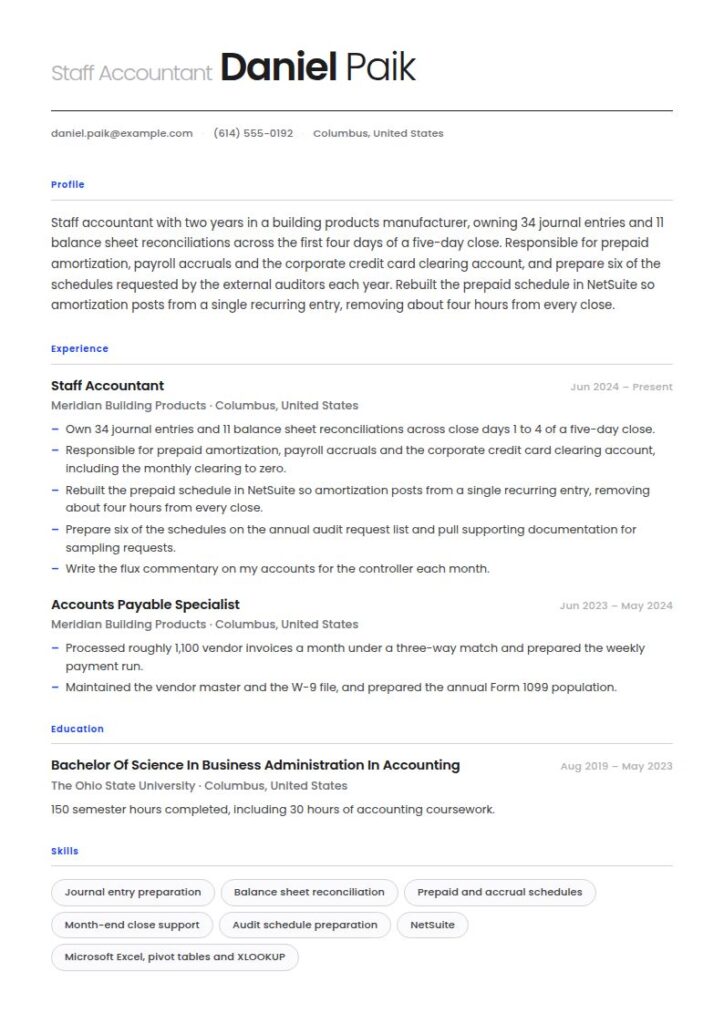
Staff accountant with two years in a building products manufacturer, owning 34 journal entries and 11 balance sheet reconciliations across the first four days of a five-day close. Responsible for prepaid amortization, payroll accruals and the corporate credit card clearing account, and prepare six of the schedules requested by the external auditors each year. Rebuilt the prepaid schedule in NetSuite so amortization posts from a single recurring entry, removing about four hours from every close.
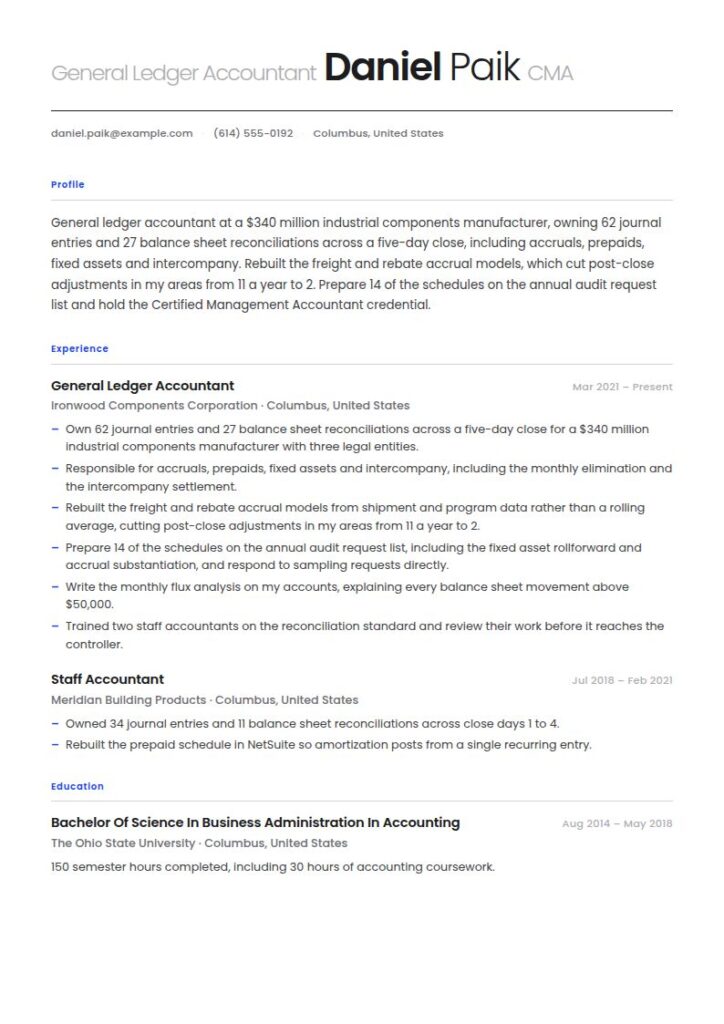
General ledger accountant at a $340 million industrial components manufacturer, owning 62 journal entries and 27 balance sheet reconciliations across a five-day close, including accruals, prepaids, fixed assets and intercompany. Rebuilt the freight and rebate accrual models, which cut post-close adjustments in my areas from 11 a year to 2. Prepare 14 of the schedules on the annual audit request list and hold the Certified Management Accountant credential.
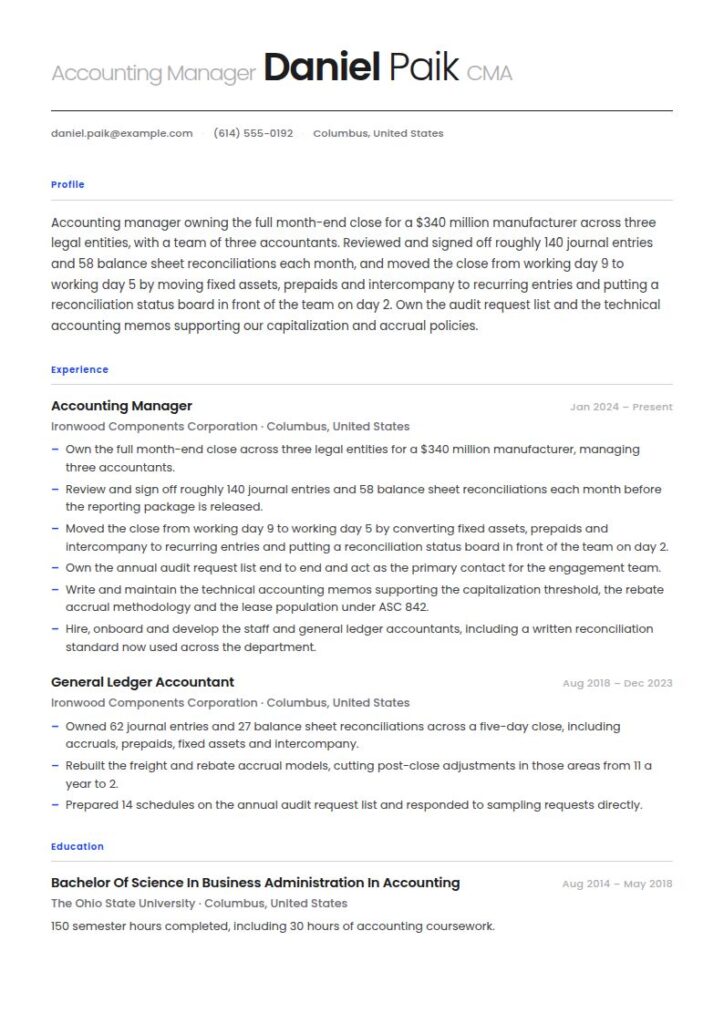
Accounting manager owning the full month-end close for a $340 million manufacturer across three legal entities, with a team of three accountants. Reviewed and signed off roughly 140 journal entries and 58 balance sheet reconciliations each month, and moved the close from working day 9 to working day 5 by moving fixed assets, prepaids and intercompany to recurring entries and putting a reconciliation status board in front of the team on day 2. Own the audit request list and the technical accounting memos supporting our capitalization and accrual policies.
Right vs wrong: the same accountant summary, twice
| ✅ Right | ❌ Wrong |
|---|---|
| Own 62 journal entries and 27 balance sheet reconciliations across a five-day close. | Responsible for month-end close activities and account reconciliations. |
| Rebuilt the freight and rebate accrual models, cutting post-close adjustments from 11 a year to 2. | Strong knowledge of GAAP with excellent analytical skills. |
| Prepare 14 of the schedules on the annual audit request list. | Assisted external auditors during the annual audit. |
The right column is a scope statement. A controller can work out in seconds whether you sit above or below the level they are hiring for, which is the only decision being made at this stage.
Outline your accountant experience
Employer, what it does, its size if you can state that without breaching anything, and dates. Then four to six bullets per recent role, each with a number.
| Instead of | Use |
|---|---|
| Prepared journal entries | Own 62 recurring and manual journal entries across close days 1 to 5 |
| Performed account reconciliations | Reconcile 27 balance sheet accounts including accruals, prepaids, fixed assets and intercompany |
| Assisted with month-end close | Close days 1 to 5: accruals on day 1, fixed assets and prepaids on day 2, intercompany on day 3, flux analysis on day 4 |
| Supported the annual audit | Prepare 14 schedules on the audit request list and respond to sampling requests directly |
| Ensured GAAP compliance | Apply the $5,000 capitalization threshold and maintain the memo supporting it |
| Improved processes | Rebuilt the freight and rebate accrual models, cutting post-close adjustments in my areas from 11 a year to 2 |
General Ledger Accountant, Ironwood Components Corporation, Columbus, OH, March 2021 to Present
Own 62 journal entries and 27 balance sheet reconciliations across a five-day close for a $340 million industrial components manufacturer with three legal entities.
Responsible for accruals, prepaids, fixed assets and intercompany, including the monthly elimination and the intercompany settlement.
Rebuilt the freight and rebate accrual models from shipment and program data rather than a rolling average, which cut post-close adjustments in my areas from 11 a year to 2.
Prepare 14 of the schedules on the annual audit request list, including the fixed asset rollforward and the accrual substantiation, and respond to sampling requests directly.
Write the monthly flux analysis on my accounts for the controller, explaining every balance sheet movement above $50,000.
Trained two staff accountants on the reconciliation standard and review their work before it reaches the controller.
Map your close: the days you own, the accounts you reconcile, the schedules you hand the auditors
Here is the block that makes an accountant resume legible, and it is missing from almost every one. Three lists: where you sit in the close calendar, what you reconcile, and what you produce for the audit. Between them they answer the only question a controller has, which is how much of their problem you would take off them.
Close calendar: working days 1 to 5 of a 5-day close. Day 1 accruals and cutoff. Day 2 fixed assets, depreciation and prepaids. Day 3 intercompany, elimination and settlement. Day 4 flux analysis and balance sheet review. Day 5 reporting package support.
Journal entries owned: 62 a month, of which 38 recurring and 24 manual, across three legal entities
Reconciliations owned: 27 balance sheet accounts, monthly. Accrued liabilities, prepaid expenses, fixed assets and accumulated depreciation, intercompany receivable and payable, corporate card clearing, payroll clearing, rebate accrual, freight accrual
Audit deliverables: 14 schedules on the annual request list, including the fixed asset rollforward, accrual substantiation, prepaid amortization and the intercompany reconciliation
Judgment areas: freight and rebate accrual estimates, the $5,000 capitalization threshold, quarter-end cutoff, and the flux threshold at $50,000
The close calendar is the part nobody writes and everybody understands. "Days 1 to 5 of a 5-day close" tells a controller your pace, your seniority and whether you have worked somewhere that closes tightly, all at once.
Reconciliation ownership is scope in its purest form. Name the accounts: "27 balance sheet accounts including accruals, prepaids, fixed assets and intercompany" is much stronger than the count alone, because those four carry the judgment.
Audit deliverables are the tie-break in a lot of hires. An accountant who has prepared schedules, faced sampling questions and defended a number to an auditor is less risk than one who watched it from the next desk.
Judgment areas are how you say you are more than a preparer without claiming to be a senior. A threshold you apply, an estimate you build, a cutoff you call. Name three and stop.
Say what you would need to look up
Accountants oversell technical accounting more than any other group, and the interview finds it out within two questions. Listing ASC 606 and ASC 842 when your involvement was pulling a report for someone else's memo is a bad trade: it buys a screening call and loses the offer.
Write what you did, at the level you did it. "Maintain the lease schedule and post monthly right-of-use amortization under ASC 842" is a respectable sentence and it is not a claim to have written the transition memo. If you wrote the memo, say so, because that is genuinely senior and rare.
The best answer to a technical question you cannot answer shows method: which standard you would open, what facts you would gather, who you would take the conclusion to. Accountants who can say that are trusted more, not less.
Build a snapshot of your key skills
Twelve to sixteen entries in three groups: the cycle, the systems, and the reporting and analysis. Drop anything that is true of every accountant alive.
Cycle and control: Month-end close, Balance sheet reconciliation, Accrual and prepaid modeling, Fixed assets and depreciation, Intercompany and elimination, Revenue cutoff, Flux and variance analysis, Audit schedule preparation
Systems: NetSuite, SAP S/4HANA, Microsoft Dynamics 365 Business Central, BlackLine, FloQast, Concur, Microsoft Excel including Power Query and pivot tables
Reporting and standards: US GAAP, Monthly reporting package, Fixed asset rollforward, Lease schedule maintenance under ASC 842, Internal control documentation, SOX walkthrough support
Name the ERP. It is the most searched term on these listings and the single most common reason a good accountant never gets called.
List your education and certifications
A bachelor's degree is the typical entry-level education for accountants and auditors, and BLS records no required prior work experience and no on-the-job training for the occupation (Occupational Outlook Handbook, published 27 August 2026). What that leaves on the page is the degree, the credit hours if they are relevant, and whatever credential you hold or are working toward.
Certified Management Accountant (CMA), Institute of Management Accountants, 2022
Bachelor of Science in Business Administration, Accounting, The Ohio State University, Columbus, OH, 2018. 150 semester hours completed.
Continuing education: Revenue recognition and lease accounting update, 2025. NetSuite advanced financials, 2023.
Many working accountants are not CPAs and do not need to be. BLS notes that all states require CPA candidates to complete 150 semester hours of college coursework, 30 more than a usual four-year degree, and that CPAs are licensed by their state's Board of Accountancy (Occupational Outlook Handbook, published 27 August 2026). Whether that is worth doing depends on where you want to end up, and the licensing question is covered in full on the senior accountant page. What matters here is the honest version: if you have completed the 150 hours, say so, because it is the gate and it is invisible from a degree title.
Choose the right layout and design
Single column, 11 or 12 point, no photograph, no graphics. The close map is worth setting as labeled lines rather than a paragraph, because a controller scans for the account names.
State your close days as working days. Count your journal entries and your reconciliations. Name the accounts, especially the ones carrying judgment. Say how many audit schedules you prepare. Give one improvement with a before and an after. Name the ERP and the close tools. Say plainly whether you have the 150 hours.
Do not write "assisted with month-end close" and stop there. Do not list accounting standards you have only read about. Do not claim to have implemented a system you were trained on. Do not put confidential financial results of a former employer on the page; describe size in public terms or in broad bands. Do not use "detail oriented" or "team player". Do not pad to two pages before the scope earns it.
Accountant job market and outlook
A large occupation growing faster than average, with a hiring rate far above its growth rate.
| Measure | Value |
|---|---|
| Accountant and auditor jobs, 2025 | 1,595,200 |
| Projected change, 2025-35 | 5% (faster than average), +79,400 |
| Projected annual openings | About 115,300 |
| Typical entry-level education | Bachelor's degree |
| Median annual wage, May 2025 | $83,680 |
Source: U.S. Bureau of Labor Statistics, Occupational Outlook Handbook, 2025-35 projections and May 2025 wage data, published 27 August 2026.
The gap between those two middle rows matters. The occupation adds about 7,900 net positions a year and hires about 115,300 people a year, so roughly nine in ten openings exist because somebody left rather than because a seat was created.
The supply side is shrinking faster than the demand side
The AICPA's 2025 Trends report found 40,817 students earned an accounting bachelor's degree in the 2023 to 2024 academic year, a drop of 3.3 percent, while master's degrees in accounting or taxation fell about 15 percent to 14,335 (AICPA, 27 October 2025).
Public accounting firms hired 11,985 new graduates in 2024, 75 percent of them accounting degree holders (AICPA, 27 October 2025), against about 115,300 openings a year projected across the whole occupation (BLS, published 27 August 2026).
The pipeline is not keeping up with replacement demand, which is why experienced accountants change jobs with less friction than they expect. It is also why an employer will forgive a missing credential more readily than a resume they cannot size.
Where accountants work:
| Industry | Share of employment | Median annual wage (May 2025) |
|---|---|---|
| Accounting, tax preparation, bookkeeping and payroll services | 21% | $81,490 |
| Finance and insurance | 8% | $93,290 |
| Government, excluding state and local education and hospitals | 8% | $83,350 |
| Management of companies and enterprises | 6% | $91,940 |
| Self-employed | 5% | Not published |
Source: U.S. Bureau of Labor Statistics, Occupational Outlook Handbook, May 2025.
Read the first two rows together. Public accounting employs by far the largest share of the occupation and pays a median below both finance and insurance and management of companies. That is the arithmetic behind the standard career move, two or three years in public accounting and then a jump into industry, and it is worth knowing when you write the resume that makes the jump.
What salary you can expect as an accountant
The median annual wage for accountants and auditors was $83,680 in May 2025, or $40.23 an hour. The lowest 10 percent earned less than $56,020 and the highest 10 percent more than $144,090 (BLS, May 2025).
Industry explains a good deal of that, as the table shows, but within an industry the movement is scope. An accountant who owns a close, carries judgment areas and faces the auditors is doing a different job from one who prepares entries for review, and the two do not sit in the same part of the distribution even with the same title.
So the resume is not only a record, it is the argument. If your title understates what you do, the close map is where you correct it, because it describes the work rather than the label.
Key takeaways for an accountant resume
- Make scope visible: entries owned, accounts reconciled, entities covered.
- State your close as working days, and say which days are yours.
- Name the accounts with judgment in them: accruals, fixed assets, intercompany.
- Say how many audit schedules you prepare and whether you face the auditors.
- Give one improvement with a before and an after.
- Name the ERP and the close tools; it is a hard filter.
- Say whether you have the 150 hours, because a degree title does not show it.
- Write the standards you actually applied, not the ones you have read.
Build your accountant resume in 15 minutes with our AI resume builder.
Related accounting and finance resume examples
- Senior accountant resume
- Staff accountant resume
- Accounting assistant resume
- Accounting entry-level resume
- Bookkeeper resume
- Tax accountant resume
- Auditor resume
- CPA resume
- Financial analyst resume
- Accounts payable resume
- Finance manager resume
- Accounting and finance resume
Pair it with a matching accountant cover letter.
Accountant resume questions, answered
What should a staff accountant put on a resume with one year of experience?
Scope, in the same shape a senior would use, at the size you actually have: entries owned, accounts reconciled, which close days are yours, which audit schedules you prepare. One year owning eleven reconciliations across close days 1 to 4 is a real qualification, and stating it that precisely puts you ahead of candidates with three years who wrote "assisted with month-end close".
Do I need to be a CPA to work as an accountant?
No. Large numbers of working accountants are not licensed, particularly in industry roles, and the occupation's typical entry-level education is a bachelor's degree (BLS, published 27 August 2026). A license becomes close to mandatory if you want to sign opinions in public accounting, or to move into controller and above at many companies. The full picture, including the 150-hour requirement and the newer licensure pathways, is on our [senior accountant resume example](/resume/senior-accountant/).
Should I list the ERP I use?
Always, by name. NetSuite, SAP S/4HANA, Oracle Fusion Cloud, Microsoft Dynamics 365 and Sage Intacct are not interchangeable, and hiring teams filter on them harder than on credentials. Add the close tools: BlackLine and FloQast tell a controller you have worked somewhere with a disciplined reconciliation process, which is worth more than the tool itself.
How do I write about month-end close if our close takes nine days?
Write it honestly and make the improvement the story. A nine-day close is common and is usually a systems and dependency problem rather than a reflection on the accountants inside it. "Close days 1 to 9; moved fixed assets and prepaids to recurring entries and pulled my areas from day 7 to day 4" beats a five-day close with nothing behind it, because it shows you know what drives close timing.
How does the resume change between public accounting and industry?
The unit of work changes. In public accounting you describe engagements: industry, size, scope, your role on the team, and never the client's name or numbers. In industry you describe ownership: entries, accounts, close days, entities and audit deliverables. Moving from public to industry, translate deliberately, because "performed substantive testing over accrued liabilities" has to become a sentence about what you would own.
How long should an accountant resume be?
One page for the first three or four years, two once you own a material part of a close, carry judgment areas or manage people. Two pages of scope beats one page of adjectives, but only if the second page really is scope. Nothing justifies a third.