Kwame Adebayo Commercial Credit Analyst, CRC Charlotte, 28204, United States [email protected] · (704) 555-0140
13 September 2026
Mr. Corwin Hartsfield Credit Administration Fallsgate Community Bank Charlotte, United States
Application for Senior Credit Analyst, Fallsgate Community Bank
Dear Mr. Hartsfield,
I am applying for the Senior Credit Analyst post at Fallsgate Community Bank. I currently underwrite commercial and industrial credits and owner-occupied commercial real estate from $2 million to $25 million of exposure for middle market manufacturers and distributors, and I presented 74 credits in the last year.
The file I would use to describe the work is a metal fabricator in the $30 million to $60 million revenue band. I spread three years of reviewed statements plus a nine-month interim, normalized owner compensation, related party rent and a non-recurring insurance recovery, and built the global cash flow including two guarantors. Trailing debt service coverage came out at 1.38x against our 1.25x policy floor and funded debt to EBITDA at 2.9x, so I proposed an $8 million revolving line on a monthly borrowing base alongside a $4.5 million amortising term facility, with a fixed charge coverage covenant at 1.20x and a leverage covenant stepping down annually. I recommended a pass grade with a watch flag on customer concentration, and the senior credit officer approved it within delegated authority. In the same year I recommended decline on 9 files; 7 were declined, and 2 came back as smaller secured facilities with tighter coverage covenants and were approved.
Fallsgate's concentration in owner-occupied property and small manufacturing is close to the book I have been underwriting, and I have spent the last two years rebuilding an annual review calendar and a covenant tracking file that took overdue reviews from 38 to 6 in two quarters. That is the kind of work I would want to take on early, because it is usually where a credit department loses time.
I hold the Credit Risk Certification and can give four weeks' notice. Thank you for your time.
Sincerely, Kwame Adebayo
Summary
A credit analyst cover letter tells a credit officer what size and type of credit you underwrite, how many you present in a year, what you test against policy, and what happened to the last file you recommended declining. This guide gives you a full adaptable letter, the openings that place you in one sentence, and the confidentiality line that borrower detail must never cross.
Credit Analyst cover letter examples by experience level
A credit analyst cover letter is a one page letter that tells a credit officer what size and type of credit you underwrite, how many you present in a year, what you test against policy, and what you recommended the last time the answer was no.
The reader of this letter is usually the person who will sign your memos. They are not looking for enthusiasm about risk management. They are working out whether your judgement can be relied on before they have to check every number you produce.
Guide to a credit analyst cover letter
This guide and the corresponding credit analyst cover letter example will cover:
- How to structure the letter, paragraph by paragraph
- Why the exposure band and the annual credit count belong in the first line
- How to write one credit properly, including a decline
- What you may and may not say about a borrower
- The openings that place you, and the ones that waste the paragraph
How to write a credit analyst cover letter
| Paragraph | Its job | Length |
|---|---|---|
| Opening | The post, commercial or consumer, the exposure band and the annual count | 2 to 3 sentences |
| Evidence | One credit: what you spread, what you tested, what you proposed, what happened | 4 to 6 sentences |
| Fit | Something specific about their portfolio or market, and what you would bring | 3 to 4 sentences |
| Close | Credentials, availability, thank you | 2 sentences |
Place yourself in one line, then spend the letter on one file
A credit officer's first question is what they could hand you in week two. Answer it in the opening sentence: commercial or consumer, the product, the exposure band and the number of credits you present in a year.
Then take one credit apart. What you spread and what you normalized, which coverage and leverage tests you ran and against which policy thresholds, what structure and covenants you proposed, what rating you recommended, and who approved it.
The strongest version of that paragraph ends with a decline. Every credit officer has been handed a file that should not have reached them, and a candidate who can describe recommending no, and what happened next, is answering the question the whole letter is about.
A credit analyst cover letter example you can adapt
Dear Mr. Hartsfield,
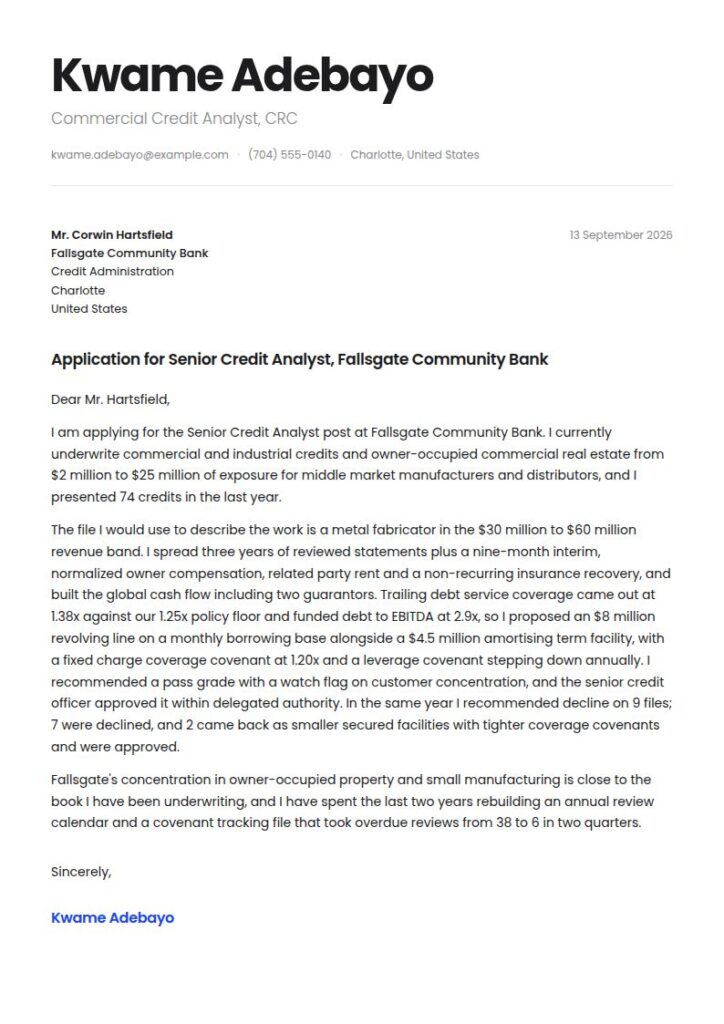
I am applying for the Senior Credit Analyst post at Fallsgate Community Bank. I currently underwrite commercial and industrial credits and owner-occupied commercial real estate from $2 million to $25 million of exposure for middle market manufacturers and distributors, and I presented 74 credits in the last year.
The file I would use to describe the work is a metal fabricator in the $30 million to $60 million revenue band. I spread three years of reviewed statements plus a nine-month interim, normalized owner compensation, related party rent and a non-recurring insurance recovery, and built the global cash flow including two guarantors. Trailing debt service coverage came out at 1.38x against our 1.25x policy floor and funded debt to EBITDA at 2.9x, so I proposed an $8 million revolving line on a monthly borrowing base alongside a $4.5 million amortising term facility, with a fixed charge coverage covenant at 1.20x and a leverage covenant stepping down annually. I recommended a pass grade with a watch flag on customer concentration, and the senior credit officer approved it within delegated authority. In the same year I recommended decline on 9 files; 7 were declined, and 2 came back as smaller secured facilities with tighter coverage covenants and were approved.
Fallsgate's concentration in owner-occupied property and small manufacturing is close to the book I have been underwriting, and I have spent the last two years rebuilding an annual review calendar and a covenant tracking file that took overdue reviews from 38 to 6 in two quarters. That is the kind of work I would want to take on early, because it is usually where a credit department loses time.
I hold the Credit Risk Certification and can give four weeks' notice. Thank you for your time.
Sincerely, Kwame Adebayo
Openings that place you
| Instead of | Use |
|---|---|
| I am passionate about credit risk and financial analysis | I underwrite commercial and industrial credits from $2 million to $25 million of exposure and presented 74 credits last year |
| I am writing to express my interest in the credit analyst position | I am applying for the Senior Credit Analyst post and can give four weeks' notice |
| I have strong analytical and financial modeling skills | Trailing debt service coverage of 1.38x against our 1.25x policy floor, with leverage at 2.9x |
| I have experience preparing credit memoranda | I set the covenant package and recommend the risk rating on every file I write |
| I would be an asset to your credit team | Fallsgate's concentration in owner-occupied property and small manufacturing is close to the book I underwrite |
Write one credit, five ways
The evidence paragraph is the whole letter. It has five moving parts and most candidates write only the first.
| Part | What the sentence has to contain |
|---|---|
| The spread | Years of statements, the interim, and what you normalized |
| The tests | The ratios you ran and the policy threshold each was measured against |
| The structure | Facilities, amounts, covenants, testing frequency and reporting |
| The rating | What you recommended and who approved it, within what authority |
| The decline | One file you recommended against, what the analysis found, and the outcome |
Any one of those is a bullet on a resume. Together they are the only evidence at this stage that you can take a file from spread to decision.
What you may say about a borrower
Describe a borrower by industry, revenue band and structure. Give ratios against policy thresholds. Name the facilities and covenants you proposed. Say what rating you recommended and at what authority it was approved. Write a decline and its outcome. Name the systems you work in.
Do not name a borrower, a guarantor, a loan number or a branch. Do not describe a borrower specifically enough that industry, size and geography together identify it. Do not give a borrower's revenue, EBITDA, balances or internal rating as precise figures. Do not attach a credit memo, a spread or a committee paper. Do not quote a committee minute or an examination finding. Do not claim approval authority you do not hold.
The occupation is shrinking and the judgement work is not
The Bureau of Labor Statistics counted 64,700 credit analysts in 2025, with employment projected to fall 4 percent to 62,000 by 2035 and a median annual wage of $83,510 in May 2025 (BLS Occupational Outlook Handbook, Data for Occupations Not Covered in Detail, published 27 August 2026). Financial risk specialists, a separately measured occupation of which 35 percent work in credit intermediation, had a median of $117,330 in the same cycle (BLS Occupational Outlook Handbook, May 2025).
The lending backdrop is steady rather than dramatic. In the July 2026 Senior Loan Officer Opinion Survey, banks reported commercial and industrial standards basically unchanged with moderately stronger demand from large and middle market firms (Federal Reserve Board, released 3 August 2026), and delinquency rates at all commercial banks in the second quarter of 2026 were 1.42 percent on total loans and leases and 1.27 percent on commercial and industrial loans (Federal Reserve Board, released 25 August 2026).
For a letter, that is an instruction about emphasis. Template and scorecard work is the part of this occupation under pressure. Structure, covenants, ratings, stress cases and concentration are not, and a letter that shows judgement on those is competing in a better market than the job title suggests.
Length, format and sending it
One page, four paragraphs, 300 to 400 words. PDF unless the bank's portal says otherwise, named for yourself and the post: kwame-adebayo-senior-credit-analyst-cover-letter.pdf.
Address a person. Credit department leadership is usually findable, and a letter addressed to a hiring committee at a community bank reads as a letter sent to twenty banks.
Use the same figures as your resume so the two agree. Our credit analyst resume example is written with the numbers used here, and our loan officer cover letter covers the production side of the same transaction.
Key takeaways
- Say commercial or consumer, the product and the exposure band in the first sentence.
- Give the number of credits you present in a year.
- Spend the evidence paragraph on one file, from spread to approval.
- Put the policy threshold next to every ratio you quote.
- Say what you proposed, not only what you calculated.
- End with a decline and its outcome.
- Keep every borrower name, figure and identifiable detail out of the letter.
Write your credit analyst cover letter in 10 minutes with our AI cover letter builder.
Credit analyst cover letter questions, answered
How long should a credit analyst cover letter be?
One page, four paragraphs, 300 to 400 words. A credit officer reading applications alongside a review calendar is scanning for exposure band, volume and evidence of judgement, and a longer letter usually means a second file summary that the resume already carries.
Should the letter be different for a commercial job and a consumer job?
Yes, substantially. A commercial letter is about one credit in depth: the spread, the tests, the structure and the rating. A consumer letter is about volume and consistency: decisions a week, the scorecard and policy you work to, exception handling, and how you document principal reasons so that a compliant adverse action notice can be issued. Sending the commercial version to a consumer lender reads as someone applying to the wrong job.
Can I name a borrower if the loan was publicly reported?
No, and this is stricter than the equivalent rule in advisory work. Even where a financing was announced, a borrower's relationship with your bank, its internal rating and the terms you proposed are the bank's and the borrower's confidential information, and your employment agreement almost certainly says so. Describe by industry, size band and structure.
How do I write about a credit that went wrong?
By what the analysis said at the time and what you changed afterwards. A credit that deteriorates after approval is a normal event in a portfolio, and a candidate who can describe the early warning they raised, the downgrade they recommended and the reporting they tightened is describing the most valuable part of the job. What reads badly is a letter in which nothing ever deteriorated.
What do I write if I am moving from accounting into credit?
Lead with the spreading. Statement analysis, accruals, revenue recognition and related party transactions are exactly what a credit analyst normalizes, and an accountant who can describe finding a non-recurring item is describing credit work. Then name your accounting semester hours, say which coverage and leverage tests you understand, and be explicit about what you have not yet done, such as proposing a covenant package. Credit departments train for that; they do not train for accounting.