Private Equity Associate Zofia Wojciechowski
Private Equity Associate
[email protected] | (312) 555-0104 | Chicago, United States
Profile
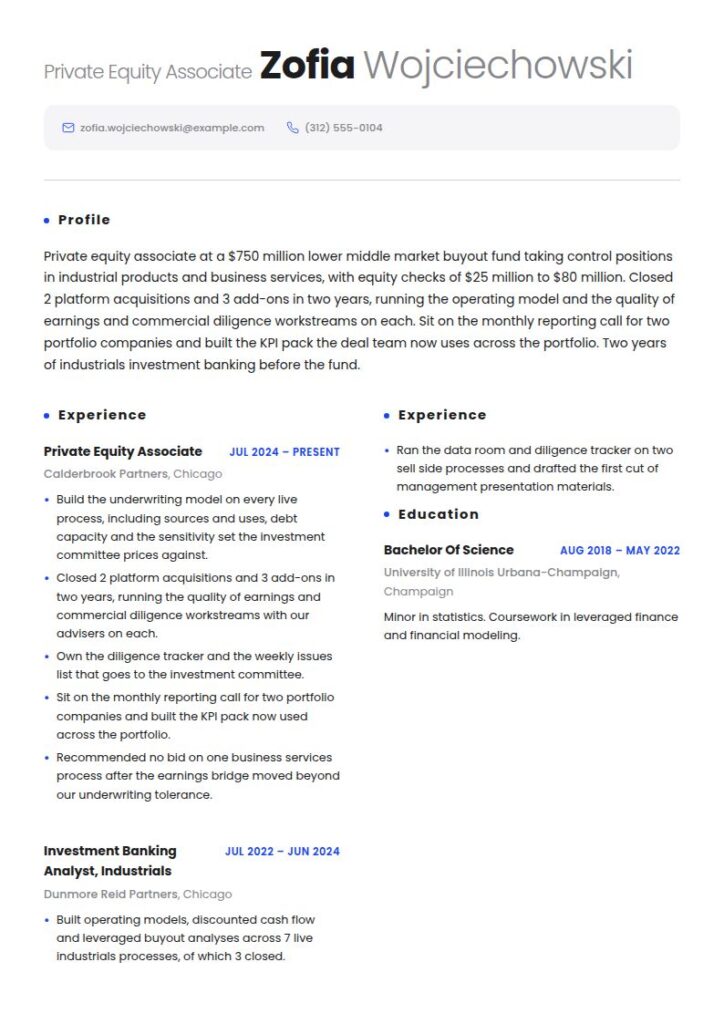
Private equity associate at a $750 million lower middle market buyout fund taking control positions in industrial products and business services, with equity checks of $25 million to $80 million. Closed 2 platform acquisitions and 3 add-ons in two years, running the operating model and the quality of earnings and commercial diligence workstreams on each. Sit on the monthly reporting call for two portfolio companies and built the KPI pack the deal team now uses across the portfolio. Two years of industrials investment banking before the fund.
Work Experience
07/2024 - Present, Private Equity Associate, Calderbrook Partners, Chicago, United States
- Build the underwriting model on every live process, including sources and uses, debt capacity and the sensitivity set the investment committee prices against.
- Closed 2 platform acquisitions and 3 add-ons in two years, running the quality of earnings and commercial diligence workstreams with our advisers on each.
- Own the diligence tracker and the weekly issues list that goes to the investment committee.
- Sit on the monthly reporting call for two portfolio companies and built the KPI pack now used across the portfolio.
- Recommended no bid on one business services process after the earnings bridge moved beyond our underwriting tolerance.
07/2022 - 06/2024, Investment Banking Analyst, Industrials, Dunmore Reid Partners, Chicago, United States
- Built operating models, discounted cash flow and leveraged buyout analyses across 7 live industrials processes, of which 3 closed.
- Ran the data room and diligence tracker on two sell side processes and drafted the first cut of management presentation materials.
Education
08/2018 - 05/2022, Bachelor of Science, Finance, University of Illinois Urbana-Champaign, Champaign, United States
Minor in statistics. Coursework in leveraged finance and financial modeling.
Skills
Leveraged buyout modeling, 80
Quality of earnings review, 70
Debt capacity and covenant headroom, 70
Diligence tracker and issues list ownership, 80
Portfolio KPI design and monthly reporting, 70
Excel to a modeling standard, 90
Capital IQ and PitchBook, 80
Languages
English, native
Polish, fluent
Certificates
08/2024, CFA Program, Level II passed, CFA Institute
Level II passed. Candidate for Level III. Not a charterholder.
Summary
A private equity resume is a one page document naming the fund and strategy you worked in, where you sat in each deal, the diligence workstreams you ran, what the model was used to decide, and what you owned in the portfolio after close. This guide gives you three adaptable versions, the hold period block most candidates leave out, and an honest read of pay where no federal occupation matches the job.
Private Equity resume examples by experience level
A private equity resume is a one page document that names the fund and strategy you worked in, where you sat in each transaction, the diligence workstreams you ran, what your model was actually used to decide, and what you owned in the portfolio company after the money went out.
That last clause is the one that separates this page from a banking resume. In fact, buying a business is half of the job. The other half is the three to six years afterwards, and it is the half that almost nobody writes down.
Resume guide for a private equity resume
To start, this guide and the corresponding private equity resume example will cover:
- First, how to write a private equity resume, section by section
- How to state fund size, strategy and check size so a reader can place you
- Then, three adaptable summaries: associate, senior associate and principal
- Also, what to write about the hold period, and what has to stay off the page
- What the market looks like, and why pay has to be bracketed rather than quoted
How to write a private equity resume
Overall, use five blocks: contact header, summary, investment experience, the deal and hold period record, and education with any credentials. One page, through principal.
| Section | What it is answering | Where it goes |
|---|---|---|
| Summary | What fund, what strategy, what check size, how many closed deals? | Top, three or four lines |
| Investment experience | What did you do inside a process, and at what level of responsibility? | Reverse chronological, by firm |
| Deal and hold period record | What closed, what you owned during diligence, and what you owned after close | Its own block, the longest part of the page |
| Education and credentials | Degree, institution, year, anything quantitative | Last, compact |
State the fund and the strategy before you state the deals
"Private equity associate" is not a placeable sentence. A reader needs four facts before your deals mean anything: fund size, strategy, check size and sector.
Write it as one line: "Associate at a $750 million lower middle market buyout fund, control positions, equity checks of $25 million to $80 million, in industrial products and business services." That tells a reader whether your experience transfers to the seat they are filling.
Strategy is the part candidates skip and the part that decides fit. Control buyout, growth equity, minority recapitalization, distressed and secondaries are five different jobs. So is a fund that underwrites operational improvement against one that underwrites multiple expansion. Say which one you have lived in.
Run the finished file through the ATS resume checker before you submit. Funds and the search firms that staff for them parse applications into structured records, and a deal table built with tab stops is where that parse breaks.
Choosing the best resume format for a private equity resume
Reverse chronological, single column, one page. The convention is as strong as it is in banking: a reader is scanning a stack of files that all have the same shape, and a file that departs from it reads as unfamiliar rather than original.
Keep dates to month and year. However, the one real format decision is what to put under each deal. For example, a banking resume puts the process there. A private equity resume puts the investment decision and the years after it, which is why the deal block is usually two lines longer per transaction than a banking deal sheet.
Include your contact information
| ✅ Right | ❌ Wrong |
|---|---|
| Zofia Wojciechowski | Zofia Wojciechowski |
| Private Equity Senior Associate, Industrials and Business Services | Investment professional with a track record of value creation |
| Lower middle market control buyout, $25m to $80m equity checks | Experienced in all aspects of the deal lifecycle |
| (312) 555-0104, [email protected], Chicago, IL | (312) 555-0104, [email protected] |
In particular, the third line is the one that makes a reader keep going. That is because strategy and check size place you in about a second, and a reader who cannot place you moves on.
Make use of a summary
Next, write three or four lines: level, fund size and strategy, closed deal count with your role, one portfolio result you were personally responsible for, and the sector.
Private equity associate at a $750 million lower middle market buyout fund taking control positions in industrial products and business services, with equity checks of $25 million to $80 million. Closed 2 platform acquisitions and 3 add-ons in two years, running the operating model and the quality of earnings and commercial diligence workstreams on each. Sit on the monthly reporting call for two portfolio companies and built the KPI pack the deal team now uses across the portfolio. Two years of industrials investment banking before the fund.
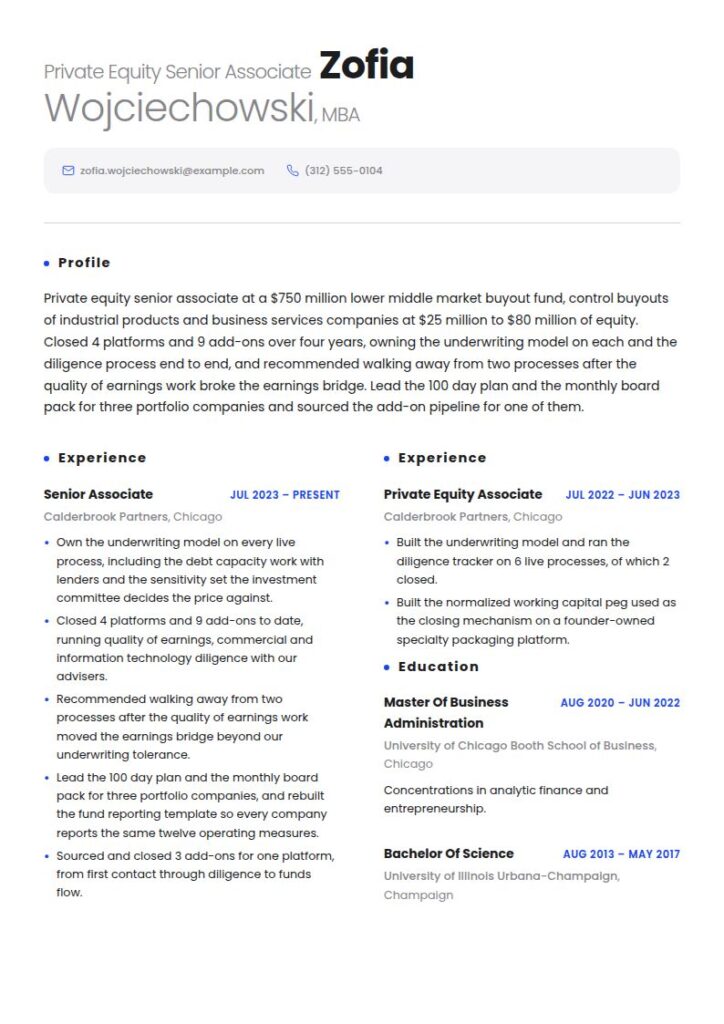
Private equity senior associate at a $750 million lower middle market buyout fund, control buyouts of industrial products and business services companies at $25 million to $80 million of equity. Closed 4 platforms and 9 add-ons over four years, owning the underwriting model on each and the diligence process end to end, and recommended walking away from two processes after the quality of earnings work broke the earnings bridge. Lead the 100 day plan and the monthly board pack for three portfolio companies and sourced the add-on pipeline for one of them.
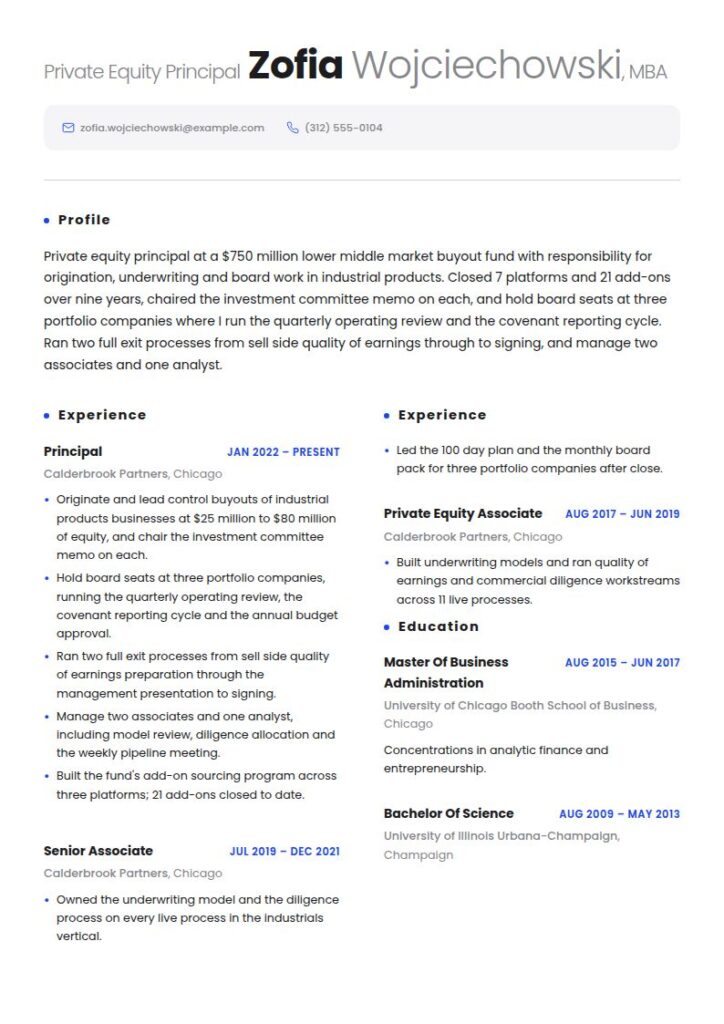
Private equity principal at a $750 million lower middle market buyout fund with responsibility for origination, underwriting and board work in industrial products. Closed 7 platforms and 21 add-ons over nine years, chaired the investment committee memo on each, and hold board seats at three portfolio companies where I run the quarterly operating review and the covenant reporting cycle. Ran two full exit processes from sell side quality of earnings through to signing, and manage two associates and one analyst.
Right vs wrong: the same private equity summary, twice
| ✅ Right | ❌ Wrong |
|---|---|
| $750 million lower middle market buyout fund, control positions, $25m to $80m equity checks. | Experience across a broad range of private equity transactions and asset classes. |
| Closed 4 platforms and 9 add-ons over four years, owning the underwriting model on each. | Executed numerous complex transactions from origination through to exit. |
| Recommended walking away from two processes after the quality of earnings work broke the earnings bridge. | Performed extensive due diligence and financial analysis on potential investments. |
In short, a reader can place the right column against a job description. The left column is what a candidate writes when they do not want to say how many deals they have closed or what they did on them.
Outline your private equity experience
Firm, strategy, city, title and dates. Then three or four bullets per role about what you did inside a process and what you did after it, not about what the process was.
| Instead of | Use |
|---|---|
| Built LBO models for potential acquisitions | Own the underwriting model on every live process: sources and uses, debt capacity, management case against our case, and the entry multiple the return threshold implies |
| Conducted due diligence on target companies | Run the quality of earnings, commercial and IT workstreams with our advisers; manage the diligence tracker and the weekly issues list to the investment committee |
| Assisted with portfolio company monitoring | Run the monthly reporting cycle for three portfolio companies: the operating pack, the covenant certificate and the lender report |
| Supported add-on acquisition strategy | Built and maintain the add-on pipeline for one platform; 9 targets contacted, 4 in dialogue, 2 closed |
Senior Associate, Calderbrook Partners, Chicago, IL, July 2023 to Present
$750 million lower middle market buyout fund taking control positions in industrial products and business services at $25 million to $80 million of equity.
Own the underwriting model on every live process, including the debt capacity work with lenders and the sensitivity set the investment committee decides the price against; 4 platforms and 9 add-ons closed to date.
Run the quality of earnings, commercial and information technology diligence workstreams with our advisers, and write the weekly issues list that goes to the investment committee.
Recommended walking away from two processes after the quality of earnings work moved the earnings bridge by more than our underwriting tolerance; both were later reported as closing above our maximum price.
Lead the 100 day plan and the monthly board pack for three portfolio companies, and rebuilt the fund's reporting template so every company reports the same twelve operating measures.
Say where you sat in each deal, and what you owned through the hold period
This is the block that makes a private equity resume different from a banking resume, and most candidates write only the first half of it.
A banking deal sheet answers what closed and what you produced; our investment banker resume example covers that form. A private equity record has to answer two further questions: what you were accountable for when the fund put its own money at risk, and what happened to the business afterwards.
Then give each transaction four lines: the deal, the seat, the model, and the hold.
Platform, industrial filtration, closed Q2 2024. Enterprise value in the $90 million to $120 million range, control position. Seat: ran the process day to day under the deal partner, owned the model and the diligence tracker. Model: built the debt capacity and downside cases; the model set the maximum price and we bid $6 million below the guide. Hold: wrote the 100 day plan, chair the monthly operating review, and closed 3 add-ons in the first 20 months.
Add-on, industrial filtration, closed Q1 2025. Bolt-on to the platform above, funded from the revolver. Seat: led it end to end, from first contact to funds flow. Model: accretion, integration cost and pro forma covenant headroom. Hold: integration tracking for two quarters against a stated synergy number.
Declined, business services, Q3 2024. Recommended no bid after the quality of earnings work moved the earnings bridge beyond our underwriting tolerance. Seat: owned the model and the earnings bridge review.
Exit, diagnostics services, signed Q2 2026. Sell side process on a business held five years. Seat: ran sell side quality of earnings preparation, the data room and the management presentation build with the chief executive.
Four rules govern that block.
Name the seat honestly. "Ran the process day to day under the deal partner" and "second associate on the deal" are different claims, and both are respectable. A passive construction that lets a reader assume the larger one is not.
Say what the model decided, not that you built it. Everyone at your level builds models. The sentence that carries weight connects the model to a decision: the maximum price, the debt quantum, the walk-away, the closing mechanism, the synergy the add-on was underwritten to.
Write the declines. A recommendation not to invest is the most underrated line on a private equity resume and the one a partner will ask about. Funds look at far more businesses than they buy, and the judgment that says no is the one they are hiring.
Write the hold, in specifics. Board or observer seat, the reporting cycle you run, the 100 day plan, the hires you helped make, the add-on pipeline, the covenant and lender reporting, the exit preparation. A candidate who can describe that is describing the job rather than the transaction.
What you may publish about a deal, and what you may not
Three categories of information routinely appear on private equity resumes where they do not belong.
Unannounced transactions. A live process is confidential: the obligation comes from the confidentiality agreement over the process and from your firm's own policy.
Fund and deal returns. Internal rate of return, multiple of invested capital and fund level performance belong to the fund and its investors, not to you. Advisers also live under presentation rules: the Securities and Exchange Commission's marketing rule requires that an advertisement not present gross performance unless it also presents net performance, among other conditions (SEC, rule 206(4)-1 as adopted 22 December 2020).
Portfolio company financials that are not public. Revenue, margin, covenant headroom and purchase price for a privately held company are the company's information. Use ranges and size bands.
What you may always write is your own work: the seat, the workstreams, the recommendation, the deliverables you produced and the operating measures you built.
Build a snapshot of your key skills
Keep it short. In practice, on a one page file the deal and hold record earns the space, and this block only confirms it.
Underwriting: Leveraged buyout modeling, Debt capacity and covenant headroom, Returns bridges and sensitivity design, Normalized working capital and closing mechanisms
Diligence: Quality of earnings scoping and review, Commercial diligence management, Information technology and cyber diligence, Management assessment, Diligence tracker and issues list ownership
Portfolio: 100 day planning, Monthly operating and board reporting, KPI design, Covenant compliance and lender reporting, Exit readiness and sell side preparation
Tools: Excel to a modeling standard, PowerPoint, Capital IQ, PitchBook, Datasite, Power BI
List your education and credentials
Degree, institution, year, then anything quantitative worth knowing. Credentials are short here because no license gates this job.
Master of Business Administration, University of Chicago Booth School of Business, Chicago, IL, 2023
Bachelor of Science, Finance, University of Illinois Urbana-Champaign, Champaign, IL, 2017
Additional: CFA Program, Level II passed, 2022. Financial modeling and leveraged finance coursework, 2019. Polish, fluent, used in European add-on diligence.
Notably, you need no license or registration to work at a private equity fund in the way you need one to work at a broker-dealer. The Financial Industry Regulatory Authority's Series 79 registration belongs to investment banking representatives at member firms, and candidates "must be associated with and sponsored by a FINRA member firm" even to sit it (FINRA, accessed September 2026), so it is neither expected nor obtainable on your own.
Similarly, readers view the CFA charter favorably, but it is not the standard path. For instance, CFA Institute requires three exams plus "at least 4,000 hours of relevant work experience, completed in no fewer than 36 months", and states that the three levels take three to four years (CFA Institute, accessed September 2026). If you hold it or have passed a level, write the exact status and year. If you are choosing between the charter and another two closed deals, the deals are worth more here.
Choose the right layout and design
Also keep to one page, single column, 10 or 10.5 point, half inch to three quarter inch margins. Above all, the deal and hold record may be a simple table or a set of labeled lines; lay out nothing else on the page.
State fund size, strategy and check size in the first line. Split platforms from add-ons and say which. Name your seat on every deal in plain words. Say what the model was used to decide. Write the hold period: the plan, the reporting, the hires, the add-ons, the exit. Include at least one deal you recommended against. Keep the whole file to one page.
Do not put a live or unannounced process on the page. Do not quote fund or deal returns you do not have written permission to publish. Do not publish a private portfolio company's revenue, margin or purchase price as a precise figure. Do not describe a business specifically enough to identify it. Do not attach a model, a memo or a diligence report as a work sample; it belongs to your firm and usually to a counterparty as well. Do not claim a deal you joined for the last fortnight of diligence.
Private equity job market and outlook
Of course, the Bureau of Labor Statistics publishes no Occupational Outlook Handbook profile for private equity. The Handbook covers broad occupations rather than job titles, and the work here is split across three of them, so no single published profile matches the job.
The honest way to read the market is to bracket the role between those three, in the way our investment banker resume example does for the sell side.
| Bracketing occupation | Employment, 2025 | Projected change, 2025 to 2035 | Annual openings | Median annual wage, May 2025 |
|---|---|---|---|---|
| Securities, commodities and financial services sales agents | 531,000 | 1 percent growth, +7,500 | ~35,100 | $78,660 |
| Financial analysts | 443,100 | 7 percent growth, +32,000 | ~29,500 | $103,570 |
| Financial managers | 879,700 | 10 percent growth, +84,900 | ~65,600 | $166,570 |
Source: U.S. Bureau of Labor Statistics, Occupational Outlook Handbook, May 2025 wage data and 2025 to 2035 projections, published 27 August 2026.
Specifically, within financial analysts, 24 percent work in securities, commodity contracts and other financial investments, and that industry paid the highest median in the profile at $124,370 in May 2025 (BLS Occupational Outlook Handbook, May 2025). In other words, it is the closest the federal data comes to describing where fund investment staff sit.
How big the asset class actually is, in filed federal data
The clearest public count of private equity comes from the Securities and Exchange Commission, which aggregates Form PF and Form ADV filings by registered advisers into a quarterly Private Fund Statistics report. As of the fourth calendar quarter of 2025, it counted 27,682 private equity funds with an aggregate gross asset value of $9,334 billion and an aggregate net asset value of $8,523 billion, advised by 2,047 advisers (SEC Division of Investment Management, Private Fund Statistics, fourth calendar quarter 2025, data as of 3 July 2026).
Private equity was the largest single fund type in that report by both fund count and net asset value, against 58,891 private funds of all types holding $29,631 billion of gross assets and $19,013 billion of net assets in the same quarter.
Two things follow. 2,047 advisers is a small and well connected industry, so every number on your page should be one you can defend in a reference call; and the count spans a wide range of fund sizes and strategies, which is why stating yours in the first line does more work than any adjective.
What salary you can expect in private equity
Likewise, no federal source publishes a median for this job title. Instead, what anyone can say accurately is where the surrounding measured occupations sit.
For example, securities, commodities and financial services sales agents had a median annual wage of $78,660 in May 2025, financial analysts $103,570, and financial managers $166,570 (BLS Occupational Outlook Handbook, May 2025). Early in a fund career you sit nearer the middle figure; most institutions, however, band a principal or partner against the third.
Moreover, the Bureau's published wages are "straight-time, gross pay, exclusive of premium pay", including base rate, commissions, incentive pay and production bonuses, and excluding non-production bonuses, overtime and the employer cost of benefits (BLS Occupational Employment and Wage Statistics, accessed September 2026). As a result, a discretionary year-end bonus is a non-production bonus and falls outside these figures, and carried interest falls outside them entirely. No federal source publishes either, so this page quotes neither. Treat the published medians as a floor, get the bonus structure in writing, and ask about carry allocation, vesting and whether it is granted at your level at all.
Still, what a resume moves is the band a reader places you in. Fund size and strategy, closed platform and add-on counts, the seat you held in each, the decisions your model carried, and a described hold period are what decide whether you are screened as an associate, a senior associate or a principal.
Key takeaways for a private equity resume
- First, open with fund size, strategy and check size; nothing else places you as fast.
- Then split platforms from add-ons, and give a count for each.
- Next, name your seat on every deal in plain words, and expect interviewers to ask about it.
- Also say what the model decided: the price, the debt, the mechanism, the walk-away.
- Write the hold period, because that is where the job actually is.
- Include at least one deal you recommended against, with what the diligence found.
- Finally, keep returns, private financials and unannounced processes off the page entirely.
Build your private equity resume in 15 minutes with our AI resume builder.
Related accounting and finance resume examples
- Investment banker resume
- Financial analyst resume
- Credit analyst resume
- Finance director resume
- Finance manager resume
- Financial advisor resume
- Banker resume
- Compliance officer resume
- Auditor resume
- Accountant resume
- CPA resume
- Accounting and finance resume
Pair it with a matching private equity cover letter.
Private equity resume questions, answered
How long should a private equity resume be?
One page, through principal. The deal and hold record compresses well, and the convention is strong enough that a two page file reads as a candidate who has not worked in a fund. Partners and operating partners are the usual exception.
Does the Bureau of Labor Statistics publish a private equity salary?
No. There is no Occupational Outlook Handbook profile for the title, so no median exists for it. Bracket the role between securities, commodities and financial services sales agents at $78,660, financial analysts at $103,570 and financial managers at $166,570, all May 2025 (BLS Occupational Outlook Handbook, published 27 August 2026). Treat any single quoted figure for the job title itself with suspicion.
Can I put my fund's returns or a deal's multiple on my resume?
Not without written permission, and usually not at all. Fund and deal performance belongs to the fund and its investors, and advisers operate under presentation rules: the SEC's marketing rule requires that an advertisement not present gross performance unless net performance is also presented, among other conditions (SEC, rule 206(4)-1, adopted 22 December 2020). Describe what you did and what you decided instead.
How do I move from investment banking into private equity?
Lead with the analytical seat rather than the process seat. Write which models were yours, what buy side mandates you worked on, what you found in diligence, and any moment where your work changed a price or a recommendation. Then show you understand the second half of the job by naming what you would want to own after close.
What do I write with no fund experience yet?
Write the closest work you have in the same structure: buy side advisory mandates, quality of earnings engagements, corporate development projects, restructuring assignments, or an operating role where you owned a plan and reported against it. Give the count, the size band, your seat, what your analysis decided and what happened afterwards.
Should I list a board seat at a portfolio company?
Yes, with the exact role, because board seat and board observer are different and a reader knows the difference. Describe the business by sector and size band rather than by name where the investment is not public, and say what you actually run: the operating review, the reporting cycle, the covenant pack, the chief executive search.