Zofia Wojciechowski Private Equity Senior Associate Chicago, 60607, United States [email protected] · (312) 555-0104
13 September 2026
Ms. Celia Ravenhill Investment Team Thornwick Capital Partners Chicago, United States
Application for Senior Associate, Thornwick Capital Partners
Dear Ms. Ravenhill,
I am applying for the Senior Associate post at Thornwick Capital Partners. I have spent four years at Calderbrook Partners, a $750 million lower middle market buyout fund taking control positions in industrial products and business services at $25 million to $80 million of equity, where I have closed 4 platforms and 9 add-ons and owned the underwriting model on each.
The deal I would most want to talk about is an industrial filtration platform we closed in 2024. I ran the process day to day under the deal partner, owned the model and the diligence tracker, and scoped the quality of earnings work. The earnings bridge came back with two adjustments the seller had not disclosed, which moved our maximum price by more than the guide range allowed, and we bid below it rather than stretch. We won anyway. Since close I have written the 100 day plan, chaired the monthly operating review and closed 3 add-ons for that platform, from first contact through to funds flow. I have also recommended walking away from two processes on the same basis, and I think the second of those is the better answer I have given as an investor.
Thornwick's industrials practice and its stated preference for founder-owned businesses with no chief financial officer at entry is close to the work I have been doing. On our specialty packaging platform I ran the chief financial officer search brief and the first two quarters of monthly reporting after the hire, which is the least glamorous and most useful thing I have done since I joined a fund. I would be glad to do more of it.
I can work to your timetable and can provide references from my deal partner and from two portfolio company chief executives. Thank you for reading.
Sincerely, Zofia Wojciechowski
Summary
A private equity cover letter names the strategy you have actually worked in, the seat you held in one specific deal, what your analysis decided, and what you owned in the portfolio after close. This guide gives you a full adaptable letter, the opening lines that place you in a sentence, and the rules on what you may say about a fund, a deal and a portfolio company.
Private Equity cover letter examples by experience level
A private equity cover letter is a one page letter that tells a fund which strategy you have actually worked in, what you did in one specific transaction, and what you owned in the years after it closed.
In practice, funds hire in small numbers and read carefully. As a result, a fund discards a letter that says you are passionate about value creation in a second. By contrast, a letter that says which strategy, which check size, which seat and which decline is a letter from somebody who has done the job.
Guide to a private equity cover letter
Specifically, this guide and the corresponding private equity cover letter example will cover:
- First, how to structure the letter, paragraph by paragraph
- Then, why fund size, strategy and check size belong in the first two sentences
- How to write one deal properly instead of five badly
- What you may say about a fund, a deal and a portfolio company
- Finally, the openings that place you, and the ones that waste the paragraph
How to write a private equity cover letter
| Paragraph | Its job | Length |
|---|---|---|
| Opening | The seat you are applying for, your strategy, check size and closed count | 2 to 3 sentences |
| Evidence | One deal: your seat, what the model decided, what you owned in the hold | 4 to 6 sentences |
| Fit | Something specific and true about their fund, and what you would bring to it | 3 to 4 sentences |
| Close | Availability, references, thank you | 2 sentences |
Place yourself in the first two sentences, then spend the letter on one deal
The reader's first question is whether your experience transfers. Answer it immediately: fund size, strategy, check size, sector, closed count. Five facts, one sentence.
Then resist the temptation to list every transaction. Your resume already carries the list. The letter's job is to take one deal apart: what you owned, what the diligence found, what the model said, what price that implied, and what you did in the twenty months afterwards.
One deal written properly is the strongest thing you can put in front of a fund, because it is the only part of your file a reader cannot get from a database.
A private equity cover letter example you can adapt
Dear Ms. Ravenhill,
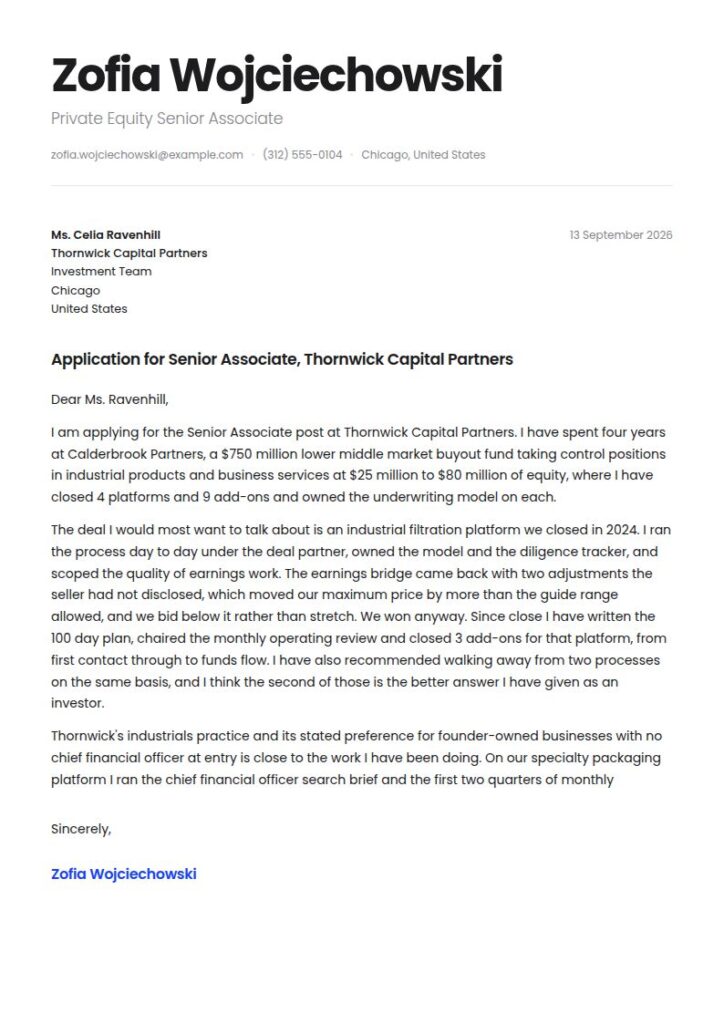
I am applying for the Senior Associate post at Thornwick Capital Partners. I have spent four years at Calderbrook Partners, a $750 million lower middle market buyout fund taking control positions in industrial products and business services at $25 million to $80 million of equity, where I have closed 4 platforms and 9 add-ons and owned the underwriting model on each.
The deal I would most want to talk about is an industrial filtration platform we closed in 2024. I ran the process day to day under the deal partner, owned the model and the diligence tracker, and scoped the quality of earnings work. The earnings bridge came back with two adjustments the seller had not disclosed, which moved our maximum price by more than the guide range allowed, and we bid below it rather than stretch. We won anyway. Since close I have written the 100 day plan, chaired the monthly operating review and closed 3 add-ons for that platform, from first contact through to funds flow. I have also recommended walking away from two processes on the same basis, and I think the second of those is the better answer I have given as an investor.
Thornwick's industrials practice and its stated preference for founder-owned businesses with no chief financial officer at entry is close to the work I have been doing. On our specialty packaging platform I ran the chief financial officer search brief and the first two quarters of monthly reporting after the hire, which is the least glamorous and most useful thing I have done since I joined a fund. I would be glad to do more of it.
I can work to your timetable and can provide references from my deal partner and from two portfolio company chief executives. Thank you for reading.
Sincerely, Zofia Wojciechowski
Openings that place you
| Instead of | Use |
|---|---|
| I am passionate about private equity and value creation | I have spent four years at a $750 million lower middle market buyout fund, control positions, $25m to $80m equity checks |
| I am writing to express my interest in the Senior Associate position | I am applying for the Senior Associate post, and I have closed 4 platforms and 9 add-ons in industrial products |
| I have extensive transaction experience across multiple sectors | I own the underwriting model on every live process in our industrials vertical |
| I would bring strong analytical skills to your team | The quality of earnings work moved our maximum price and we bid below the guide range rather than stretch |
| I admire your firm's impressive track record | Your stated preference for founder-owned businesses with no chief financial officer at entry is close to what I have been doing |
Write one deal, four ways
In fact, the deal paragraph is the whole letter. However, it has four moving parts and most candidates write only the first.
| Part | What the sentence has to contain |
|---|---|
| The seat | Your actual role in plain words, under whom, and what you personally owned |
| The finding | What diligence turned up that was not in the information memorandum |
| The decision | What the model said and what the fund did about it, including the price |
| The hold | What you have owned since close, with a period attached |
Any of those four on its own, however, is a bullet. Together, by contrast, they are the only evidence a fund can read at this stage that it can trust you with an underwriting.
What you may say about a fund, a deal and a portfolio company
Name your fund's size, strategy, sector and check size, all of which are usually public and all of which place you. Describe closed deals that were publicly announced. Describe a private portfolio company by sector, size band and situation. Say what your analysis decided and what you owned after close. Write one decline and what the diligence found.
Do not describe a live or unannounced process in a letter. Do not quote fund or deal returns without written permission from your firm. Do not publish a private portfolio company's revenue, margin, covenant headroom or purchase price as a precise figure. Do not name a limited partner. Do not describe a business specifically enough that a reader in the same sector could identify it. Do not attach a model, a memo or a diligence report; it is not yours to send.
The industry is smaller than the letter assumes
The Securities and Exchange Commission aggregates Form PF and Form ADV filings into a quarterly Private Fund Statistics report. As of the fourth calendar quarter of 2025 it counted 27,682 private equity funds with an aggregate gross asset value of $9,334 billion and a net asset value of $8,523 billion, advised by 2,047 advisers (SEC Division of Investment Management, Private Fund Statistics, fourth calendar quarter 2025, data as of 3 July 2026).
Two thousand advisers is a small professional world. The person reading your letter probably knows somebody who worked on the deal you are describing, and may know the adviser who ran the quality of earnings on it.
That is the practical argument for precision. Overstate your seat and it is checkable. State it exactly, including the parts where you were the second person on the model rather than the first, and the letter reads as credible before anyone has picked up a phone.
Length, format and sending it
One page, four paragraphs, 300 to 400 words. PDF unless the portal says otherwise, named for yourself and the seat: zofia-wojciechowski-private-equity-senior-associate-cover-letter.pdf.
Address a person. Nearly every fund website lists its investment team; as a result, a letter addressed to a hiring committee at a firm with twelve investment professionals reads as a letter sent to forty funds.
Use the same figures as your resume so the two agree. Our private equity resume example is written with the numbers used here, and our investment banker cover letter covers the sell side equivalent.
Key takeaways
- First, place yourself in the first sentence: fund size, strategy, check size, sector, closed count.
- Then spend the letter on one deal, not on a list.
- Name your seat exactly, including where you were not the lead.
- Next, say what the model decided and what the fund did about it.
- Write the hold period, because it is half the job and almost nobody mentions it.
- Also, include one decline and what the diligence found.
- Above all, keep returns, private financials, limited partners and live processes out of it.
Write your private equity cover letter in 10 minutes with our AI cover letter builder.
Private equity cover letter questions, answered
How long should a private equity cover letter be?
One page, four paragraphs, 300 to 400 words. Funds read files in small batches and length is not read as effort. If the letter runs longer, the usual cause is a list of deals that already appears on the resume.
Should I send a cover letter if the fund only asked for a resume?
Attach one wherever there is a field for it, and keep it short if there is not. The resume carries the deal list; the letter is the only place you can say what one of those deals taught you and what you did during the hold period, which is the part that distinguishes candidates whose deal sheets look identical.
Can I mention a deal that has not been announced?
No. A live or unannounced process is confidential under the process agreement and under your firm's own policy, and describing it in a disguised form is not a solution. Write an announced deal instead, or describe the sector, the situation and your workstream without the transaction.
What do I write if I am coming from investment banking?
Write the buy side mandate that came closest to an investment decision. Which model was yours, what the diligence found, what price it implied, and what you would have recommended. Then name the part of the fund's job you have not done yet and say what you would want to own after close. Candour about the gap reads better than pretending it is not there.
How do I write about a deal that went badly?
Plainly, with what you learned and what you would do differently at underwriting. Funds know that some investments do not work, and a candidate who can describe a difficult hold period, the covenant conversations and the decisions taken is describing the real job. What they will not accept is a letter in which every deal was a success and no judgement was ever tested.