Danielle Vukovich Credit and Collections Manager Cleveland, 44113, United States [email protected] · (216) 555-0174
11 September 2026
Mr. Sean Halloran Finance Director Lakeshore Fabrication Group Cleveland, United States
Application for Credit and Collections Manager, Lakeshore Fabrication Group
Dear Mr. Halloran,
I am applying for the Credit and Collections Manager post at Lakeshore Fabrication Group. I currently run a $34m receivables ledger across 1,400 active accounts at Northcoast Industrial Supply, leading a team of four, and days sales outstanding is down from 58 days to 41 over the last three years.
Most of that came from one unglamorous decision. When I took the ledger, disputes and deductions were sitting inside the ageing, so the over-90 bucket looked like delinquency when a good part of it was unresolved pricing and shortage claims. I pulled them out into a separate log, routed pricing claims to sales and shortage claims to the warehouse on the day they were raised, and average resolution fell from 46 days to 18. Once that noise was gone we could see the accounts that genuinely were not paying, and the over-90 bucket went from 11% of ledger balance to 3%. Bad debt written off fell from 0.9% of revenue to 0.2% over the same period, helped by rebuilding credit limits on a scored annual review.
Your posting mentions that collections and credit sit in different teams at present. That split is usually where the days hide, because a hold that nobody can release is just a delay with a different name. The first thing I would want to agree is a service level on credit hold releases; ours is four business hours, agreed with sales, and it removed most of the argument.
I hold the Credit Business Associate designation from the National Association of Credit Management and sign off write-offs above $5,000 in my current role. I can give four weeks' notice. Thank you for your time.
Sincerely, Danielle Vukovich, CBA
Summary
An accounts receivable cover letter names the ledger you collect, the days sales outstanding you moved it to, and the one thing you changed to get there. This guide gives you a full adaptable letter, the openings that work, how to write about a difficult account without naming a customer, and what to say when your employer never measured DSO at all.
Accounts Receivable cover letter examples by experience level
In short, an accounts receivable cover letter is a one-page letter that tells a controller how big a ledger you have collected, how many days you took out of it, and what you had to fix to do that.
In most cases, the reader is a controller, a credit manager or a finance director, and they have a cash problem or they would not be hiring. For this reason, answer the cash problem in the first three sentences.
Guide to an accounts receivable cover letter
Specifically, this guide and the corresponding accounts receivable cover letter example will cover:
- First, how to structure the letter, paragraph by paragraph
- Then, why the ledger value and the days sales outstanding belong at the top
- What to write when nobody at your employer ever calculated DSO
- Also, how to describe a difficult account without naming a customer
- Finally, the openings that work and the ones readers skip
How to write an accounts receivable cover letter
| Paragraph | Its job | Length |
|---|---|---|
| Opening | The role, your ledger value, account count and DSO | 2 to 3 sentences |
| Evidence | One movement, the period, and the mechanism behind it | 4 to 5 sentences |
| Fit | Something specific about their situation and what you would do first | 3 to 4 sentences |
| Close | Credential, authority level, availability, thank you | 2 sentences |
Lead with the ledger, then the direction of travel
A controller reading collections letters is looking for two facts and rarely finds either: how big a book you have handled, and whether it got better while you had it.
"I manage a $34m receivables ledger across 1,400 active accounts, and days sales outstanding is down from 58 to 41 over three years" delivers both in one sentence. Everything else in the letter is support for it.
If you are moving up in ledger size, say the current figure honestly and then give the reason the step is credible: national accounts, portal-based customers, deduction-heavy trade, or a team you already coach.
An accounts receivable cover letter example you can adapt
Dear Mr. Halloran,
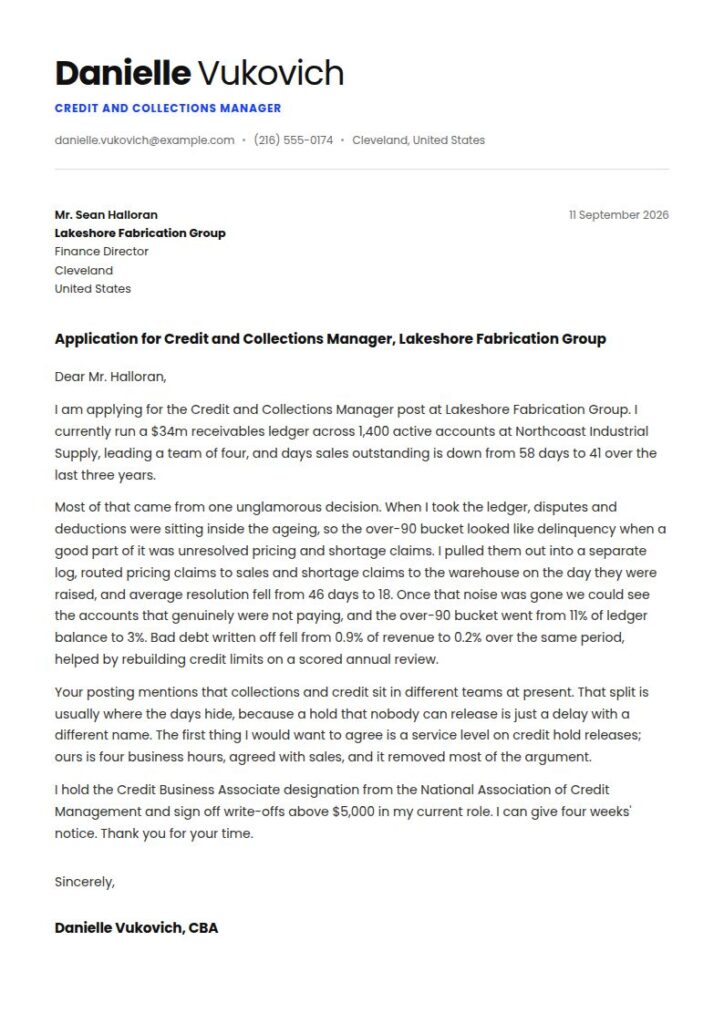
I am applying for the Credit and Collections Manager post at Lakeshore Fabrication Group. I currently run a $34m receivables ledger across 1,400 active accounts at Northcoast Industrial Supply, leading a team of four, and days sales outstanding is down from 58 days to 41 over the last three years.
Most of that came from one unglamorous decision. When I took the ledger, disputes and deductions were sitting inside the ageing, so the over-90 bucket looked like delinquency when a good part of it was unresolved pricing and shortage claims. I pulled them out into a separate log, routed pricing claims to sales and shortage claims to the warehouse on the day they were raised, and average resolution fell from 46 days to 18. Once that noise was gone we could see the accounts that genuinely were not paying, and the over-90 bucket went from 11% of ledger balance to 3%. Bad debt written off fell from 0.9% of revenue to 0.2% over the same period, helped by rebuilding credit limits on a scored annual review.
Your posting mentions that collections and credit sit in different teams at present. That split is usually where the days hide, because a hold that nobody can release is just a delay with a different name. The first thing I would want to agree is a service level on credit hold releases; ours is four business hours, agreed with sales, and it removed most of the argument.
I hold the Credit Business Associate designation from the National Association of Credit Management and sign off write-offs above $5,000 in my current role. I can give four weeks' notice. Thank you for your time.
Sincerely, Danielle Vukovich, CBA
Openings that work
| Instead of | Use |
|---|---|
| I am writing to apply for the accounts receivable position advertised | I run a $34m ledger across 1,400 accounts, with DSO down from 58 days to 41 |
| I have excellent communication and negotiation skills | I work a statement, call, hold ladder at about 70 documented contacts a week |
| I am passionate about helping businesses improve cash flow | Average deduction resolution fell from 46 days to 18 once disputes came out of the ageing |
| I believe I would be an asset to your finance team | Your posting mentions credit and collections sitting in separate teams, which is usually where the days hide |
What counts as evidence in receivables
| Kind of evidence | What it looks like in a sentence |
|---|---|
| Ledger and direction | A $34m ledger across 1,400 accounts, DSO from 58 days to 41 over three years |
| Ageing shape | Over-90 bucket from 11% to 3% of ledger balance across five quarters |
| Bad debt | Written off from 0.9% to 0.2% of revenue |
| Disputes | Average deduction resolution from 46 days to 18 |
| Cash application | Unapplied cash from $410,000 to under $25,000, 98% same-day application |
| Contact volume | About 70 documented contacts a week with promises to pay logged |
| Authority | Write-off sign-off above $5,000 and credit hold release inside four business hours |
One of these goes in the letter. The rest belong on the accounts receivable resume.
Where collections jobs actually are, and what they pay
Bill and account collectors numbered 160,200 in 2025, with employment projected to fall 10 percent by 2035, about 11,200 openings a year and a median annual wage of $47,030 in May 2025 (BLS Occupational Outlook Handbook, published 27 August 2026).
The sector split matters more than the median. Business support services, which is the third-party agency sector, holds 25 percent of those jobs at a median of $38,020, while management of companies pays $50,340 and credit intermediation $48,730 (BLS, May 2025).
If you are writing from agency experience into an in-house role, the letter has to do translation work. Portfolio value, contacts per week, cure rate and the size of the decisions you were trusted with all carry across. Script adherence and call quotas do not, and leading with them makes an in-house controller assume you have never set a credit limit.
Writing about a difficult account without naming a customer
The most interesting thing that happened to you last year is probably the one thing that cannot go in the letter.
Describe the pattern rather than the account: a national customer paying to its own cycle, a deduction-heavy trade, a portal that resets the clock. Give the outcome as a number. Say what authority you held. Name one specific thing from their posting or their situation, and say what you would do about it first.
Do not name a customer, an outstanding balance, an account number or a payment plan. Do not describe a debtor's financial position or the reason they could not pay, even without a name, if the description would identify them. Do not repeat anything you learned from a credit file; that information was given to your employer. Do not write that you "aggressively pursued" anything, which reads badly in a function that has to keep the customer.
What to write when nobody measured DSO
Plenty of finance teams never calculate it, and that is not a gap in your experience.
Use what the ledger will show instead. For example, the share of balance over 90 days at the start and end of a period. Total value collected against total billed. Also, the value of aged balances cleared in a quarter. Unapplied cash before and after. In addition, the count of disputes open at the start of a year and at the end.
Then say why the number was missing, in one clause, without criticising your employer: "we did not report DSO, so I tracked the over-90 share instead, which fell from 14% to 5% across 2025." That sentence tells a reader you know what someone should have measured, which is its own qualification.
Length, format and sending it
One page, four paragraphs, 250 to 400 words. PDF unless the portal insists otherwise, named for yourself and the role: danielle-vukovich-credit-collections-manager-cover-letter.pdf.
Address a person. The company site usually names finance leadership, and a named recipient on a letter that also names a real detail from the posting reads as a genuine application rather than a batch.
Above all, keep the figures identical to the resume. After all, a DSO of 41 in one document and "significantly reduced" in the other is exactly the kind of inconsistency a credit manager has learned to spot.
Key takeaways
- First, open with ledger value, account count and days sales outstanding.
- Then give one movement with the period and the mechanism attached.
- Separate disputes from delinquency and say so; it is the mark of an experienced hand.
- Next, state your credit hold and write-off authority in dollars.
- Use the aging when nobody ever calculated DSO.
- At the same time, keep every customer, balance and credit file detail off the page.
- Finally, name one real thing from their situation and say what you would do first.
Write your accounts receivable cover letter in 10 minutes with our AI cover letter builder.
Accounts receivable cover letter questions, answered
How long should an accounts receivable cover letter be?
One page, four paragraphs, 250 to 400 words. The reader is a finance manager with a cash problem, and the letter's value is in the first three sentences.
Should I use the same letter for accounts payable roles?
No. They are opposite risks and the evidence does not transfer. Payables letters are written on invoice volume, match exceptions and duplicate payments; receivables letters are written on DSO, ageing and bad debt. The [accounts payable cover letter example](/cover-letter/accounts-payable/) is a different document for a reason.
What if I have only worked in a collections agency?
Say so plainly and translate. Portfolio value, contact volume, cure rate, payment plan negotiation and dispute handling all carry into in-house work. Be explicit about whether your accounts were consumer or commercial, because the legal framework differs and an in-house commercial credit manager will ask in the first interview.
How do I write this letter with no receivables experience?
Write the adjacent work as receivables work. Billing, statement runs, cash application, chasing purchase order numbers, uploading invoices into customer portals: that is the front half of the cycle. Give counts, name the system, and then name the credential you are working toward. The Credit Business Associate has no minimum work experience requirement at that level, which makes it a genuine option early.
Should I mention a customer I got paid after a long dispute?
Mention the mechanism and the number, not the customer. "Average deduction resolution fell from 46 days to 18 by routing pricing claims to sales on the day they were raised" is the same achievement, and it does not put a trading partner's payment behavior into a document you cannot control.