Yasmin Abbasi Senior Financial Analyst, FP&A Columbus, 43215, United States [email protected] · (614) 555-0128
11 September 2026
Ms. Dana Trent Finance Wexford Materials Cleveland, United States
Application for Senior Financial Analyst, Wexford Materials
Dear Ms. Trent,
I am applying for the Senior Financial Analyst post at Wexford Materials. At Mereton Industrial Group I own the revenue and gross margin forecast for a $340 million industrial components segment across 11 plants, on a monthly close with a rolling six-quarter forecast, and I write the segment pack that goes to the segment president and the group CFO on day 6.
The part I would most want to bring to Wexford is the accuracy work. Our forecast used to run off prior-year growth rates and missed badly whenever the order book turned. I rebuilt it on shipment schedules and order backlog, and one-quarter-ahead revenue forecast error came down from 9.1% to 3.4% over eight quarters, measured as mean absolute percentage error against the reported actual. The same model now carries the annual plan and the monthly bridge, so 40 cost center owners work from one assumption set rather than three.
Your last two annual reports describe a shift toward configured-to-order products, which is exactly the change that breaks a growth-rate forecast and rewards a backlog-driven one. That is the build I would want to start on, alongside whatever shape your rolling forecast is in now. I would also expect to spend the first month in the plants rather than in the model, because the assumptions only get better when the people making the product recognize them.
I work daily in Excel, SQL, Power BI and NetSuite, hold the FPAC credential from the Association for Financial Professionals, and have passed CFA Level II. I could start within four weeks of an offer. Thank you for your time.
Sincerely, Yasmin Abbasi, FPAC
Summary
A financial analyst cover letter names the forecast you own, how accurate it has been, and the model or recurring deliverable the hiring team would inherit. This guide gives you a full adaptable letter, the openings that work on a finance reader, and how to write about numbers you are not allowed to publish.
Financial Analyst cover letter examples by experience level
A financial analyst cover letter is a one-page letter that tells a finance hiring manager what you forecast, how close that forecast has been, and what they would inherit if they hired you.
Finance readers are unusual in one respect: they will check your arithmetic. A letter of adjectives reads as a candidate with nothing countable to offer, and a single defensible number does more than three paragraphs of enthusiasm.
Guide to a financial analyst cover letter
This guide and the corresponding financial analyst cover letter example will cover:
- How to structure the letter, paragraph by paragraph
- Why the forecast you own belongs in the first paragraph
- One accuracy number, defined well enough to survive the interview
- How to write about figures you are not allowed to publish
- The openings that get a finance file read to the end
How to write a financial analyst cover letter
| Paragraph | Its job | Length |
|---|---|---|
| Opening | The post, the business you forecast and its size, the cadence | 2 to 3 sentences |
| Evidence | One line item, one accuracy or impact number, one period | 4 to 5 sentences |
| Fit | Something specific about their business, and what you would build | 3 to 4 sentences |
| Close | Systems, credential status, availability, thank you | 2 sentences |
Put the forecast and its scale in the first two lines
A finance hiring manager reads the opening paragraph to work out whether you have done the job at their size. "Senior financial analyst at a manufacturer" does not answer that. "I own the revenue and gross margin forecast for a $340 million, 11-plant segment on a monthly close and a rolling six-quarter cycle" does.
Then add the accuracy line, because it is the only claim in the letter that distinguishes a good analyst from a busy one: "one-quarter-ahead revenue forecast error has come down from 9.1% to 3.4% over eight quarters."
Be ready to explain the measure. If you write a forecast error figure, expect to be asked which error metric, measured at which horizon, against which actual.
A financial analyst cover letter example you can adapt
Dear Ms. Trent,
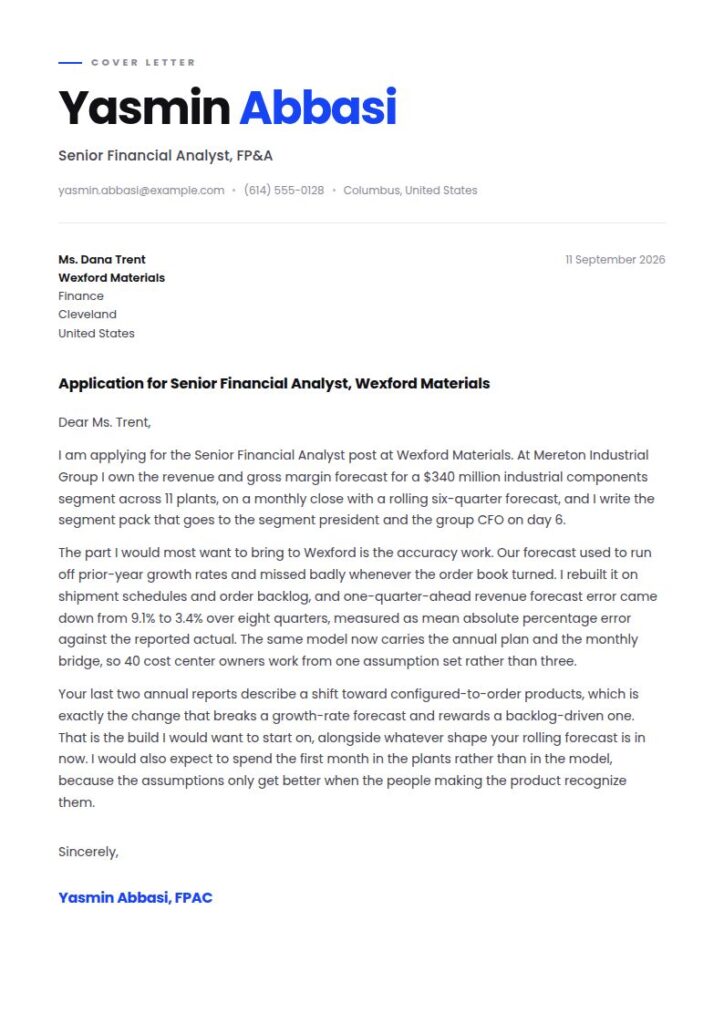
I am applying for the Senior Financial Analyst post at Wexford Materials. At Mereton Industrial Group I own the revenue and gross margin forecast for a $340 million industrial components segment across 11 plants, on a monthly close with a rolling six-quarter forecast, and I write the segment pack that goes to the segment president and the group CFO on day 6.
The part I would most want to bring to Wexford is the accuracy work. Our forecast used to run off prior-year growth rates and missed badly whenever the order book turned. I rebuilt it on shipment schedules and order backlog, and one-quarter-ahead revenue forecast error came down from 9.1% to 3.4% over eight quarters, measured as mean absolute percentage error against the reported actual. The same model now carries the annual plan and the monthly bridge, so 40 cost center owners work from one assumption set rather than three.
Your last two annual reports describe a shift toward configured-to-order products, which is exactly the change that breaks a growth-rate forecast and rewards a backlog-driven one. That is the build I would want to start on, alongside whatever shape your rolling forecast is in now. I would also expect to spend the first month in the plants rather than in the model, because the assumptions only get better when the people making the product recognize them.
I work daily in Excel, SQL, Power BI and NetSuite, hold the FPAC credential from the Association for Financial Professionals, and have passed CFA Level II. I could start within four weeks of an offer. Thank you for your time.
Sincerely, Yasmin Abbasi, FPAC
Openings that work
| Instead of | Use |
|---|---|
| I am writing to express my interest in the financial analyst position | I am applying for the Senior Financial Analyst post, and I currently own the forecast for a $340 million segment |
| I have strong analytical and modeling skills | I rebuilt a segment forecast on backlog drivers and cut one-quarter-ahead error from 9.1% to 3.4% |
| I am passionate about finance and driving business results | Your last two annual reports describe a shift to configured-to-order products, which is what breaks a growth-rate forecast |
| I am a detail-oriented team player with a proven track record | I write the 14-page segment pack that reaches the group CFO on day 6 of close |
What counts as evidence in a financial analyst letter
Not every analyst owns a forecast yet, and not every finance function measures accuracy. Use whatever your team actually tracks.
| Kind of evidence | What it looks like in a sentence |
|---|---|
| Forecast accuracy | One-quarter-ahead revenue forecast error fell from 9.1% to 3.4% over eight quarters |
| Cycle time | Cut the interval from close to board pack from 12 business days to 6 |
| Model adoption | Built the planning model now used by 40 cost center owners for plan, forecast and bridge |
| Process rebuild | Replaced manual consolidation with a SQL-backed refresh; the weekly flash went from 9 hours to under 2 |
| Decision supported | A contribution margin and capacity study led to the approved exit of a $12 million product line |
| Coverage | Followed 22 North American industrials names and published a quarterly preview on each |
Writing about numbers you are not allowed to publish
This is the part of a finance letter that goes wrong quietly, and it is worth more care than the prose.
Describe the business by approximate size and structure: a segment of roughly $340 million across 11 plants. Give movements and ratios rather than absolute internal figures, since an error rate that fell from 9.1% to 3.4% discloses nothing. Use figures your employer has already published, and say so if it helps. On the investment side, describe your process and your coverage universe rather than what the fund held. Ask yourself whether a compliance officer at your current employer would be comfortable reading the sentence.
Do not quote unpublished segment, plant, customer or margin figures from a company that has not disclosed them. Do not name customers, counterparties or portfolio holdings. Do not describe a transaction that has not been announced. Do not attach a model, a pack or a screenshot as a work sample; the format is the property of your employer and the contents usually are too. Do not claim a decision that a committee made on your analysis.
The occupation is growing, and it splits by industry more than by title
Financial analysts held 443,100 jobs in 2025, with employment projected to grow 7 percent between 2025 and 2035, much faster than the average for all occupations, and about 29,500 openings a year over the decade (BLS Occupational Outlook Handbook, 2025-35 projections).
Pay separates by setting rather than by job title. Among financial and investment analysts, securities, commodity contracts and other financial investments paid a median of $124,370 in May 2025 against $100,120 in credit intermediation and $95,830 in insurance carriers, while the occupation's own median was $102,740 (BLS Occupational Outlook Handbook, May 2025).
That is why a letter that names the industry, the size of the business and the cadence of the work is doing real work. The reader is placing you on a scale where the same title spans a $60,000 difference, and the letter is the first chance to say where you sit on it.
Length, format and sending it
One page, four paragraphs, 250 to 400 words. PDF unless the portal says otherwise, named for yourself and the post: yasmin-abbasi-senior-financial-analyst-cover-letter.pdf.
Address a person. Finance teams are small and named on company sites, on annual report pages and in press releases. "Dear Hiring Manager" on an otherwise specific letter reads as a file sent to twelve companies.
Keep every figure identical to the one on your resume. A number that differs between the two documents is the single fastest way to lose a finance reader. Our financial analyst resume example uses the same figures as the letter above.
Key takeaways
- Name the business you forecast and its approximate size in the first two lines.
- Give one accuracy or cycle-time number, and define it well enough to defend.
- Say what the team would inherit: a model, a cadence, a pack, a rebuilt process.
- Name one specific thing about their business, taken from their own published material.
- Keep unpublished figures, holdings and unannounced transactions off the page.
- Match every number to your resume exactly.
- Address a named person and keep it to one page.
Write your financial analyst cover letter in 10 minutes with our AI cover letter builder.
Financial analyst cover letter questions, answered
How long should a financial analyst cover letter be?
One page, four paragraphs, 250 to 400 words. Finance hiring managers read these between meetings, and length is not read as effort. The letter's job is to make the resume worth opening.
What do I write if I have never owned a forecast?
Write the deliverable you do own. A weekly flash, a monthly reconciliation pack, a dashboard, a data pipeline, a capital request template: any of these is a real, countable contribution. Then give one improvement with a before, an after and a period, and say which part of a forecast you want to own next.
Should I mention the CFA if I have not finished it?
Yes, with the exact level and year, and never as letters after your name. CFA Institute requires three exams plus at least 4,000 hours of relevant experience completed in no fewer than 36 months before the charter is awarded, and states that all three levels take three to four years (CFA Institute, accessed September 2026). "CFA Level II passed, 2025, candidate for Level III" is accurate and reads well.
Is a cover letter still worth sending for an analyst role?
Send one wherever there is a field for it. The application form collects the same structured data from every candidate. The letter is the only place you can name the size of the business you forecast, your accuracy, and what you would build in the first quarter.
How do I write to a company I do not know?
Read their published material for twenty minutes first: the latest annual report or filing, the investor presentation if there is one, and the segment breakdown. One accurate sentence about how their business is actually structured is worth more than a paragraph of admiration, and it is the part that cannot be reused in the next letter.