Event Manager, Commercial Exhibitions Corrine Ashcombe
Event Manager
[email protected] | (401) 555-0517 | Providence, United States
Profile
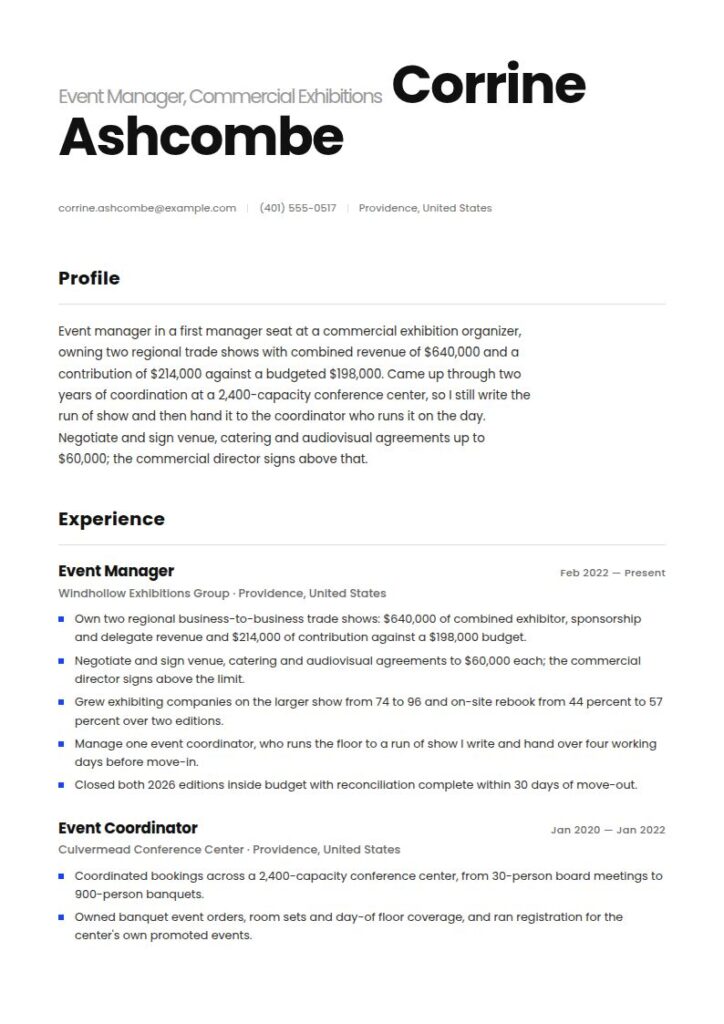
Event manager in a first manager seat at a commercial exhibition organizer, owning two regional trade shows with combined revenue of $640,000 and a contribution of $214,000 against a budgeted $198,000. Came up through two years of coordination at a 2,400-capacity conference center, so I still write the run of show and then hand it to the coordinator who runs it on the day. Negotiate and sign venue, catering and audiovisual agreements up to $60,000; the commercial director signs above that.
Work Experience
02/2022 - Present, Event Manager, Windhollow Exhibitions Group, Providence, United States
- Own two regional business-to-business trade shows: $640,000 of combined exhibitor, sponsorship and delegate revenue and $214,000 of contribution against a $198,000 budget.
- Negotiate and sign venue, catering and audiovisual agreements to $60,000 each; the commercial director signs above the limit.
- Grew exhibiting companies on the larger show from 74 to 96 and on-site rebook from 44 percent to 57 percent over two editions.
- Manage one event coordinator, who runs the floor to a run of show I write and hand over four working days before move-in.
- Closed both 2026 editions inside budget with reconciliation complete within 30 days of move-out.
01/2020 - 01/2022, Event Coordinator, Culvermead Conference Center, Providence, United States
- Coordinated bookings across a 2,400-capacity conference center, from 30-person board meetings to 900-person banquets.
- Owned banquet event orders, room sets and day-of floor coverage, and ran registration for the center's own promoted events.
07/2018 - 12/2019, Event Services Assistant, Culvermead Conference Center, Providence, United States
- Room turns, signage, vendor check-in and registration desk cover across a full commercial calendar.
Education
09/2014 - 05/2018, Bachelor of Science, Business Administration, University of Rhode Island, Kingston, United States
Concentration in marketing. Worked the campus conference services desk throughout.
Skills
Event budget building and reconciliation, 75
Venue and catering contract negotiation, 65
Exhibitor relationship management, 75
Sponsorship fulfillment, 65
Run of show production and handover, 85
Cvent and Microsoft Excel budget models, 80
Languages
English, native
Portuguese, intermediate
Certificates
09/2022, Cvent Event Management Certification, Cvent
02/2026, First Aid and CPR, American Red Cross
Summary
An event manager resume is a one to two page document showing what your events were bought for, what they cost, what came back, and which contracts carry your signature. This guide gives you three adaptable versions, a way to write a portfolio across a year including an event you changed or canceled, and current Bureau of Labor Statistics pay and outlook.
Event Manager resume examples by experience level
In short, an event manager resume is a one to two page document about ownership and money.
That is the difference between this page and a coordinator resume. On one hand, an employer hires a coordinator to deliver an event already decided on, and a good coordinator resume proves they can hold a fixed date under pressure. On the other hand, an employer hires a manager to decide what the event is for, what it may cost, what it has to return, and whether it should run again in that form. As a result, two people can work the same show and be applying for different jobs.
So the numbers on a manager's page are commercial rather than operational: objective, budget, return, contracts, team, portfolio. The floor plan, the run of show and the thing that broke at nine in the morning belong on the event coordinator resume example, and a manager who fills a page with them is applying for the job below the one advertised.
Resume guide for an event manager resume
To that end, this guide and the corresponding event manager resume example will cover:
- To begin with, how to write an event manager resume, section by section
- Then, the four commercial facts every event on your page needs
- Also, three adaptable summaries: first manager role, portfolio manager and senior
- In addition, how to write the event you changed or canceled, the strongest entry on the page
- Finally, what the market looks like and what you can expect to earn
How to write an event manager resume
Six blocks: contact header, summary, the portfolio block, experience, skills and systems, then education and certifications. Generally, one page for your first three years as a manager, two once you carry a portfolio.
Above all, the portfolio block replaces the event-by-event listing a coordinator writes. An employer hires a manager against a calendar and a budget line, so the reader wants the shape of the year you carry rather than the detail of any one date.
| Section | What it is answering | Where it goes |
|---|---|---|
| Portfolio | How many events a year, what revenue or budget, what came back? | Directly under the summary |
| Contract authority | What carries your signature, and what did you negotiate into it? | Its own lines, with the limit stated |
| Experience | What changed commercially because you had the job? | Reverse chronological |
Four commercial facts per event, before any operational detail
A manager's event line is built from four things, and none of them is the attendee count: the objective in the language of whoever paid for it, the money in both directions, the contract exposure, and the decision rights. Each is unpacked further down this page.
"Regional building products show, 214 exhibiting companies, 41,800 net square feet sold, $1.92 million revenue against $1.18 million direct cost, 68 percent on-site rebook" is a manager's line. "Managed a large trade show" is not a line at all.
Run the finished file through the ATS resume checker. Event roles attract high application volume and a parser reads the page before anybody with a calendar does.
Choosing the best resume format for an event manager resume
Overall, reverse chronological with a portfolio block under the summary. In other words, one page for your first three years in a manager seat, two once the portfolio needs the room.
The mistake specific to this level is writing up rather than writing across. However, a manager who has run one flagship for four years often spends the whole page on it. The reader wants the opposite: the shape of the whole year, then the flagship as one entry among several. After all, portfolio breadth is what distinguishes a manager from a very experienced coordinator.
Meanwhile, the second thing to avoid is the designed resume. Keep the page plain and put a portfolio link in the header if you need to show visual work.
Include your contact information
| ✅ Right | ❌ Wrong |
|---|---|
| Corrine Ashcombe, CEM | Corrine Ashcombe |
| Event Manager, commercial exhibitions and conferences | Creative events leader and experience designer |
| 6-show portfolio, $4.1M revenue, $1.4M contribution, contracts to $150K | Managed high-profile events for leading brands |
| (401) 555-0517, [email protected], Providence, RI | (401) 555-0517, [email protected] |
The third line does the work, and it is three numbers rather than adjectives: how many events, what they were worth, and what you are trusted to sign. A hiring director can place you against their own calendar and delegation of authority before reading a bullet.
Make use of a summary
In effect, four lines: the portfolio, the flagship with its commercial numbers, the contract authority, and the team.
Event manager in a first manager seat at a commercial exhibition organizer, owning two regional trade shows with combined revenue of $640,000 and a contribution of $214,000 against a budgeted $198,000. Came up through two years of coordination at a 2,400-capacity conference center, so I still write the run of show and then hand it to the coordinator who runs it on the day. Negotiate and sign venue, catering and audiovisual agreements up to $60,000; the commercial director signs above that.
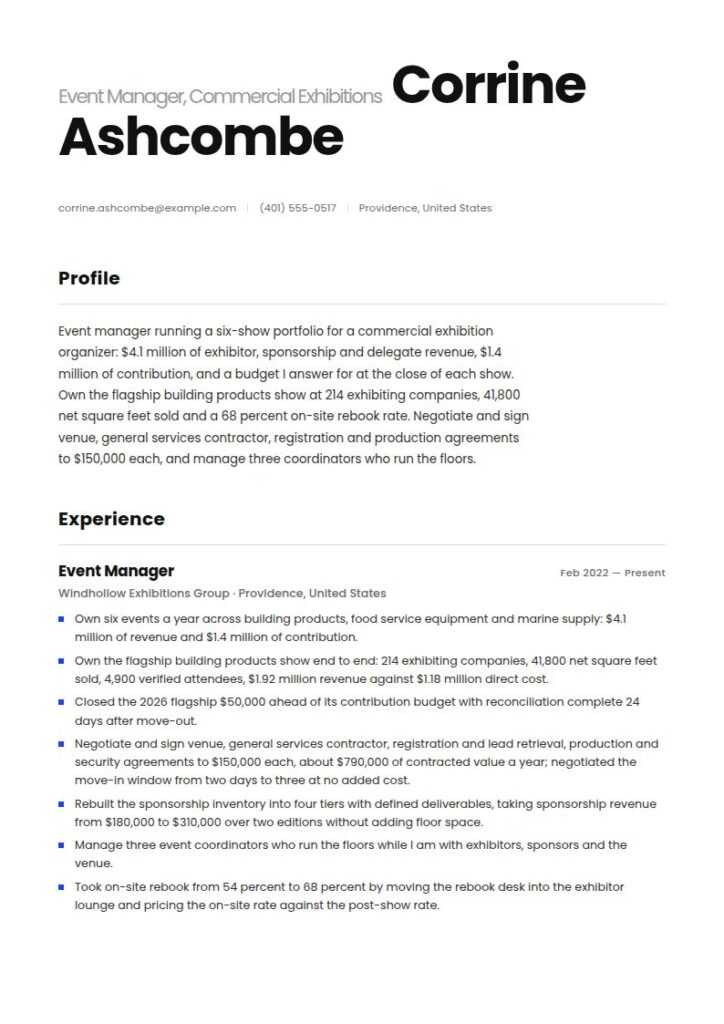
Event manager running a six-show portfolio for a commercial exhibition organizer: $4.1 million of exhibitor, sponsorship and delegate revenue, $1.4 million of contribution, and a budget I answer for at the close of each show. Own the flagship building products show at 214 exhibiting companies, 41,800 net square feet sold and a 68 percent on-site rebook rate. Negotiate and sign venue, general services contractor, registration and production agreements to $150,000 each, and manage three coordinators who run the floors.
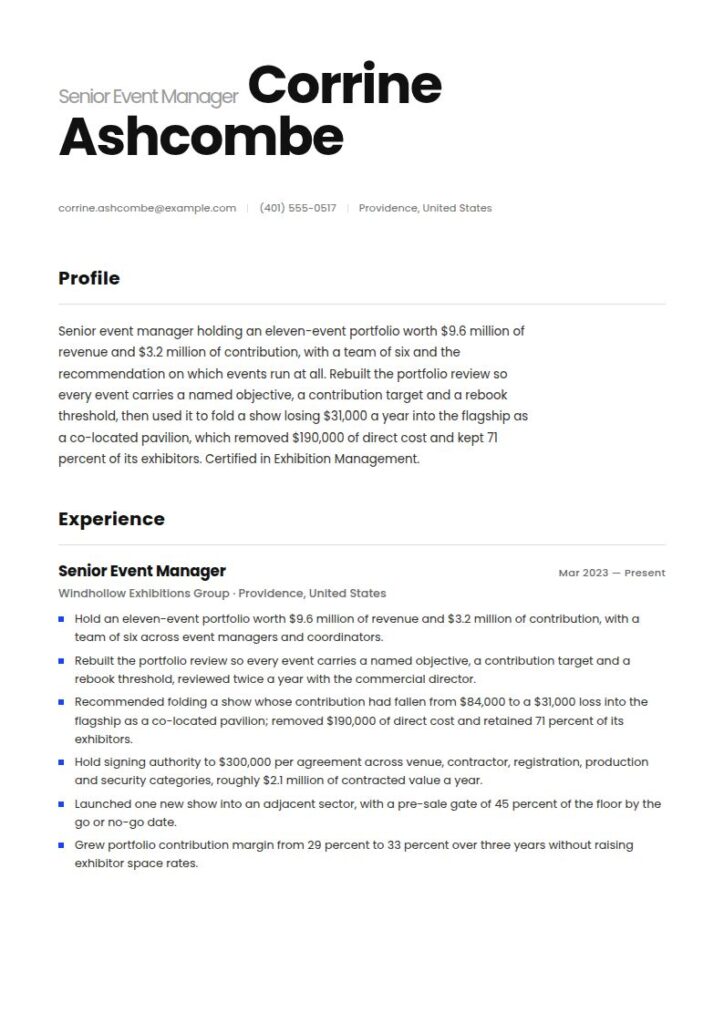
Senior event manager holding an eleven-event portfolio worth $9.6 million of revenue and $3.2 million of contribution, with a team of six and the recommendation on which events run at all. Rebuilt the portfolio review so every event carries a named objective, a contribution target and a rebook threshold, then used it to fold a show losing $31,000 a year into the flagship as a co-located pavilion, which removed $190,000 of direct cost and kept 71 percent of its exhibitors. Certified in Exhibition Management.
Right vs wrong: the same event manager summary, twice
| ✅ Right | ❌ Wrong |
|---|---|
| Six-show portfolio, $4.1 million revenue, $1.4 million contribution. | Managed a diverse portfolio of high-profile corporate events. |
| 214 exhibiting companies, 41,800 net square feet sold, 68 percent on-site rebook. | Delivered outstanding experiences that exceeded stakeholder expectations. |
| Negotiate and sign venue, contractor, registration and production agreements to $150,000. | Strong vendor management and negotiation skills. |
In contrast, the right column is a set of claims a reference call can confirm in four minutes. The left column is what the other thirty applications said, and the reader stopped believing it some time before yours.
Outline your event management experience
Employer, what it sells, the portfolio you carry, your dates, then who reports to you. Four to six bullets per role, each commercial rather than logistical.
| Instead of | Use |
|---|---|
| Managed all aspects of corporate and trade events | Own a six-show portfolio: $4.1 million revenue, $1.4 million contribution, budget answered for at each close |
| Responsible for event budgets | Closed the flagship show at $1.92 million revenue against $1.18 million direct cost, $50,000 ahead of the contribution budget |
| Negotiated with venues and suppliers | Signed the $312,000 venue license and the $268,000 general services contract, moving the move-in window from two days to three at no added cost |
| Managed a team | Manage three coordinators and a shared operations coordinator; the floor is run by them while I am with exhibitors and sponsors |
Event Manager, Windhollow Exhibitions Group, Providence, RI, February 2022 to Present
Commercial exhibition organizer running business-to-business trade shows in building products, food service equipment and marine supply. Own six events a year: $4.1 million of combined revenue and $1.4 million of contribution.
Own the flagship regional building products show end to end: 214 exhibiting companies, 41,800 net square feet sold, 4,900 verified attendees, $1.92 million of revenue against $1.18 million of direct cost.
Closed the 2026 edition $50,000 ahead of its contribution budget and completed reconciliation within 24 days of move-out.
Negotiate and sign venue, general services contractor, registration, production and security agreements to $150,000 each, about $790,000 a year; above that the commercial director countersigns.
Rebuilt the sponsorship inventory into four tiers with defined deliverables, which took sponsorship revenue from $180,000 to $310,000 over two editions without adding floor space.
Manage three event coordinators and share an operations coordinator with the marine portfolio; they run the floor while I am with exhibitors and sponsors.
Write the event as a commercial object: the objective, the money and what came back
Indeed, this section decides an event manager resume, and almost every draft skips it. Therefore, start by naming the objective in the words of the person whose budget it came out of. In fact, what an organization buys an event for changes completely by setting.
| Setting | What the event is bought for | The number a manager reports |
|---|---|---|
| Commercial organizer | Exhibitor, sponsorship and delegate revenue | Revenue, direct cost, contribution, rebook rate |
| Corporate in-house | Pipeline, product launch, customer retention | Cost per qualified opportunity, attendance by target account, renewal rate |
| Association | Member renewal, non-dues revenue, education delivery | Non-dues revenue, member attendance share, renewal among attendees |
| Venue and hospitality | Occupancy of space and catering covers | Space sold, covers, revenue per available square foot |
| Agency | Client retention and margin on the contract | Margin against the scope of services, client renewal |
Then, whichever row you sit in, write four lines per significant event.
The objective. One sentence, in the sponsor's language. "Bought to hold exhibitor renewals in a year the sector was consolidating" is an objective; "to deliver a world-class attendee experience" is a mission statement.
The money in both directions. The budget you carried and the figure you closed at, plus whatever came back on the objective's own measure. Give the actual close.
The contracts. Which agreements carry your signature, what they were worth, and one term you moved: a longer move-in window, a graduated cancellation schedule, a rebate on space over a threshold. Naming the term is what separates it from "managed vendor relationships".
The decision rights. What you could decide alone: format, date, pricing, adding an event, stopping one. Titles vary wildly between employers, which is why you have to say.
Portfolio, 2026: 6 events, $4.1 million revenue, $1.4 million contribution, 11,400 verified attendees, 3 coordinators.
Flagship, regional building products show. Objective: hold exhibitor renewals through a consolidating supply base and grow sponsorship without adding floor space. 214 exhibiting companies, 41,800 net square feet sold, 4,900 verified attendees. $1.92 million revenue, $1.18 million direct cost, $740,000 contribution against a $690,000 budget. On-site rebook 68 percent, up from 54 percent.
Contracts signed: venue license $312,000, general services contractor $268,000, registration and lead retrieval $74,000, production and audiovisual $96,000, security $41,000. Signing authority $150,000 per agreement. Negotiated the move-in window from two days to three at no added cost.
Changed or stopped: the food service equipment show carried a contribution of $84,000 in 2023 and a loss of $31,000 by 2025, with exhibitor rebook falling from 61 percent to 38 percent. Recommended folding it into the flagship as a co-located pavilion. Removed $190,000 of direct cost and retained 71 percent of its exhibitors.
That last block is the strongest thing an event manager can put on a page, and it is almost never there. Anyone can report a good year. A manager who concluded an event they ran should not run again in that form, and carried the case to the people who fund it, is describing the part of the job that is management. Similarly, write it without drama: the trend, the measure that failed, the recommendation, the decision, the result.
Business events are a measured sector, so borrow its vocabulary
The Events Industry Council, with Oxford Economics, measures the global business events sector across more than 180 countries. Its 2026 study reports that business events generated US$1.3 trillion in direct spending in 2025 with 1.65 billion participants, supported 9.7 million direct jobs and US$759 billion in direct GDP, and 24.2 million jobs and US$1.8 trillion in total GDP once indirect and induced effects are counted, with 2025 direct spending 12.2 percent above 2019 (Events Industry Council, 2026 Global Economic Significance of Business Events, published 15 May 2026).
Two things follow. This is an industry with real financial reporting behind it, so a page written in adjectives reads as someone who has not been near its commercial side. And if you work for an organizer, a venue or a destination, that study's vocabulary is your reader's: direct spending, participants, contribution, space sold. In-house, translate into your sponsor's vocabulary. Either way the test is the same: could the person who funded your event repeat your sentence to their finance director without changing it.
Build a snapshot of your key skills
For skills, likewise, twelve to fourteen entries in four groups: commercial, contracting, delivery and systems. Keep delivery short, because at this level readers assume it, and let commercial be the long group.
Commercial: Event profit and loss ownership, Contribution and margin analysis, Sponsorship inventory and tiering, Exhibitor pricing and floor plan yield, Rebook and renewal management, Portfolio review and closure decisions
Contracting: Venue licenses, General services contractor agreements, Registration and lead retrieval contracts, Production and audiovisual agreements, Cancellation and force majeure terms
Delivery and team: Coordinator management and development, Delegation of the run of show, Exhibitor and sponsor relationship management, Move-in and move-out oversight
Systems: Cvent, Map Your Show, Salesforce, Microsoft Excel profit and loss models, Asana
List your education and certifications
Degree, then the industry credential with its issuing body and year, then anything venue, safety or finance related. Five or six lines is enough.
Bachelor of Science, Business Administration, University of Rhode Island, Kingston, RI, 2016
Certified in Exhibition Management (CEM), International Association of Exhibitions and Events, 2024
Finance for non-financial managers, completed 2023
Contract review for commercial managers, completed 2025
Two credentials matter here. The Certified in Exhibition Management designation is administered by the International Association of Exhibitions and Events through a course-based program; the association publishes that eleven courses are available on demand, that a candidate "must complete the exam within 90 days of the date the course was completed", that a failed exam may be retaken within one year, and that on completing the program requirements and passing the ninth course exam a candidate receives a letter from the CEM Commission permitting use of the designation (International Association of Exhibitions and Events, accessed 14 September 2026). The other is the Certified Meeting Professional from the Events Industry Council; its eligibility rules are on our event planner resume example.
Finance training is the underrated line. For example, a manager who has taken a course in reading a profit and loss statement, or in contract review, is signaling the exact competence the step up from coordinator is about.
Choose the right layout and design
In general, single column, 11 or 12 point, plain headings, no photograph, no event imagery. Also keep the portfolio block on page one and save as a PDF named for yourself and the role.
Name what each event was bought for, in the funder's language. Give revenue or budget and the actual close, not the plan. State your signing authority and one contract term you negotiated. Say who reports to you and who runs the floor. Show the whole year, not only the flagship. Write the event you changed or canceled. Say what you could decide without asking.
Do not fill a manager's page with run of show, floor plans and day-of recovery; that is the coordinator's evidence. Do not claim a budget you tracked rather than carried. Do not quote registered numbers as verified attendance. Do not name an exhibitor, sponsor, vendor or client. Do not call an event successful without the measure it was judged on.
Event manager job market and outlook
Specifically, the published federal occupation is meeting, convention and event planners, which covers coordinator, planner and manager titles in one profile. Read it as the ladder rather than your rung, with the management bracket above it as the other half.
| Measure | Meeting, convention and event planners | General and operations managers |
|---|---|---|
| Employment, 2025 | 172,100 | 3,599,000 |
| Projected employment, 2035 | 182,100 | Not quoted here |
| Projected change, 2025 to 2035 | 6 percent, faster than average, +10,000 | 5 percent, +181,300 |
| Projected annual openings | About 16,800 | Published for top executives as a group only |
| Typical entry-level education | Bachelor's degree | Bachelor's degree |
| Median annual wage, May 2025 | $61,160 | $105,770 |
Source: U.S. Bureau of Labor Statistics, Occupational Outlook Handbook, meeting, convention and event planners and top executives, May 2025 wage data and 2025 to 2035 projections, published 27 August 2026. Moreover, the Handbook does not publish annual openings for general and operations managers separately; it publishes about 304,100 a year for the top executives group of 3,890,600.
Event manager pay by title and setting
Those two rows are the range a manager title spans. A corporate events manager inside a marketing department is usually counted in the planners profile; a director of events running a portfolio, a team and a budget line can be counted in general and operations management, and the difference at the median is more than $44,000. Therefore, what your resume shows you own settles which one your next employer thinks they are hiring.
Setting, meanwhile, moves the number inside the planners profile too. For instance, median annual wages in May 2025 ran from $63,170 in administrative and support services and $62,790 in religious, grantmaking, civic and professional organizations down to $59,290 in accommodation and food services and $51,220 in arts, entertainment and recreation (BLS Occupational Outlook Handbook, May 2025). Employment is spread rather than concentrated: 14 percent in religious, grantmaking, civic and professional organizations, 12 percent each in arts, entertainment and recreation and in accommodation and food services, 11 percent in administrative and support services, and 10 percent self-employed (BLS, May 2025).
What salary you can expect as an event manager
Overall, meeting, convention and event planners had a median annual wage of $61,160 in May 2025, or $29.41 an hour, with the lowest 10 percent under $36,830 and the highest 10 percent over $101,700 (BLS Occupational Outlook Handbook, May 2025). A manager sits above that median, because the same profile contains the coordinator seats below you.
Beyond setting, three things also move you up the band. Budget or revenue owned is the first, and owned is the word being tested: not the figure you tracked, but the one you answered for at close. Second is contract authority, because a manager trusted to negotiate a venue license removes work from somebody more expensive. Third is portfolio breadth, since an employer is buying a year rather than an event.
However, read the published number for what it measures. In particular, the federal wage survey collects straight-time gross pay and excludes overtime, non-production bonuses, year-end bonuses and profit sharing (BLS, Occupational Employment and Wage Statistics survey documentation, accessed 14 September 2026). At organizer and agency employers, a commission or a share of contribution is often a real part of the package, so compare offers whole.
Key takeaways for an event manager resume
- Firstly, name what the funder bought each event for, in the language of whoever funded it.
- Give the money in both directions: what it cost and what came back on that measure.
- Secondly, put the portfolio under your name: events a year, revenue or budget, contribution.
- Equally, state your signing authority and name one contract term you moved.
- Say who reports to you and who runs the floor while you are elsewhere.
- Likewise, write the event you changed or canceled, with the measure that failed and the result.
- Finally, say what you can decide alone: format, date, pricing, adding or stopping an event, and leave the run of show to the coordinator page.
Build your event manager resume in 15 minutes with our AI resume builder.
Related business and management resume examples
- Event coordinator resume
- Operations manager resume
- Program manager resume
- Project manager resume
- Project coordinator resume
- Manager resume
- Assistant manager resume
- Supervisor resume
- Team lead resume
- Business management resume
- Consultant resume
- Business development resume
Pair it with a matching event manager cover letter.
Event manager resume questions, answered
What is the difference between an event manager and an event coordinator on a resume?
Ownership, and it shows in which numbers are on the page. A coordinator's evidence is the run of show, the on-site staffing and the recovery. A manager decides what the event is for and answers for the money, so their evidence is objective, budget, return, contracts and portfolio. If your page is mostly operational detail you are applying for the coordinator job, whatever the posting says.
How long should an event manager resume be?
One page for your first three years in a manager seat, two once you carry a portfolio, a team and signing authority. The second page holds the portfolio and the contracts, not more description of the flagship.
Should I put an event that lost money on my resume?
Yes, if you did something about it. An event whose contribution fell for two years, which you reviewed, recommended changing or closing, and then executed, is the strongest entry available to a manager. Write the trend, the measure that failed, your recommendation, who decided and what it saved. What reads badly is a portfolio in which everything grew every year.
How do I show a return when my events are not sold?
Translate into your funder's measure. In-house events are bought for pipeline, launch coverage, customer retention, member renewal or staff retention, so report cost per qualified opportunity, attendance by target account, or whatever your organization already tracks. Use their existing number rather than inventing one, because a figure the finance team publishes carries more weight than one you calculated for the resume.
Do I need the CEM or the CMP?
Neither is required. The Handbook notes that voluntary certifications are available for meeting and convention planners and are not required (BLS Occupational Outlook Handbook, published 27 August 2026). Which one helps depends on where you work: Certified in Exhibition Management is the exhibition and trade show credential; the Certified Meeting Professional is the broader meetings one. Put the year on either, and if you are part way through, say which stage.
I have only ever run one big event a year. How do I show portfolio breadth?
Write the year around it honestly: one flagship plus the smaller things you also own, including the ones not called events, such as a roadshow, an exhibitor program at somebody else's show or a webinar series with a budget attached. Name the commercial facts for each, and say that the flagship is where the scale sits. An employer would rather read an accurate small portfolio than one event described five times.