Event Coordinator Petronella Vandersloot
Event Coordinator
[email protected] | (843) 555-0139 | Charleston, United States
Profile
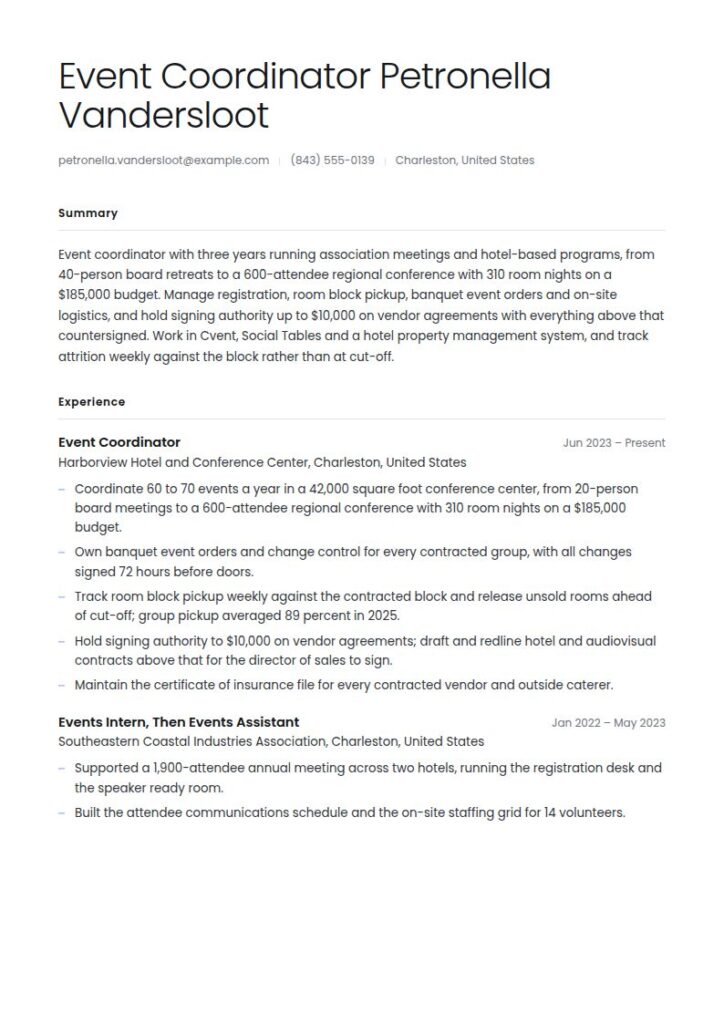
Event coordinator with three years running association meetings and hotel-based programs, from 40-person board retreats to a 600-attendee regional conference with 310 room nights on a $185,000 budget. Manage registration, room block pickup, banquet event orders and on-site logistics, and hold signing authority up to $10,000 on vendor agreements with everything above that countersigned. Work in Cvent, Social Tables and a hotel property management system, and track attrition weekly against the block rather than at cut-off.
Work Experience
06/2023 - Present, Event Coordinator, Harborview Hotel and Conference Center, Charleston, United States
- Coordinate 60 to 70 events a year in a 42,000 square foot conference center, from 20-person board meetings to a 600-attendee regional conference with 310 room nights on a $185,000 budget.
- Own banquet event orders and change control for every contracted group, with all changes signed 72 hours before doors.
- Track room block pickup weekly against the contracted block and release unsold rooms ahead of cut-off; group pickup averaged 89 percent in 2025.
- Hold signing authority to $10,000 on vendor agreements; draft and redline hotel and audiovisual contracts above that for the director of sales to sign.
- Maintain the certificate of insurance file for every contracted vendor and outside caterer.
01/2022 - 05/2023, Events Intern, then Events Assistant, Southeastern Coastal Industries Association, Charleston, United States
- Supported a 1,900-attendee annual meeting across two hotels, running the registration desk and the speaker ready room.
- Built the attendee communications schedule and the on-site staffing grid for 14 volunteers.
Education
08/2018 - 05/2022, Bachelor of Science, Hospitality and Tourism Management, College of Charleston, Charleston, United States
Coursework in event operations, hospitality finance and contract law for hospitality.
Skills
Registration and attendee management, 85
Banquet event order review, 80
Room block pickup tracking, 80
On-site logistics and staffing, 85
Contract drafting and redlining, 60
Cvent and Social Tables, 80
Languages
English, native
Dutch, intermediate
Certificates
09/2023, Cvent Event Management Certification, Cvent, CVT-EM-220714
Event management and registration build.
03/2025, Food Safety Manager Certification, National Restaurant Association, FSM-7714902
Summary
An event planner resume is a one to two page ledger showing the size and format of the events you ran, the budget you carried, and the contract terms you personally negotiated or held. This guide gives you three adaptable versions, the CMP requirements from the Events Industry Council, and current Bureau of Labor Statistics pay and outlook for the occupation.
Event Planner resume examples by experience level
An event planner resume is a one to two page document that reads as a ledger: how many people, in what format, on what budget, in what venue, and which contract terms you were trusted to negotiate.
Adjectives do nothing here. Every planner is organized, calm under pressure and detail-oriented, and every planner writes exactly that. What separates two candidates is that one carried a $1.2 million budget with a signed room block behind it and the other ran a lunch and learn for forty people. Both are real jobs. Only the ledger says which one you have done.
Resume guide for an event planner resume
This guide and the event planner resume example below will cover:
- How to write an event planner resume, section by section
- The five numbers every experience entry should carry
- The contract terms that separate a planner from an assistant
- Three adaptable summaries: coordinator, manager and director level
- What the job market looks like and what you can expect to earn
How to write an event planner resume
Six blocks: contact header, summary, event ledger, experience, skills and systems, education and certifications. One page under five years, two once the ledger itself needs the room.
The ledger sits directly under the summary because it answers the reader's question fastest. A hiring manager scanning forty applications wants to know which scale of event you have survived, before they read a single bullet.
| Section | What it is answering | Where it goes |
|---|---|---|
| Event ledger | What size and shape of event can this person actually run? | Directly under the summary |
| Contract authority | What were they allowed to sign, and for how much? | Inside the ledger, its own line |
| Experience | What did they deliver, and what went right or wrong? | Reverse chronological, numbers in every bullet |
| Certifications | Do they hold the CMP, and is it current? | Below education, with the year |
Write the two events first: your largest and your most complex
Before you draft anything else, name two events. Your largest by attendance or budget, and your most complex by moving parts. They are rarely the same event, and a resume that shows only one of them is showing half of what you can do.
A 2,400-person annual conference is large. A 640-person hybrid summit with simultaneous interpretation, a government co-host and three time zones is complex. The first says you can hold scale; the second says you can hold ambiguity, and the second is the harder hire.
Write each with the same five facts: attendees, format, venue or room nights, budget, and what you personally negotiated.
Run the finished file through the free Rezoom ATS resume checker before you send it. Associations and venue groups run applications through parsing software, and a table-heavy layout is where that breaks.
Choosing the best resume format for an event planner resume
Reverse chronological, single column. One page under five years, two once you have a ledger worth reading.
Avoid the portfolio layout. Event planners are drawn to color blocks, ballroom photography and a timeline graphic across the top, and none of it parses. If you have images worth showing, link to them once and check the link works from a phone.
Include your contact information
| ✅ Right | ❌ Wrong |
|---|---|
| Petronella Vandersloot, CMP | Petronella Vandersloot |
| Event Planner, association conferences and hybrid summits | Creative event professional and detail-oriented organiser |
| Largest: 2,400 attendees, 1,850 room nights, $1.28M budget | Experienced in events of all sizes |
| (843) 555-0139, [email protected], Charleston, SC | (843) 555-0139, [email protected] |
The CMP after your name matters: it is the field's recognized credential and readers look for it. The third line is unusual, and it is why this header works. One glance places you in a band.
Make use of a summary
Four lines: the kind of events you run, the ledger headline, one thing you negotiated, and the systems you work in.
Event coordinator with three years running association meetings and hotel-based programs, from 40-person board retreats to a 600-attendee regional conference with 310 room nights on a $185,000 budget. Manage registration, room block pickup, banquet event orders and on-site logistics, and hold signing authority up to $10,000 on vendor agreements with everything above that countersigned. Work in Cvent, Social Tables and a hotel property management system, and track attrition weekly against the block rather than at cut-off.
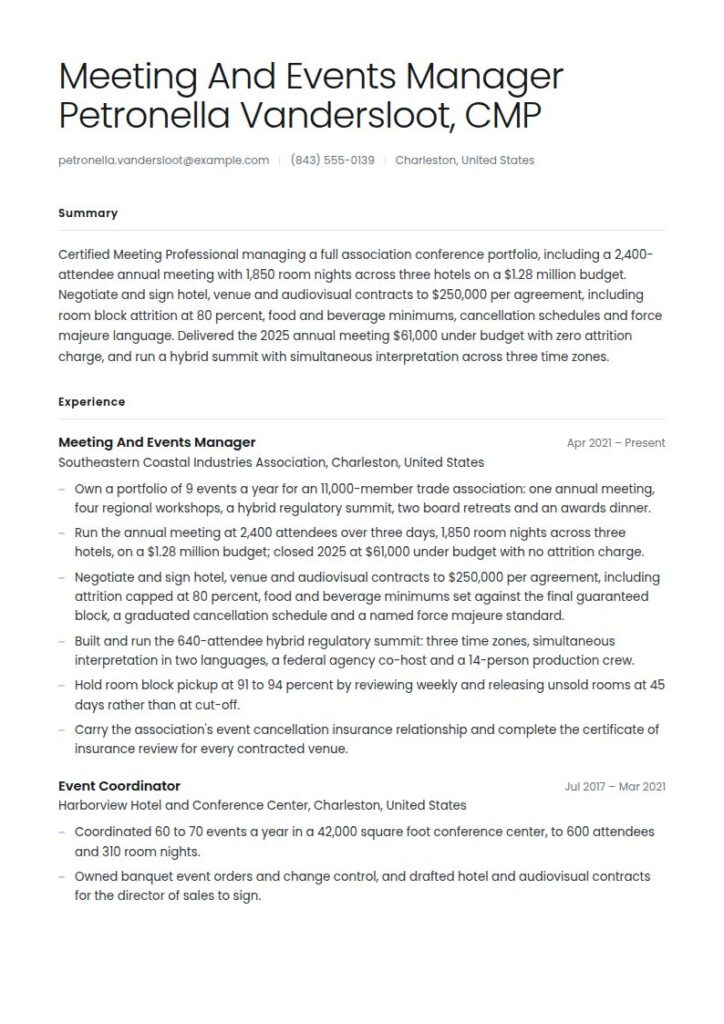
Certified Meeting Professional managing a full association conference portfolio, including a 2,400-attendee annual meeting with 1,850 room nights across three hotels on a $1.28 million budget. Negotiate and sign hotel, venue and audiovisual contracts to $250,000 per agreement, including room block attrition at 80 percent, food and beverage minimums, cancellation schedules and force majeure language. Delivered the 2025 annual meeting $61,000 under budget with zero attrition charge, and run a hybrid summit with simultaneous interpretation across three time zones.
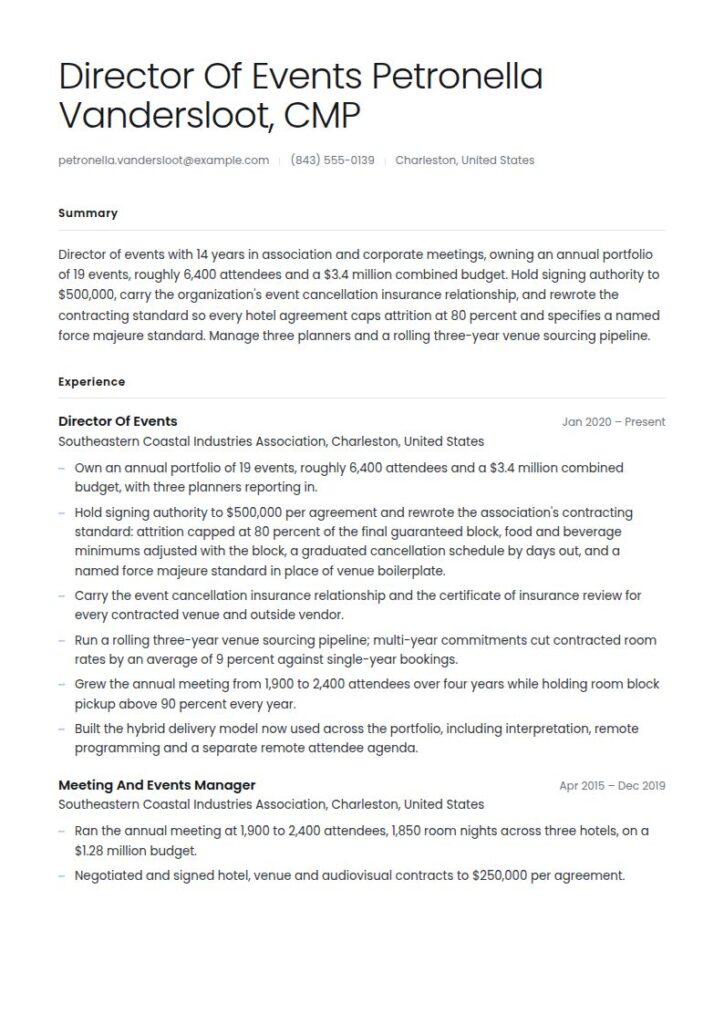
Director of events with 14 years in association and corporate meetings, owning an annual portfolio of 19 events, roughly 6,400 attendees and a $3.4 million combined budget. Hold signing authority to $500,000, carry the organization's event cancellation insurance relationship, and rewrote the contracting standard so every hotel agreement caps attrition at 80 percent and specifies a named force majeure standard. Manage three planners and a rolling three-year venue sourcing pipeline.
Right vs wrong: the same event planner summary, twice
| ✅ Right | ❌ Wrong |
|---|---|
| 2,400-attendee annual meeting, 1,850 room nights, $1.28 million budget. | Managed large-scale conferences and corporate events. |
| Negotiate and sign hotel and venue contracts to $250,000 per agreement. | Experienced in vendor negotiation and contract management. |
| Attrition capped at 80 percent, with food and beverage minimums tied to the final block. | Skilled at building strong relationships with venue partners. |
| Delivered the 2025 annual meeting $61,000 under budget with zero attrition charge. | Consistently delivered events on time and within budget. |
Every line on the right is a number a reference can confirm. Every line on the left was written by the other thirty-nine applicants.
Outline your event planning experience
Employer, what it does, the portfolio you carried, your dates. Then three to five bullets, each with a count, a format, a figure and an outcome.
| Instead of | Use |
|---|---|
| Planned and executed large corporate events | Ran a 2,400-attendee, 3-day annual meeting across three hotels on a $1.28 million budget |
| Managed vendor relationships | Negotiated and signed 14 hotel, venue and audiovisual contracts in 2025, to $250,000 each |
| Handled event budgets | Carried a $1.28 million event budget and closed $61,000 under, with zero attrition charge |
| Coordinated hotel accommodation | Held an 1,850 room night block at 80 percent attrition and hit 94 percent pickup |
| Organized virtual events | Ran a 640-attendee hybrid summit across three time zones with simultaneous interpretation in two languages |
| Ensured events ran smoothly | Rebuilt the banquet event order review so every change order was signed 72 hours before doors |
Meeting and Events Manager, Southeastern Coastal Industries Association, Charleston, SC, April 2021 to Present
Trade association with 11,000 members. Own a portfolio of 9 events a year: one annual meeting, four regional workshops, a hybrid regulatory summit, two board retreats and an awards dinner.
Run the annual meeting at 2,400 attendees over three days, 1,850 room nights across three hotels, on a $1.28 million budget; closed 2025 at $61,000 under budget with no attrition charge.
Negotiate and sign hotel, venue and audiovisual contracts to $250,000 per agreement, including attrition capped at 80 percent, food and beverage minimums set against the final guaranteed block, a graduated cancellation schedule and a named force majeure standard.
Built and run the 640-attendee hybrid regulatory summit: three time zones, simultaneous interpretation in two languages, a federal agency co-host and a 14-person production crew.
Hold room block pickup at 91 to 94 percent by reviewing against the block weekly and releasing unsold rooms at 45 days rather than at cut-off.
Carry the association's event cancellation insurance relationship and complete the certificate of insurance review for every contracted venue.
Put your event ledger on the page: size, format, budget and the contracts you signed
This is the section that gets planners hired, and most resumes skip straight past it into adjectives.
A ledger is not a list of event names. It is five facts per event, written so a reader can compare you to the person they hired last year. Put it under your summary, and give your largest event and your most complex event separate lines, because they are rarely the same event and prove different things.
| Ledger element | What to write | Why the reader cares |
|---|---|---|
| Attendee count | The number that actually showed, not the number registered | It sets the operational band you have worked in |
| Format | In person, hybrid or virtual, and how many days | Hybrid and multi-day are different jobs, not variations |
| Venue scale | Room nights, square footage, number of properties, or covers served | Room nights are the currency hotels and associations think in |
| Budget carried | Total budget and whether you owned it or supported it | Budget size is the single strongest scale signal |
| What you negotiated or signed | Contract types, your signing limit, the terms you moved | It separates a planner from an assistant |
Largest event: 2,400 attendees, 3-day in-person annual meeting, 1,850 room nights across three hotels, $1.28 million budget, sole planner with two on-site contractors.
Most complex event: 640 attendees, 2-day hybrid regulatory summit, three time zones, simultaneous interpretation in two languages, federal agency co-host, $410,000 budget, 14-person production crew.
Annual portfolio: 9 events, roughly 4,100 total attendees, $2.1 million combined budget.
Contracts negotiated and signed: hotel room block and meeting space, convention center license, audiovisual and production, catering, registration platform, speaker agreements. Signing authority to $250,000 per agreement; above that, countersigned by the chief operating officer.
Terms I personally negotiate: room block attrition capped at 80 percent of the final guaranteed block, food and beverage minimums set against that same block rather than the original, a graduated cancellation schedule by days out, a named force majeure standard, complimentary room ratio, rebate structure, and a certificate of insurance from every contracted vendor.
Four things to get right in that block.
Room nights are the unit, not guest counts. Hotel sales directors and association executives both think in room nights, because that is what the contract is written in and where the financial risk sits. "1,850 room nights at 80 percent attrition, 94 percent pickup" is the language of the person reading. "Booked hotels for attendees" is not.
Attrition and food and beverage minimums are where planners lose money, so say what yours were. Attrition is the share of the contracted block your organization must pay for whether or not the rooms sell. A planner who negotiated a cap at 80 percent, tied the food and beverage minimum to the final adjusted block, and then managed pickup to 94 percent has protected real money, and every experienced reader knows it.
Say what you were authorized to sign, exactly. "Signing authority to $250,000 per agreement, above that countersigned by the chief operating officer" is a precise claim about trust, and it is checkable. If you have never held signing authority, write what you did hold: drafted and redlined contracts for signature, ran the request for proposal and the site selection, managed the certificate of insurance file. Those are real and a reader respects the accuracy.
Cancellation, force majeure and insurance belong on the page now. The years since 2020 rewrote this part of the profession. A planner who holds the event cancellation insurance relationship, negotiated a graduated cancellation schedule and specified a named force majeure standard rather than accepting venue boilerplate is describing the work that keeps an organization solvent when a hurricane closes an airport.
If you have only run small internal events, scale the same ledger honestly
A planner whose largest event is a 60-person internal all-hands still has a ledger, and writing it properly beats inflating it.
Write the same five facts at your real scale: "42 attendees, half-day in person, single conference room, $4,800 budget including catering and audiovisual, negotiated the catering order and held the vendor certificate of insurance file." That is a complete professional statement.
Then add volume, which is your genuine strength. Someone who has run 38 internal events in two years has more reps than someone who ran two conferences, and reps are what stop you panicking when a keynote misses a flight. Write the count: "38 events in 24 months, 20 to 300 attendees, combined budget $340,000."
Then name the contract work you have touched without signing it: catering agreements, audiovisual quotes, a hotel room block for an offsite, speaker agreements. A candidate who writes "drafted and redlined, signed by the director of operations" is trusted more than one who implies authority they did not have.
Build a snapshot of your key skills
Twelve to sixteen entries in three groups: planning, contracts and finance, and the systems. Keep it to things you have run yourself.
Planning and delivery: Site selection and request for proposal, Room block management, Banquet event order review, Production and audiovisual direction, Hybrid and virtual delivery, Speaker and agenda management, On-site staffing
Contracts and finance: Hotel and venue contract negotiation, Attrition and food and beverage minimum management, Cancellation and force majeure terms, Certificate of insurance review, Budget forecasting and reconciliation, Sponsorship fulfillment
Systems: Cvent, Social Tables, Zoom Events, Stova, Asana, Excel budget models, Salesforce
List your education and certifications
Degree, then the Certified Meeting Professional credential with its year and cycle, then anything venue or safety related.
Bachelor of Science, Hospitality and Tourism Management, College of Charleston, Charleston, SC, 2012.
Certified Meeting Professional, Events Industry Council, 2022. Current recertification cycle through December 2027.
Certificate in Sustainable Event Strategies, 2024.
Food safety manager certification, 2025. CPR and first aid, American Red Cross, 2026.
The Certified Meeting Professional program has been run by the Events Industry Council since 1985. Eligibility is 36 months of full-time work in the meetings and events industry, or 24 months plus an industry-specific degree, or 36 months as a full-time educational instructor, together with either 25 clock hours of continuing education related to the CMP International Standards or a 200-hour industry-specific internship (Events Industry Council CMP Handbook, accessed 13 September 2026).
The CMP International Standards blueprint covers nine domains: strategic planning, project management, risk management, financial management, human resources, stakeholder management, meeting or event design, site management, and marketing (Events Industry Council, accessed 13 September 2026). Recertification runs on a five-year cycle expiring 31 December, so write the cycle end date rather than only the year you passed.
If you are not yet eligible, say where you stand against the 36 months. "CMP eligible from March 2027" is useful to an employer planning a training budget.
Choose the right layout and design
Single column, 11 point body type, no photograph, no ballroom imagery. PDF unless the portal asks for Word. Keep the ledger as short labeled lines rather than a graphic, because that is the part that must survive parsing.
Give attendees, format, venue scale, budget and contract terms for every significant event. Show your largest and your most complex separately. State your signing authority in dollars and say where countersignature sat. Name the terms you moved, not just that you negotiated. Write room nights and pickup percentages. Put CMP after your name if you hold it, with the recertification cycle below.
Do not write "events of all sizes"; it reads as having run none of them. Do not quote a registered figure as an attendance figure. Do not claim a budget you supported rather than carried. Do not imply signing authority you did not have, because references confirm it. Do not fill the page with photographs of ballrooms.
Event planner job market and outlook
A mid-sized occupation growing faster than average, with steady replacement demand and a strong association and hospitality concentration.
| Measure | Value |
|---|---|
| Meeting, convention and event planner jobs, 2025 | 172,100 |
| Projected employment, 2035 | 182,100 |
| Projected change, 2025 to 2035 | 6 percent, faster than average |
| Projected annual openings | ~16,800 |
| Typical entry-level education | Bachelor's degree |
| Median annual wage, May 2025 | $61,160 |
Source: U.S. Bureau of Labor Statistics, Occupational Outlook Handbook, May 2025 wages and 2025 to 2035 projections, published 27 August 2026.
Where planners actually work, and what each setting pays
Employment is spread across five settings rather than concentrated in one. In 2025, 14 percent of meeting, convention and event planners worked in religious, grantmaking, civic and professional organizations, 12 percent in arts, entertainment and recreation, 12 percent in accommodation and food services, 11 percent in administrative and support services, and 10 percent were self-employed (BLS Occupational Outlook Handbook, May 2025).
Pay follows the setting. Median annual wages in May 2025 were $63,170 in administrative and support services, $62,790 in religious, grantmaking, civic and professional organizations, $59,290 in accommodation and food services and $51,220 in arts, entertainment and recreation (BLS Occupational Outlook Handbook, May 2025).
The association row, where most conference planning sits, also holds the largest budgets and the longest contracts. If your ledger is built on association conferences, the contract terms in it should be the loudest thing on the page.
Employment is projected to grow 6 percent between 2025 and 2035, which the Bureau of Labor Statistics describes as faster than the average for all occupations, with about 16,800 openings a year (BLS Occupational Outlook Handbook, 2025 to 2035 projections).
What salary you can expect as an event planner
The median annual wage for meeting, convention and event planners was $61,160 in May 2025, which is $29.41 an hour. The lowest 10 percent earned less than $36,830 and the highest 10 percent more than $101,700 (BLS Occupational Outlook Handbook, May 2025).
That spread is wide, and the ledger is the reason. The bottom of the range is coordinator work: registration desks, banquet event orders, someone else's contracts. The top is a director carrying a multi-million dollar portfolio with signing authority and an insurance relationship. Both are called event planning, and the resume is where you say which you are.
Three things move you up the band. Budget scale is the cleanest proxy for trust. Contract authority is the one most planners under-report: a planner who can be handed a hotel agreement and trusted to cap attrition is worth measurably more. Format breadth is the third, since a planner who has delivered genuine hybrid events, rather than an in-person event with a webcam at the back, is still a scarce hire.
Key takeaways for an event planner resume
- Write a ledger, not adjectives: attendees, format, venue scale, budget, contracts.
- Show your largest event and your most complex event separately.
- Use room nights, attrition percentage and pickup, because that is the contract currency.
- State your signing authority in dollars and say where countersignature sat.
- Name the terms you moved: attrition cap, food and beverage minimum, cancellation schedule, force majeure.
- Put CMP after your name with its recertification cycle if you hold it.
- At small scale, write the same ledger honestly and lead with volume and repetition.
Build your event planner resume in 15 minutes.
Related marketing resume examples
- Marketing coordinator resume
- Public relations resume
- Brand ambassador resume
- Marketing manager resume
- Social media manager resume
- Marketing associate resume
- Marketing director resume
- Brand manager resume
- Advertising director resume
- Creative director resume
- Marketing resume
- Marketing consultant resume
Pair it with a matching event planner cover letter.
Event planner resume questions, answered
How long should an event planner resume be?
One page under five years, two once the ledger needs the room. The second page is for event history, contract detail and portfolio scale, which is what a reader wants. It is not for a list of soft skills.
Do I need the CMP to get hired as an event planner?
Not to get hired, but it opens doors in associations and it is a common screening line. Eligibility requires 36 months of full-time industry work, or 24 months plus an industry-specific degree, plus 25 clock hours of continuing education or a 200-hour internship (Events Industry Council CMP Handbook, accessed 13 September 2026). If you are working toward it, write the date you become eligible.
What if I have never signed a contract myself?
Write what you did do, precisely. Drafting and redlining, running the request for proposal, comparing bids, managing the certificate of insurance file and tracking room block pickup are all real contract work, and saying someone above you signed is accuracy rather than weakness. Overstating authority is the fastest way to lose an offer at the reference stage.
How do I show hybrid and virtual events without sounding like everyone else?
Give the production detail. The split between in person and remote, number of streams, interpretation languages, time zones, platform, crew size, and whether remote attendees had their own program or watched the room. "640 attendees, 380 in person and 260 remote, two-language interpretation, three time zones" shows the job. "Experienced in hybrid events" does not.
What numbers should I use if my events were confidential or under an agreement?
Use bands and ratios. "Annual meeting in the low seven figures, room block above 1,500 nights, attrition capped at 80 percent" reveals nothing client-specific and still places you. Never name a client whose contract forbids it, and never describe an identifiable individual attendee or speaker.
Is event planning a growing field?
Yes, modestly. Employment of meeting, convention and event planners is projected to grow 6 percent between 2025 and 2035, from 172,100 jobs to 182,100, with about 16,800 openings a year (BLS Occupational Outlook Handbook, 2025 to 2035 projections). Most of those openings come from replacement rather than growth.