Digital Marketing Specialist, Acquisition Thaddeus Wrenfield
Digital Marketing Specialist, Acquisition
[email protected] | (414) 555-0172 | Milwaukee, United States
Profile
Digital marketing specialist working the acquisition stage for a direct to consumer cycling retailer, responsible for paid search and paid social traffic at roughly $28,000 a month in spend. Held to cost per first order and to qualified session volume, and took cost per first order from $71 to $52 across three quarters by rebuilding the search account around margin tiers instead of product categories. Run Google Ads, Meta Ads Manager and GA4, and hand over at the landing page, where the conversion team owns everything after the click.
Work Experience
02/2025 - Present, Digital Marketing Specialist, Acquisition, Cedarbrook Cycle Works, Milwaukee, United States
- Own the acquisition stage for a direct to consumer cycling retailer: paid search and paid social at roughly $28,000 a month, held to cost per first order and qualified session volume.
- Cost per first order moved from $71 to $52 across three quarters after rebuilding the search account around margin tiers rather than product categories.
- Agreed a qualified session definition with the conversion team so traffic quality disputes are settled in the weekly stage review rather than at quarter end.
- Build the weekly acquisition report from GA4 and the order system, not from platform-reported conversions.
08/2022 - 01/2025, Store Operations Lead, Cedarbrook Cycle Works, Milwaukee, United States
- Ran a 14-person retail floor, including the fitting and service booking path that most walk-in customers abandoned.
- Redesigned the service booking queue and cut abandoned bookings by roughly a third, which is the work that moved me into the conversion side of digital marketing.
Education
09/2018 - 05/2022, Bachelor of Business Administration, Marketing, University of Wisconsin-Milwaukee, Milwaukee, United States
Coursework in consumer behavior, marketing research and business statistics.
Skills
Paid search account structure, 75
Paid social audience and creative testing, 70
Cost per acquisition management, 75
GA4 and Google Tag Manager, 70
Landing page briefing and handover, 65
Weekly performance reporting, 80
Languages
English, native
German, intermediate
Certificates
02/2026, Google Ads Search Certification, Google Skillshop, GSK-AD-4471902
Renewed February 2026.
01/2026, Google Analytics Certification, Google Skillshop, GSK-GA-4471903
Renewed January 2026.
Summary
A digital marketing resume is a one to two page document that names the stage of the funnel you own, the metric that stage is judged on, and where your work hands over to someone else. This guide gives you three adaptable versions, a way to place yourself on a real requisition, and current Bureau of Labor Statistics pay and outlook for the occupations the title sits inside.
Digital Marketing resume examples by experience level
A digital marketing resume is a one to two page document that says which part of the funnel you own, what that part is measured on, and who picks the work up after you.
The trap is the word itself. Digital marketing is a discipline, not a job, in the way medicine is a discipline and cardiology is a job. Every requisition that says digital marketing resolves, once you read the responsibilities, into one seat: getting strangers to arrive, turning arrivals into customers, keeping them, or making the whole thing pay. A resume that gestures at all four reads as one that has held none.
Resume guide for a digital marketing resume
This guide and the digital marketing resume example below will cover:
- How to write a digital marketing resume, section by section
- The four funnel stages a digital marketing requisition actually resolves to
- The metric each stage is judged on, and where the handover sits
- Three adaptable summaries: acquisition, activation and conversion, and lifecycle
- What the job market looks like and what you can expect to earn
How to write a digital marketing resume
Six blocks: contact header, summary, funnel stage, experience, skills and stack, education and certifications. One page under five years, two after that.
The stage block sits directly under the summary because it is what the reader is trying to work out. A hiring manager with an unfilled seat has a gap in one place, not four, and your document's first job is to say whether you fill it.
| Section | What it is answering | Where it goes |
|---|---|---|
| Funnel stage owned | Which part of this machine did they run? | Directly under the summary |
| Primary metric | What were they held to, and on what baseline? | Same block, one line |
| Experience | What changed, over what period, with what evidence? | Reverse chronological, numbers in the bullets |
| Handover | Where does their work end and the next team's begin? | Same block, one line |
| Skills and stack | Which systems have they personally operated? | Short grouped block |
Read the responsibilities, not the title, then match the seat
Ignore the title. Go to the responsibilities and count which stage the verbs belong to.
Spend, keywords, audiences, creative testing and cost per something means an acquisition seat. Landing pages, checkout, trial to paid, onboarding and conversion rate means activation and conversion. Segments, email and SMS, churn, win-back and repeat purchase means retention and lifecycle. Pricing, promotion depth, margin, payback and reporting to finance means monetisation and commercial analysis.
Then rewrite your summary in that stage's vocabulary before you apply. Not a new resume, a new first four lines.
Run the finished file through the free Rezoom ATS resume checker before you send it. Marketing postings attract high application volume and are parsed before a person opens them.
Choosing the best resume format for a digital marketing resume
Reverse chronological, single column. One page for the first five years, two once you have worked more than one stage or business model.
Resist the dashboard. Digital marketers produce the most decorated unreadable resumes of any profession: skill dials, tool grids, a colored bar claiming 85 percent Google Ads. None of it parses and none of it answers the stage question. If you want to show craft, link one short case study and check the link works.
Include your contact information
| ✅ Right | ❌ Wrong |
|---|---|
| Thaddeus Wrenfield | Thaddeus Wrenfield |
| Digital Marketing, activation and conversion | Digital marketing professional and growth enthusiast |
| Site conversion rate, trial to paid, onboarding lifecycle | Full-funnel, data-driven, results-oriented |
| (414) 555-0172, [email protected], Milwaukee, WI | (414) 555-0172, [email protected] |
The second and third lines are the whole trick. Two seconds in, the reader knows which seat to consider you for and what you were held to. "Full-funnel" in that space tells a reader with one gap to fill that they will have to read the whole document to find out whether it is filled.
Make use of a summary
Four lines: the stage you own, the business and its model, one result with baseline and period, and the systems you run yourself.
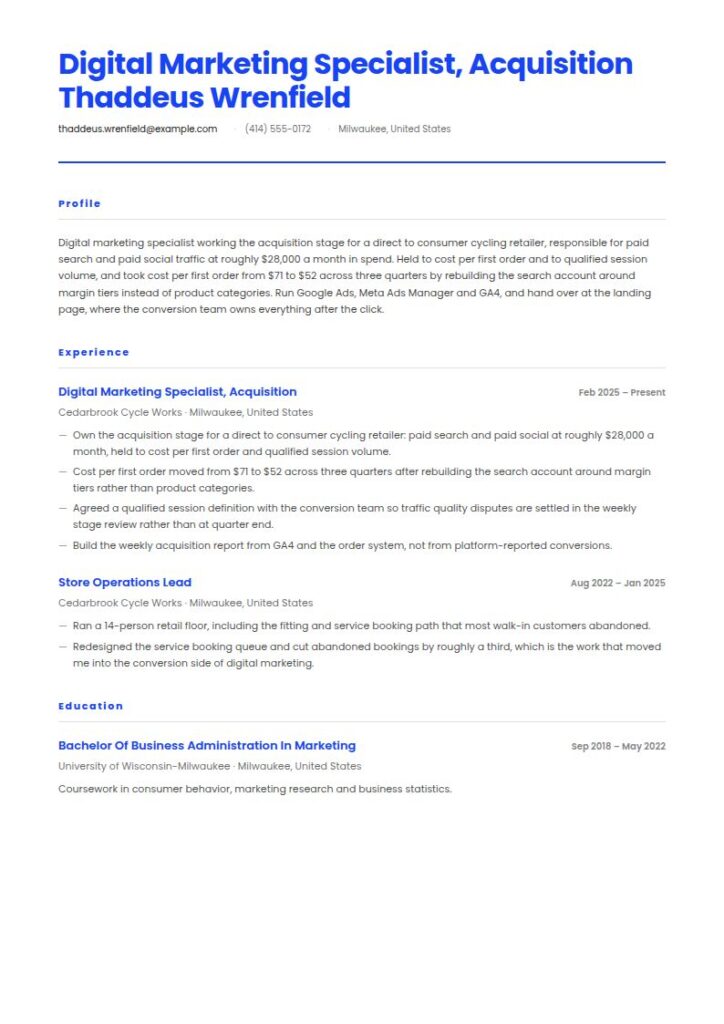
Digital marketing specialist working the acquisition stage for a direct to consumer cycling retailer, responsible for paid search and paid social traffic at roughly $28,000 a month in spend. Held to cost per first order and to qualified session volume, and took cost per first order from $71 to $52 across three quarters by rebuilding the search account around margin tiers instead of product categories. Run Google Ads, Meta Ads Manager and GA4, and hand over at the landing page, where the conversion team owns everything after the click.
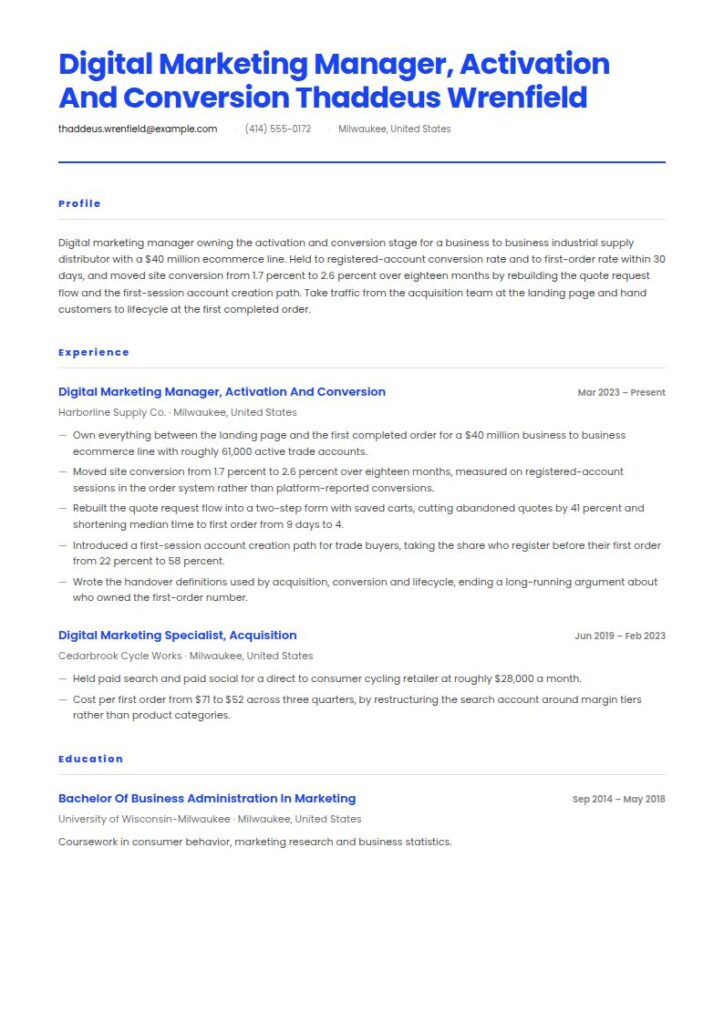
Digital marketing manager owning the activation and conversion stage for a business to business industrial supply distributor with a $40 million ecommerce line. Held to registered-account conversion rate and to first-order rate within 30 days, and moved site conversion from 1.7 percent to 2.6 percent over eighteen months by rebuilding the quote request flow and the first-session account creation path. Take traffic from the acquisition team at the landing page and hand customers to lifecycle at the first completed order.
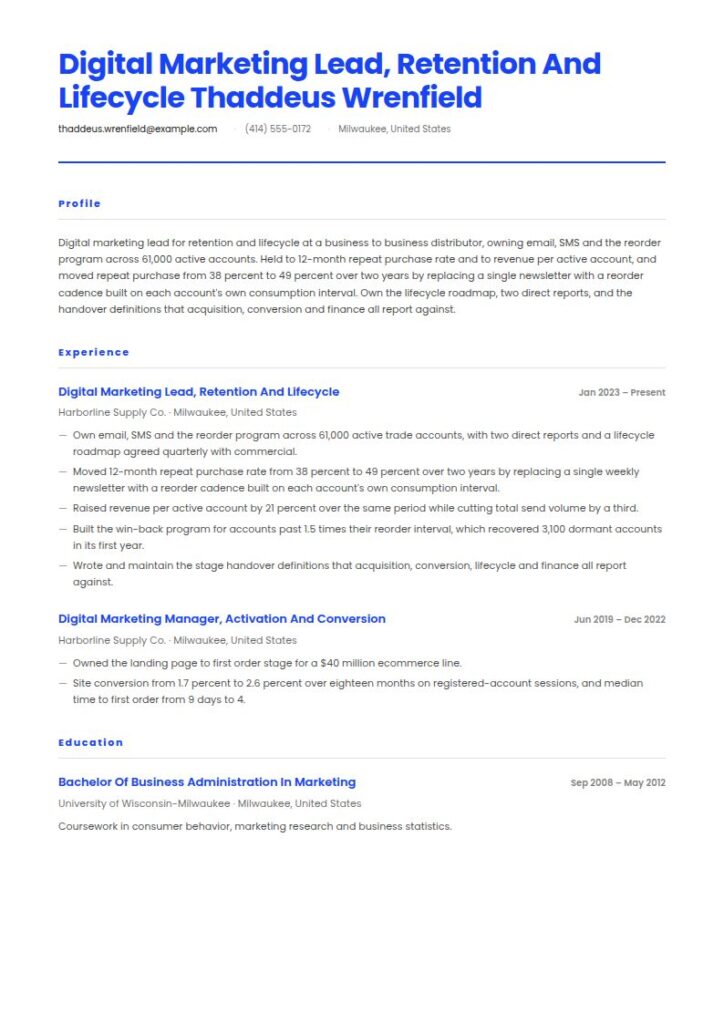
Digital marketing lead for retention and lifecycle at a business to business distributor, owning email, SMS and the reorder program across 61,000 active accounts. Held to 12-month repeat purchase rate and to revenue per active account, and moved repeat purchase from 38 percent to 49 percent over two years by replacing a single newsletter with a reorder cadence built on each account's own consumption interval. Own the lifecycle roadmap, two direct reports, and the handover definitions that acquisition, conversion and finance all report against.
Right vs wrong: the same digital marketing summary, twice
| ✅ Right | ❌ Wrong |
|---|---|
| Own the activation and conversion stage for a $40 million ecommerce line. | Full-funnel digital marketer with experience across all channels. |
| Held to registered-account conversion rate and first-order rate within 30 days. | Responsible for driving growth and engagement across the customer journey. |
| Moved site conversion from 1.7 percent to 2.6 percent over eighteen months. | Delivered significant improvements in key performance indicators. |
| Take traffic at the landing page and hand customers to lifecycle at first order. | Collaborated cross-functionally with internal and external stakeholders. |
The right column can be checked. Ask someone who owned conversion for eighteen months what their biggest winning test was and they will have an answer. The left column cannot be checked, which is why it gets written.
Outline your digital marketing experience
Company, what it sells, the business model, your stage, your dates. Then three to five bullets, each with a baseline, a change and a period.
| Instead of | Use |
|---|---|
| Managed digital marketing campaigns across multiple channels | Owned the acquisition stage: paid search and paid social at $28,000 a month |
| Increased website traffic and engagement | Grew qualified sessions 34 percent over two quarters at a flat cost per session |
| Improved conversion rates | Moved site conversion from 1.7 percent to 2.6 percent over eighteen months |
| Ran email marketing campaigns | Rebuilt the reorder program around each account's consumption interval, repeat purchase 38 percent to 49 percent |
| Worked closely with the sales team | Defined the handover: marketing qualified at form fill, sales accepted within 48 hours, with a weekly rejection review |
Digital Marketing Manager, Activation and Conversion, Harborline Supply Co., Milwaukee, WI, March 2023 to Present
Business to business industrial supply distributor with a $40 million ecommerce line and roughly 61,000 active trade accounts. Own everything between the landing page and the first completed order.
Moved site conversion from 1.7 percent to 2.6 percent over eighteen months, measured on registered-account sessions in the order system rather than on platform-reported conversions.
Rebuilt the quote request flow into a two-step form with saved carts, which cut abandoned quotes by 41 percent and shortened median time to first order from 9 days to 4.
Introduced a first-session account creation path for trade buyers, taking the share who register before their first order from 22 percent to 58 percent.
Wrote the handover definitions used by acquisition, conversion and lifecycle, ending an eighteen-month argument about who owned the first-order number.
Name the funnel stage you own, because digital marketing is not one job
This is the section that decides whether you get read, and almost nobody writes it.
Four stages exist. Each has its own requisition titles, its own primary metric and its own quarrel with the stage next door. Screeners reject candidates who describe all four vaguely, because that is what someone writes when they have owned none of them, and also what someone writes when they have owned all four and did not think to rank them. The screener cannot tell those apart, so they reject both.
| Stage | What you own | Titles the requisition uses | Primary metric | Handover |
|---|---|---|---|---|
| Acquisition | Spend, channels, audiences, creative and keywords; getting strangers to arrive | Paid media specialist, performance marketing manager, SEO specialist, demand generation manager | Cost per acquisition or per qualified lead, at a volume target | Hands over at the landing page or the form fill |
| Activation and conversion | Landing pages, checkout or quote flow, trial to paid, first-run onboarding | Conversion rate optimization manager, growth marketing manager, ecommerce manager, lifecycle onboarding manager | Conversion rate, activation rate, revenue per session | Takes over at arrival, hands over at first order or first value |
| Retention and lifecycle | Email, SMS, push, loyalty, win-back, reorder and renewal programs | Lifecycle marketing manager, CRM manager, email marketing manager, retention marketing manager | Repeat purchase rate, churn or renewal rate, revenue per active customer | Takes over at first order, hands over to monetisation on pricing and offer |
| Monetisation and commercial analysis | Pricing, promotion depth, mix, margin after media, payback, forecasting | Marketing analyst, commercial analyst, pricing manager, marketing operations manager | Contribution margin after media, payback period, forecast accuracy | Sits across all three and reports to finance |
Write your version of one row. Four lines, directly under the summary.
Stage owned: activation and conversion. Everything between the landing page and the first completed order, for a business to business ecommerce line of roughly $40 million.
Held to: registered-account site conversion rate, first-order rate within 30 days of account creation, and median time from first session to first order.
Source of truth: the order system, joined to session data by account identifier. Platform-reported conversions used for in-flight paid media decisions only, and not in my reporting.
Handover: I take traffic from acquisition at the landing page against an agreed qualified-session definition, and hand the customer to lifecycle at the first completed order. Disputes go to the weekly stage review, not to the quarterly.
Adjacent, not owned: paid media buying, which sits with the acquisition team, and pricing, which sits with commercial. I brief both and hold neither.
That last line is what builds trust. A candidate who marks the edge of their own authority is one whose other claims survive checking.
Three more things matter in that block.
Name the metric the way your company defined it, then define it. Conversion rate means six different things depending on the denominator: all sessions, new sessions, registered sessions, product page sessions, cart sessions or users. A number without its denominator is not a number. Write "1.7 percent to 2.6 percent on registered-account sessions" and the reader can use it.
Say where the handover sits, because that is where the arguments happen. Acquisition and conversion teams disagree about traffic quality; conversion and lifecycle teams disagree about who owns the first repeat order. Describing that disagreement accurately, and how it was settled, is real operating experience that no certification tests.
If you have genuinely run more than one stage, sequence them. Acquisition for three years, then conversion for two, now lifecycle. That is a career and it reads as one. "Full-funnel" is a claim; a sequence with dates is a record.
Changing career into digital marketing: pick the stage your old work already maps to
Career changers apply to all four stages at once, which is the same mistake in a different hat. Choose the one your existing work already resembles and apply only there for the first six months.
Retail or hospitality floor work maps to activation and conversion: you have spent years watching people fail to complete a purchase and fixing it in real time.
Account management, customer success and inside sales map to retention and lifecycle: you know why accounts leave and what a reorder cycle looks like in a customer's calendar.
Finance, operations analysis and pricing map to monetisation and commercial analysis: you can read a margin line and challenge a forecast, which most marketers cannot.
Journalism, teaching and anything that involved persuading a cold audience maps to acquisition, which is also the most crowded entry point, so expect that route to be slower.
Then write the mapping down. One sentence: "Five years running a 14-person retail floor, where the work was the same problem this role has: finding out where buyers stop, and removing the step that stops them." That sentence beats a portfolio of certificate badges.
Build a snapshot of your key skills
Twelve to sixteen entries in three groups: your stage, measurement, and the stack. Keep it to systems you have operated yourself, and lead with the group that matches the requisition.
Stage: Conversion rate optimization, Landing page and checkout design, Quote and cart flow rebuilds, Onboarding and first-run sequences, Experiment design and readout, Trade account registration paths
Measurement and analysis: Test design and sample sizing, Session to order joins, Cohort analysis, Funnel step reporting, Server-side event tracking, SQL for reporting
Stack: GA4, Google Tag Manager, Optimizely, Hotjar, Klaviyo, HubSpot, Shopify Plus, Looker Studio, BigQuery
Do not list a platform you have only watched a colleague use; the interview question is always "walk me through how you set that up". And do not list fourteen channels when you own one stage.
List your education and certifications
Short and dated. Digital marketing certifications are inexpensive and widely held, so they prove currency rather than distinction.
Bachelor of Business Administration, Marketing, University of Wisconsin-Milwaukee, Milwaukee, WI, 2018.
Google Analytics Certification, Google Skillshop, most recent renewal 2026.
Google Ads Search Certification, Google Skillshop, most recent renewal 2026.
Meta Certified Media Buying Professional, Meta Blueprint, 2024.
Continuing: SQL for marketing analysis, 2025. Experiment design and statistics for practitioners, 2024.
The Bureau of Labor Statistics gives the typical entry-level education for market research analysts and marketing specialists as a bachelor's degree, and describes certification in the field as voluntary (BLS Occupational Outlook Handbook, published 27 August 2026). Keep certifications dated, keep them low, and never let them sit above your stage block.
Choose the right layout and design
Single column, 11 point body type, no photograph, no skill dials, no charts. PDF unless the portal asks for Word, named for yourself and the seat.
Name one funnel stage in your header and your summary. Give the primary metric with its denominator and its baseline. Say where you take work over and where you hand it on. Sequence multiple stages with dates rather than merging them. Mark what was adjacent but not yours. Rewrite the first four lines for each requisition, matched to its responsibilities.
Do not write "full-funnel" as a substitute for saying which part you ran. Do not quote a conversion rate without its denominator. Do not claim a channel your agency bought unless you say so. Do not list every platform in the category to look broad; it reads as thin. Do not put certifications above the stage block, because they answer a question nobody asked.
Digital marketing job market and outlook
Start with the caveat, because it matters for salary research. The Bureau of Labor Statistics publishes no separate Occupational Outlook Handbook profile for digital marketing. There is no official employment count, wage or projection for the phrase. Roles that carry it are reported inside two published occupations: advertising, promotions and marketing managers, and market research analysts and marketing specialists.
| Measure | Advertising, promotions and marketing managers | Market research analysts and marketing specialists |
|---|---|---|
| Employment, 2025 | 454,800 | 952,700 |
| Projected change, 2025 to 2035 | 6 percent | 7 percent |
| Projected annual openings | ~36,300 | ~82,000 |
| Typical entry-level education | Bachelor's degree | Bachelor's degree |
| Median annual wage, May 2025 | $166,790 marketing managers; $133,660 advertising and promotions managers | $78,760 |
Source: U.S. Bureau of Labor Statistics, Occupational Outlook Handbook, May 2025 wages and 2025 to 2035 projections, published 27 August 2026.
Those two rows are the two halves of a digital marketing career: specialist and analyst work sits in the second column, and running a team and a budget moves you into the first.
The specialist occupation is the one that is growing
Employment of market research analysts and marketing specialists is projected to grow 7 percent between 2025 and 2035, which the Bureau of Labor Statistics calls much faster than the average for all occupations, with about 82,000 openings a year from a 2025 base of 952,700. Advertising, promotions and marketing managers are projected to grow 6 percent over the same period, with about 36,300 openings a year from a base of 454,800 (BLS Occupational Outlook Handbook, 2025 to 2035 projections).
Read the industry concentration alongside that: 11 percent of market research analysts and marketing specialists work in management, scientific and technical consulting services, 10 percent in finance and insurance and 9 percent in information (BLS Occupational Outlook Handbook, May 2025).
Those industries hire different stages. Consulting and agencies buy acquisition capability, because that is what clients pay for. Finance, insurance and wholesale distribution buy retention and conversion, because their customers are already acquired. The stage you claim decides which door you are knocking on.
What salary you can expect in digital marketing
There is no digital marketing wage figure to quote, because there is no digital marketing occupation in the Handbook. Use the two anchors instead.
For specialist and analyst-level work, the median annual wage for market research analysts and marketing specialists was $78,760 in May 2025, with the lowest 10 percent earning less than $43,390 and the highest 10 percent more than $155,480 (BLS Occupational Outlook Handbook, May 2025). Industry moves this a long way: the median was $102,670 in information, $99,850 in management of companies and enterprises and $94,330 in finance and insurance in the same cycle (BLS Occupational Outlook Handbook, May 2025).
For roles with a team and a budget, marketing managers had a median annual wage of $166,790 in May 2025, with the lowest 10 percent under $90,260 and the highest 10 percent over $293,610; advertising and promotions managers had a median of $133,660 (BLS Occupational Outlook Handbook, May 2025).
The practical point is the size of those spreads. Two people can hold the same title and sit $100,000 apart, and what separates them is rarely channel knowledge. It is whether they owned a stage with a number attached, measured on company data rather than platform data. Naming your stage moves you out of the bottom of a very wide band.
Key takeaways for a digital marketing resume
- Pick one funnel stage and name it in the header, the summary and the stage block.
- Give the primary metric with its denominator, baseline and period.
- Say where you take work over and where you hand it on.
- Mark the adjacent work you briefed but did not own.
- Sequence multiple stages with dates instead of calling yourself full-funnel.
- Career changers should map old work to one stage and apply only there at first.
- Keep certifications dated and low; they show currency, not capability.
Build your digital marketing resume in 15 minutes.
Related marketing resume examples
- Digital marketing manager resume
- Marketing manager resume
- Marketing analyst resume
- SEO resume
- Ecommerce resume
- Social media manager resume
- Content marketing associate resume
- Marketing coordinator resume
- Marketing associate resume
- Brand manager resume
- Marketing director resume
- Marketing resume
Pair it with a matching digital marketing cover letter.
Digital marketing resume questions, answered
How long should a digital marketing resume be?
One page for the first five years, two after that. The second page earns its place if you have worked more than one funnel stage or business model, because that history is what a reader is assessing. It does not earn its place as a list of platforms.
Should I write one resume or one per funnel stage?
One resume, with a first four lines you rewrite per application. Experience, skills and education stay fixed; the header line, the summary and the stage block get matched to the responsibilities in the posting. That takes ten minutes and it is the highest-return edit available to you.
What if I genuinely have run the whole funnel at a small company?
Say so, and then rank. "Ran all four stages for a nine-person company; deepest in activation and conversion, thinnest in monetisation, where pricing sat with the founder." A reader believes that sentence. They do not believe "full-funnel expert", and small-company candidates lose jobs to that phrase constantly.
Do I need Google and Meta certifications on a digital marketing resume?
They help at entry level and stop mattering quickly. The Bureau of Labor Statistics describes certification for market research analysts and marketing specialists as voluntary, demonstrating a level of professional competency (BLS Occupational Outlook Handbook, published 27 August 2026). Include them with dates, below your experience, and never let a badge take space a metric could.
How do I show results if my numbers were confidential or bad?
Use ratios and directions rather than absolutes: "site conversion up by roughly half over eighteen months on a mid-eight-figure ecommerce line" reveals nothing contractual and still carries the shape. If a period went backwards, write the test you ran and the decision it produced. Anyone who has owned a funnel stage knows most tests fail.