Ecommerce Coordinator, DTC apparel, Shopify Hana Miyashiro
Ecommerce Coordinator
[email protected] | (503) 555-0194 | Portland, United States
Profile
Ecommerce coordinator on a direct-to-consumer outdoor apparel store running on Shopify, covering roughly 1,400 active SKUs and 340,000 sessions a quarter. Rewrote 320 product detail pages with fit, fabric and measured sizing, which moved the apparel return rate from 28.4 percent to 23.1 percent across two seasons. Run the weekly merchandising of collection pages, the sale calendar and the product data feed.
Work Experience
08/2019 - Present, Ecommerce Coordinator, Cedarline Outfitters (direct-to-consumer outdoor apparel, Shopify), Portland, United States
- Ran weekly merchandising for a roughly 1,400 SKU Shopify store at about 340,000 sessions a quarter: collection ordering, sale calendar and product data feed.
- Rewrote 320 product detail pages with fit, fabric and measured sizing; apparel return rate moved from 28.4 percent to 23.1 percent across two seasons.
- Built and maintained the size guide and the fit finder, and fed post-purchase survey responses back into the copy each season.
- Produced the weekly trading report on sessions, conversion, average order value and sell-through for the buying team.
06/2018 - 08/2019, Customer Experience Associate, Cedarline Outfitters, Portland, United States
- Handled order, sizing and returns enquiries across email and live chat, roughly 60 contacts a day in peak weeks.
- Logged the recurring sizing complaints that later became the product page rewrite brief.
Education
09/2015 - 06/2019, Bachelor of Science, Business Administration, Marketing concentration, Portland State University, Portland, United States
Marketing concentration with coursework in retail analytics and consumer behavior.
Skills
Shopify admin and merchandising, 80
Product detail page structure and copy, 85
Product data and attribute governance, 75
Google Analytics 4, 70
Collection and category merchandising, 75
Return rate analysis, 70
Promotional and sale calendar, 70
Languages
English, native
Japanese, intermediate
Certificates
04/2020, Google Analytics Certification, Google Skillshop
GA4 property configuration and ecommerce reporting.
Summary
An ecommerce resume is a one to two page document that treats the store as a profit and loss account: sessions, conversion rate, average order value, return rate and the platform you actually operated. This guide gives you three adaptable versions, the revenue equation that organizes the whole page, and current Bureau of Labor Statistics figures for the occupations ecommerce roles are banded against.
Ecommerce resume examples by experience level
An ecommerce resume is a one to two page document that treats the store as a profit and loss account rather than as a marketing channel. It says how much traffic you had, what share of it bought, what those buyers spent, how much came back as returns, and which platform you were doing it on.
That is the whole difference between an ecommerce resume and a general marketing one. A marketing resume can describe campaigns. An ecommerce resume has to describe a number that closes a month, because the person reading it is accountable for one. Ecommerce manager, ecommerce specialist and ecommerce coordinator postings all screen on the same evidence, and the difference between the three is the size of the number you owned, not the vocabulary.
Resume guide for an ecommerce resume
This guide and the corresponding ecommerce resume example will cover:
- How to write an ecommerce resume, section by section
- The revenue equation that should organize the entire page
- Three adaptable summaries: coordinator, manager and director
- How to name the platform you operated and what you could change on it
- What the market looks like and what the banding occupations pay
How to write an ecommerce resume
Six sections: contact header, summary, a metrics block, experience, platform and tools, and education with certifications. One page under five years, two once you have owned a revenue line and a team.
The metrics block near the top is the part that separates a real ecommerce resume from a marketing one. A hiring manager wants to know the scale you worked at before they read a single bullet, because the same sentence means different things at 40,000 sessions a month and at four million.
| Section | What it is answering | Where it goes |
|---|---|---|
| Metrics block | What scale did they operate at, and on what numbers? | Directly under the summary |
| Experience | Which term of the revenue equation did they move, and by how much? | Reverse chronological, one number per bullet |
| Platform and tools | Can they do this in our stack without a six-month ramp? | Its own block, with permission level |
| Education and certifications | Anything formal, briefly | Last |
State the baseline before you state the improvement
"Increased conversion rate by 50 percent" is unreadable. It could be 0.2 percent to 0.3 percent on a store nobody visits, or 1.6 percent to 2.4 percent on a store doing eleven million a year.
Write both ends and the period: "Took site-wide conversion from 1.6 percent to 2.4 percent over 18 months on roughly 1.4 million sessions a quarter." Now the reader knows the scale, the direction and the time it took, and they can judge whether it was hard.
The same rule applies to average order value, return rate, repeat purchase rate and email revenue share. A percentage change without its baseline is the single most common way an otherwise strong ecommerce resume gets discounted.
Run the finished file through the free Rezoom ATS resume checker before you submit, because ecommerce postings attract high volume and most of it is filtered before a person reads it.
Choosing the best resume format for an ecommerce resume
Reverse chronological, with a metrics block above the experience. One page for a coordinator or specialist, two for a manager or director with a revenue line and reports.
Skip the functional format. Ecommerce hiring is suspicious of it for a specific reason: the discipline is full of people who have worked adjacent to a store without ever owning a number on it, and a format that separates skills from employers is exactly how that looks on paper. Reverse chronological with numbers attached to each employer is the format that proves you were the one accountable.
Include your contact information
| ✅ Right | ❌ Wrong |
|---|---|
| Hana Miyashiro | Hana Miyashiro |
| Ecommerce Manager, DTC home goods, Shopify Plus | Results-driven ecommerce professional |
| $19.2M online revenue, 2.4% conversion, $81 AOV | Experienced in all aspects of ecommerce |
| (503) 555-0194, [email protected], Portland, OR | (503) 555-0194, [email protected] |
The third line is doing unusual work for a contact header, and it earns its place. Three numbers tell the reader the scale, the efficiency and the basket size of the store you ran, which is most of what they need before deciding to read on.
Make use of a summary
Four lines: the category and model you sell in, the platform, the revenue you were responsible for, and one metric you moved with both ends stated.
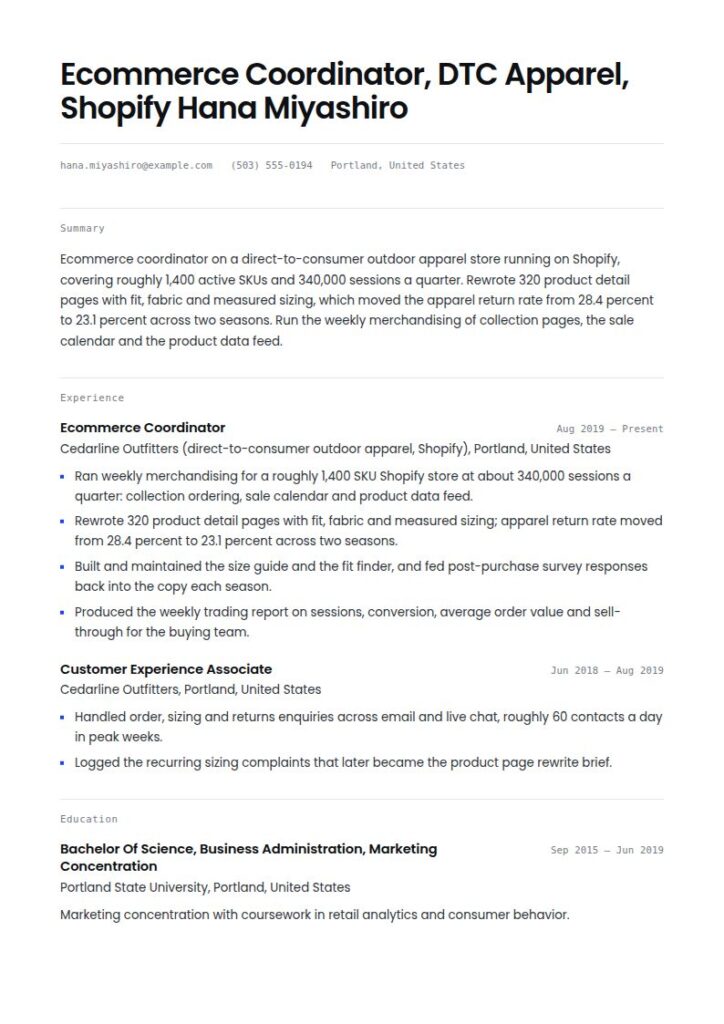
Ecommerce coordinator on a direct-to-consumer outdoor apparel store running on Shopify, covering roughly 1,400 active SKUs and 340,000 sessions a quarter. Rewrote 320 product detail pages with fit, fabric and measured sizing, which moved the apparel return rate from 28.4 percent to 23.1 percent across two seasons. Run the weekly merchandising of collection pages, the sale calendar and the product data feed.
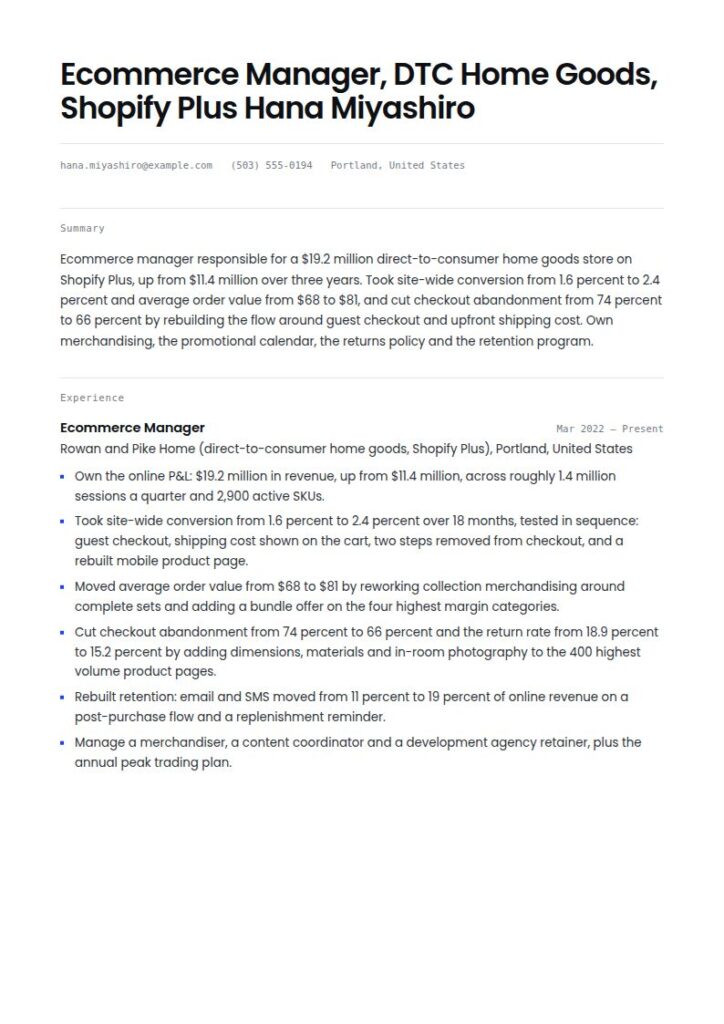
Ecommerce manager responsible for a $19.2 million direct-to-consumer home goods store on Shopify Plus, up from $11.4 million over three years. Took site-wide conversion from 1.6 percent to 2.4 percent and average order value from $68 to $81, and cut checkout abandonment from 74 percent to 66 percent by rebuilding the flow around guest checkout and upfront shipping cost. Own merchandising, the promotional calendar, the returns policy and the retention program.
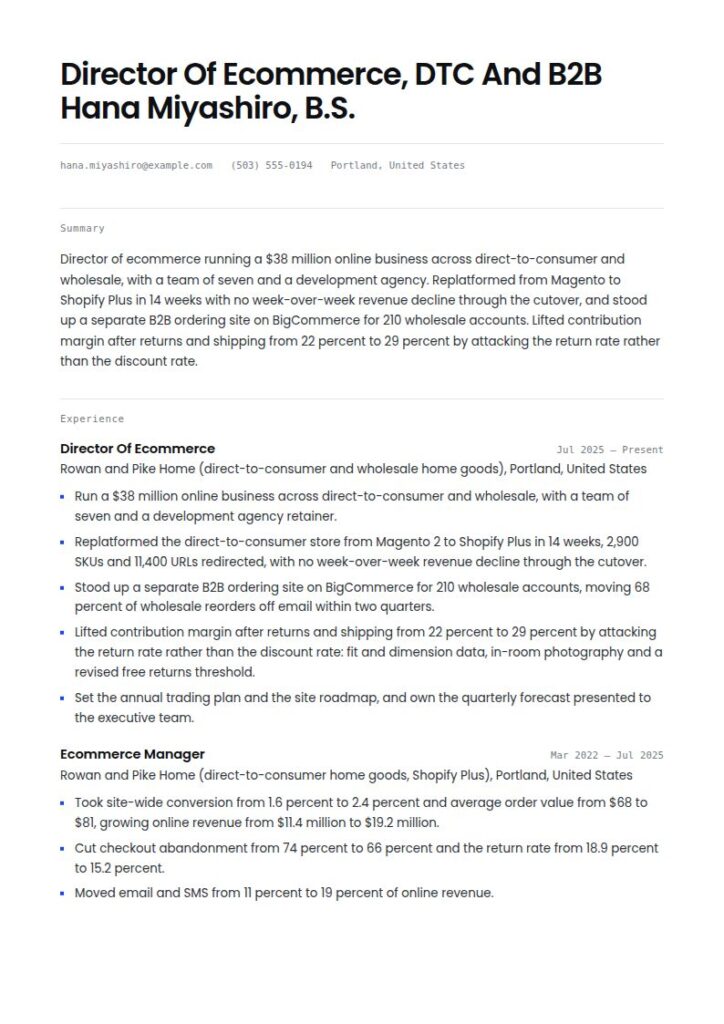
Director of ecommerce running a $38 million online business across direct-to-consumer and wholesale, with a team of seven and a development agency. Replatformed from Magento to Shopify Plus in 14 weeks with no week-over-week revenue decline through the cutover, and stood up a separate B2B ordering site on BigCommerce for 210 wholesale accounts. Lifted contribution margin after returns and shipping from 22 percent to 29 percent by attacking the return rate rather than the discount rate.
Right vs wrong: the same ecommerce summary, twice
| ✅ Right | ❌ Wrong |
|---|---|
| Ecommerce manager responsible for a $19.2 million direct-to-consumer store on Shopify Plus. | Results-driven ecommerce professional with a passion for online retail. |
| Took site-wide conversion from 1.6 percent to 2.4 percent and average order value from $68 to $81. | Significantly improved key ecommerce metrics and drove revenue growth. |
| Cut checkout abandonment from 74 percent to 66 percent by rebuilding around guest checkout. | Optimized the customer journey to deliver a seamless shopping experience. |
Every claim in the right column has a baseline, an endpoint and a mechanism. Every claim in the left column could be written by someone who has never had access to an analytics account.
Outline your ecommerce experience
Company, category, model, platform, dates. Then four to six bullets, each attached to one term of the revenue equation and each carrying a before and an after.
| Instead of | Use |
|---|---|
| Managed the company's ecommerce website | Owned a $19.2M Shopify Plus store, 1.4M sessions a quarter, 2.4% conversion, $81 average order value |
| Improved the customer experience | Rebuilt checkout around guest checkout and upfront shipping cost; abandonment fell from 74% to 66% |
| Optimized product pages | Rewrote 320 product detail pages with measured sizing and fabric detail; apparel returns fell from 28.4% to 23.1% |
| Increased online sales | Grew online revenue from $11.4M to $19.2M over three years, 62% of it from conversion and basket rather than traffic |
| Handled returns and fulfillment | Cut return rate from 18.9% to 15.2% and reduced click to ship from 2.1 days to 0.9 days |
| Ran email marketing | Took email from 11% to 19% of online revenue with a post-purchase and replenishment flow |
Ecommerce Manager, Rowan and Pike Home, direct-to-consumer home goods, Shopify Plus, Portland, OR, March 2022 to Present
Own the online P&L: $19.2 million in revenue, up from $11.4 million, across roughly 1.4 million sessions a quarter and 2,900 active SKUs.
Took site-wide conversion from 1.6 percent to 2.4 percent over 18 months, tested in sequence rather than all at once: guest checkout, shipping cost shown on the cart, two steps removed from checkout, and a rebuilt mobile product page.
Moved average order value from $68 to $81 by reworking collection merchandising around complete sets and adding a bundle offer on the four highest margin categories.
Cut checkout abandonment from 74 percent to 66 percent and cut the return rate from 18.9 percent to 15.2 percent by adding dimensions, materials and in-room photography to the 400 highest volume product pages.
Rebuilt the retention program: email and SMS moved from 11 percent to 19 percent of online revenue, driven by a post-purchase flow and a replenishment reminder on consumables.
Manage a merchandiser, a content coordinator and a development agency retainer, plus the annual peak trading plan.
Break revenue into its three terms and show which one you moved
Online revenue is three numbers multiplied together: sessions, conversion rate and average order value. Then returns come off the top, and fulfillment cost comes off what is left. Almost every ecommerce job is really a job on one or two of those terms, and almost every ecommerce resume fails to say which.
This matters because the terms are not equally hard, not equally durable, and not equally yours. Traffic can be bought, so a revenue increase that came entirely from a larger media budget says little about you. Conversion rate and average order value are earned on the site itself, which is why hiring managers weight them heavily. Return rate is the one nobody puts on a resume and the one that decides whether the revenue was worth having.
Store: direct-to-consumer home goods, Shopify Plus, 2,900 active SKUs, US and Canada
Scale: 1.4M sessions per quarter, $19.2M annual online revenue (from $11.4M in 2022)
Conversion rate: 1.6% to 2.4% site-wide, 18 months
Average order value: $68 to $81
Checkout abandonment: 74% to 66%
Return rate: 18.9% to 15.2%
Retention: email and SMS from 11% to 19% of online revenue
Fulfillment: click to ship 2.1 days to 0.9 days, 3PL managed
Write the block once, near the top, and then let the experience bullets explain the mechanism behind each line. Four rules make it credible.
Give both ends and the period. A single figure is a snapshot; a pair with a date range is a result. This is the rule that most improves an ecommerce resume, and it costs nothing.
Attribute honestly. If revenue grew and traffic grew with it, say how the growth split. "Grew online revenue from $11.4M to $19.2M, 62 percent of it from conversion and basket rather than traffic" is a stronger claim than the revenue number alone, because it survives the obvious follow-up question.
Name the mechanism. Conversion rates move because something changed: a checkout step removed, shipping cost surfaced earlier, a page made faster, a size guide added. The change is the evidence that you did it rather than watched it.
Carry returns. Gross revenue flatters; net revenue pays salaries. A candidate who reports return rate alongside conversion is telling the reader they have seen the bottom of the P&L, and very few applicants do.
Where the money actually leaks
The average documented online shopping cart abandonment rate is 70.22 percent, calculated across 50 separate studies (Baymard Institute, cart abandonment rate list, updated September 2025). The leading reasons given, excluding people who were only browsing, are extra costs such as shipping, tax and fees being too high at 40 percent, delivery being too slow at 20 percent, not trusting the site with card details at 19 percent, and being required to create an account at 18 percent.
Returns take a second bite. The National Retail Federation expected $849.9 billion of merchandise returns in 2025, equal to 15.8 percent of annual retail sales, with an estimated 19.3 percent of online sales returned (National Retail Federation, 15 October 2025).
Read those two together and you have the argument for the whole page. Seven in ten carts are lost before payment, and one in five online orders that does complete comes back. A resume that reports only revenue growth has skipped both of the numbers the business is actually losing money on, and an ecommerce hiring manager reads that omission as inexperience rather than modesty.
Build a snapshot of your key skills
Twelve to sixteen entries in four groups, and name your permission level where it matters. "Shopify Plus, admin" and "Shopify, staff account with theme access" describe two different people.
Platform: Shopify Plus (store owner), Shopify (admin), Magento 2 (admin, migrated from), BigCommerce B2B (admin), Liquid template edits, app stack evaluation
Merchandising and content: Collection and category merchandising, Product detail page structure, Product data and attribute governance, Site search and filtering, Promotional and peak trading calendar
Analytics and testing: Google Analytics 4, Looker Studio, A/B and sequential testing, Funnel and cohort analysis, Attribution reading, Post-purchase survey design
Operations and retention: 3PL and fulfillment SLAs, Returns policy and reverse logistics, Inventory and sell-through planning, Email and SMS lifecycle flows, Subscription and replenishment
List your education and certifications
Education is the least important block on this page, so keep it short and put it last. A degree is common in ecommerce hiring but rarely decisive, and no employer is going to choose a conversion rate over a transcript.
Bachelor of Science, Business Administration, Marketing concentration, Portland State University, Portland, OR, 2019
Certifications: Shopify Foundations Certification, Shopify Academy (2023). Google Analytics Certification, Google Skillshop (2025, renewed annually). Google Ads Search Certification, Google Skillshop (2025).
Platform experience in lieu of certification: Magento 2 administration, 2019 to 2022, including a full catalog migration to Shopify Plus in 2025.
Vendor certifications are worth listing because they are free, current and checkable, and because they answer the ramp-up question. They are not worth listing in bulk. Three relevant ones read as currency; eleven read as a substitute for having run a store.
Choose the right layout and design
Single column, plain type at 11 or 12 point, section headings a parser can find, no dashboard screenshots. Ecommerce people are visual by trade and are the most likely of any marketing discipline to build an attractive two-column resume with icons and sparkline graphics, which is also the layout most likely to arrive at the hiring manager as scrambled text.
Give a baseline and an endpoint for every metric, with the period. Name the platform and your permission level on it. Say which term of the revenue equation each result belongs to. Report return rate and fulfillment alongside conversion. Split revenue growth between traffic and on-site improvement. Keep the numbers on the resume identical to the ones in your cover letter.
Do not write a percentage change without its baseline. Do not claim a company-wide revenue figure as a personal result when you owned one channel. Do not list every app you have ever logged into; list the stack you operated and what you could change without a developer. Do not use a two-column template with icons. Do not hide the return rate because it was high; explain what you did about it.
Ecommerce job market and outlook
The Bureau of Labor Statistics publishes no Occupational Outlook Handbook profile for ecommerce manager or ecommerce specialist. The Handbook covers broad occupations rather than job titles, and ecommerce work is split across three of them depending on whether your employer files you as marketing, as analysis or as site build.
The honest reading is to bracket the role between those three, which is roughly what a compensation team does when it bands an ecommerce job internally.
| Measure | Advertising, promotions and marketing managers | Market research analysts and marketing specialists | Web developers and digital designers |
|---|---|---|---|
| Employment, 2025 | 454,800 | 952,700 | 220,100 |
| Projected change, 2025 to 2035 | 6 percent | 7 percent | 5 percent |
| Projected annual openings | About 36,300 | About 82,000 | About 13,600 |
| Median annual wage, May 2025 | $165,780 | $78,760 | $99,520 |
| Typical entry-level education | Bachelor's degree | Bachelor's degree | Bachelor's degree |
Source: U.S. Bureau of Labor Statistics, Occupational Outlook Handbook, May 2025 wage data and 2025 to 2035 projections.
The channel is still growing faster than the store count
U.S. retail ecommerce sales were an estimated $340.2 billion in the second quarter of 2026, adjusted for seasonal variation, up 12.2 percent on the second quarter of 2025 and accounting for 17.1 percent of total retail sales (U.S. Census Bureau, Quarterly Retail E-Commerce Sales, released 18 August 2026).
Total retail sales grew far more slowly over the same period, which is why ecommerce headcount holds up in years when store headcount does not. The bracketing occupations are all projected to grow: advertising, promotions and marketing managers by 6 percent from 2025 to 2035, market research analysts and marketing specialists by 7 percent, and web developers and digital designers by 5 percent, together producing about 132,000 openings a year (BLS Occupational Outlook Handbook, 2025 to 2035 projections).
The practical consequence for your resume is that the demand is real but the screening is quantitative. A growing channel with a bachelor's degree entry bar attracts a large applicant pool, and the filter that pool is put through is whether the file contains defensible numbers with baselines attached.
What salary you can expect in ecommerce
There is no published federal median for ecommerce manager, so the accurate answer is the band, not a single figure.
Advertising, promotions and marketing managers had a combined median annual wage of $165,780 in May 2025, with marketing managers specifically at $166,790, the lowest 10 percent under $90,260 and the highest 10 percent over $293,610. Market research analysts and marketing specialists had a median of $78,760, with the lowest 10 percent under $43,390 and the highest 10 percent over $155,480. Web developers and digital designers had a combined median of $99,520, with web and digital interface designers at $104,000 (BLS Occupational Outlook Handbook, May 2025).
Industry moves the number inside every bracket. For marketing managers the May 2025 medians run $192,600 in information, $172,580 in management of companies and enterprises and $172,350 in finance and insurance. For market research analysts and marketing specialists they run $102,670 in information, $99,850 in management of companies and $94,330 in finance and insurance, against $78,780 in wholesale trade (BLS Occupational Outlook Handbook, May 2025).
Three things move an individual ecommerce offer, and all three are resume facts rather than interview facts. Revenue scale is first, because the band follows the size of the P&L you have run. Ownership is second: a candidate who owned the number is paid differently from one who reported on it, and the language that distinguishes them is "owned" against "supported". Breadth is third. An ecommerce manager who has run merchandising, checkout, retention, returns and a replatform is a general manager of a store, and that is banded above a specialist who ran one channel well.
Key takeaways for an ecommerce resume
- Treat the store as a P&L: sessions, conversion, average order value, returns, fulfillment cost.
- Put a metrics block under the summary so the reader knows your scale before the bullets.
- Give a baseline and an endpoint with a period for every metric you claim.
- Say which term of the revenue equation each result belongs to, and split growth between traffic and on-site work.
- Name the platform and your permission level on it, because ramp-up time is a real cost.
- Report return rate; it is the number that proves you have seen the bottom of the P&L.
- Keep it single column and parseable, however good you are at design.
Build your ecommerce resume in 15 minutes.
Related marketing resume examples
- Digital marketing manager resume
- Digital marketing resume
- Marketing analyst resume
- SEO resume
- Marketing manager resume
- Marketing director resume
- Brand manager resume
- Content marketing associate resume
- Social media manager resume
- UX designer resume
- Graphic designer resume
- Marketing resume
Pair it with a matching ecommerce cover letter.
Ecommerce resume questions, answered
How long should an ecommerce resume be?
One page for a coordinator or specialist, two once you have owned a revenue line, a team and a replatform. The second page has to earn itself with numbers, not with a longer skills list.
Which metrics belong on an ecommerce resume?
Sessions or traffic, conversion rate, average order value, revenue, return rate and one retention metric such as repeat purchase rate or email share of revenue. Add checkout abandonment if you moved it and fulfillment speed if you owned it. Six to eight numbers with baselines beats twenty without.
Do I name the platform I worked on?
Yes, with your permission level. Shopify, Shopify Plus, Magento, BigCommerce, WooCommerce and headless builds are genuinely different jobs, and the first question after "what did you move" is "could you do it here without a six-month ramp". If you have migrated between two of them, that is a distinct and well-paid experience: name the platforms, the catalog size and the cutover window.
What if my conversion rate looks low?
Report it anyway, with the category. Conversion rates are not comparable across categories, basket sizes or traffic mixes, and a hiring manager in your category knows what normal looks like. A candidate who states 1.1 percent on a considered, high-ticket purchase reads as honest; one who states a vague "improved conversion significantly" reads as though the number was bad.
How do I show ecommerce work if I was part of a big team?
Narrow the claim until it is entirely yours, then keep the scale as context. "Owned the product detail page template and the size guide rollout on a store doing 1.4 million sessions a quarter; apparel returns fell from 28.4 percent to 23.1 percent across two seasons" is stronger than a share of a company revenue figure, because it is specific, checkable and clearly attributable to you.
Should I put a replatform on my resume?
Yes, and give it the detail it deserves: the platforms, the catalog size, the number of URLs redirected, the cutover window and what happened to revenue and organic traffic through the transition. Replatforms are the most visible thing that can go wrong in ecommerce, so a candidate who has run one without a revenue drop has evidence that is hard to get any other way.