Content Marketing Assistant Tamsin Nakamura-Greaves
Content Marketing Assistant
[email protected] | (402) 555-0113 | Omaha, United States
Profile
Content marketing assistant at a fourteen-person agency, drafting and scheduling blog and social content for six client accounts. Publish 12 to 16 pieces a month in WordPress and cut each one into social posts for LinkedIn and Instagram on a scheduled push, so nothing goes live and then sits. Build the weekly client newsletter in Mailchimp for a manager to approve and send, and file the post-send numbers in the shared report. Keep the content calendar, the asset library and the social scheduling queue.
Work Experience
06/2025 - Present, Content Marketing Assistant, Dundee Creative, Omaha, United States
- Draft and schedule 12 to 16 blog and social pieces a month across six client accounts in WordPress and the agency scheduling queue.
- Cut every published piece into LinkedIn and Instagram posts on a scheduled push, so no piece goes live and then sits.
- Build the weekly client newsletter in Mailchimp for the account manager to approve and send, then file the post-send numbers in the shared report.
- Keep the content calendar, the asset library and the social queue for all six accounts.
06/2024 - 08/2024, Content Marketing Intern, Omaha Public Media, Omaha, United States
- Produced the twice-weekly member newsletter and scheduled the social follow-up for each segment.
- Rewrote 22 archive features into short social posts for a back catalog push.
Education
08/2021 - 05/2025, Bachelor of Arts, Journalism, University of Nebraska at Omaha, Omaha, United States
Minor in agricultural economics. Edited the student magazine's newsletter and its social distribution.
Skills
Long-form and blog writing, 75
Editing to a style guide, 70
Social cut production and scheduling, 80
Newsletter build in Mailchimp, 75
Content calendar ownership, 80
WordPress publishing, 85
Languages
English, native
Japanese, intermediate
Certificates
09/2025, Content Marketing Certification, HubSpot Academy
Content strategy, production and promotion.
Summary
A content marketing associate resume is a one page document showing what happened to a piece of content after it was published: the repurposing chain, the channels, the nurture sequence it fed and the handover to sales. This guide gives you three adaptable versions, an attribution rule that keeps you honest, and current Bureau of Labor Statistics pay and outlook.
Content Marketing Associate resume examples by experience level
A content marketing associate resume is a one page document showing what you published, where it went afterwards, and which of the numbers around it are actually yours.
The second of those three is the one nearly every candidate leaves out. Associate resumes describe writing: pieces produced, topics covered, word counts implied. Then they stop at the publish button, which is roughly halfway through the job as the person hiring you understands it.
Resume guide for a content marketing associate resume
This guide and the corresponding content marketing associate resume example will cover:
- How to write a content marketing associate resume, section by section
- Why the post-publish half of the job decides the hire
- Three adaptable summaries: assistant, associate and senior associate
- The attribution rule that keeps your numbers credible
- What the job market looks like and what you can expect to earn
How to write a content marketing associate resume
Six blocks: contact header, summary, distribution and channels, experience, skills, then education and certifications. One page. This is an early to mid career role and a second page reads as padding.
The distribution block goes under the summary because it answers the question the posting is really asking. Everybody applying can write. The hiring manager wants to know whether each piece will get used once or eleven times.
| Section | What it is answering | Where it goes |
|---|---|---|
| Distribution and channels | Where does a piece go after it publishes, and who pushes it there? | Directly under the summary |
| Experience | What volume, on what cadence, through which channels? | Reverse chronological, numbers in the bullets |
| Attribution | Which results does this person claim, and are those claims safe? | Inside the experience bullets |
| Education and certifications | Degree, then platform certifications as supporting evidence | Bottom, short |
Write the second life of one piece
Pick your best piece of content and write, in one line, everything that happened to it after it went live.
"A 4,000-word yield benchmarking report became a six-email nurture sequence, 14 social cuts across three channels, a two-page sales one-pager, a webinar and its follow-up, and three partner co-posts."
That single sentence tells a hiring manager more than a list of twenty headlines. It says you think in assets rather than articles, that you know where the audience actually is, and that you do not need a manager to tell you what happens next.
Run the finished file through the free Rezoom ATS resume checker before you send it. Content roles attract very high application volumes and are almost always parsed first.
Choosing the best resume format for a content marketing associate resume
Reverse chronological, single column, one page. Put the distribution and channels block high, because a recruiter scanning for a specific channel or email platform will not find it at the bottom.
Avoid the functional format even if your experience is thin. The reader wants the sequence: internship, first role, what you took on next, what you were trusted to send without approval.
Include your contact information
| ✅ Right | ❌ Wrong |
|---|---|
| Tamsin Nakamura-Greaves | Tamsin Nakamura-Greaves |
| Content Marketing Associate. Blog, newsletter to 18,400, webinar follow-up. | Creative content professional and storyteller |
| Omaha, NE. Writing samples and one distribution plan on request. | Omaha, NE |
| (402) 555-0113, [email protected] | (402) 555-0113, [email protected] |
The second line in the right column names three surfaces and one audience size in ten words. Offering a distribution plan rather than only writing samples is unusual enough to be remembered.
Make use of a summary
Four lines: what you publish and how often, where it goes afterwards, the audience or channel you own, and one number you can defend.
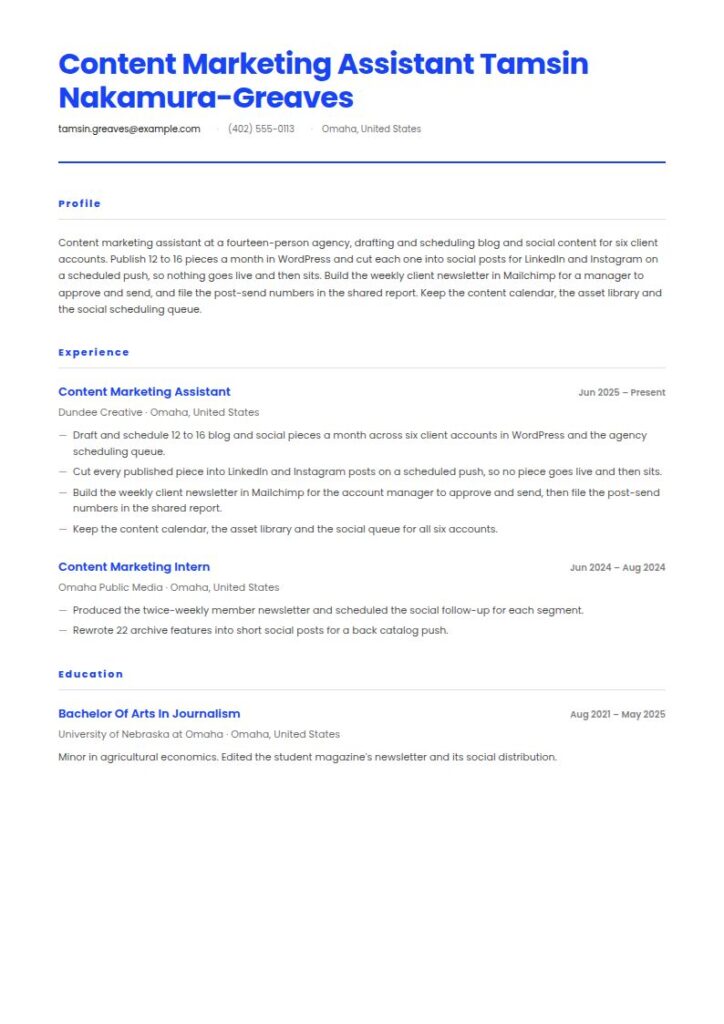
Content marketing assistant at a fourteen-person agency, drafting and scheduling blog and social content for six client accounts. Publish 12 to 16 pieces a month in WordPress and cut each one into social posts for LinkedIn and Instagram on a scheduled push, so nothing goes live and then sits. Build the weekly client newsletter in Mailchimp for a manager to approve and send, and file the post-send numbers in the shared report. Keep the content calendar, the asset library and the social scheduling queue.
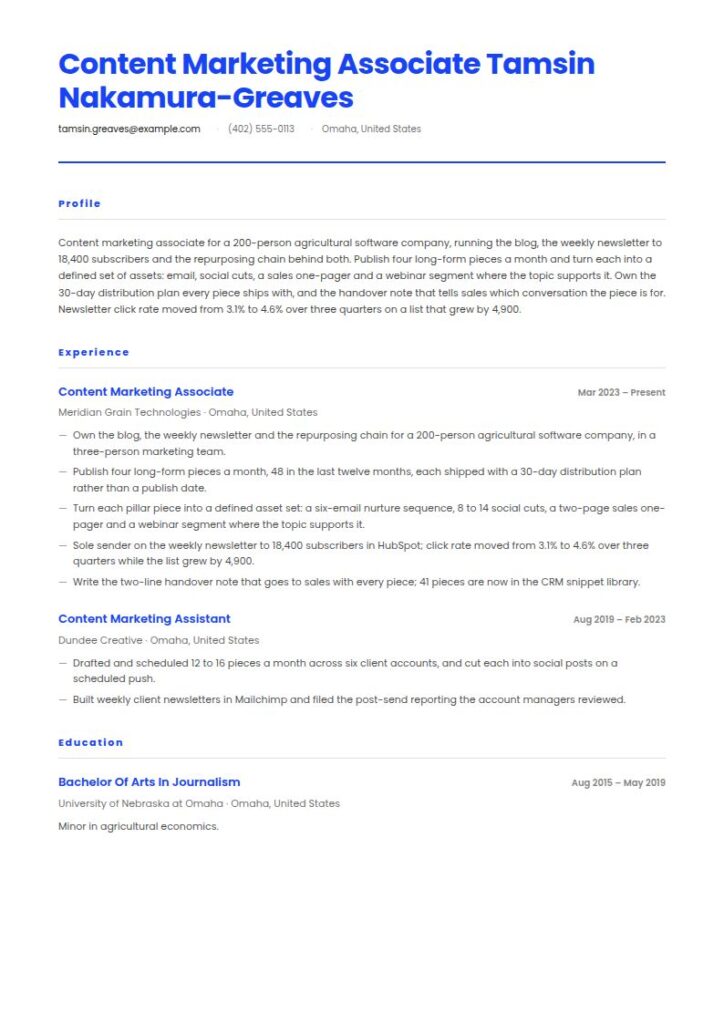
Content marketing associate for a 200-person agricultural software company, running the blog, the weekly newsletter to 18,400 subscribers and the repurposing chain behind both. Publish four long-form pieces a month and turn each into a defined set of assets: email, social cuts, a sales one-pager and a webinar segment where the topic supports it. Own the 30-day distribution plan every piece ships with, and the handover note that tells sales which conversation the piece is for. Newsletter click rate moved from 3.1% to 4.6% over three quarters on a list that grew by 4,900.
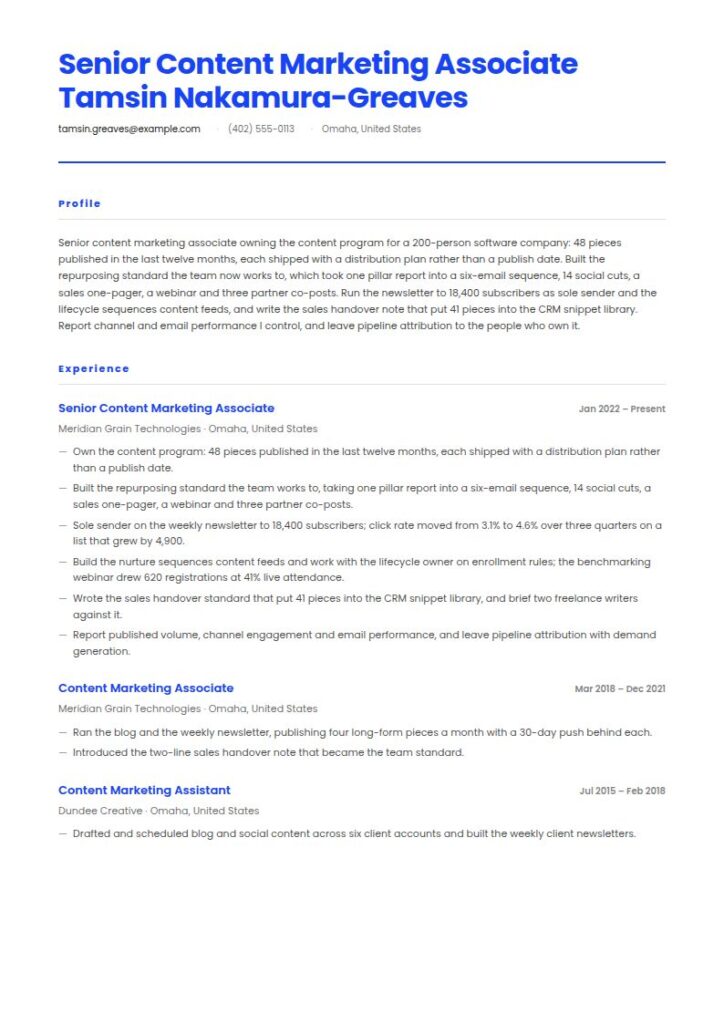
Senior content marketing associate owning the content program for a 200-person software company: 48 pieces published in the last twelve months, each shipped with a distribution plan rather than a publish date. Built the repurposing standard the team now works to, which took one pillar report into a six-email sequence, 14 social cuts, a sales one-pager, a webinar and three partner co-posts. Run the newsletter to 18,400 subscribers as sole sender and the lifecycle sequences content feeds, and write the sales handover note that put 41 pieces into the CRM snippet library. Report channel and email performance I control, and leave pipeline attribution to the people who own it.
Right vs wrong: the same content marketing associate summary, twice
| ✅ Right | ❌ Wrong |
|---|---|
| Publish four long-form pieces a month, each shipped with a 30-day distribution plan. | Create engaging content that resonates with target audiences. |
| Newsletter click rate moved from 3.1% to 4.6% over three quarters on a list that grew by 4,900. | Drove significant engagement across all marketing channels. |
| Wrote the sales handover note that put 41 pieces into the CRM snippet library. | Contributed to pipeline growth and revenue generation. |
The right column describes work somebody did. The left column is a claim the candidate cannot substantiate and will be asked about, and that conversation goes badly in the first screening call.
Outline your experience
Employer, what it sells, team size, your scope in one clause, then dates. Three to five bullets, each carrying a volume, a cadence or a named channel.
| Instead of | Use |
|---|---|
| Wrote blog posts and articles | Published 48 long-form pieces in twelve months, each shipped with a 30-day distribution plan |
| Managed social media content | Cut every long-form piece into 8 to 14 posts across LinkedIn, YouTube Shorts and the customer community |
| Supported email marketing | Sole sender on a weekly newsletter to 18,400 subscribers; click rate 3.1% to 4.6% over three quarters |
| Helped sales with content | Wrote a two-line handover note for each piece; 41 went into the CRM snippet library sales sends from |
| Increased leads and revenue | Webinar built from the benchmarking report drew 620 registrations at 41% live attendance |
Content Marketing Associate, Meridian Grain Technologies, Omaha, NE, March 2023 to Present
Agricultural software company, 200 staff, three-person marketing team. Own the blog, the weekly newsletter and the repurposing chain that connects them.
Publish four long-form pieces a month, 48 in the last twelve months, each shipped with a 30-day distribution plan rather than a publish date.
Turn each pillar piece into a defined asset set: a six-email nurture sequence, 8 to 14 social cuts, a two-page sales one-pager, and a webinar segment where the topic supports it.
Sole sender on the weekly newsletter to 18,400 subscribers in HubSpot. Click rate moved from 3.1% to 4.6% over three quarters while the list grew by 4,900.
Write the handover note that goes to sales with every piece: two lines on which conversation it is for. 41 pieces are now in the CRM snippet library.
Show what you did after publish, not just what you wrote
Write what happened to a piece after it went live: where it was pushed, on what schedule, what it was cut into, which sequence it fed, and what sales did with it.
This is the half of the job that decides the hire, and it is missing from most applications. The reason is understandable. Writing is the visible part, the part with a portfolio attached, and the part candidates feel proudest of. But a content team that publishes good work nobody sees has a distribution problem, not a writing problem, and the person hiring an associate has usually just lived through exactly that.
The repurposing chain. One piece of long-form work should produce a known set of derivatives. Write yours as a chain, not as a list of formats you are familiar with.
| Source | Becomes | Who it is for |
|---|---|---|
| A 4,000-word benchmarking report | A six-email nurture sequence | People who downloaded it but did not reply |
| The same report | 8 to 14 social cuts across three channels | The audience that will never download anything |
| The same report | A two-page sales one-pager | A representative in a live conversation |
| The same report | A webinar and its follow-up sequence | Buyers who want the argument explained |
| The same report | Three partner co-posts | An audience you do not own |
Five derivatives from one source is a normal working ratio, and writing it that way tells a reader you are not producing content that lives in one place and dies there.
The push, and its schedule. Channels without a schedule are a list of logos. Give the shape of the push instead: what goes out on the day, what follows in the first week, and what happens in the month after, when most teams have already moved on.
| When | What happens |
|---|---|
| Day 0 | Published, indexed, newsletter slot booked, social cuts queued |
| Days 1 to 5 | Social sequence runs, internal note goes to sales, community post |
| Week 2 | Newsletter feature, partner or community syndication |
| Week 4 | Added to the relevant nurture sequence and the sales snippet library |
| Quarter end | Refreshed or retired, depending on what the channel numbers say |
The sequence it feeds. Say which nurture or lifecycle program the piece entered, who built that sequence, and what your part in it was. "Wrote the six-email sequence and built it in HubSpot; the lifecycle manager set the enrollment rules" is precise, credible and instantly useful to a reader.
The handover to sales. This is the cheapest differentiator on the page because almost nobody writes it down. Two lines per piece, in the channel sales actually reads, saying which conversation the piece is for. If any of that content ended up in a CRM snippet library or a sales enablement folder, that is a number you can count.
Certification is voluntary, so the distribution story has to carry the file
Content marketing associate roles sit inside the Bureau of Labor Statistics occupation market research analysts and marketing specialists, which numbered 952,700 in 2025, with a projected change of 7 percent from 2025 to 2035 and about 82,000 openings projected each year on average (BLS Occupational Outlook Handbook, 2025 to 2035 projections).
BLS gives a bachelor's degree as the typical entry-level education for the occupation and describes certification as voluntary, demonstrating a level of professional competency (BLS Occupational Outlook Handbook, accessed September 2026).
Read those together and the conclusion is uncomfortable but useful. Neither the degree nor the certificate separates anyone in a field with 82,000 openings a year and a common entry credential. What separates candidates is evidence of the work that is hardest to fake, and a distribution chain with dates and channel numbers attached is exactly that.
Claim what you controlled, not what the pipeline did
Three columns of numbers exist around content work, and only one of them belongs on your resume without qualification.
| Yours to claim | Claim with your part named | Not yours |
|---|---|---|
| Pieces published, cadence held, assets produced | Webinar registrations, downloads, campaign results | Pipeline created |
| Newsletter list size, open and click rates you moved | Organic sessions where SEO was a shared effort | Revenue and closed won |
| Social engagement on cuts you made and scheduled | Sequence performance built with a lifecycle owner | Sales quota attainment |
| Snippets adopted, handovers written, sequences built | Event attendance you drove content for | Retention and expansion |
The middle column is where careful phrasing earns its keep. "Wrote and built the six-email sequence behind a launch that brought 620 webinar registrations" credits you with the work you did and lets the number stand next to it. "Generated 620 registrations" claims a campaign. "Drove $400,000 in pipeline" claims something you almost certainly cannot evidence, and any marketing manager knows it, because they have spent their own career arguing with attribution models.
There is a second reason to be strict here. Pipeline and revenue attribution in content marketing is contested inside companies, not just on resumes. A candidate who says "I own published volume, channel engagement and email performance; pipeline sat with demand generation and I fed it" sounds like someone who has worked in a real marketing team. A candidate who claims revenue sounds like someone repeating a sentence from a job posting.
Write the repurposing chain for one real piece, source to derivatives. Give the push schedule with days and weeks, not just channel names. Name the sequence the content fed and who built the enrollment rules. Say what sales received and whether they used it. Keep volume with a period attached: pieces a month, sends a week, assets per pillar.
Do not stop the story at the publish date. Do not list channels as logos with no cadence behind them. Do not claim pipeline or revenue you cannot evidence. Do not describe content as engaging, compelling or high-performing without a number. Do not let a certification stand in for shipped and distributed work.
Build a snapshot of your key skills
Ten to fourteen entries in three groups, kept separate from the distribution block so the two do not read as one list twice.
Production: Long-form writing, Editing to a style guide, Interview-based content, Content calendar ownership, Asset briefing for design
Distribution: Repurposing chains, Channel scheduling, Newsletter build and send, Nurture and lifecycle sequence build, Community and partner syndication, Sales enablement handover
Measurement and tools: HubSpot Marketing Hub, WordPress, Google Analytics 4, Looker Studio reporting, Email list hygiene and segmentation, Basic short-form video editing
List your education and certifications
Degree, then certifications with the issuing body and the year. The Bureau of Labor Statistics gives a bachelor's degree as the typical entry-level education for market research analysts and marketing specialists and describes certification as voluntary, demonstrating a level of professional competency (BLS Occupational Outlook Handbook, accessed September 2026). Treat them accordingly: supporting evidence for a platform claim, never a replacement for distributed work.
Bachelor of Arts, Journalism, University of Nebraska at Omaha, Omaha, NE, 2019. Minor in agricultural economics.
HubSpot Content Marketing Certification, HubSpot Academy, 2023
HubSpot Email Marketing Certification, HubSpot Academy, 2024
Google Analytics Certification, Google Skillshop, 2025
Content marketing internship, Omaha Public Media, summer 2018: newsletter production and social scheduling
Choose the right layout and design
Single column, 11 or 12 point, plain headings, no photograph, PDF unless the portal asks for Word. Keep the distribution block as labeled plain lines so a parser reads each channel and platform as text.
One page. At this level a second page reads as an inability to prioritize, which is close to the thing being tested when a job is largely about deciding what gets pushed where.
Content marketing associate job market and outlook
There is no Handbook profile called content marketing associate. The seat is counted inside market research analysts and marketing specialists, and that is the occupation a recruiter benchmarks the offer against, so those are the numbers to know before you negotiate.
| Measure | Value |
|---|---|
| Median annual wage, May 2025 | $78,760 |
| Lowest 10 percent | less than $43,390 |
| Highest 10 percent | more than $155,480 |
| Employment, 2025 | 952,700 |
| Projected change, 2025 to 2035 | 7 percent |
| Projected annual openings | about 82,000 |
| Typical entry-level education | Bachelor's degree |
Source: U.S. Bureau of Labor Statistics, Occupational Outlook Handbook, May 2025 wage data and 2025 to 2035 projections.
The step above this seat is a marketing management role, and BLS reports that separately. Marketing managers had a median annual wage of $166,790 in May 2025 and advertising and promotions managers $133,660, in an occupation group of 454,800 in 2025 with a projected change of 6 percent from 2025 to 2035 and about 36,300 openings each year on average (BLS Occupational Outlook Handbook, May 2025 and 2025 to 2035 projections). BLS gives the typical entry route into those roles as a bachelor's degree plus work experience in a related advertising, marketing, promotions or sales occupation, which is the seat you are applying for now.
The distribution work you describe looks different depending on where the job sits, and the occupation is spread widely: in 2025 management, scientific and technical consulting services held 11 percent of employment, finance and insurance 10 percent, information 9 percent, management of companies and enterprises 7 percent and wholesale trade 7 percent (BLS Occupational Outlook Handbook, 2025). Agency and consulting seats tend to hand an associate more channels at once; in-house finance and insurance seats hand over fewer channels and a longer compliance queue.
What salary you can expect as a content marketing associate
Read the published band before you quote a number. Across market research analysts and marketing specialists the median annual wage was $78,760 in May 2025, the lowest 10 percent earned under $43,390 and the highest 10 percent over $155,480 (BLS Occupational Outlook Handbook, May 2025). That band spans the whole occupation, including specialists a decade in, so a first or second associate role sits well below the midpoint and the useful comparison is the bottom quartile, not the median.
Industry moves it more than title does. In May 2025 the occupation's median was $102,670 in information, $99,850 in management of companies and enterprises and $94,330 in finance and insurance, against $78,780 in wholesale trade and $77,820 in management, scientific and technical consulting services (BLS Occupational Outlook Handbook, May 2025).
What moves you inside a band is scope, and distribution is where an associate gets it. Taking the send, the sequence build, the syndication relationship or the sales handover is each a task a more expensive person stops doing. Ask for one at a time, keep the numbers, and the resume writes itself into the next band.
Key takeaways for a content marketing associate resume
- Do not stop the story at the publish button; the second half is what is being bought.
- Write the repurposing chain for one real piece: source, derivatives, audiences.
- Give the push schedule in days and weeks, not a list of channel names.
- Name the sequence the content fed and exactly what part of it you built.
- Write the sales handover, because almost nobody does and it is countable.
- Claim volume, channel and email numbers; leave pipeline and revenue to their owners.
- Keep it to one page in a layout a parser can read cleanly.
Build your content marketing associate resume in 15 minutes.
Related marketing resume examples
- Marketing associate resume
- Content writer resume
- Blog writer resume
- Social media manager resume
- Marketing coordinator resume
- Digital marketing resume
- SEO resume
- Marketing manager resume
- Magazine editor resume
- Brand manager resume
- Marketing intern resume
- Marketing analyst resume
Pair it with a matching content marketing associate cover letter.
Content marketing associate resume questions, answered
How long should a content marketing associate resume be?
One page. Everything that decides the role fits: what you publish, where it goes afterwards, the channels you run, and the numbers you can defend. A second page at this level reads as padding.
What is the difference between a content marketing associate and a content writer?
Scope after publication. A content writer is hired to produce the piece; an associate is hired to produce it and then get it used, which means the repurposing, the channel push, the sequence and the handover to sales. Resumes that describe only the writing are applying for the narrower job by accident.
Should I put a portfolio link on the resume?
Yes, in the header as plain text. Then add one thing most candidates do not: offer a distribution plan for one piece alongside the writing samples. It is the artefact that proves the half of the job the samples cannot show.
How do I show results when someone else owned the campaign?
Name your part and let the number stand beside it. "Wrote and built the six-email sequence behind a launch that brought 620 webinar registrations" is honest and still credits you. Claiming the campaign is unnecessary, since nobody expects an associate to have owned demand generation.
Can I put pipeline or revenue numbers on a content marketing resume?
Only with your contribution named, and usually it is wiser not to. Attribution between content and revenue is argued inside companies, so a claim of revenue invites a question you cannot win. Published volume, channel engagement and email performance you controlled are defensible, specific and enough.