Content Writer Ingeborg Quintero-Hayes
Content Writer
[email protected] | (208) 555-0147 | Boise, United States
Profile
Content writer producing 8 to 10 pieces a month for business software clients, working to AP style with a client house supplement. Take a brief from the account lead, interview one subject matter expert per piece, and clear an editorial pass before publishing in WordPress with the title tag, meta description, alt text and internal links written myself. Brief to live in 5 working days through three gates, and I have never missed a publication date in two years.
Work Experience
07/2024 - Present, Content Writer, Cascade Peak Media, Boise, United States
- Write 8 to 10 pieces a month for business software clients through a three-gate chain: brief sign-off with the account lead, a subject matter expert accuracy check, and an editorial pass against AP style with a client house supplement.
- Run one 45-minute expert interview per piece to a fixed question set and return a claim list with sources rather than a transcript.
- Publish in WordPress and own the title tag, meta description, slug, heading structure, alt text and internal links.
- Hold brief to live at 5 working days and have not missed a publication date in 24 months.
- Built the shared interview question set now used by four writers on the team.
01/2023 - 06/2024, Communications Assistant, Boise State University, College of Arts and Sciences, Boise, United States
- Wrote the college newsletter and faculty features, cleared by the college communications director before each send.
- Learned the two-gate loop: department fact check, then communications sign-off, with a fixed Thursday send.
Education
08/2019 - 05/2023, Bachelor of Arts, English, Boise State University, Boise, United States
Coursework in rhetoric, technical communication and editing.
Skills
AP style, 85
Subject matter expert interviewing, 75
Brief and outline writing, 75
WordPress publishing and on-page metadata, 85
Claim sourcing and fact-checking, 70
Search intent mapping, 65
Languages
English, native
Spanish, advanced
Certificates
03/2024, Content Marketing Certification, HubSpot Academy, HS-CM-6620418
01/2026, Google Analytics Certification, Google Skillshop, GSK-GA-9930277
Renewed January 2026.
Summary
A content writer resume is a one to two page document showing the review chain your drafts pass through: brief sign-off, subject matter expert accuracy checks, legal or compliance review, the editorial pass, and publication. This guide gives you three adaptable versions, the details editors look for, and current Bureau of Labor Statistics pay and outlook.
Content Writer resume examples by experience level
A content writer resume is a one to two page document showing that you can move a draft through a review chain and out the other side, on schedule, without the reviewers dreading your name in their queue.
That is a strange thing to say about a writing job, and it is the truth of it. Prose quality is table stakes; everyone shortlisted can write a clean sentence. What varies is whether a writer can take a brief, interview an expert without wasting an hour of their time, survive a compliance reviewer with a veto, absorb a style guide, and publish with correct metadata by Thursday. Hiring managers have been burned by beautiful writers who could do none of that.
Resume guide for a content writer resume
This guide and the content writer resume example below will cover:
- How to write a content writer resume, section by section
- The five gates a draft passes before it goes live, and who holds each one
- How to name your style guide, your CMS and your turnaround
- Three adaptable summaries: junior, staff and content lead
- What the job market looks like and what you can expect to earn
How to write a content writer resume
Six blocks: contact header, summary, review chain, experience, skills and systems, education and certifications. One page under five years, two after that.
The review chain block sits under the summary because it answers a question no other section can. Volume and topic say what you have written. The review chain says what happens when you hand a draft to someone with authority over it, and that is what an editor is buying.
| Section | What it is answering | Where it goes |
|---|---|---|
| Review chain | Who signs off on this person's work, and can they survive it? | Directly under the summary |
| Style guide and CMS | Can they be dropped into our house standard on day one? | Same block, one line each |
| Experience | What did they publish, at what cadence, in what sector? | Reverse chronological, with counts and turnarounds |
| Skills and systems | Which tools and workflows have they actually worked inside? | Short grouped block |
Write your turnaround from brief to live, in days
One line moves a content writer resume more than any adjective: how long a piece takes from brief to published, and how many reviewers sit in between.
"Brief to live in 9 working days through four gates: brief sign-off, subject matter expert accuracy check, compliance review and editorial pass" tells an editor everything. It says you know the chain has gates, that you have counted them, that you have a normal cadence, and that you are not going to be surprised when legal takes three days.
If your sector has no compliance step, say your number anyway. "Brief to live in 4 working days through two gates" is a different job, honestly described, and an editor hiring for an unregulated blog prefers it to a vague claim of fast turnaround.
Run the finished file through the free Rezoom ATS resume checker before you send it. Content roles attract very high application volume and are almost always parsed before a person opens them.
Choosing the best resume format for a content writer resume
Reverse chronological, single column. One page under five years, two once you have worked in more than one review environment.
Writers are tempted by design here and should resist. A two-column layout with a sidebar, a display face and a pull quote from something you wrote does not parse, and it signals that you think the resume is the work sample. It is the document that gets you to the work sample.
Include your contact information
| ✅ Right | ❌ Wrong |
|---|---|
| Ingeborg Quintero-Hayes | Ingeborg Quintero-Hayes |
| Content Writer, regulated financial services | Wordsmith, storyteller, creative content creator |
| AP style with a house supplement, WordPress and Contentful | Passionate about crafting compelling content |
| (208) 555-0147, [email protected], Boise, ID | (208) 555-0147, [email protected] |
The third line is the unusual one, and it is why this header works. An editor knows you have written inside a house standard, knows which one, and knows you have published in a real content management system rather than handed over documents.
Make use of a summary
Four lines: the sector you write in, the review chain you work through, your cadence, and the systems.
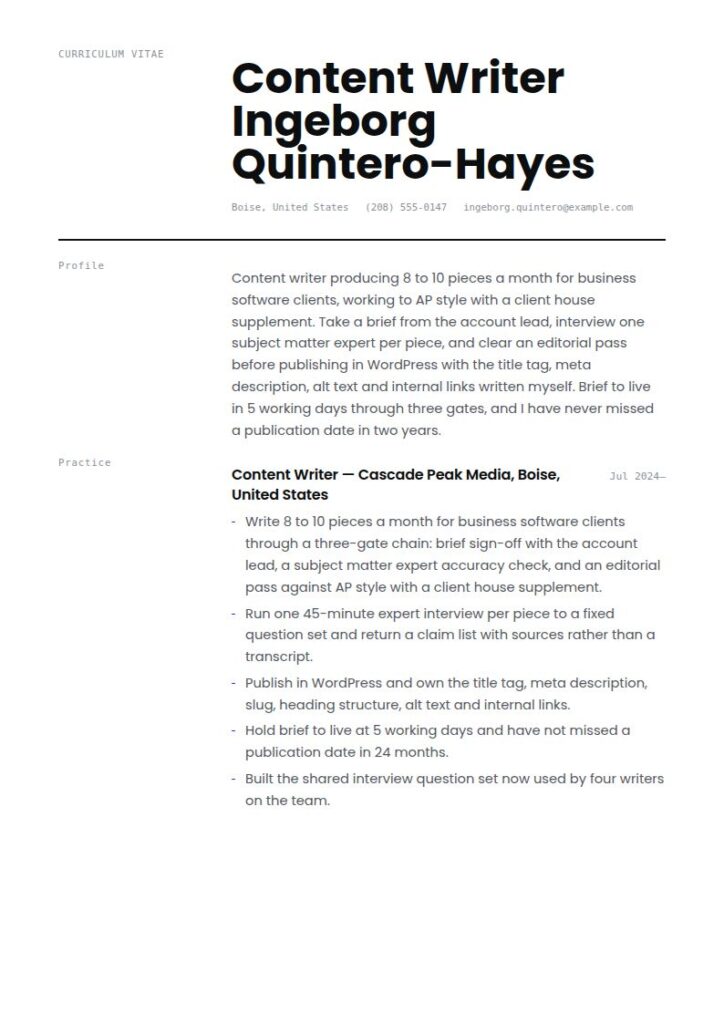
Content writer producing 8 to 10 pieces a month for business software clients, working to AP style with a client house supplement. Take a brief from the account lead, interview one subject matter expert per piece, and clear an editorial pass before publishing in WordPress with the title tag, meta description, alt text and internal links written myself. Brief to live in 5 working days through three gates, and I have never missed a publication date in two years.
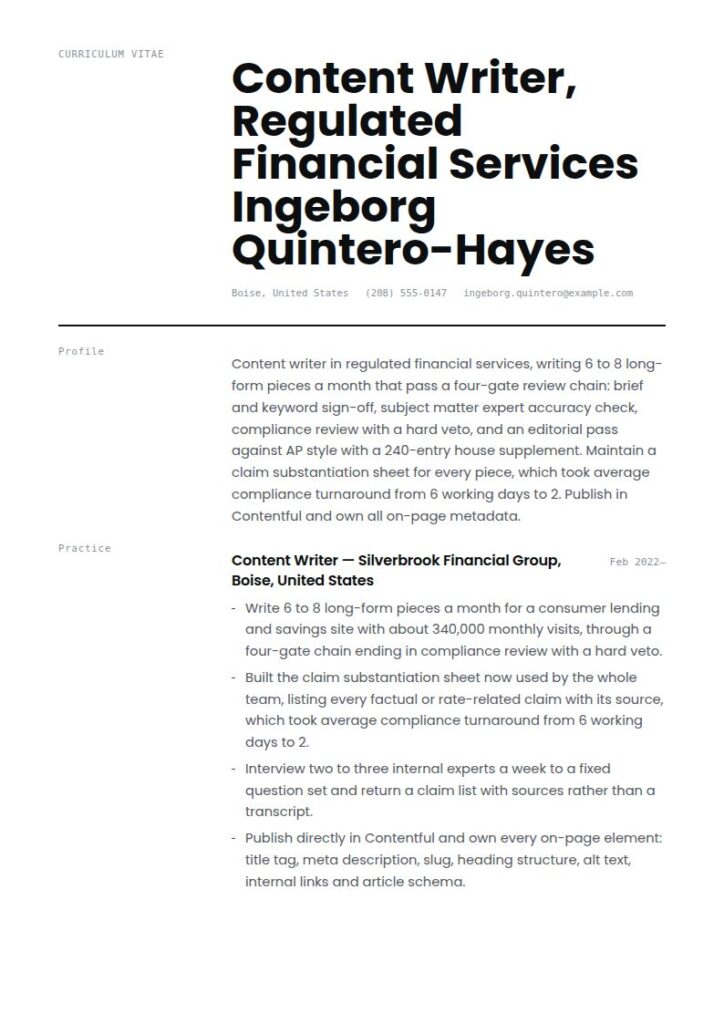
Content writer in regulated financial services, writing 6 to 8 long-form pieces a month that pass a four-gate review chain: brief and keyword sign-off, subject matter expert accuracy check, compliance review with a hard veto, and an editorial pass against AP style with a 240-entry house supplement. Maintain a claim substantiation sheet for every piece, which took average compliance turnaround from 6 working days to 2. Publish in Contentful and own all on-page metadata.
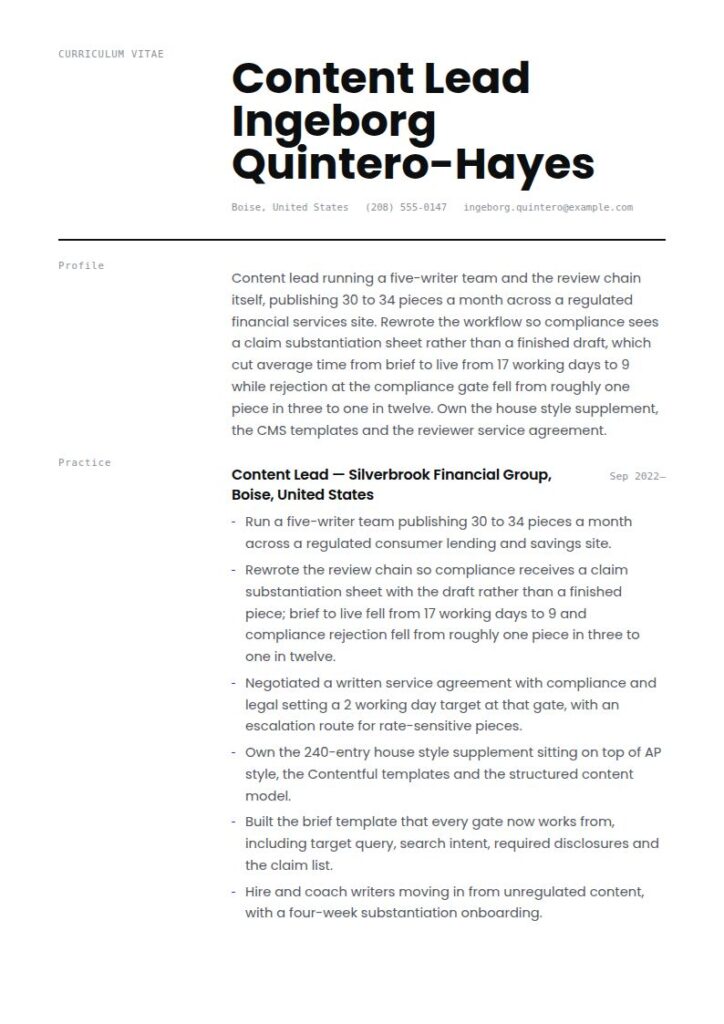
Content lead running a five-writer team and the review chain itself, publishing 30 to 34 pieces a month across a regulated financial services site. Rewrote the workflow so compliance sees a claim substantiation sheet rather than a finished draft, which cut average time from brief to live from 17 working days to 9 while rejection at the compliance gate fell from roughly one piece in three to one in twelve. Own the house style supplement, the CMS templates and the reviewer service agreement.
Right vs wrong: the same content writer summary, twice
| ✅ Right | ❌ Wrong |
|---|---|
| Six to eight long-form pieces a month through a four-gate review chain. | Experienced in producing high-quality content at scale. |
| Compliance review with a hard veto, cleared in an average of 2 working days. | Collaborated closely with legal and other stakeholders. |
| AP style with a 240-entry house supplement, published in Contentful. | Strong command of grammar and editorial best practices. |
| Brief to live in 9 working days, no missed publication date in two years. | Consistently delivered engaging content on deadline. |
The right column describes a process a reader recognizes from their own building. The left column could have been written by someone who has never had a draft rejected, which is the doubt an editor is trying to resolve.
Outline your content writing experience
Employer, what it publishes, the sector, your dates. Then three to five bullets, each carrying a volume, a gate, a turnaround or a standard.
| Instead of | Use |
|---|---|
| Wrote blog posts and web content | Wrote 6 to 8 long-form pieces a month for a regulated financial services site |
| Worked with subject matter experts | Ran 45-minute expert interviews to a fixed question set and returned a claim list with sources for each piece |
| Collaborated with the legal team | Cleared compliance review in an average of 2 working days by supplying a claim substantiation sheet with the draft |
| Followed brand guidelines | Wrote to AP style with a 240-entry house supplement, and maintained the supplement |
| Published content on the website | Published in Contentful, writing the title tag, meta description, slug, alt text, internal links and schema |
| Met tight deadlines | Held brief to live at 9 working days across four gates for 22 consecutive months |
Content Writer, Silverbrook Financial Group, Boise, ID, February 2022 to Present
Consumer lending and savings, writing for a site with about 340,000 monthly visits and a compliance function that holds a hard veto on published claims.
Write 6 to 8 long-form pieces a month through a four-gate chain: brief and keyword sign-off with the content lead, a subject matter expert accuracy check, compliance review, and an editorial pass against AP style with a 240-entry house supplement.
Built the claim substantiation sheet now used by the whole team, listing every factual or rate-related claim with its source, which took average compliance turnaround from 6 working days to 2.
Interview two to three internal experts a week, to a fixed question set, and return a claim list with sources rather than a transcript.
Publish directly in Contentful and own every on-page element: title tag, meta description, slug, heading structure, alt text, internal links and article schema.
Hold brief to live at 9 working days and have not missed a publication date in 22 months.
Show the review chain your copy passes through before it publishes
This is the section that separates two writers whose samples read equally well, and almost nobody includes it.
A draft is not finished when it is good. It is finished when the last person with authority over it says yes. Between your first sentence and the live URL there are usually five gates, each held by someone with a different job and a different reason to stop you. Name them, name who holds them, and say how long each takes.
| Gate | Who holds it | What they can block | What you supply | Typical turnaround |
|---|---|---|---|---|
| Brief and keyword sign-off | Content lead, or an SEO specialist | Scope, target query, angle, length | Outline, target query and search intent, proposed structure | 1 working day |
| Subject matter expert accuracy check | An internal expert or practitioner | Any factual or technical claim | Interview notes and a claim list with sources | 2 to 3 working days |
| Legal or compliance review | Counsel or a compliance officer | Anything at all, with a hard veto in regulated sectors | Claim substantiation sheet, required disclosures, source links | 2 to 6 working days |
| Editorial and style pass | An editor or managing editor | Structure, style guide conformance, house terms | Clean draft against the guide, with tracked changes accepted | 1 to 2 working days |
| Publication and metadata | Usually you | Nothing, but it is yours to get wrong | Title tag, meta description, slug, alt text, internal links, schema, publish state | Same day |
Write your version of that as a short block, directly under the summary.
Review chain: brief and keyword sign-off with the content lead; subject matter expert accuracy check with a lending or savings specialist; compliance review with a hard veto; editorial pass against house style; publication by me.
Style guide: AP style with a 240-entry house supplement, which I maintain. Previously Chicago on academic client work.
CMS: Contentful, publishing directly, with all on-page metadata written by me. Previously WordPress with Yoast.
Sign-off: the content lead approves the brief; the compliance officer is the final gate and cannot be overruled by marketing.
Cadence: 6 to 8 long-form pieces a month, brief to live in 9 working days, 22 consecutive months without a missed publication date.
Four things worth getting exactly right in that block.
Name the style guide, not "brand guidelines". AP, Chicago, AMA, a house guide, or AP with a house supplement. Those are different disciplines, and an editor hiring for an AP shop reads "Chicago" and thinks about retraining time. If you maintain the house supplement rather than only following it, say so, because maintaining a guide is an editorial job dressed as a writing job.
Name the CMS and say whether you publish or hand over. A writer who hands a document to someone else has not done the last third of the work. A writer who publishes in Contentful, Sitecore, WordPress or a headless setup has, and the model matters: writing into structured fields is a different skill from writing into a page.
Say who signs off, and whether anyone can overrule them. This reveals how much authority you have worked under. "The compliance officer is the final gate and cannot be overruled by marketing" tells an editor the stakes were real. On an unregulated blog the honest version is "the content lead is the final gate", which is fine to write.
Give turnaround in working days, per gate if you can. Averages beat bests. "Compliance clears in 2 working days on average, 5 at worst" reads as someone who tracked it. "Fast turnaround" reads as someone who did not.
Unregulated blog writing and regulated writing are different jobs
The largest difference between two content writing roles is whether a reviewer holds a veto, and applicants routinely apply across that line without noticing.
On an unregulated blog, review is advisory. An editor pushes back, you argue, and the worst case is delay. Speed is the constraint, the chain is usually two gates, and the writer often has final say over publication.
In financial services, healthcare, insurance, pharmaceuticals, legal services and regulated consumer products, a compliance or legal reviewer can stop a piece permanently and does not have to negotiate. Every substantive claim needs a source the reviewer accepts. Draft cycles are longer, volume is lower, and the writers who survive are the ones who supply substantiation with the draft rather than after the rejection.
Moving from the first world into the second, do not lead with volume; it will look impressive and irrelevant. Lead with anything in your history that resembles substantiation: fact-checking, citing sources, working to a medical or legal reviewer, getting statistics approved, writing disclosures. One paragraph of that beats three hundred published posts.
If you are moving the other way, lead with your turnaround and your ability to hold a cadence without a reviewer forcing the pace.
Build a snapshot of your key skills
Twelve to sixteen entries in three groups: writing and research, review and standards, and systems. Keep it to things you have done.
Writing and research: Long-form explainers, Subject matter expert interviewing, Claim substantiation and sourcing, Outline and brief writing, Search intent mapping, Plain language editing
Review and standards: AP style, Chicago style, House style guide maintenance, Compliance and legal review preparation, Fact-checking, Tracked change and query resolution
Systems: Contentful, WordPress, Google Docs with suggestion mode, Asana, Semrush, Grammarly for house term enforcement, Google Search Console
List your education and certifications
Degree, then anything signaling editorial standards or sector knowledge. Short and dated.
Bachelor of Arts, English, Boise State University, Boise, ID, 2019.
Content Marketing Certification, HubSpot Academy, 2024.
Google Analytics Certification, Google Skillshop, most recent renewal 2026.
Continuing: consumer lending fundamentals, internal certification, 2023. Plain language writing for regulated products, 2025.
The Bureau of Labor Statistics says a college degree in English, communications or journalism is generally required for a salaried writing position, and gives a bachelor's degree as the typical entry-level education for writers and authors (BLS Occupational Outlook Handbook, published 27 August 2026). In a regulated field, sector training matters more than certificates: an internal course in lending, claims or clinical terminology is what shortens your review cycle.
Choose the right layout and design
Single column, 11 point body type, no photograph, no pull quotes, no display type. PDF unless the portal asks for Word. Your file should be the plainest document the reader opens that day and the clearest.
Name every gate your work passes and who holds it. Name your style guide exactly, and say if you maintain it. Name the CMS and say whether you publish yourself. Give turnaround in working days, with an average. Say whether a reviewer holds a veto. List the on-page elements you are responsible for.
Do not write "brand guidelines" when you mean a named style guide. Do not imply you publish if you hand over a document. Do not claim a turnaround you have not tracked. Do not describe review as collaboration when it was a veto, or as a veto when it was advice. Do not design the resume; it is not the writing sample.
Content writer job market and outlook
A flat occupation with heavy self-employment and steady replacement demand, which makes the review chain detail more valuable, not less.
| Measure | Value |
|---|---|
| Writers and authors, employment 2025 | 140,300 |
| Projected employment, 2035 | 139,900 |
| Projected change, 2025 to 2035 | Little or no change, a fall of about 500 jobs |
| Projected annual openings | ~11,900 |
| Typical entry-level education | Bachelor's degree |
| Median annual wage, May 2025 | $76,910 |
Source: U.S. Bureau of Labor Statistics, Occupational Outlook Handbook, May 2025 wages and 2025 to 2035 projections, published 27 August 2026.
Two thirds of this occupation is self-employed
In 2025, 65 percent of writers and authors were self-employed, with 9 percent in professional, scientific and technical services, 8 percent in information, 3 percent in educational services and 2 percent in religious, grantmaking, civic and professional organizations (BLS Occupational Outlook Handbook, May 2025).
Pay by industry in May 2025 ran $80,480 in religious, grantmaking, civic and professional organizations, $77,860 in professional, scientific and technical services, $74,590 in information and $72,610 in educational services (BLS Occupational Outlook Handbook, May 2025).
Employment is projected to show little or no change between 2025 and 2035, moving from 140,300 to 139,900, with about 11,900 openings a year (BLS Occupational Outlook Handbook, 2025 to 2035 projections).
That shape explains why salaried content roles are competitive and why the review chain is what to lead with. A staff job exists because someone needs copy that clears internal approval reliably, week after week. If the employer only needed words, the self-employed two thirds of the occupation would already be supplying them.
What salary you can expect as a content writer
The median annual wage for writers and authors was $76,910 in May 2025, which is $36.98 an hour. The lowest 10 percent earned less than $44,310 and the highest 10 percent more than $139,870 (BLS Occupational Outlook Handbook, May 2025).
The spread tracks the review environment. The bottom of the range is high-volume unregulated writing where the only gate is an editor's read. The top is writing that clears legal, compliance or clinical review in a sector where a wrong sentence is a regulatory problem, and each published piece costs the employer far more than the words.
Two things move you up. The first is a sector with a real reviewer, because scarcity sits there: plenty of people can write, and fewer can produce a claim substantiation sheet a compliance officer accepts first time. The second is owning part of the chain rather than passing through it. A writer who maintains the house style supplement, negotiated the reviewer service agreement or rebuilt the brief template has moved from being reviewed to shaping how review works, and that step changes the title.
Key takeaways for a content writer resume
- Put the review chain under your summary and name every gate.
- Say who holds each gate and whether anyone has a veto.
- Name your style guide precisely, and say if you maintain it.
- Name the CMS and say whether you publish or hand over.
- Give turnaround in working days, with an average rather than a best.
- List the on-page elements you are responsible for at publication.
- Moving into a regulated sector, lead with substantiation rather than volume.
Build your content writer resume in 15 minutes.
Related marketing resume examples
- Blog writer resume
- Magazine editor resume
- Content marketing associate resume
- Content acquisitions director resume
- SEO resume
- Marketing associate resume
- Social media manager resume
- Public relations resume
- Marketing coordinator resume
- Brand manager resume
- UX researcher resume
- Marketing consultant resume
Pair it with a matching content writer cover letter.
Content writer resume questions, answered
How long should a content writer resume be?
One page under five years, two after that. The second page earns its place when you have worked in more than one review environment, because an editor wants to know whether you have written somewhere a reviewer could stop you. It does not earn its place as a longer list of topics.
What style guide should I say I follow?
The one you actually work to, named exactly: AP, Chicago, AMA or a house guide, and say if the house guide sits on top of a public one. If you have worked to more than one, list them in order of depth. An editor is estimating retraining time, and an honest answer shortens that estimate.
How do I show my writing is accurate without a formal fact-checking role?
Describe your mechanism. A claim list with sources attached to each draft, a fixed interview question set, a substantiation sheet, a rule that no statistic goes in without a primary source and a date. Editors care less about the title of fact-checker than about a habit that keeps errors out.
Is it worth listing the CMS I use?
Yes, and be specific about your depth in it. Publishing directly, building in a structured content model, managing templates and writing schema are different levels, and they are the difference between a writer who needs a publisher and one who does not. Say which one you are.
What do I put on a content writer resume with no professional experience?
Write the chain you have, honestly. Student publication work, a department newsletter or volunteer communications all have briefs, reviewers and deadlines. Name who read your drafts, what they could change, and how long the loop took. Then name a style guide you can work to and a CMS you can publish in. A first-job candidate who understands that review exists is ahead of one who thinks the job is only writing.
Does a compliance reviewer really change the job that much?
Yes, and it is the most useful thing to be clear about in an application. A reviewer with a veto changes your volume, your research method, your sourcing standard and your relationship with deadlines. Writers who move into regulated sectors without expecting it have a hard first quarter, and hiring managers there screen for candidates who know what is coming.