Associate Creative Director, two accounts Hollis Terrazas-Nwosu
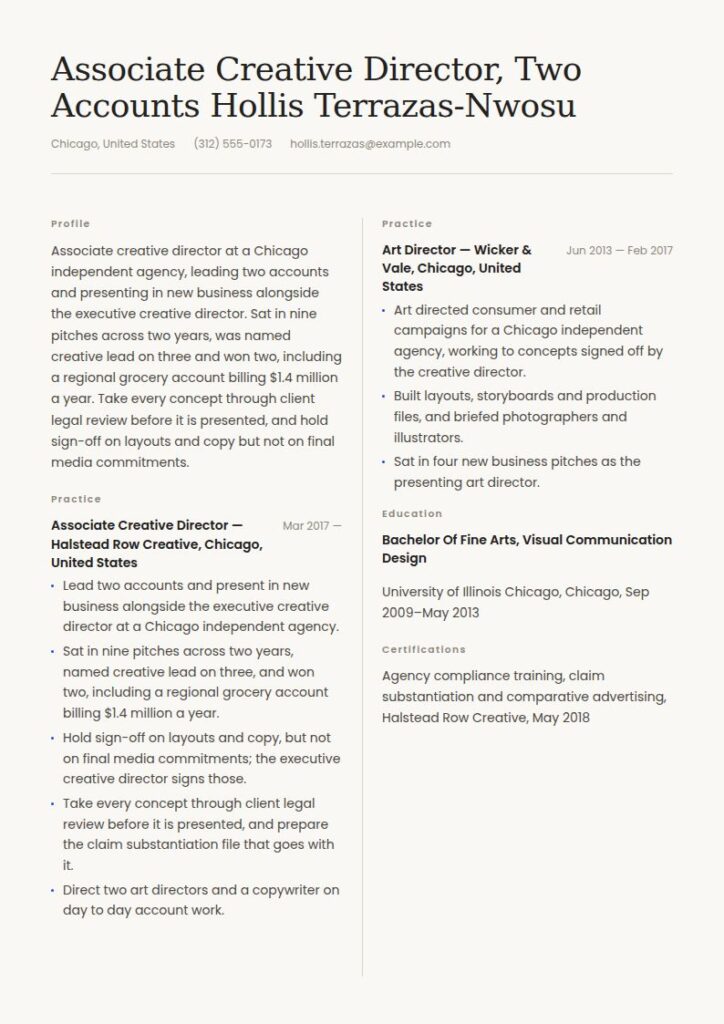
Associate Creative Director
[email protected] | (312) 555-0173 | Chicago, United States
Profile
Associate creative director at a Chicago independent agency, leading two accounts and presenting in new business alongside the executive creative director. Sat in nine pitches across two years, was named creative lead on three and won two, including a regional grocery account billing $1.4 million a year. Take every concept through client legal review before it is presented, and hold sign-off on layouts and copy but not on final media commitments.
Work Experience
03/2017 - Present, Associate Creative Director, Halstead Row Creative, Chicago, United States
- Lead two accounts and present in new business alongside the executive creative director at a Chicago independent agency.
- Sat in nine pitches across two years, named creative lead on three, and won two, including a regional grocery account billing $1.4 million a year.
- Hold sign-off on layouts and copy, but not on final media commitments; the executive creative director signs those.
- Take every concept through client legal review before it is presented, and prepare the claim substantiation file that goes with it.
- Direct two art directors and a copywriter on day to day account work.
06/2013 - 02/2017, Art Director, Wicker & Vale, Chicago, United States
- Art directed consumer and retail campaigns for a Chicago independent agency, working to concepts signed off by the creative director.
- Built layouts, storyboards and production files, and briefed photographers and illustrators.
- Sat in four new business pitches as the presenting art director.
Education
09/2009 - 05/2013, Bachelor of Fine Arts, Visual Communication Design, University of Illinois Chicago, Chicago, United States
Visual communication design, with electives in advertising copywriting and media law.
Skills
Concept development, 85
Creative brief writing, 75
Team direction and critique, 70
New business presenting, 70
Claim substantiation, 70
Client legal review preparation, 75
Art direction, 90
Copy direction, 75
Production oversight, 70
Brand guardianship, 75
Languages
English, native
Spanish, professional working
Certificates
05/2018, Agency compliance training, claim substantiation and comparative advertising, Halstead Row Creative
Internal training on substantiating performance and comparative claims before publication.
Summary
A creative director resume is a one to two page document showing what you presented, who bought it, and the approval chain the work cleared before it reached an audience. This guide gives you three adaptable versions, a pitch record block that replaces a list of campaigns, and current Bureau of Labor Statistics pay and outlook for art directors.
Creative Director resume examples by experience level
A creative director resume is a one to two page document that names what you presented, who bought it, and what the work had to clear before it ran.
Most creative director resumes answer neither. They describe campaigns in a voice that implies the writer made them, and leave the reader guessing about the two things that decide the hire: whether you can win business in a room, and whether you can get difficult work through a governance process without it being dismantled.
Those are the jobs. A creative director sells and protects; executing is what the people you direct are for.
Resume guide for a creative director resume
This guide and the corresponding creative director resume example will cover:
- How to write a creative director resume, section by section
- Why the pitch record, not the campaign list, is what establishes level
- Three adaptable summaries: associate, creative director and group lead
- How to write the approvals your work cleared, including regulated review
- What the job market looks like and what you can expect to earn
How to write a creative director resume
Six blocks: contact header, summary, pitch record, experience, skills, and education with continuing training. One page as an associate, two once you carry sign-off across a portfolio.
The pitch record sits high because it is the only part of the document that cannot be borrowed. Anyone can stand next to a famous campaign. Very few can say they were the named creative lead in the room and that the account billed for four years afterwards.
| Section | What it is answering | Where it goes |
|---|---|---|
| Pitch record | Did they sell work, or were they handed it? | Directly under the summary |
| Sign-off chain | Can they get difficult work through review intact? | Its own short block |
| Experience | What was their authority, and over how many people? | Reverse chronological, numbers in the bullets |
| Skills | Direction, critique and client handling, not software | Short grouped block |
Write the sentence that says what you were allowed to approve
Creative authority is a specific, bounded thing, and almost nobody writes it down.
Somewhere in your agency or in-house team there is a line describing what goes out on your say-so: concept and layout but not media commitment, or everything below a certain production budget, or final sign-off on one account and advisory input on three others.
Write that line: "held final creative sign-off on four accounts, advisory on the remaining six". A reader instantly knows your level, and they stop having to infer it from adjectives.
Then write who could overturn you: an executive creative director, a managing partner, a client regulatory panel. The approval order above you is a more honest measure of seniority than any title, because creative titles inflate faster than responsibilities do.
Run the finished file through the free Rezoom ATS resume checker before you send it. Creative roles draw very high volume, and the first reader is usually a parser.
Choosing the best resume format for a creative director resume
Reverse chronological, single column, plain type. One page as an associate, two once you have led pitches and carried a portfolio.
Creative people reach for the designed resume here, and it is a mistake at this level. You are being assessed on judgement, authority and commercial nerve, not on typographic taste in a two-page document. Put the visual argument in the portfolio and link to it once.
Include your contact information
| ✅ Right | ❌ Wrong |
|---|---|
| Hollis Terrazas-Nwosu | Hollis Terrazas-Nwosu |
| Group Creative Director, 3 teams, 22 people, final sign-off across the portfolio | Award-winning creative leader and visual storyteller |
| 41 pitches presented, 26 led, 15 won | Passionate about big ideas and beautiful craft |
| (312) 555-0173, [email protected], Chicago, IL | (312) 555-0173, [email protected] |
Three lines, three facts: how much you direct, what you may approve, and whether you can win. A reader places you before reaching the first job.
Make use of a summary
Four lines: your remit and headcount, your sign-off scope, your pitch record with a conversion number, and the review your work passes.
Associate creative director at a Chicago independent agency, leading two accounts and presenting in new business alongside the executive creative director. Sat in nine pitches across two years, was named creative lead on three and won two, including a regional grocery account billing $1.4 million a year. Take every concept through client legal review before it is presented, and hold sign-off on layouts and copy but not on final media commitments.
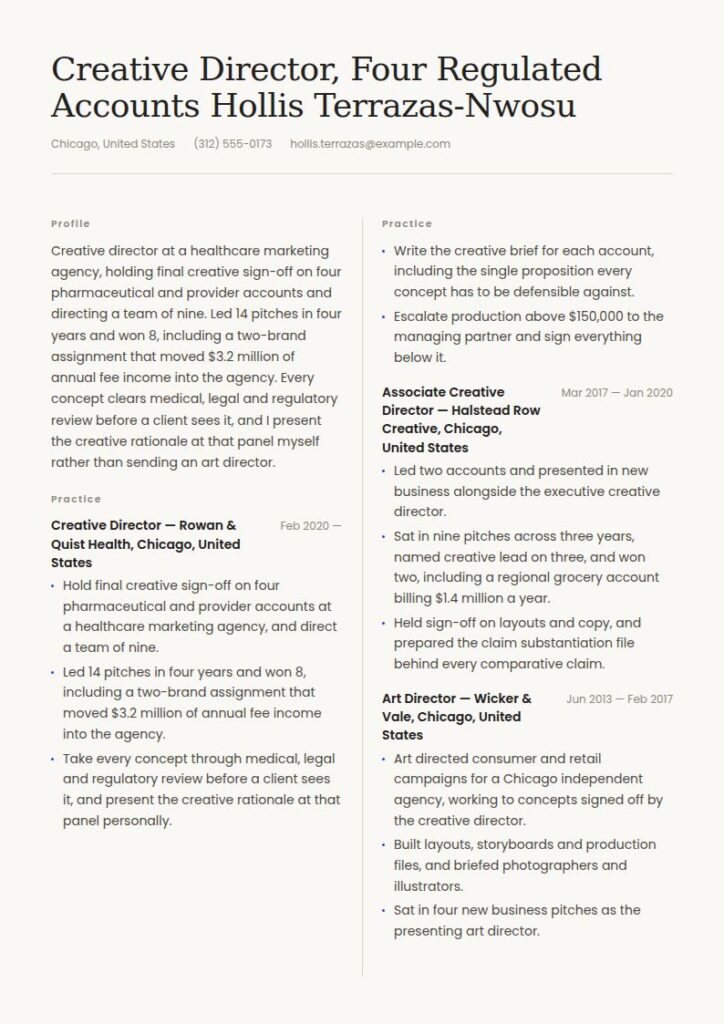
Creative director at a healthcare marketing agency, holding final creative sign-off on four pharmaceutical and provider accounts and directing a team of nine. Led 14 pitches in four years and won 8, including a two-brand assignment that moved $3.2 million of annual fee income into the agency. Every concept clears medical, legal and regulatory review before a client sees it, and I present the creative rationale at that panel myself rather than sending an art director.
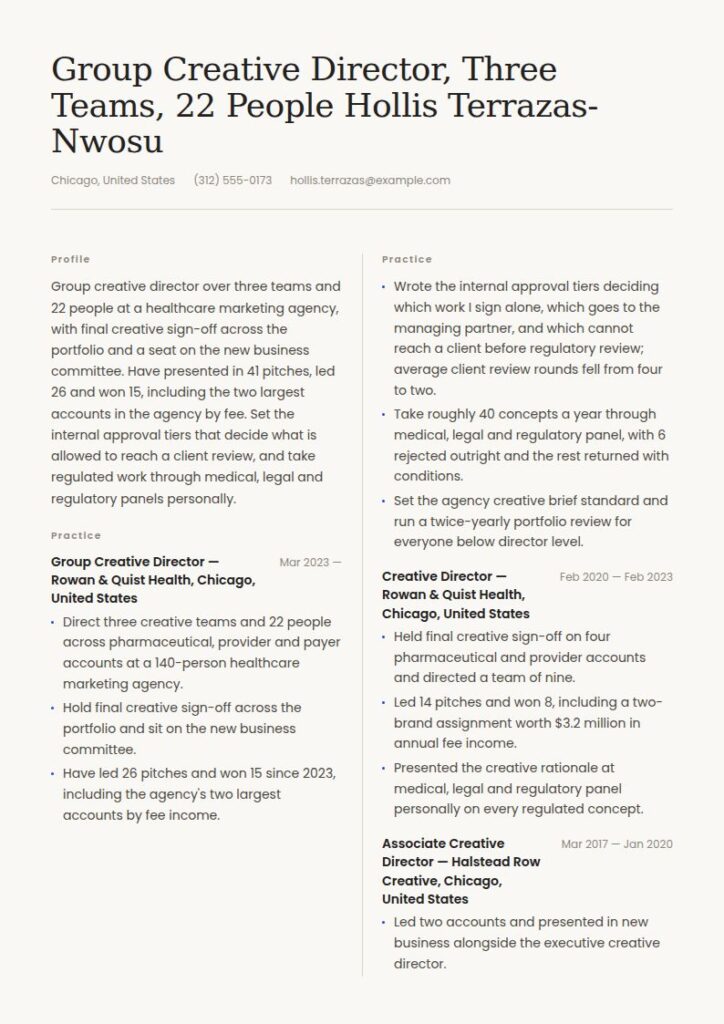
Group creative director over three teams and 22 people at a healthcare marketing agency, with final creative sign-off across the portfolio and a seat on the new business committee. Have presented in 41 pitches, led 26 and won 15, including the two largest accounts in the agency by fee. Set the internal approval tiers that decide what is allowed to reach a client review, and take regulated work through medical, legal and regulatory panels personally.
Right vs wrong: the same creative director summary, twice
| ✅ Right | ❌ Wrong |
|---|---|
| Led 14 pitches in four years and won 8, including a $3.2 million two-brand assignment. | Delivered award-winning creative for leading national brands. |
| Hold final creative sign-off on four accounts and direct a team of nine. | Led talented teams of designers, writers and producers. |
| Every concept clears medical, legal and regulatory review before a client sees it. | Collaborated closely with cross-functional partners and stakeholders. |
The right column describes someone who has been in rooms where something was at stake. The left describes someone who has been near the work, and a hiring principal reading sixty creative resumes a week tells the difference in a line.
Outline your creative direction experience
Agency or company, what it sells, your remit, headcount, sign-off scope, dates. Then three to five bullets, each carrying either a sale or a piece of governance, because those are the two things the job is.
| Instead of | Use |
|---|---|
| Led creative for major national campaigns | Led the creative pitch for a two-brand pharmaceutical assignment worth $3.2 million in annual fee |
| Managed a team of designers and copywriters | Directed nine people across two teams and held final sign-off on four accounts |
| Presented creative work to senior stakeholders | Presented in 14 pitches over four years as named creative lead, converting 8 |
| Ensured brand consistency across all channels | Wrote the approval tiers that decide what reaches a client review and what I sign alone |
| Worked closely with the legal team | Took 40 concepts a year through medical, legal and regulatory panel, with 6 rejected outright |
Group Creative Director, Rowan & Quist Health, Chicago, IL, March 2023 to Present
Healthcare marketing agency, roughly 140 people. Direct three creative teams and 22 people across pharmaceutical, provider and payer accounts. Hold final creative sign-off on the portfolio and sit on the new business committee.
Have led 26 pitches and won 15 since 2023, including the agency's two largest accounts by fee income.
Wrote the internal approval tiers deciding which work I sign alone, which goes to the managing partner, and which cannot be shown to a client before regulatory review; average client review rounds fell from four to two.
Take roughly 40 concepts a year through medical, legal and regulatory panel and present the creative rationale personally, rather than sending the art director who made the layout.
Set the creative brief standard used across the agency, and run a twice-yearly portfolio review for everyone below director level.
Write the pitch record: what you presented, to whom, and what was bought
A creative director is bought on selling as much as on making, and the pitch record is the one part of the resume a hiring principal cannot get from the portfolio.
It is also the part candidates are squeamish about. Naming a loss feels like an admission; it is the opposite, because a record with losses in it is the only kind a reader believes. Five facts make it legible, written as a block.
| Part of the record | What to write | Why it lands |
|---|---|---|
| Volume | How many pitches you have presented in | It separates being in the room from being told about it |
| Role | How many you led as the named creative lead | Presenting and leading are different jobs and readers know it |
| Conversion | How many were won, as a plain count | A ratio is checkable; "successful track record" is not |
| Size | The fee, billings or budget of the ones you won | It places you on the client-size scale in one number |
| Retention | How long the account stayed | Winning is a skill; keeping is a different and rarer one |
Pitches presented: 41 since 2017, across pharmaceutical, provider, consumer health and retail grocery.
Led as named creative lead: 26. Won 15, lost 11.
Largest won: a two-brand pharmaceutical assignment, $3.2 million annual fee, retained four years and still active.
Largest lost: a national retail pharmacy account, lost on price after two rounds.
Retention: of the 15 won, 11 are still with the agency at an average tenure of 3.4 years.
Three notes on writing it honestly.
Presented, led and won are three separate counts. Collapsing them into "won over 15 pitches" invites the question that destroys the claim, which is what your actual role in the room was.
Fee income beats media value. "A $40 million campaign" usually means the client's media budget, which you did not control. The fee or retainer is the number the person interviewing you thinks in.
Retention is the strongest line you have. An account that renewed three times means the promise made in the room survived contact with the work, which is exactly what a hiring principal is trying to find out.
Name the sign-off chain the work had to clear
The second half of the job is getting work through governance without letting it be argued into nothing. On regulated accounts that is most of the week, and it is almost entirely absent from creative resumes. Say who signs, in order, and what each can stop.
Internal tiers: I sign concept, layout and copy on all portfolio accounts. Production above $150,000 goes to the managing partner. Anything making a comparative claim goes to the agency's claim substantiation check before it leaves the building.
Client approval order: brand manager, marketing director, then the client's regulatory affairs lead. Two accounts add a global brand team review after local approval.
Regulated review: all pharmaceutical work goes to a medical, legal and regulatory panel before it can be presented. I attend and present the creative rationale.
Substantiation: every performance or comparative claim carries a cited source held in the claim file, kept current by the account team and checked at each new execution.
Typical throughput: about 40 concepts a year through regulated review, with 6 rejected outright and the rest returned with conditions.
The vocabulary is worth getting right, because it is how a reader separates an experienced creative director from a capable one who has only worked in unregulated categories.
Self-regulation is real and it has deadlines. The National Advertising Division, established in 1971 and now a unit of BBB National Programs, reviews the truthfulness of nationally disseminated advertising in any medium, including product labeling, and runs a fast-track route that resolves a challenge in 20 business days (BBB National Programs, National Advertising Division, accessed September 2026). A creative director who has built a claim file specifically so it would survive a challenge should say so.
Regulated categories have a named reviewer. Prescription medicine promotion is reviewed by the U.S. Food and Drug Administration's Office of Prescription Drug Promotion, which gives written feedback on proposed promotional materials and issues compliance letters where a promotional communication is false or misleading (U.S. Food and Drug Administration, accessed September 2026). That experience is scarce and worth a line rather than a hint.
Write what you protected, not only what you passed. The most useful sentence in this block is the one describing a piece of work you kept intact through a hostile review, and what you conceded in order to do it. That is the skill being bought, and it is the interview question you want asked.
Build a snapshot of your key skills
Twelve to sixteen entries in three groups. Keep software out of it: nobody hires a creative director for command of a page layout application, and listing it reads as a claim to a job you are meant to have left behind.
Direction and leadership: Creative brief writing, Concept development, Team direction and critique, Creative hiring and portfolio review, Mentoring art directors and writers, Setting approval tiers
Selling and client work: New business pitching, Chemistry meeting preparation, Presenting creative rationale, Scope and fee negotiation input, Client relationship recovery, Annual creative planning
Governance and craft: Claim substantiation, Regulated review preparation, Comparative advertising rules, Endorsement and disclosure policy, Production oversight, Brand guardianship and evolution
List your education and certifications
Short and dated, with the authority named. Formal credentials count for far less here than the pitch record, but evidence that you have been trained on the commercial and regulatory side of the job is unusual enough to be worth four lines.
Bachelor of Fine Arts, Visual Communication Design, University of Illinois Chicago, Chicago, IL, 2013.
Executive education, Marketing Leadership, Kellogg School of Management, Northwestern University, 2022.
Continuing education, advertising self-regulation and claim substantiation, BBB National Programs, National Advertising Division, 2024.
Agency compliance training, promotional labeling and prescription drug advertising, delivered against U.S. Food and Drug Administration Office of Prescription Drug Promotion guidance, 2023.
Choose the right layout and design
Single column, 11 point body type, no photograph, no skill bars, no full-bleed color. PDF unless the portal asks for Word.
One portfolio link, live, and either open or with the password on the line next to it. A hiring principal will not email you for access, and a dead link at this level reads as someone who does not check the work before it ships.
Give the pitch record as three separate counts: presented, led, won. Name the fee or retainer of what you won, not the client's media budget. Say how long the accounts you won stayed. Write your sign-off scope as a bounded sentence. Name who can overturn you. Describe the regulated or legal review your work passes and whether you attend it.
Do not imply authorship of work you directed at a distance; one question about the team will expose it. Do not quote campaign media spend as though it were your budget. Do not hide losses, because a record with none in it is not read as a record. Do not list design software. Do not present a two-column designed resume to an applicant tracking system. Do not describe governance as "working with legal" when you can name the panel and the throughput.
Creative director job market and outlook
The federal statistical system publishes no occupation called creative director. The closest match is art directors, where most agency and in-house creative leadership sits, with advertising, promotions and marketing managers as the client-side comparison.
| Measure, art directors | Value |
|---|---|
| Employment, 2025 | About 140,200 |
| Projected change, 2025 to 2035 | 4 percent growth |
| Projected annual openings | About 12,200 |
| Self-employed workers | 62 percent |
| Typical entry-level education | Bachelor's degree |
| Median annual wage, May 2025 | $114,850 |
Source: U.S. Bureau of Labor Statistics, Occupational Outlook Handbook, May 2025 wage data and 2025 to 2035 projections.
Most of this occupation is not on a payroll
Sixty-two percent of art directors were self-employed in 2025, against employment of about 140,200 and a projected 4 percent growth between 2025 and 2035, with roughly 12,200 openings a year (BLS Occupational Outlook Handbook, May 2025 wage data and 2025 to 2035 projections).
That figure explains most of what is strange about hiring at this level. A majority of the people you compete with are freelance, so salaried posts are fewer than the job boards suggest, and the person reading your file may be deciding between hiring you and retaining three contractors for the same money.
It also explains why the pitch record matters more here than in almost any other marketing role. A staff creative director who can win business is cheaper than a business development function, and that is the argument your resume makes whether you intend it or not.
The Handbook also notes that most art directors reach the role after five or more years in another occupation, so the earlier craft years belong on the page, compressed rather than deleted.
Where the money sits by industry:
| Industry, art directors | Median annual wage, May 2025 |
|---|---|
| Motion picture and video industries | $142,570 |
| Publishing, broadcasting, and content providers | $122,700 |
| Advertising, public relations, and related services | $121,490 |
| Management, scientific, and technical consulting services | $95,200 |
Source: U.S. Bureau of Labor Statistics, Occupational Outlook Handbook, May 2025.
On the client side, employment across advertising, promotions and marketing managers stood at 454,800 in 2025 and is projected to grow 6 percent between 2025 and 2035, with about 36,300 openings a year (BLS Occupational Outlook Handbook, 2025 to 2035 projections). Moving in-house is a live option at this level, and it changes what the resume has to argue.
What salary you can expect as a creative director
Art directors had a median annual wage of $114,850 in May 2025, with the lowest 10 percent earning less than $64,900 and the highest 10 percent more than $213,050 (BLS Occupational Outlook Handbook, May 2025).
That spread is more than three to one, and it is not explained by talent but by what you are trusted with. At the bottom of the band sits a title given instead of a raise, with no headcount and no sign-off. At the top sits someone carrying a portfolio and the authority to approve work that goes to air.
Three things move you through it. Pitch record comes first, because winning business is the only creative skill with a direct line to agency revenue. Sign-off scope and headcount come second. Category comes third: the Handbook's May 2025 figures put motion picture and video at $142,570 and publishing, broadcasting and content providers at $122,700, against $95,200 in management, scientific and technical consulting.
If you are weighing an in-house move, advertising and promotions managers had a median of $133,660 and marketing managers $166,790 in May 2025 (BLS Occupational Outlook Handbook, May 2025). Those roles trade pitch variety for one brand, so a resume aimed that way should lead with governance rather than conversion.
Key takeaways for a creative director resume
- Give the pitch record as three counts: presented, led, won, with the losses in it.
- Use fee or retainer value, never the client's media budget.
- Say how long the accounts you won were retained.
- Write your sign-off scope as a bounded sentence, and name who can overturn you.
- Describe the approval chain the work clears, including regulated review, and say whether you attend.
- Name one piece of work you kept intact through a hostile review.
- Keep the document plain and single column; the portfolio carries the visual argument.
Build your creative director resume in 15 minutes.
Related marketing resume examples
- Art director resume
- Advertising director resume
- Marketing director resume
- Marketing manager resume
- Brand manager resume
- Graphic designer resume
- Content acquisitions director resume
- UX designer resume
- Social media manager resume
- Public relations resume
- Digital marketing manager resume
- Event planner resume
Pair it with a matching creative director cover letter.
Creative director resume questions, answered
How long should a creative director resume be?
One page as an associate creative director, two once you hold sign-off across a portfolio. The second page earns its place if it carries a pitch record and a governance block, because a portfolio cannot show either. It does not earn its place as a longer list of brands you have been near.
Does my portfolio replace the resume?
No, and assuming it does is the most common mistake at this level. A portfolio shows what the work looked like. It cannot show whether you sold it, what you were allowed to approve, how many people you directed, or what the work survived on its way to air.
Should I include pitches I lost?
Yes, as a count, and ideally one named loss. A record that reports only wins reads as a filtered one, and every hiring principal knows conversion rates in new business are nowhere near 100 percent. Naming a loss briefly and without blame makes every other number on the page credible.
How do I write this resume if I have never pitched?
Write the equivalent selling you have done: internal pitches for budget, annual creative plans presented to an executive team, a brand platform argued for against an incumbent. All of these involve presenting unbought work to people who could refuse it. Describe them at the scale they happened rather than implying agency new business experience you do not have.
What if my category has no legal or regulatory review?
Then write the approval chain you do have, which always exists: who signs concept, who signs production spend, who can overturn you, and whether there is a claim substantiation step. Describing it accurately shows you understand that the job is partly about moving work through people.