Junior UX Designer Siobhan Fitzgibbon
Junior UX Designer
[email protected] | (412) 555-0194 | Pittsburgh, United States
Profile
Junior UX designer at a fourteen-person digital agency, working on client web products under a senior designer's review. Designed eleven client projects to WCAG 2.2 level AA, owning the contrast and focus order decisions and the keyboard path through every form I shipped, and annotating each handoff file with the focus behavior and error text engineering needed. Ran keyboard-only and screen reader passes on my own work before review, which is how the last four projects reached audit with no level A findings. Hold the IAAP CPACC credential.
Work Experience
07/2025 - Present, Junior UX Designer, Rivergate Interactive, Pittsburgh, United States
- Designed 11 client web projects to WCAG 2.2 level AA under a senior designer's review, owning contrast, focus order and the keyboard path through every form shipped.
- Annotated each handoff file with focus behavior, error wording and the keyboard route, so engineering received accessibility as a spec rather than a conversation.
- Ran keyboard-only and screen reader passes on my own screens before design review; the last four projects reached client audit with no level A findings.
- Built and maintained the studio's shared component sheet, setting minimum interactive target sizes and the focus indicator treatment.
06/2024 - 08/2024, UX Design Intern, Rivergate Interactive, Pittsburgh, United States
- Redrew two client form flows to remove re-entry of information the user had already supplied.
- Assisted on 6 moderated usability sessions and wrote the session notes the team designed from.
Education
08/2021 - 04/2025, Bachelor of Science, Information Science, University of Pittsburgh, Pittsburgh, United States
Human-centered computing concentration. Senior project: a keyboard-first redesign of a county service finder.
Skills
Interaction design, 70
WCAG 2.2 level AA design practice, 75
Accessibility annotation for handoff, 70
Screen reader and keyboard testing, 70
Figma including variables and auto layout, 85
Moderated usability testing, 60
Languages
English, native
Spanish, beginner
Certificates
03/2026, Certified Professional in Accessibility Core Competencies (CPACC), International Association of Accessibility Professionals, IAAP-CPACC-40218
Core competencies in disability, accessibility standards and universal design.
Summary
A UX designer resume is a one to two page document naming the products you shaped, the accessibility standard and conformance level you designed to, and the evidence that proved it. This guide gives you three adaptable versions, the standards block most applicants leave out, and current Bureau of Labor Statistics pay and outlook for the occupation BLS publishes this work under.
UX Designer resume examples by experience level
A UX designer resume is a one to two page document naming the products you shaped, the decisions you personally made inside them, and the accessibility standard you designed to.
That last part is unusual advice and it is the most useful thing on this page. Almost everything else a UX designer claims is a matter of taste and argument. Accessibility is the one part of the work with an external, published, checkable bar.
Resume guide for a UX designer resume
This guide and the corresponding UX designer resume example will cover:
- How to write a UX designer resume, section by section
- Why the accessibility standard and conformance level belong on the page
- Three adaptable summaries: junior, product designer and lead
- How to evidence conformance, and how to describe work you did not sign off
- What the job market looks like and what you can earn
How to write a UX designer resume
Six blocks: contact header, summary, standards and evidence, experience, skills and tools, then education and certifications. One page for your first four or five years, two once you lead a surface and can cite outcomes across several releases.
The standards block sits directly under the summary because it is the only claim on the file a reader can independently verify.
| Section | What it is answering | Where it goes |
|---|---|---|
| Standards and evidence | Which standard and level did this person design to, and who checked? | Directly under the summary |
| Experience | What did they decide, ship and measure? | Reverse chronological, one number per bullet |
| Skills and tools | What can they run, and how do they hand work to engineering? | Grouped, plain lines |
| Education and certifications | Degree, plus accessibility credentials from a named body | Bottom, short |
Write the version and the level, not the word accessible
"Accessible design" on a resume is an adjective. "Designed to WCAG 2.2 level AA" is a claim with a document behind it.
WCAG 2.2 became a W3C Recommendation on 12 December 2024 and defines three conformance levels, A, AA and AAA (W3C, WCAG 2.2, accessed September 2026). Most commercial and public sector work targets AA, so naming AA tells a reader you worked to the bar the market actually uses.
Then add who checked. A standard with no evidence behind it is still an assertion.
Run the finished file through the free Rezoom ATS resume checker before you submit. Design roles attract high application volumes and are parsed before a human opens the portfolio.
Choosing the best resume format for a UX designer resume
Reverse chronological, single column. One page while your experience fits on one; two once you have led a surface through several releases with outcomes worth citing.
Do not design the resume as a portfolio piece. What a hiring manager wants from it is scope, sequence and specificity, and an art-directed layout hides all three while breaking the parser.
Include your contact information
| ✅ Right | ❌ Wrong |
|---|---|
| Siobhan Fitzgibbon | Siobhan Fitzgibbon |
| Product Designer. WCAG 2.2 AA, audited. IAAP CPACC and WAS. | Creative UX professional passionate about user-centered design |
| Pittsburgh, PA. Portfolio link, four case studies. | Pittsburgh, PA |
| (412) 555-0194, [email protected] | (412) 555-0194, [email protected] |
The second line in the right column names a standard, a conformance level, the fact that an outside party checked it, and two credentials from a named body, in eleven words, above the fold.
Make use of a summary
Four lines: the surface you own, the standard and level you design to, one outcome with a number, and the handoff you run.
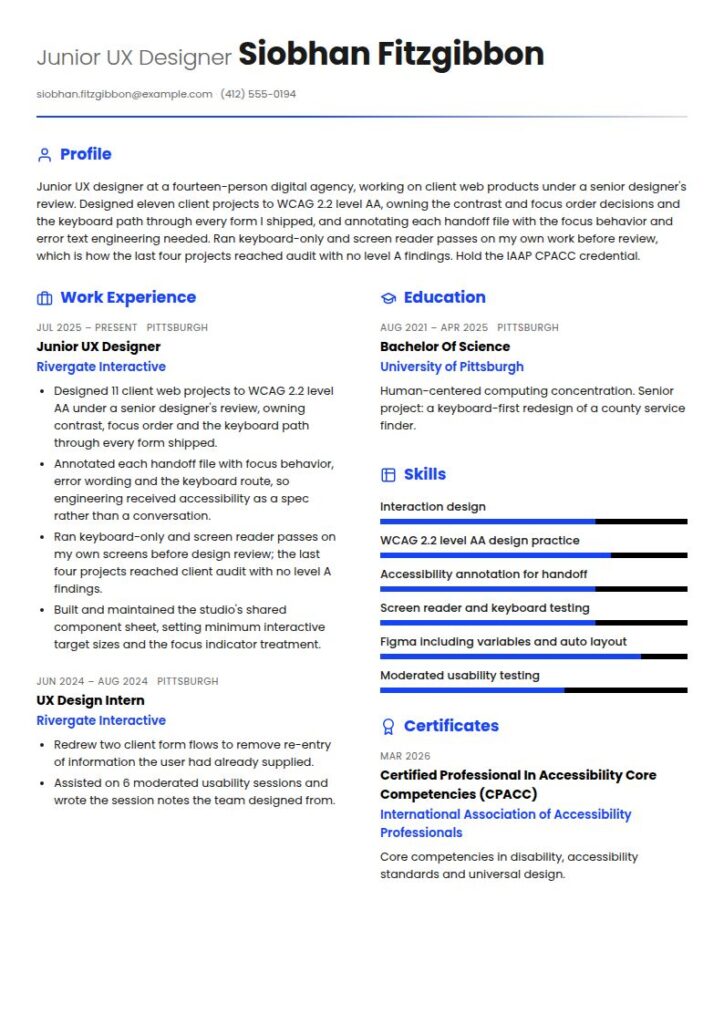
Junior UX designer at a fourteen-person digital agency, working on client web products under a senior designer's review. Designed eleven client projects to WCAG 2.2 level AA, owning the contrast and focus order decisions and the keyboard path through every form I shipped, and annotating each handoff file with the focus behavior and error text engineering needed. Ran keyboard-only and screen reader passes on my own work before review, which is how the last four projects reached audit with no level A findings. Hold the IAAP CPACC credential.
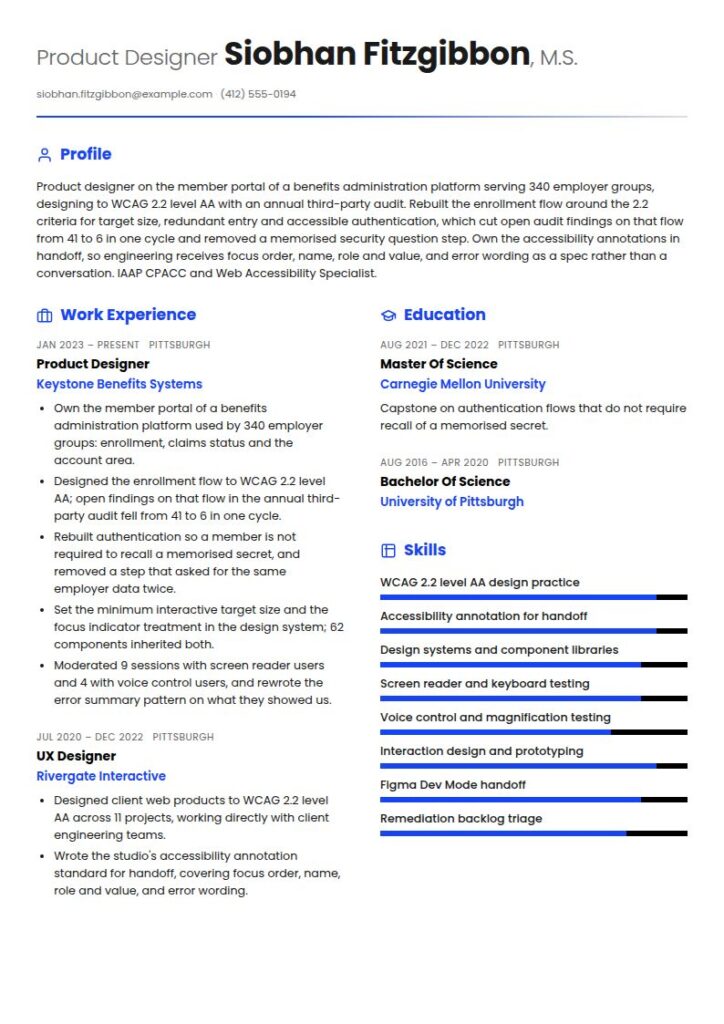
Product designer on the member portal of a benefits administration platform serving 340 employer groups, designing to WCAG 2.2 level AA with an annual third-party audit. Rebuilt the enrollment flow around the 2.2 criteria for target size, redundant entry and accessible authentication, which cut open audit findings on that flow from 41 to 6 in one cycle and removed a memorised security question step. Own the accessibility annotations in handoff, so engineering receives focus order, name, role and value, and error wording as a spec rather than a conversation. IAAP CPACC and Web Accessibility Specialist.
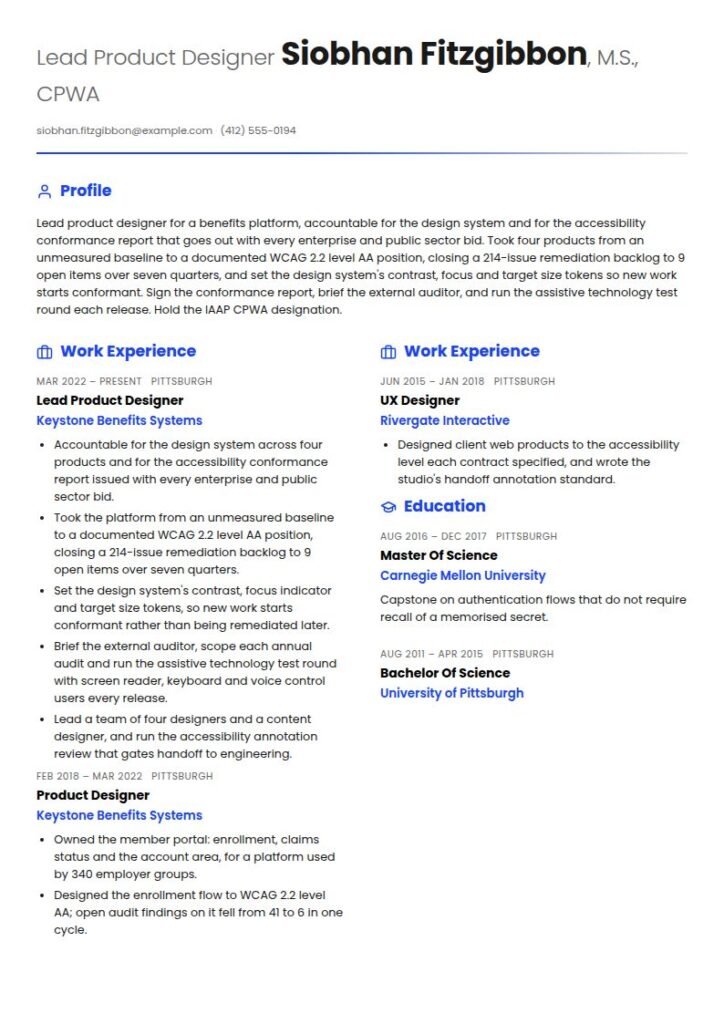
Lead product designer for a benefits platform, accountable for the design system and for the accessibility conformance report that goes out with every enterprise and public sector bid. Took four products from an unmeasured baseline to a documented WCAG 2.2 level AA position, closing a 214-issue remediation backlog to 9 open items over seven quarters, and set the design system's contrast, focus and target size tokens so new work starts conformant. Sign the conformance report, brief the external auditor, and run the assistive technology test round each release. Hold the IAAP CPWA designation.
Right vs wrong: the same UX designer summary, twice
| ✅ Right | ❌ Wrong |
|---|---|
| Designed the member portal to WCAG 2.2 level AA, verified by an annual third-party audit. | Committed to accessible, inclusive design for all users. |
| Cut the audit's open findings on the enrollment flow from 41 to 6 in one cycle. | Improved usability and accessibility across the product. |
| Hand engineering focus order, name, role and value, and error wording as annotated specs. | Collaborated closely with developers throughout the process. |
The right column can be checked. The left is what several hundred other applicants wrote, and a hiring manager reading design files at volume is looking for the part that can be checked.
Outline your experience
Employer, what the product is, who it serves, your surface, then dates. Three to five bullets, each naming a decision you made and a number attached to it.
| Instead of | Use |
|---|---|
| Designed accessible user interfaces | Designed the enrollment flow to WCAG 2.2 level AA; open audit findings on it fell from 41 to 6 in one cycle |
| Worked closely with developers | Annotated every handoff with focus order, name, role and value, and error text, so accessibility reached engineering as a spec |
| Conducted user research | Ran moderated sessions with 9 screen reader users on the enrollment flow, which changed the error summary pattern we shipped |
| Made the product more inclusive | Replaced memorised security questions with an authentication path that does not require recall, under WCAG 2.2 criterion 3.3.8 |
Product Designer, Keystone Benefits Systems, Pittsburgh, PA, January 2023 to Present
Benefits administration platform used by 340 employer groups. Own the member portal: enrollment, claims status and the account area.
Designed the enrollment flow to WCAG 2.2 level AA. Open findings on it in the annual third-party audit fell from 41 to 6 in one cycle, and the two remaining level A issues closed in the next release.
Rebuilt authentication so a member is not required to recall a memorised secret, and removed a step that asked for the same employer data twice.
Set the minimum interactive target size and the focus indicator treatment in the design system; 62 components inherited both, which is why new screens now reach audit clean.
Moderated 9 sessions with screen reader users and 4 with voice control users, and rewrote the error summary pattern on what they showed us.
Name the accessibility standard you designed to and how you proved conformance
Name three things in one line: the standard and its version, the conformance level, and who verified it. "Designed to WCAG 2.2 level AA, verified by an annual third-party audit and documented in the accessibility conformance report issued with enterprise bids" is a complete claim.
Most of a UX resume is contestable and gets settled in a portfolio review, not on the page. Accessibility is the exception: a published standard, defined levels, and a way to find out whether a product met them.
The standard. The Web Content Accessibility Guidelines 2.2 are published by the World Wide Web Consortium and became a W3C Recommendation on 12 December 2024 (W3C, WCAG 2.2, accessed September 2026). They define three conformance levels, A, AA and AAA, and add nine success criteria over WCAG 2.1, including 2.4.11 Focus Not Obscured (Minimum) at level AA, 2.5.7 Dragging Movements, 2.5.8 Target Size (Minimum), 3.2.6 Consistent Help, 3.3.7 Redundant Entry and 3.3.8 Accessible Authentication (Minimum). Content that conforms to WCAG 2.2 also conforms to WCAG 2.0 and 2.1, which is worth knowing when a posting names an older version. Each of those six is a design decision rather than a code fix, settled in a design file weeks before an engineer touches it, so if you made one it is yours to claim.
The other bar. If your work is bought by a United States federal agency, Section 508 of the Rehabilitation Act applies: it requires federal agencies to make their electronic and information technology accessible to people with disabilities, giving disabled employees and members of the public access comparable to that available to others. The US Access Board's Revised 508 Standards, a final rule of 18 January 2017 effective 18 January 2018, harmonise with and incorporate WCAG 2.0 by reference (Section508.gov, laws and policies, accessed September 2026). Which bar your work was measured against tells a reader where you came from: consumer product, enterprise procurement or public sector delivery.
What you personally did. A standard names an outcome; a designer makes the decisions that reach it.
| The decision | How it reads on the resume |
|---|---|
| Contrast | Set the text and non-text contrast ratios in the design system; rejected two brand colors that failed in body text |
| Focus order and visible focus | Specified focus order for every modal, drawer and multi-step form, and the focus indicator itself |
| Target size | Set the minimum interactive target size in the component library, which is where 2.5.8 is won or lost |
| Keyboard path | Documented the keyboard route through each form, including how a user leaves a component |
| Error and authentication flows | Rewrote error summaries and removed a memorised-secret step, against the redundant entry and accessible authentication criteria |
| Handoff annotation | Delivered focus order, name, role and value and error wording as an annotated spec |
How it was proved. Four kinds of evidence carry weight, so say which you have. An audit: name the scope and the cycle, and the finding count before and after if you know it, which is the strongest number a UX resume can carry. An accessibility conformance report: say which product it covered and which parts were yours. Assistive technology testing: screen reader, keyboard only, voice control and magnification, with the number of sessions, since automated checking finds only a minority of issues. And a remediation backlog, unglamorous and persuasive, because working one down is the part most teams abandon.
Pick the criterion you actually moved and write a bullet about it. Do not list all nine as a skills line: listing a standard is not the same as designing to it, and the difference shows in the first three minutes of a screening call.
Say whether you designed to the standard or signed it off
These are two different jobs, paid differently, so be exact about which one was yours.
Designing to the standard means your work met the bar: you made the contrast, focus, target and flow decisions, annotated them for engineering, and checked your own screens before review. Signing it off means you were accountable for the claim the organization published: you scoped the audit, decided what counted as conformant, maintained the report, and carried the risk when a buyer relied on it. Most designers do the first for years before anyone offers the second. "Ensured WCAG compliance" is the sentence that gets a candidate caught, because the next question is who issued the report.
| If this was your role | Write |
|---|---|
| You designed to the bar, someone else verified | Designed to WCAG 2.2 level AA; conformance verified by an annual third-party audit |
| You ran the testing but did not own the claim | Ran the assistive technology round each release: 9 screen reader and 4 voice control sessions |
| You owned the published claim | Maintain the accessibility conformance report issued with enterprise bids and brief the external auditor |
| You inherited a failing product | Closed a 214-issue remediation backlog to 9 open items over seven quarters |
Now the harder case: your last employer had no accessibility bar at all. That is common, and it is only a hole if you leave it as one. Do not invent a standard you did not work to; write what is true. You applied it yourself without being asked: "designed to WCAG 2.2 level AA as a personal working standard; the product was never externally audited." You built the case for one: "wrote the accessibility baseline the design team now works to." Or you learned it outside the job, where a credential from a named body does real work: the International Association of Accessibility Professionals awards the CPACC and Web Accessibility Specialist certifications and confers the CPWA designation on holders of both (International Association of Accessibility Professionals, accessed September 2026). A reader who cannot tell whether you were audited assumes you were not.
Name the standard, its version and the conformance level in one line. Say who verified it and on what cycle. Claim the decisions that are yours: contrast, focus order, target size, keyboard path, error and authentication flows. Give a before and after finding count if you have one. Say plainly when a product was never audited.
Do not write "WCAG compliant" with no version and no level. Do not claim you ensured compliance when someone else issued the report. Do not present an automated scanner score as an audit. Do not call a product accessible when the work stopped at a color contrast pass.
Build a snapshot of your key skills
Ten to fourteen entries in three groups, kept distinct from the standards block so the two do not read as one list written twice.
Design practice: Interaction design, Information architecture, Design systems and component libraries, Prototyping to interactive fidelity, Moderated usability testing, Assistive technology user sessions
Accessibility and standards: WCAG 2.2 level AA design practice, Accessibility annotation for handoff, Screen reader and keyboard testing, Voice control and magnification testing, Remediation backlog triage, Accessibility conformance reporting
Tools and handoff: Figma including variables and auto layout, Figma Dev Mode handoff, Storybook review, Jira and Linear, Axe and WAVE for automated checks, NVDA, JAWS and VoiceOver
List your education and certifications
Degree first, then accessibility credentials with the issuing body and the year. The Bureau of Labor Statistics gives a bachelor's degree as the typical entry-level education for web developers and digital designers while noting that requirements vary (BLS Occupational Outlook Handbook, accessed September 2026), which fairly describes a field where self-taught designers are hired routinely.
Master of Science, Human-Computer Interaction, Carnegie Mellon University, Pittsburgh, PA, 2022
Bachelor of Science, Information Science, University of Pittsburgh, Pittsburgh, PA, 2020
Certified Professional in Accessibility Core Competencies (CPACC), International Association of Accessibility Professionals, 2021, #IAAP-CPACC-40218
Web Accessibility Specialist (WAS), International Association of Accessibility Professionals, 2024, #IAAP-WAS-40218
Portfolio: four case studies, each naming the surface, the constraint and the conformance level the work was designed to
In public sector delivery or enterprise procurement, put the accessibility credentials above the degree. That is the line being scanned for.
Choose the right layout and design
Single column, 11 or 12 point, plain headings, no photograph, PDF unless the portal asks for Word. The temptation to treat the resume as a design artefact is worth resisting: multi-column grids, text inside graphics and decorative type are what parsers mangle, and the reader who would appreciate the craft opens your portfolio anyway.
Put the portfolio link in the header as plain readable text, and check the target does not sit behind a password that expires.
UX designer job market and outlook
The Bureau of Labor Statistics publishes no separate Occupational Outlook Handbook profile for "UX designer", so the closest published figures come from web and digital interface designers, reported within the web developers and digital designers profile.
| Measure | Value |
|---|---|
| Web and digital interface designers, median annual wage, May 2025 | $104,000 |
| Lowest 10 percent | less than $53,750 |
| Highest 10 percent | more than $201,550 |
| Employment, web developers and digital designers, 2025 | 220,100, of which 132,700 are digital designers |
| Projected employment, 2035 | 231,400 |
| Projected change, 2025 to 2035 | 5 percent, about 11,300 jobs |
| Projected annual openings | about 13,600 |
| Typical entry-level education | Bachelor's degree, requirements vary |
Source: U.S. Bureau of Labor Statistics, Occupational Outlook Handbook, May 2025 wage data and 2025 to 2035 projections.
A small occupation with an unusually wide pay range
Web developers and digital designers numbered 220,100 in 2025, of whom 132,700 were web and digital interface designers. Employment is projected to reach 231,400 by 2035, a change of 5 percent and a gain of about 11,300 jobs, with about 13,600 openings a year on average (BLS Occupational Outlook Handbook, 2025 to 2035 projections).
The median annual wage for web and digital interface designers was $104,000 in May 2025, with the lowest 10 percent under $53,750 and the highest 10 percent over $201,550 (BLS Occupational Outlook Handbook, May 2025), a spread of roughly four to one.
This is a modest occupation with an enormous distance between the ends of its pay range. In a market shaped like that, what moves a candidate is not portfolio volume, which everybody has, but a claim the employer can verify.
Where the jobs sit, by employment share for digital designers in 2025: information 27 percent, self-employed 13 percent, computer systems design and related services 13 percent, finance and insurance 6 percent, and wholesale trade 5 percent (BLS Occupational Outlook Handbook, 2025).
What salary you can expect as a UX designer
The median annual wage for web and digital interface designers was $104,000 in May 2025, against $92,650 for web developers in the same profile, with the lowest 10 percent of designers earning less than $53,750 and the highest 10 percent more than $201,550 (BLS Occupational Outlook Handbook, May 2025).
Industry moves the number more than title does. For digital designers in May 2025, finance and insurance paid a median of $133,260 and information $130,140, against $109,990 in computer systems design and related services and $87,640 in wholesale trade (BLS Occupational Outlook Handbook, May 2025). The two best-paying industries there are also the two with the heaviest regulatory and procurement scrutiny, which is not a coincidence.
That is the practical argument for the standards block: it makes you legible to the part of the market that pays the most, and it takes four lines to write.
Key takeaways for a UX designer resume
- Name the standard, the version and the level: WCAG 2.2 level AA, not "WCAG compliant".
- Say who verified it and on what cycle.
- Claim the decisions that are yours: contrast, focus order, target size, keyboard path, error and authentication flows.
- Separate designing to the standard from signing off the claim; they are different jobs.
- Give a before and after number, such as audit findings closed or a backlog cleared.
- If there was no accessibility bar where you worked, say so and write what you did instead.
- Keep the layout plain and single column, with the portfolio link as readable text.
Build your UX designer resume in 15 minutes.
Related marketing resume examples
- UX researcher resume
- Graphic designer resume
- Art director resume
- Creative director resume
- Digital marketing manager resume
- Marketing manager resume
- Marketing analyst resume
- SEO resume
- Brand manager resume
- Ecommerce resume
- Content writer resume
- Marketing coordinator resume
Pair it with a matching UX designer cover letter.
UX designer resume questions, answered
How long should a UX designer resume be?
One page for your first four or five years. Two once you have led a surface through several releases, owned a design system, or carried a conformance claim. The portfolio is where depth belongs.
Do I need to name a WCAG version and level, or is "accessible design" enough?
Name the version and the level. WCAG 2.2 became a W3C Recommendation on 12 December 2024 and defines conformance levels A, AA and AAA (W3C, WCAG 2.2, accessed September 2026), and a resume that names neither tells a reader you have not opened the document. AA is what most commercial and public sector work targets.
What if I have never worked anywhere with an accessibility program?
Say that, then say what you did anyway. Designing to the standard as a personal practice, writing the baseline your team now follows, or holding a credential from a named body are all real answers. What fails is the vague sentence that leaves a reader assuming you were audited when you were not.
Should UX designers list certifications at all?
As supporting evidence, not as a substitute for shipped work. The International Association of Accessibility Professionals awards the CPACC and WAS certifications and confers CPWA on holders of both (International Association of Accessibility Professionals, accessed September 2026). Next to an audited product a credential corroborates the claim; alone it says you studied the material.
Is UX designer the right job title to put on the resume?
Use the title the posting uses. The Bureau of Labor Statistics publishes no separate Handbook profile for UX designer; the published occupation is web and digital interface designers, within web developers and digital designers (BLS Occupational Outlook Handbook, accessed September 2026). Employers use product designer, UX designer and interaction designer interchangeably, so let the bullets define your scope.