Associate UX Researcher Hyejin Baek
Associate UX Researcher
[email protected] | (206) 555-0132 | Seattle, United States
Profile
Associate UX researcher with two years in business-to-business logistics software. Ran 14 studies in the last year, 9 moderated and 5 unmoderated, with 96 recruited participants across shipper and carrier roles. Wrote the screeners and ran recruitment myself, over-recruiting 20 percent against a no-show rate of 11 percent. A five-participant formative round on the booking flow removed a required field that was blocking roughly a quarter of first-time bookings.
Work Experience
02/2025 - Present, Associate UX Researcher, Tessaro Freight Systems, Seattle, United States
- Ran 14 studies in the last year, 9 moderated and 5 unmoderated, with 96 recruited participants across shipper and carrier dispatch roles.
- Wrote every screener and ran recruitment and scheduling in-house, over-recruiting 20 percent against an 11 percent no-show rate.
- A five-participant formative round on the booking flow removed a required reference-number field that was blocking roughly a quarter of first-time bookings; the round was reported as directional, not measured.
- Built the study card template now used across the team, recording method, sample, recruitment source, limits and resulting decision.
- Run the biweekly readout for one product manager and two designers, and log every decision taken against a study in the repository.
09/2023 - 01/2025, Research Coordinator, Glasswing Research, Seattle, United States
- Coordinated recruitment, consent and incentives for 31 client studies across retail, public sector and software clients.
- Screened and scheduled 340 participants through two external panel vendors, tracking incidence rate and no-show rate by segment.
- Moderated 22 usability sessions under supervision in the final year and wrote the session notes for analysis.
Education
09/2019 - 06/2023, Bachelor of Arts, Psychology, University of Washington, Seattle, United States
Research methods and statistics sequence completed. Two quarters as an undergraduate research assistant on a cognition laboratory study, running participant sessions to protocol.
Skills
Moderated usability testing, 75
Unmoderated task-based studies, 70
Screener writing and recruitment, 85
Semi-structured interviews, 70
Thematic analysis, 65
Consent and incentive handling, 80
UserTesting and Dovetail, 80
Languages
English, native
Korean, native
Certificates
02/2024, Human Subjects Research, Social and Behavioral Research, CITI Program
Refreshed 2025.
Summary
A UX researcher resume is a one to two page document showing the methods you can design, the samples you recruited, the limits you stated, and the product decisions that changed because of your findings. This guide gives you three adaptable versions, a study card format hiring managers can interrogate, and federal pay data for the occupations that cover this work.
UX Researcher resume examples by experience level
A UX researcher resume is a one to two page document that shows what you can design, who you studied, what your sample could not tell you, and which product decision came out differently because of it.
The failure mode is almost universal. Candidates write "conducted user research and delivered insights to product teams", which is true of a researcher who ran a properly powered benchmark against a recruited panel and equally true of someone who watched three unmoderated sessions and wrote a summary. A hiring manager who cannot tell those apart assumes the second, because the second is more common.
Resume guide for a UX researcher resume
This guide and the corresponding UX researcher resume example will cover:
- How to write a UX researcher resume, section by section
- Why the sample and the method belong next to every finding
- Three adaptable summaries: associate, researcher and lead
- How to write a study so a hiring manager can interrogate it
- What the job market looks like and what you can expect to earn
How to write a UX researcher resume
Six sections: contact header, summary, research experience, a study block, methods and tools, and education with certifications. One page for your first five years, two once you are setting research standards for other people.
The order is set by how these files are read. A research hiring manager scans for the methods you can run without supervision, then for evidence that you understand sampling, then for one finding they can push on. Everything else is furniture.
| Section | What it is answering | Where it goes |
|---|---|---|
| Summary | Which methods, what volume, what decision changed? | Top, four lines |
| Research experience | Did product teams act on this person's work? | Reverse chronological, decisions in the bullets |
| Study block | Do they understand sample, method and limits? | Its own block, two or three studies |
| Methods and tools | What can they run unsupervised, and what have they only assisted on? | Grouped, honest about depth |
Say whether you recruited your own participants
Recruitment is the part of the job that eats the calendar and the part nobody writes down. Two researchers with identical method lists can have completely different working lives depending on whether a research operations function exists behind them.
Write which side you were on. "Wrote the screener, ran recruitment through an external panel and scheduled sessions myself, over-recruiting 20 percent against an 11 percent no-show rate" is a claim about competence that no methods list contains. So is "worked with a research operations partner who handled panel and incentives", which is not a weaker claim.
If you have ever built or maintained a participant panel, put the size of it on the page. A researcher who can field a study in eight days without a vendor is solving a problem most teams have.
Run the finished file through the free Rezoom ATS resume checker before you submit. Research roles are usually posted through the same design or product requisitions pipeline, and the parser does not know the difference.
Choosing the best resume format for a UX researcher resume
Reverse chronological. One page early, two once you have led a practice, built research operations, or run programs across several product teams.
The temptation is a portfolio-style layout that leads with three case studies and puts employment at the bottom. Resist it here and keep the case studies in the portfolio. A hiring manager needs to see which organization gave you which scope, because "ran a discovery program" means something different in a five-person startup and in a product organization of four hundred.
Include your contact information
| ✅ Right | ❌ Wrong |
|---|---|
| Hyejin Baek | Hyejin Baek |
| UX Researcher, Mixed Methods | User advocate and empathy champion |
| Moderated, unmoderated, diary, survey, benchmark | Expert in all research methods |
| (206) 555-0132, [email protected], Seattle, WA, portfolio link | (206) 555-0132, [email protected] |
Include a portfolio link, because you will be asked for one anyway, and make sure it works without a password. A research portfolio behind a form is a portfolio nobody opens.
Make use of a summary
Four lines: the methods you run, the volume, one benchmark or study result, and what changed because of it.
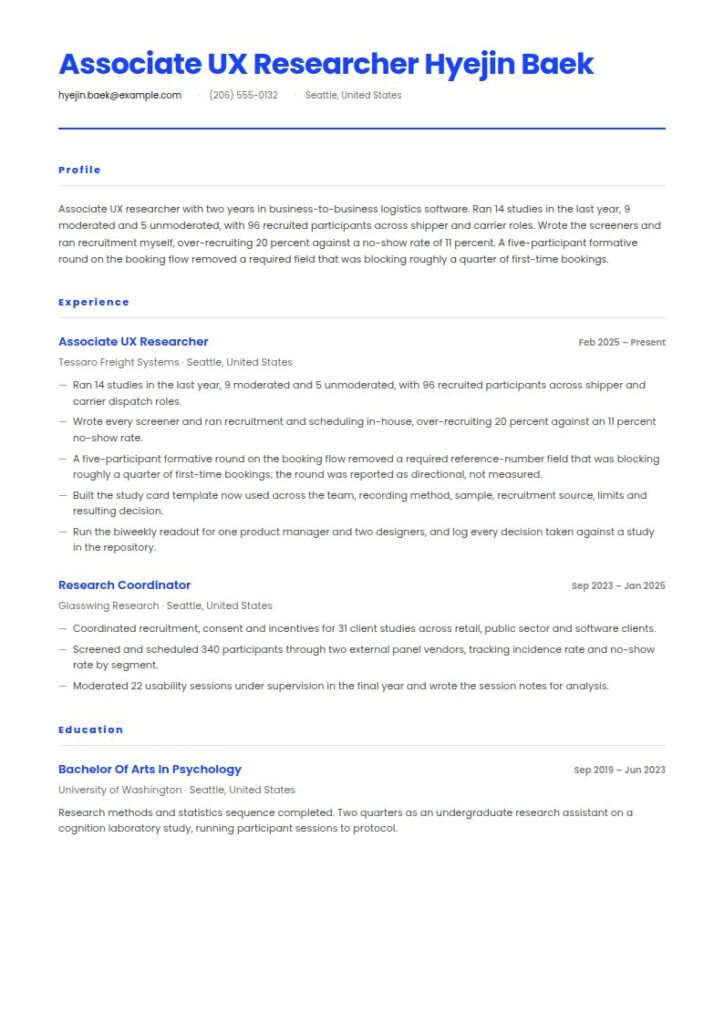
Associate UX researcher with two years in business-to-business logistics software. Ran 14 studies in the last year, 9 moderated and 5 unmoderated, with 96 recruited participants across shipper and carrier roles. Wrote the screeners and ran recruitment myself, over-recruiting 20 percent against a no-show rate of 11 percent. A five-participant formative round on the booking flow removed a required field that was blocking roughly a quarter of first-time bookings.
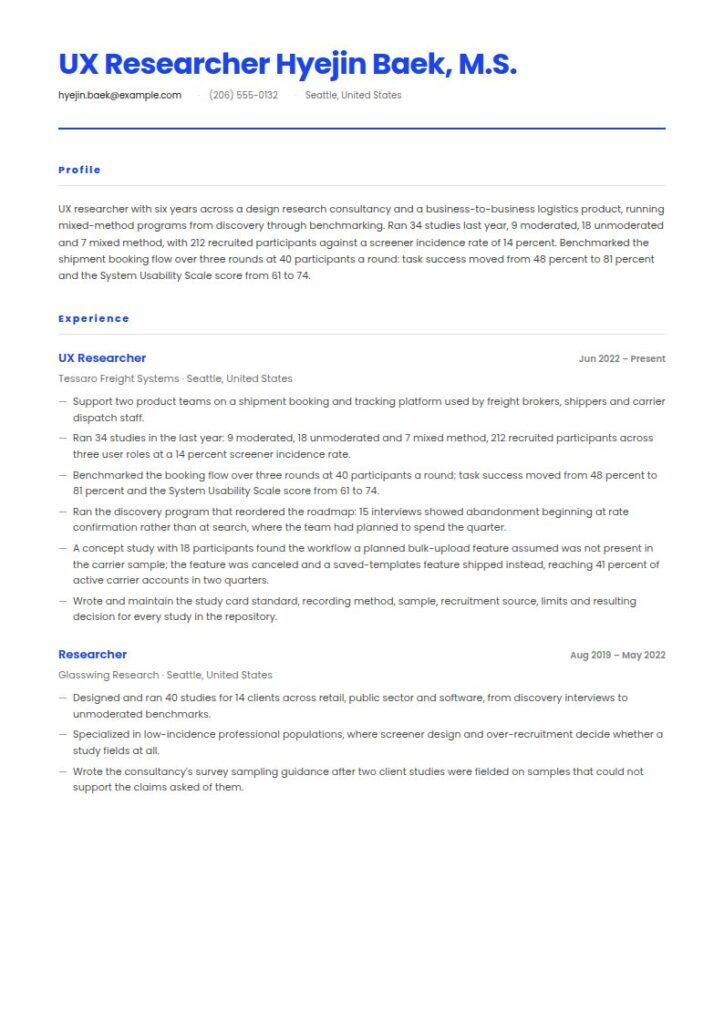
UX researcher with six years across a design research consultancy and a business-to-business logistics product, running mixed-method programs from discovery through benchmarking. Ran 34 studies last year, 9 moderated, 18 unmoderated and 7 mixed method, with 212 recruited participants against a screener incidence rate of 14 percent. Benchmarked the shipment booking flow over three rounds at 40 participants a round: task success moved from 48 percent to 81 percent and the System Usability Scale score from 61 to 74.
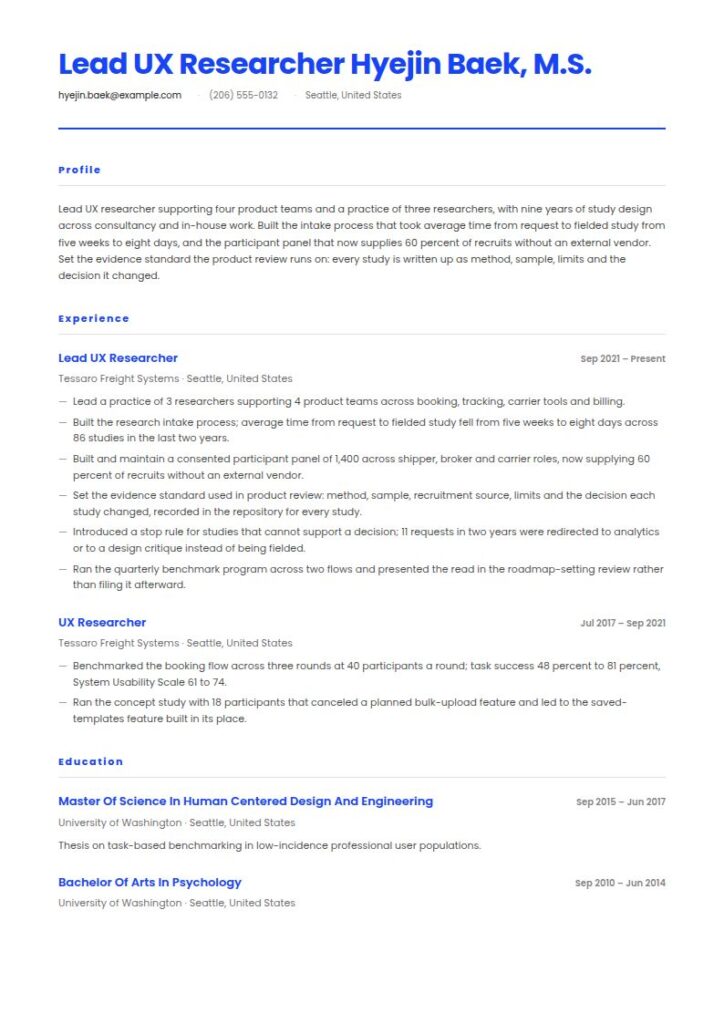
Lead UX researcher supporting four product teams and a practice of three researchers, with nine years of study design across consultancy and in-house work. Built the intake process that took average time from request to fielded study from five weeks to eight days, and the participant panel that now supplies 60 percent of recruits without an external vendor. Set the evidence standard the product review runs on: every study is written up as method, sample, limits and the decision it changed.
Right vs wrong: the same UX researcher summary, twice
| ✅ Right | ❌ Wrong |
|---|---|
| Ran 34 studies last year, 9 moderated, 18 unmoderated and 7 mixed method, with 212 recruited participants. | Conducted extensive user research across multiple product areas. |
| Benchmarked the booking flow over three rounds at 40 participants a round: task success 48 percent to 81 percent. | Delivered insights that significantly improved the user experience. |
| Screener incidence rate of 14 percent, with recruitment and scheduling run in-house. | Skilled in usability testing, interviews, surveys and journey mapping. |
The right column tells a research manager what you can be trusted to field alone. The wrong column describes a job title, and every applicant has one of those.
Outline your research experience
Organization, product area, the teams you supported, and dates. Then four to six bullets. Each bullet carries a method, a number of participants, and where possible a decision.
| Instead of | Use |
|---|---|
| Conducted user interviews and usability testing | Ran 9 moderated sessions and 18 unmoderated studies in a year, 212 recruited participants across two user roles |
| Delivered actionable insights to product teams | Discovery round of 15 interviews found the pricing step, not the search step, was where abandonment started; the roadmap was reordered |
| Improved the user experience of the checkout flow | Benchmarked the booking flow across three rounds at 40 participants a round; task success 48 percent to 81 percent |
| Collaborated with designers and product managers | Ran a weekly readout with two product managers and four designers; 11 of 14 recommendations from the year were shipped |
| Created research documentation and artifacts | Built the repository and study card standard now used by three researchers, with method, sample and limits recorded for every study |
| Recruited participants for research studies | Wrote the screeners and ran recruitment in-house at a 14 percent incidence rate, over-recruiting 20 percent against an 11 percent no-show rate |
UX Researcher, Tessaro Freight Systems, Seattle, WA, June 2022 to Present
Support two product teams on a shipment booking and tracking platform used by freight brokers, shippers and carrier dispatch staff.
Ran 34 studies in the last year: 9 moderated, 18 unmoderated and 7 mixed method, with 212 recruited participants across three user roles and a screener incidence rate of 14 percent.
Benchmarked the shipment booking flow over three rounds at 40 participants a round. Task success moved from 48 percent to 81 percent and the System Usability Scale score from 61 to 74 across the series.
Ran the discovery program that reordered the roadmap: 15 interviews showed that abandonment began at the rate confirmation step rather than at search, which was where the team had planned to spend the quarter.
Killed a planned bulk-upload feature after a concept study with 18 participants found that the workflow it assumed did not exist for the carrier segment; the team shipped a saved-templates feature instead and adoption reached 41 percent of active carrier accounts in two quarters.
Wrote and maintain the study card standard, recording method, sample, recruitment source, limits and resulting decision for every study in the repository.
Write each study as a method, a sample and the decision it changed
This is the block that separates a researcher from someone who watches sessions, and it is the one almost nobody puts on the page.
Every finding you report is an answer to two questions the reader is asking silently. How confident should I be in this, and what happened next. Method and sample answer the first. A named decision answers the second. A finding that arrives without both is a story, and product organizations have plenty of those already.
What the sample-size literature actually says
The guidance that everybody half-remembers is Jakob Nielsen's, and it is specifically about qualitative work: test five users in a qualitative usability study for the best return on the effort (Nielsen Norman Group, June 2012). Nielsen's separate recommendation for quantitative usability work is that about 20 users gives a reasonably tight confidence interval, and he notes that this makes quantitative studies roughly four times as expensive as qualitative ones (Nielsen Norman Group, June 2006).
Later NN/g work is stricter. Budiu and Moran conclude that 40 participants is an appropriate number for most quantitative studies, and that accepting a 15 percent margin of error at 90 percent confidence still requires 28 users, while a 20 percent margin needs 15 (Nielsen Norman Group, July 2021).
For questionnaire benchmarks there is a published reference point. Jeff Sauro's analysis of more than 5,000 users across 500 evaluations put the average System Usability Scale score at 68, which is why a raw SUS number means very little without that comparison next to it (MeasuringU, February 2011).
A candidate who writes "five participants, formative, directional only" is demonstrating all of this in six words. A candidate who writes "user testing confirmed the design worked" is demonstrating the opposite.
Write two or three studies as cards. Five lines each, and a hiring manager can read them in under a minute.
Booking flow benchmark, 2025. Question: can a new dispatcher complete a first booking unassisted? Method: unmoderated task-based benchmark, three rounds over nine months, 40 participants per round, recruited through an external panel screened for dispatch experience. Result: task success 48 percent, then 67 percent, then 81 percent; System Usability Scale 61, 68, 74. Limits: single user role, English only, desktop only, so nothing here speaks to the mobile carrier app. Decision: the rebuilt flow shipped to all accounts after round two rather than piloting for another quarter.
Carrier bulk upload concept study, 2025. Question: would carriers use a bulk shipment upload? Method: moderated concept evaluation, 18 participants across small and mid-size carrier operations, recruited from the in-house panel. Result: the assumed workflow, preparing shipment data in a spreadsheet ahead of time, was not present in the recruited sample; 15 of 18 entered shipments one at a time as they were booked. Limits: no enterprise carriers in the sample, and the concept was tested as a prototype rather than in production. Decision: the feature was canceled and a saved-templates feature built instead, reaching 41 percent of active carrier accounts within two quarters.
The limits line is the most persuasive part of the whole resume: naming what your study cannot support is the clearest signal of a trained researcher. The recruitment source tells the reader whether you can field studies at all. The decision line proves a product team moved, which is the only outcome research is bought for.
Build a snapshot of your key skills
Twelve to fifteen entries in four groups: qualitative methods, quantitative methods, research operations, and tools. Group them, because the groups are what a research manager is matching against the gaps in their team.
Qualitative: Moderated usability testing, semi-structured interviews, contextual inquiry, diary studies, concept evaluation, thematic analysis
Quantitative: Unmoderated task-based benchmarking, survey design and sampling, System Usability Scale and task success metrics, descriptive statistics and confidence intervals, card sorting and tree testing
Research operations: Screener writing, panel building and maintenance, external panel vendor management, consent and incentive handling, repository taxonomy and study card standards
Tools: UserTesting, Dovetail, Optimal Workshop, Qualtrics, Lookback, Figma and FigJam
Be honest about depth. A two-year resume listing ethnography, eye tracking, conjoint analysis and diary studies reads as a list of things the candidate has heard of, and the interviewer will pick the least plausible one to ask about.
List your education and certifications
Degree, institution, year, then the research training that matters, then certifications with the issuing body and date.
Master of Science, Human Centered Design and Engineering, University of Washington, Seattle, WA, 2020. Thesis on task-based benchmarking in low-incidence professional user populations.
Bachelor of Arts, Psychology, University of Washington, Seattle, WA, 2017. Research methods and statistics sequence completed.
Certifications: UX Certification with a specialty in User Research, Nielsen Norman Group (2023). Human Subjects Research, Social and Behavioral Research course, CITI Program (2022, refreshed 2025).
Portfolio: three written case studies, each with method, sample, limits and the decision it changed.
Graduate training in a research discipline does real work here. Psychology, human computer interaction, human factors, anthropology, sociology and information science all read as credible, and so does statistics if your work leans quantitative. List human subjects training too: it signals you understand consent and participant handling, an exposure most product teams have never thought about.
Choose the right layout and design
Single column, plain type at 11 point, clear headings, no photograph and no rating bars. A skills chart that gives yourself 4 out of 5 in statistics is an unsourced quantitative claim on a resume about measurement discipline, and research interviewers notice.
Put the method and the sample size next to every finding. State the limits of at least one study. Say who recruited your participants and from where. Give the number of studies you ran in a year, split by method. End findings with the decision that followed. Include a working portfolio link that needs no password.
Do not describe participants as individuals or include anything that could identify one; describe the recruited sample by role, size and screening criteria. Do not claim a method you have only observed. Do not report a percentage without the denominator. Do not write "user advocate" or "voice of the customer". Do not present a five-participant formative round as though it were a measured result.
UX researcher job market and outlook
The Bureau of Labor Statistics publishes no Occupational Outlook Handbook profile for UX researcher, and no single published occupation matches the job. The Handbook covers broad occupations rather than titles, and this work sits across three of them.
The honest way to read the market is to bracket the role between the published occupations that cover pieces of it: market research analysts, who do the commercial study design and survey work; survey researchers, who do the methodological and sampling work; and web and digital interface designers, who are where an in-house product research role usually sits inside a technology employer's job architecture.
| Bracketing occupation | Employment, 2025 | Projected change, 2025 to 2035 | Annual openings | Median annual wage, May 2025 |
|---|---|---|---|---|
| Market research analysts | 952,700 | 7 percent growth, 66,300 jobs | About 82,000 | $78,760 |
| Survey researchers | 9,800 | Decline 5 percent, 500 jobs | About 600 | $69,460 |
| Web and digital interface designers | 132,700 within a 220,100 occupation | 5 percent growth across the occupation | About 13,600 across the occupation | $104,000 |
Source: U.S. Bureau of Labor Statistics, Occupational Outlook Handbook, May 2025 wage data and 2025 to 2035 projections.
Three occupations, three very different markets
Market research analysts numbered 952,700 in 2025 and are projected to grow 7 percent by 2035, which the Handbook calls much faster than average, with about 82,000 openings a year and a median annual wage of $78,760 in May 2025 (BLS Occupational Outlook Handbook, May 2025 and 2025 to 2035 projections).
Survey researchers are a tiny and shrinking occupation by comparison: 9,800 jobs in 2025, projected to decline 5 percent to 9,300 by 2035, with about 600 openings a year and a median of $69,460 in May 2025. A master's degree is the typical entry-level qualification (BLS Occupational Outlook Handbook, May 2025 and 2025 to 2035 projections).
Web and digital interface designers, the group an in-house product research role is most often banded with inside a technology employer, had a median of $104,000 in May 2025, with the lowest 10 percent under $53,750 and the highest 10 percent over $201,550 (BLS Occupational Outlook Handbook, May 2025).
The practical reading is that the same skills are priced very differently depending on which of those three job families an employer files you under. That is a reason to read the job architecture, not just the title, before you negotiate.
The professional picture adds a third dimension the federal data cannot see. The State of User Research 2025 survey of 485 researchers, fielded in July and August 2025, found respondents ran a median of three qualitative, one quantitative and two mixed-method studies in the preceding six months, and that 80 percent now use AI tools in their work, a 24-point rise on 2024 (User Interviews, September 2025).
What salary you can expect as a UX researcher
There is no published median for this job title, and quoting one would mean inventing it. What can be said accurately is where the bracketing occupations sit, which is roughly what a compensation team is working from anyway.
Web and digital interface designers had a median annual wage of $104,000 in May 2025, with a range from under $53,750 at the tenth percentile to over $201,550 at the ninetieth. Market research analysts had a median of $78,760 and survey researchers $69,460 in the same cycle (BLS Occupational Outlook Handbook, May 2025). An in-house researcher at a technology employer is usually banded with the first group; a researcher inside a marketing or insights function is more often banded with the second.
Three things move you inside a band. The first is whether you can field studies without a research operations function, because that is the difference between four studies a quarter and one. The second is quantitative range: a researcher who can design a properly powered benchmark, sample a survey correctly and say what a confidence interval means is competing in a thinner field. The third is decision proximity, and the resume has to make it visible.
Key takeaways for a UX researcher resume
- Put the method and the sample size next to every finding you report.
- State the limits of at least one study; it is the strongest signal on the page.
- Say who recruited your participants and from where.
- Give study volume for a year, split by moderated, unmoderated and mixed method.
- End findings with the decision that changed, not with the insight.
- Describe samples by role and screening criteria, never as individuals.
- Be honest about method depth, because the interviewer will pick your weakest claim.
Build your UX researcher resume in 15 minutes.
Related marketing resume examples
- UX designer resume
- Marketing analyst resume
- Graphic designer resume
- Art director resume
- Creative director resume
- Content writer resume
- Marketing manager resume
- Digital marketing resume
- Social media manager resume
- Brand manager resume
- Content marketing associate resume
- Marketing resume
Pair it with a matching UX researcher cover letter.
UX researcher resume questions, answered
How long should a UX researcher resume be?
One page for your first five years. Two once you have led a practice, built research operations, or supported several product teams at once. The second page has to be study cards and scope, not a longer methods list.
Do I need a portfolio as well as a resume?
Yes, and you will be asked for it before the first interview. Three written case studies is enough, each one showing the question, the method, the sample and how it was recruited, what the study could not tell you, and the decision that followed. Keep it open, because a portfolio behind a password or a contact form does not get opened.
How do I write a UX researcher resume coming from academia?
Translate scope, not vocabulary. A dissertation is a multi-year study with a sample, a method and a defended set of limits, which is the structure this job runs on. Write it that way: method, participants, recruitment, analysis approach. Then add anything you have done on a deadline, because the one real doubt about academic candidates is speed.
Should I list every study I have run?
No. Give the annual volume split by method, then write two or three studies as full cards. Volume shows you can field work; the cards show you can design it. A list of twenty study titles shows neither.
How do I show impact when the team did not ship my recommendation?
Write the decision that was actually made, including the ones where research stopped something. "The feature was canceled after a concept study with 18 participants found the assumed workflow was not present in the sample" is a better outcome than most shipped features, and it is a decision. If a recommendation was overruled, the study still changed what the team knew; say what was decided and leave the editorial out.
Moderated or unmoderated: which should I emphasize?
Whichever the posting is built around, but claim both honestly and say which you have run unsupervised. Unmoderated work signals you can reach a sample size that supports a measured claim; moderated work signals you can run a session and follow a thread. Teams hiring a single researcher usually need both.