Hyejin Baek UX Researcher Seattle, 98103, United States [email protected] · (206) 555-0132
11 September 2026
Mr. Elias Sundermark Product Design Nordhaven Software Seattle, United States
Application for Senior UX Researcher, Nordhaven Software
Dear Mr. Sundermark,
I am applying for the Senior UX Researcher post at Nordhaven Software. I run mixed-method research on a business-to-business logistics platform, 34 studies last year across 212 recruited participants, and I write and field my own screeners rather than waiting on a vendor.
The study I would most want to bring over is a concept evaluation that stopped a feature. The team was about to build bulk shipment upload, which assumed that carriers prepared shipment data in a spreadsheet ahead of time. I ran a moderated concept study with 18 participants recruited from our own panel across small and mid-size carrier operations, and 15 of the 18 entered shipments one at a time as they were booked. That sample contained no enterprise carriers and the concept was tested as a prototype rather than in production, so I wrote both limits into the readout. The feature was canceled and a saved-templates feature was built instead; it reached 41 percent of active carrier accounts within two quarters.
Your posting says research requests currently queue behind a single researcher and that you want a benchmark you can track quarterly. Those are the two problems I have spent the last two years on: an intake process that took average time from request to fielded study from five weeks to eight days, and a three-round benchmark at 40 participants a round where task success moved from 48 percent to 81 percent. I would start with intake, because a benchmark nobody can get a slot behind never becomes quarterly.
I hold an M.S. in Human Centered Design and Engineering from the University of Washington, current CITI human subjects training, and three written case studies that each state method, sample, limits and decision. I can start on four weeks of notice. Thank you for your time.
Sincerely, Hyejin Baek, M.S.
Summary
A UX researcher cover letter tells one study properly: the question, the method, how the sample was recruited, what the study could not support, and the product decision that changed. This guide gives you a full adaptable letter, the openings that work, how to write about research that stopped something, and what to send when your experience is academic or freelance.
UX Researcher cover letter examples by experience level
A UX researcher cover letter is a one-page letter that tells one study from start to finish: what you wanted to know, how you designed it, who you recruited, what the study could not tell you, and what a product team did differently afterward.
The brief is narrow on purpose. Your resume lists methods and your portfolio shows craft; the letter proves you think in samples and limits rather than in anecdotes.
Guide to a UX researcher cover letter
This guide and the corresponding UX researcher cover letter example will cover:
- How to structure the letter, paragraph by paragraph
- Why one study told in full beats a summary of your practice
- How to write about research that stopped a feature
- What to send when your background is academic, agency or freelance
- The openings that get a research file read rather than filed
How to write a UX researcher cover letter
| Paragraph | Its job | Length |
|---|---|---|
| Opening | The post, your methods, your annual study volume | 2 to 3 sentences |
| Evidence | One study: question, method, sample, limits, decision | 5 to 7 sentences |
| Fit | Something specific from their posting, and where you would start | 3 to 4 sentences |
| Close | Degree, human subjects training, portfolio, availability | 2 sentences |
Put a sample in the first paragraph, not an adjective
Research hiring managers read for one thing on the first pass: can this person field a study without supervision. Volume and recruitment answer that faster than any description of your philosophy.
"I ran 34 studies last year, 9 moderated, 18 unmoderated and 7 mixed method, with 212 recruited participants, and I write and field my own screeners" is four facts, and each closes a question the reader has. If your volume is low because your studies are large, say so. Low volume with no explanation reads as low output.
A UX researcher cover letter example you can adapt
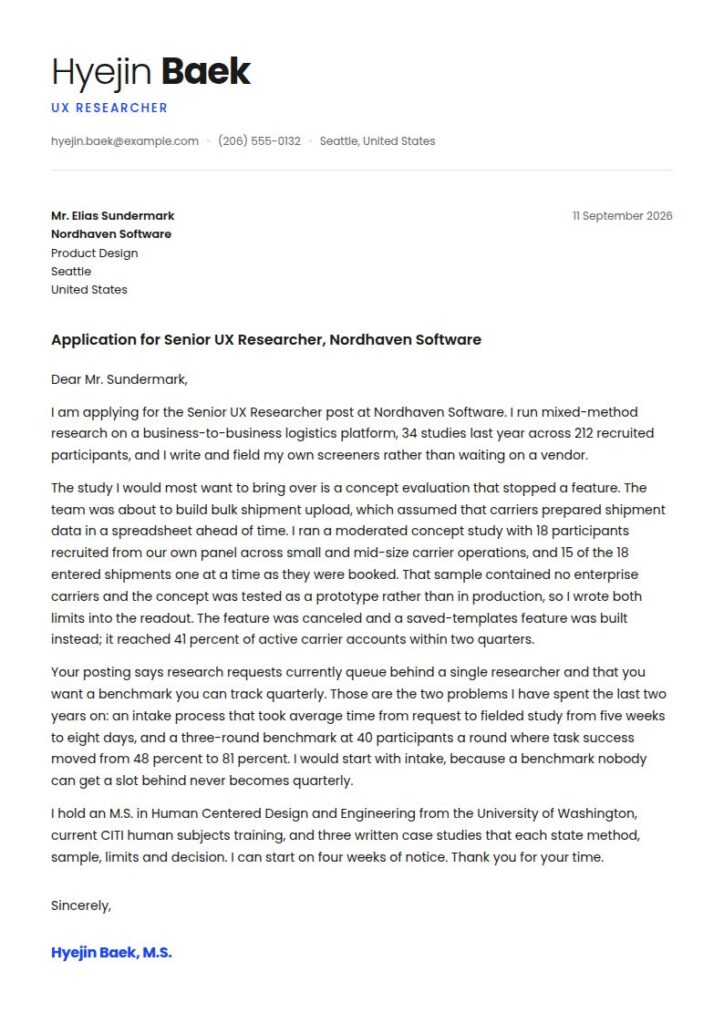
Dear Mr. Sundermark,
I am applying for the Senior UX Researcher post at Nordhaven Software. I run mixed-method research on a business-to-business logistics platform, 34 studies last year across 212 recruited participants, and I write and field my own screeners rather than waiting on a vendor.
The study I would most want to bring over is a concept evaluation that stopped a feature. The team was about to build bulk shipment upload, which assumed that carriers prepared shipment data in a spreadsheet ahead of time. I ran a moderated concept study with 18 participants recruited from our own panel across small and mid-size carrier operations, and 15 of the 18 entered shipments one at a time as they were booked. That sample contained no enterprise carriers and the concept was tested as a prototype rather than in production, so I wrote both limits into the readout. The feature was canceled and a saved-templates feature was built instead; it reached 41 percent of active carrier accounts within two quarters.
Your posting says research requests currently queue behind a single researcher and that you want a benchmark you can track quarterly. Those are the two problems I have spent the last two years on: an intake process that took average time from request to fielded study from five weeks to eight days, and a three-round benchmark at 40 participants a round where task success moved from 48 percent to 81 percent. I would start with intake, because a benchmark nobody can get a slot behind never becomes quarterly.
I hold an M.S. in Human Centered Design and Engineering from the University of Washington, current CITI human subjects training, and three written case studies that each state method, sample, limits and decision. I can start on four weeks of notice. Thank you for your time.
Sincerely, Hyejin Baek, M.S.
Openings that work
| Instead of | Use |
|---|---|
| I am passionate about understanding users and advocating for their needs | I ran 34 studies last year, 9 moderated, 18 unmoderated and 7 mixed method, 212 recruited participants |
| I am writing to express my interest in the UX Researcher position | I am applying for the Senior UX Researcher post, and the study I would bring over is the one that stopped a feature |
| I have a proven track record of delivering user insights | A three-round benchmark at 40 participants a round moved task success from 48 percent to 81 percent |
| I am skilled in both qualitative and quantitative methods | I write and field my own screeners, and I built the panel that supplies 60 percent of our recruits |
Tell one study, and state its limits
The first draft always wants to be a tour: the discovery program, the benchmark, the diary study, the survey. The reader already has your resume.
One study told properly does what no summary can. The method shows you can design, the recruitment shows you can field, the limits line shows you know what your evidence supports, and the decision shows a product team moved. State the limits before anyone asks: "no enterprise carriers in the sample, and the concept was a prototype rather than production" does more for you than a paragraph of confidence.
Sample size is the claim, not a detail
The five-user guidance everyone repeats is specifically about qualitative work: Jakob Nielsen recommends testing five users in a qualitative usability study for the best return on effort (Nielsen Norman Group, June 2012). His separate quantitative recommendation is that roughly 20 users gives a reasonably tight confidence interval (Nielsen Norman Group, June 2006), and later NN/g guidance is stricter again: Budiu and Moran conclude that 40 participants suits most quantitative studies, and that a 15 percent margin of error at 90 percent confidence still needs 28 (Nielsen Norman Group, July 2021).
For questionnaire scores, Jeff Sauro's analysis of more than 5,000 users across 500 evaluations put the average System Usability Scale score at 68 (MeasuringU, February 2011), which is why quoting a SUS number without that anchor tells a reader almost nothing.
A letter that says "five participants, formative, directional" does something a letter that says "user testing confirmed our approach" cannot.
How to write about research that stopped something
Research that prevents work is often the most valuable thing a researcher does and almost never appears in a cover letter. It should.
| The outcome | How to write it |
|---|---|
| A feature was cut | "The feature was canceled after a concept study with 18 participants found the workflow it assumed was not present in the sample." |
| The roadmap was reordered | "Fifteen interviews showed abandonment beginning at rate confirmation rather than at search, and the quarter was re-planned." |
| The result was inconclusive | "The round was underpowered for the comparison asked of it, so I reported it as directional and specified the retest." |
| A recommendation was overruled | "I recommended the simpler flow; the team shipped the other and we benchmarked both next quarter." |
Each of those shows judgment about evidence. A researcher who has never reported a null or had a recommendation declined has either had a very short career or is editing.
What to send when your experience is academic, agency or freelance
If your background is academic, write the dissertation or lab work as a study program: method, participants, recruitment, analysis, and what you concluded you could not claim. Add anything delivered to a deadline, because speed is the only real doubt about academic candidates. From an agency, name the number of clients and the range of populations you have recruited; breadth of screening experience is rare in-house. Freelance, name engagement lengths and who acted on the work.
Do not describe individual participants, quote them identifiably, or include anything from a study that was not yours to share. Do not claim a method you have only observed. Do not present a five-participant round as a measured result. Do not open with "as a lifelong advocate for users". Do not send a portfolio link that requires a password or a contact form.
Length, format and sending it
One page, four paragraphs, 300 to 400 words. PDF unless the portal says otherwise, named for yourself and the post: hyejin-baek-ux-researcher-cover-letter.pdf.
Address a person; research usually reports into design or product and both leaders are normally visible on the company site. Keep every figure identical to your resume and portfolio, because a researcher whose own documents disagree has made an unfortunate first argument. Our UX researcher resume example uses the numbers in this letter.
Key takeaways
- Open with study volume, split by method, and who recruited the participants.
- Tell one study in full: question, method, sample, limits, decision.
- State the limits yourself, before anyone asks.
- Write research that stopped something; it shows judgment.
- Name one thing from their posting and say where you would start.
- Describe samples by role and screening criteria, never as individuals.
- Close with your training, your portfolio link and your availability.
Write your UX researcher cover letter in 10 minutes.
UX researcher cover letter questions, answered
How long should a UX researcher cover letter be?
One page, four paragraphs, 300 to 400 words. The study paragraph earns most of it. If the letter runs longer, you are telling two studies.
Do I need a cover letter if I am sending a portfolio?
Yes, and they do different jobs. The portfolio shows craft and takes twenty minutes. The letter takes ninety seconds and shows how you reason about evidence. In practice it decides whether the portfolio gets the twenty minutes.
What do I write with no industry research experience?
Write the research you have done as research. A thesis, a lab assistantship, volunteer or freelance work: all of it has a method, a sample and a set of limits. Then add one thing delivered on a short deadline, because the doubt about a candidate with no industry work is never rigor, it is pace.
Should I mention AI tools in the letter?
Only if you can say what you used them for and what you checked. The State of User Research 2025 survey of 485 researchers, fielded in July and August 2025, found 80 percent now use AI tools, up 24 points on 2024 (User Interviews, September 2025), so the fact alone no longer differentiates. "I use it for first-pass transcript coding and re-check every theme against the source clips" does.
How do I write this letter for a team with no research function yet?
Lead with fielding, not findings. A team hiring its first researcher is buying the ability to get from a question to a recruited sample without help, so put screener writing, panel, consent and turnaround time in the first paragraph. Then give one study as proof, and offer the first thing you would set up, which is almost always intake.