Aurelie Mbeki-Rasmussen Content Acquisitions Director Burbank, 91502, United States [email protected] · (818) 555-0168
13 September 2026
Ms. Adaeze Okonjo-Hartley Content Acquisitions Lantern Public Media Arlington, United States
Application for Director of Content Acquisitions, Lantern Public Media
Dear Ms. Okonjo-Hartley,
I am applying for the Director of Content Acquisitions post at Lantern Public Media. I currently own an $18.6 million annual licensing budget across AVOD, FAST and SVOD windows, closed 142 deals covering 1,240 titles last year, and hold delegated authority to sign to $750,000. Your posting describes a library that needs rebalancing rather than expanding, which is the work I have spent three years on.
At Palisade Channels the change that mattered was not what we bought but what we stopped renewing. I set a title-level floor at $0.05 cost per hour viewed, reviewed every expiry against it, and declined 118 renewals, which released $2.3 million into first-window acquisitions. Over the same three cycles portfolio cost per hour viewed fell from $0.038 to $0.019 while the library grew from 3,100 to 4,900 titles. I also moved our house paper from 36-month exclusive terms to 24-month non-exclusive with a renewal option at a pre-agreed rate, which cut average upfront commitment per title by 31 percent and made the floor enforceable in the first place.
Your catalog appears to sit heavily in long-term exclusive documentary licenses, several of which I would expect to be expensive against their viewing. The first thing I would do is build the expiry calendar and the cost per hour viewed by title, because until those two exist there is no basis for deciding what to keep. I would also look at territory: you are licensing US-only where a modest localisation budget would open LatAm on the same masters.
I negotiate in French and Portuguese as well as English, which has been useful on LatAm and EMEA deals with dubbed and subtitled deliverables. I am available at six weeks' notice and would be glad to talk through the renewal floor and how we defended it with programming. Thank you for your time.
Sincerely, Aurelie Mbeki-Rasmussen
Summary
A content acquisitions director cover letter states the licensing budget you own, the deals you closed and their shape, the signing authority you hold, and one portfolio number that ties cost to performance. This guide gives you a full adaptable letter, a safe way to write terms under a non-disclosure agreement, and the openings that get a file read rather than filed.
Content Acquisitions Director cover letter examples by experience level
A content acquisitions director cover letter tells the person holding the content budget what you have bought, on what terms, for how much, and what it returned.
The reader is usually a chief content officer, a general manager or a head of programming. They are not looking for taste, because everybody applying has taste. They are looking for someone who can negotiate a rights grid and then be answerable for the cost of it a year later.
Guide to a content acquisitions director cover letter
This guide and the corresponding content acquisitions director cover letter example will cover:
- How to structure the letter, paragraph by paragraph
- Why deal volume and signing authority belong in the first paragraph
- How to write deal terms that sit under a non-disclosure agreement
- What a portfolio number looks like when you tie cost to performance
How to write a content acquisitions director cover letter
| Paragraph | Its job | Length |
|---|---|---|
| Opening | The post, the budget you own, the deal count and your signing limit | 2 to 3 sentences |
| Evidence | One deal structure and one portfolio number, with the measure named | 4 to 6 sentences |
| Fit | Something specific about their library or windowing, and what you would look at | 3 sentences |
| Close | Territories, languages, availability | 2 sentences |
Open with the budget, the deal count and the signing limit
Job titles in acquisitions mean almost nothing across companies. A director at a regional ad-supported operator and a director at a global service are doing jobs of very different sizes, and both letters say "director".
Three numbers fix that in one sentence: the annual licensing budget you own, the number of deals you closed last year, and the value you can sign to without a second signature. "An $18.6 million annual licensing budget, 142 deals covering 1,240 titles last year, delegated signing authority to $750,000" places you precisely.
If you are not yet signing, say what you do hold. Negotiating deal memos to signature and handing off long form with the rights grid agreed is a real and recognized scope, and stating it accurately reads far better than leaving a reader to guess upward and then be disappointed.
A content acquisitions director cover letter example you can adapt
Dear Ms. Okonjo-Hartley,
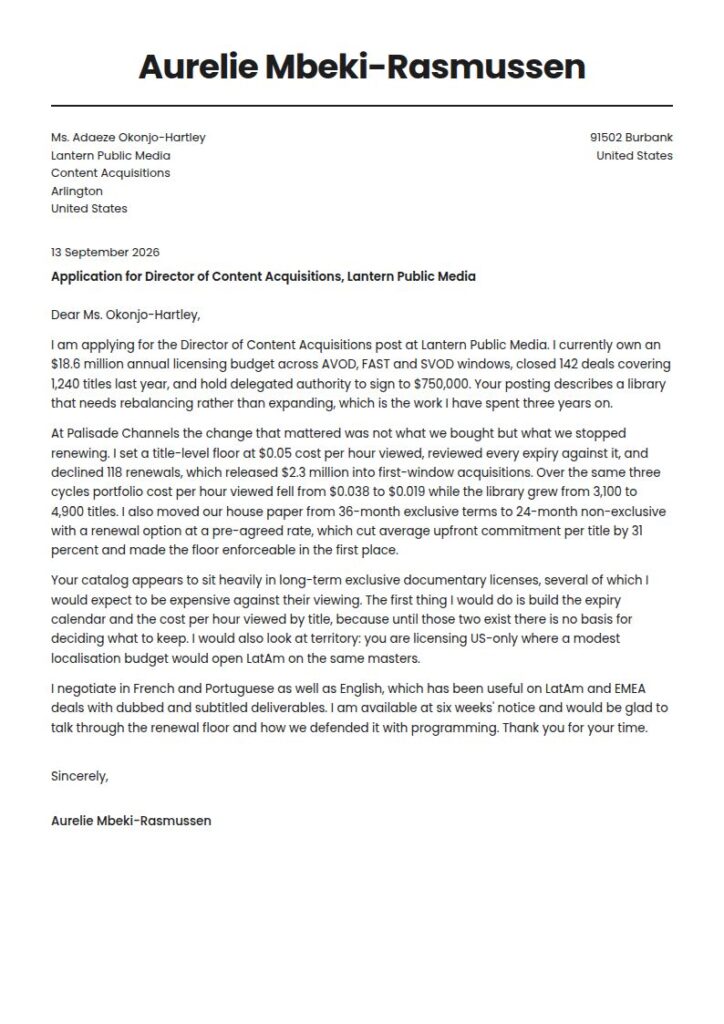
I am applying for the Director of Content Acquisitions post at Lantern Public Media. I currently own an $18.6 million annual licensing budget across AVOD, FAST and SVOD windows, closed 142 deals covering 1,240 titles last year, and hold delegated authority to sign to $750,000. Your posting describes a library that needs rebalancing rather than expanding, which is the work I have spent three years on.
At Palisade Channels the change that mattered was not what we bought but what we stopped renewing. I set a title-level floor at $0.05 cost per hour viewed, reviewed every expiry against it, and declined 118 renewals, which released $2.3 million into first-window acquisitions. Over the same three cycles portfolio cost per hour viewed fell from $0.038 to $0.019 while the library grew from 3,100 to 4,900 titles. I also moved our house paper from 36-month exclusive terms to 24-month non-exclusive with a renewal option at a pre-agreed rate, which cut average upfront commitment per title by 31 percent and made the floor enforceable in the first place.
Your catalog appears to sit heavily in long-term exclusive documentary licenses, several of which I would expect to be expensive against their viewing. The first thing I would do is build the expiry calendar and the cost per hour viewed by title, because until those two exist there is no basis for deciding what to keep. I would also look at territory: you are licensing US-only where a modest localisation budget would open LatAm on the same masters.
I negotiate in French and Portuguese as well as English, which has been useful on LatAm and EMEA deals with dubbed and subtitled deliverables. I am available at six weeks' notice and would be glad to talk through the renewal floor and how we defended it with programming. Thank you for your time.
Sincerely, Aurelie Mbeki-Rasmussen
Openings that work
| Instead of | Use |
|---|---|
| I am passionate about great storytelling and bringing it to audiences | I own an $18.6M annual licensing budget and closed 142 deals covering 1,240 titles last year |
| I am writing to express my interest in your acquisitions role | I am applying for the Director of Content Acquisitions post; I sign to $750,000 without a second signature |
| I have built a diverse and compelling content library | Portfolio cost per hour viewed fell from $0.038 to $0.019 across three cycles |
| I work closely with legal and finance teams | I hand long form to legal with the rights grid, holdbacks and delivery schedule already agreed |
Writing deal terms you are not allowed to disclose
Most of what you have negotiated is confidential, and this is the paragraph where candidates either overshare or say nothing useful. There is a third option, which is to describe structure without counterparties or exact figures.
| Confidential | Safe and still specific |
|---|---|
| The fee paid to a named studio | "A flat license fee in the low six figures per title" |
| A named output partner | "A three-year output deal with an annual minimum and a most favored nation clause" |
| Exact renewal rates | "A 12-month renewal option at a pre-agreed rate rather than at market" |
| A named competitor holdback | "A 24-month first-window holdback against two named services" |
| Title-level viewing data | "A portfolio cost per hour viewed of $0.019, down from $0.038" |
Handling this carefully on the page is itself evidence. A reader who watches you describe deal shape without naming a counterparty is watching someone who can be trusted with theirs.
What the market looks like
There is no BLS profile for this title, so bracket it
The Bureau of Labor Statistics publishes no Occupational Outlook Handbook profile for content acquisitions director. The Handbook covers broad occupations rather than job titles, so the honest approach is to bracket between the published occupations this role draws from.
Producers and directors had a median annual wage of $90,360 in May 2025, with motion picture and video industries at $105,300 and media streaming distribution services at $98,520, and the occupation is projected to grow 4 percent between 2025 and 2035 with about 12,100 openings a year. Editors had a median of $77,920 in May 2025 and are projected to decline 1 percent over the same period. Advertising, promotions and marketing managers, the band most director-level content roles are set against internally, had a combined median of $165,780 in May 2025 and are projected to grow 6 percent with about 36,300 openings a year (BLS Occupational Outlook Handbook, May 2025 wage data and 2025 to 2035 projections).
For your letter this matters in one practical way: name the setting, not just the title. The same acquisitions work is priced very differently in streaming, in film and in broadcast, and the published figures make that argument for you.
Do and do not
Lead with budget, deal count and signing limit. Give one deal structure in full: rights, window, territory, term, exclusivity, renewal. Pair a cost with a performance measure and name the measure. Say which territories you have licensed and in which languages you negotiate. Name one observable thing about their library or windowing, taken from the outside.
Do not write about the slate as though taste were the deliverable. Do not claim a deal you supported rather than negotiated; the follow-up question is what you signed to. Do not quote viewing figures with no cost attached. Do not disclose a counterparty or a fee that sits under a non-disclosure agreement. Do not describe a rights holder relationship you do not personally have.
Length, format and sending it
One page, four paragraphs, 320 to 400 words. PDF, named plainly: aurelie-mbeki-rasmussen-content-acquisitions-cover-letter.pdf.
Address a person. Content leadership is public at almost every service and distributor, and this is a small industry where a generic salutation is noticed.
Keep every figure identical to your resume. Our content acquisitions director resume example uses the same budget, deal counts and portfolio numbers as this letter.
Key takeaways
- Open with budget owned, deals closed and the value you can sign to.
- Write one deal in full: rights, window, territory, term, exclusivity, renewal.
- Pair cost with performance and name the measure you used.
- Describe confidential terms by structure, never by counterparty or exact fee.
- Say which territories and languages you can negotiate in.
- Name the setting, since streaming and film pay well above broadcast.
- One page, addressed to a named person.
Write your content acquisitions cover letter in 10 minutes.
Content acquisitions director cover letter questions, answered
How long should a content acquisitions cover letter be?
One page, four paragraphs, 320 to 400 words. The resume carries the deal sheet, so the letter needs only one deal described properly and one portfolio number. Anything longer usually means the slate has crept back in.
What if my employer will not let me share any numbers?
Use ratios, ranges and structure. "A licensing budget in the mid eight figures", "a flat fee in the low six figures per title", "renewal rate above two thirds" all place you accurately without breaching anything. State once that specifics are under a non-disclosure agreement, then keep writing; a reader will accept it and think better of you for saying so.
How do I move into acquisitions from programming or distribution?
Write the part of your current job that is closest to a deal. Distribution people have avails, delivery and rights administration. Programming people have windowing, scheduling and performance data by title. Both are half the job, and a letter that names which half you already do, and which half you are asking to learn, is far more persuasive than one that implies you do both.
Should I mention titles that did not perform?
One, with the decision you took. Declining renewals against a stated floor is the single most convincing thing an acquisitions candidate can put in a letter, because it shows you measure titles after you buy them. Everybody has bought something that underdelivered; not everybody has a floor.
Does the letter need a link to anything?
Not usually. Unlike design or writing roles, there is no portfolio to link. What replaces it is precision: the deal count, the rights grid, the term you standardized and the portfolio number. If you have written publicly about windowing or licensing, one line at the end is fine, but it is not expected.