Rosalyn Okafor-Lindley Marketing Director Minneapolis, 55405, United States [email protected] · (612) 555-0119
13 September 2026
Ms. Alma Reinholt Office of the Chief Executive Cedarbridge Health Technologies Minneapolis, United States
Application for Marketing Director, Cedarbridge Health Technologies
Dear Ms. Reinholt,
I am applying for the Marketing Director post at Cedarbridge Health Technologies. At Northmark Systems I sign for a $9.6m fully loaded budget covering program spend, agency fees and 24 salaries across four functions, and I am jointly accountable with our sales director for a $110m revenue plan; marketing carried $38m of sourced pipeline this year and delivered $41.3m.
The decision I would want you to judge me on is one I made in my second year. Our owned events program was costing $1.4m a year and returning under 1.5x on a twelve-month view, and it was the most visible thing the department did. I closed it, moved the budget into partner marketing, and that program returned 4.1x in its first full year. The same review let me retire two of five demand channels rather than trim all five, which took blended cost per opportunity from $1,940 to $1,410 over six quarters. I should say that I missed my plan in 2024 by 9% when a product launch slipped two quarters, and I reforecast in the second quarter rather than at year end.
Your last two annual reports describe a shift from direct sales into a partner-led model, and your careers page suggests the marketing function has not been rebuilt around it yet. That is the work I would want. The first thing I would look at is how qualified opportunities are defined and who owns the handover, because in my experience a channel shift fails at that seam long before it fails in the market.
I report to a chief executive today and am used to quarterly board reporting on coverage and payback. I have a three-month notice period. Thank you for your time.
Sincerely, Rosalyn Okafor-Lindley, MBA
Summary
A marketing director cover letter states the budget you signed for, the people you carried and the commercial number you were measured against, then spends its middle on one allocation decision. This guide gives you a full adaptable letter, how to write about a year you missed, and what changes when the reader is a chief executive rather than a marketer.
Marketing Director cover letter examples by experience level
A marketing director cover letter is a one-page letter written for a reader who is not a marketer. The decision usually sits with a chief executive, a chief revenue officer or a board committee, and their question is not whether you understand channels. It is whether you can be trusted with money and people.
That changes the letter. Three of your four paragraphs should be things a chief financial officer could interrogate: a budget figure, a headcount, a commercial number and its outcome, and one allocation decision with a payback attached. The marketing craft that fills a manager's letter belongs in the interview.
Guide to a marketing director cover letter
This guide and the corresponding marketing director cover letter example will cover:
- How to structure the letter for a chief executive rather than a marketing reader
- Why budget and headcount belong in the first two sentences
- Spending the middle paragraph on one allocation decision, not a career summary
- How to write about a year you missed the number
How to write a marketing director cover letter
| Paragraph | Its job | Length |
|---|---|---|
| Opening | The post, the budget you sign for, the headcount, the number you carry | 2 to 3 sentences |
| Decision | One allocation choice: what you stopped, what it cost, where it went, the return | 4 to 5 sentences |
| Their situation | Something specific about their business, and what you would look at first | 3 to 4 sentences |
| Close | Reporting line you are used to, notice period, thank you | 2 sentences |
Open with money and people, in that order
Marketing director is one of the least standardized titles in business, held by sole marketers at 30-person companies and by executives running four functions and an eight-figure budget. A reader cannot place you without numbers.
"I currently sign for a $9.6m fully loaded budget and lead 24 people across four functions, with joint accountability alongside our sales director for a $110m revenue plan."
One sentence, three facts, and the reader knows whether to keep going. Say "fully loaded" or "program only", because the same figure means two different jobs depending on whether salaries sit inside it, and say whether you are the signatory. Directors who leave this vague are read as smaller than they are.
A marketing director cover letter example you can adapt
Dear Ms. Reinholt,
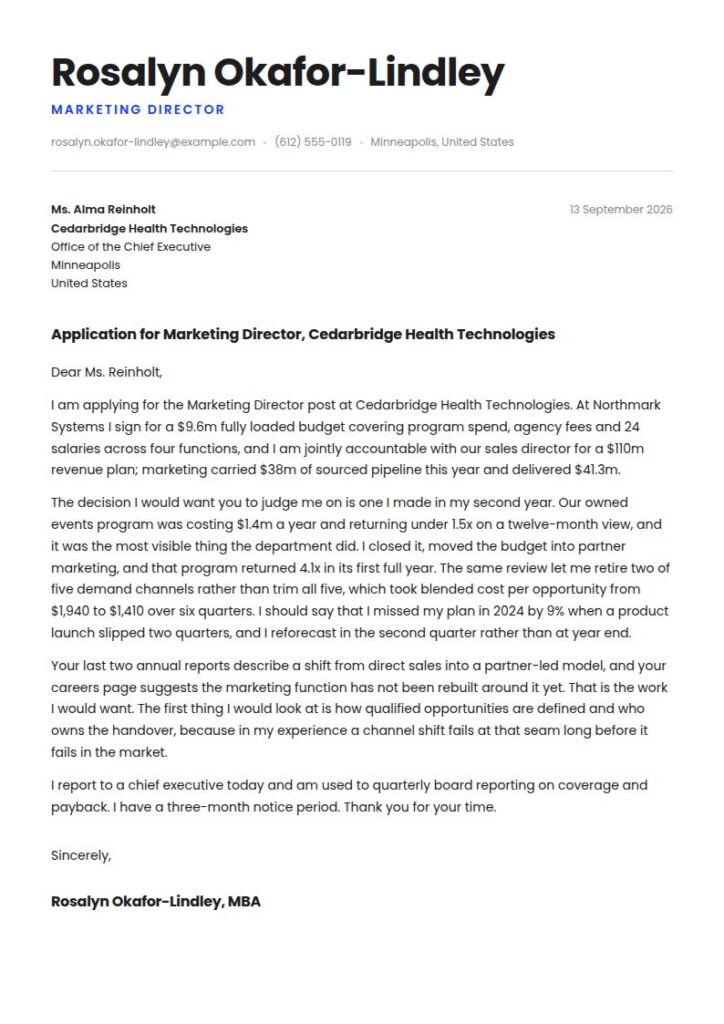
I am applying for the Marketing Director post at Cedarbridge Health Technologies. At Northmark Systems I sign for a $9.6m fully loaded budget covering program spend, agency fees and 24 salaries across four functions, and I am jointly accountable with our sales director for a $110m revenue plan; marketing carried $38m of sourced pipeline this year and delivered $41.3m.
The decision I would want you to judge me on is one I made in my second year. Our owned events program was costing $1.4m a year and returning under 1.5x on a twelve-month view, and it was the most visible thing the department did. I closed it, moved the budget into partner marketing, and that program returned 4.1x in its first full year. The same review let me retire two of five demand channels rather than trim all five, which took blended cost per opportunity from $1,940 to $1,410 over six quarters. I should say that I missed my plan in 2024 by 9% when a product launch slipped two quarters, and I reforecast in the second quarter rather than at year end.
Your last two annual reports describe a shift from direct sales into a partner-led model, and your careers page suggests the marketing function has not been rebuilt around it yet. That is the work I would want. The first thing I would look at is how qualified opportunities are defined and who owns the handover, because in my experience a channel shift fails at that seam long before it fails in the market.
I report to a chief executive today and am used to quarterly board reporting on coverage and payback. I have a three-month notice period. Thank you for your time.
Sincerely, Rosalyn Okafor-Lindley, MBA
Openings that work
| Instead of | Use |
|---|---|
| I am writing to express my interest in the Marketing Director position | I am applying for the Marketing Director post at Cedarbridge Health Technologies |
| I am a results-driven marketing leader with a passion for building teams | I sign for a $9.6m fully loaded budget and lead 24 people across four functions |
| I was excited by your company's growth trajectory | Your last two annual reports describe a shift into a partner-led model |
Spend the middle on one decision
The most common failure in a director's letter is a career summary in paragraph two: three companies, four growth figures, no choices. It reads as a resume in prose and tells the reader nothing the attachment does not.
Replace it with one allocation decision, told properly. What it was costing. What it was returning, over what window. What you decided and what you gave up. Where the money went, and what it returned there. That structure shows how you think when the answer is not obvious, which is the actual thing being hired, and it gives the interview a place to start.
| Kind of decision | What it looks like in a sentence |
|---|---|
| A program stopped | Closed a $1.4m events program returning under 1.5x and moved the budget into partners, which returned 4.1x |
| Spend not taken | Returned $600,000 of an approved budget rather than spend it into a channel that had not proved payback |
| A definition changed | Rebuilt the pipeline model around qualified opportunities; reported volume fell 62% and close rate rose from 14% to 23% |
| A supplier ended | Replaced two of three agencies after a payback review, holding the retainer flat |
Writing about a year you missed
Name one miss, in one sentence, with the year, the size and the cause. Say what you did about it and when, because the timing of a reforecast says more about you than the miss does. Keep it in the middle of the letter, where it reads as candour rather than apology.
Do not present an unbroken record of exceeded targets; an experienced reader treats that as soft targets rather than strong performance. Do not blame a predecessor, a department or a board. Do not explain a miss at length; one sentence is candour, a paragraph is a defense. Do not claim a budget you influenced rather than signed for, because it is checked.
Flat budgets, and a sixth of them moving to AI
Gartner's 2026 CMO Spend Survey put marketing budgets at 7.8% of company revenue against 7.7% a year earlier, from 401 chief marketing officers and marketing leaders surveyed across North America, the United Kingdom and Europe between January and March 2026. Within that flat envelope, respondents allocated 15.3% of budget to artificial intelligence while only 30% rated their organization's AI readiness as mature, and 56% said their budget was insufficient to deliver the 2026 strategy (Gartner, May 2026).
The occupation is steady rather than expanding: advertising, promotions and marketing managers numbered 454,800 in 2025, of whom 421,600 were marketing managers, with 6% growth projected to 2035 and about 36,300 openings a year, the great majority replacements (U.S. Bureau of Labor Statistics, Occupational Outlook Handbook, 2025 to 2035 projections).
Both facts point the same way. You are almost certainly replacing someone, into a function with no new money, where a sixth of the budget is being pulled towards a capability the organization is not ready for. A letter about what you would stop is a letter about the problem they actually have.
Length, format and sending it
One page, four paragraphs, 300 to 400 words, as a PDF named for yourself and the post. If an executive search consultant is running the process, send it to them as well as through the portal, because they brief the panel.
Address the decision maker, not the function; at this level that is usually the chief executive or the chief revenue officer. Keep every figure identical to your resume; our marketing director resume example uses the numbers in this letter.
Key takeaways
- Open with budget, headcount and the commercial number, in that order.
- Say whether the budget is fully loaded and whether you sign for it.
- Spend the middle paragraph on one allocation decision, told end to end.
- Include one miss, in one sentence, with the year and the cause.
- Name something specific about their business from a document they published, and say what you would look at first.
- State your current reporting line and your notice period.
Write your marketing director cover letter in 10 minutes.
Marketing director cover letter questions, answered
How long should a marketing director cover letter be?
One page, four paragraphs, 300 to 400 words. Slightly longer than a manager's letter because the decision paragraph needs room, and no longer because chief executives read these between meetings.
Do I need a cover letter for a director role that came through a recruiter?
Yes, and send it to the recruiter directly. The consultant writes the shortlist brief the panel reads, and your letter is the raw material for it. A letter with a budget figure and a decision in it gets summarized accurately; a letter of general claims gets summarized as one of several similar candidates.
Should I put my current compensation in the letter?
No. State budget, headcount and reporting line, which is what places you. Compensation belongs with the recruiter or at offer stage; a figure in the letter anchors the negotiation before you know the shape of the role.
How do I write this letter moving up from marketing manager?
Do not pretend to director scope. State what you actually hold, then make the case on the thing directors do that managers do not: a decision you influenced about where money went, an area you took on beyond your remit, and the part of the job you have not yet done. Naming the gap yourself is what makes the rest credible.
What if the company is much larger than anywhere I have worked?
Address it in the third paragraph rather than hoping it goes unnoticed. Say what scales cleanly, such as allocation discipline and the sales handover, and what would be new, such as operating through regional teams. Then say how you would approach the first ninety days. A candidate who has thought about the step up is a different proposition from one who has not noticed it.