Junior Art Director, social and digital Imogen Farrar-Osei
Junior Art Director
[email protected] | (718) 555-0180 | Brooklyn, United States
Profile
Junior art director with three years as a designer before the title, now art directing social and digital campaigns on two retained accounts at an independent New York agency. Concept and art direct alongside a copywriter, run layout and typography myself, and attend photography days to direct the shot list against the approved boards. Portfolio of six projects, each annotated with what I concepted, what I directed and what I executed. Comfortable presenting internally and taking a round of client notes without losing the idea.
Work Experience
06/2017 - Present, Junior Art Director, Halyard & Finch, New York, United States
- Art directed social and digital campaigns on two retained accounts at an independent agency, working to a creative director.
- Concepted with a copywriter and executed layout and typography myself.
- Attended photography days and directed the shot list against approved boards; casting and final selects sat with the art director.
- Presented internally and took a round of client notes without losing the route.
08/2014 - 05/2017, Designer, Vestibule Studio, Brooklyn, United States
- Designed identity, editorial and packaging work for a six-person studio, executing to an art director's direction.
- Set type and built layouts for print production, including press-ready artwork and press approvals.
- Executed rather than directed: concept and casting decisions sat with the studio's art director.
Education
09/2010 - 05/2014, Bachelor of Fine Arts, Graphic Design, Pratt Institute, Brooklyn, United States
Typography and editorial design concentration. Portfolio: imogenfarrarosei.example.com, password on request.
Skills
Typography and typesetting, 85
Layout and composition, 85
Concept boards and mood direction, 75
Shot list direction on set, 70
Retouching direction, 70
Adobe InDesign, Illustrator and Photoshop, 90
Figma, 75
Internal presentation, 75
Languages
English, native
Twi, intermediate
French, beginner
Certificates
06/2019, Typeface Design intensive, Type@Cooper, Cooper Union
Six-week evening intensive in typeface drawing and spacing.
Summary
An art director resume is a one to two page document whose main job is to route a reviewer into a curated portfolio and tell them what to look at. This guide gives you three adaptable versions, the distinction between what you directed and what you personally made, and current Bureau of Labor Statistics pay, outlook and the self-employment share that shapes the whole occupation.
Art Director resume examples by experience level
An art director resume is a one to two page document that cannot stand on its own, and should not try to. Its job is to get a reviewer into a curated portfolio, tell them what to look at when they arrive, and make clear which parts of the work were yours.
That dependence is built into the occupation rather than being a stylistic choice. The Bureau of Labor Statistics treats building a portfolio, a body of work showing an artist's range and abilities, as essential for entering this field (BLS Occupational Outlook Handbook, accessed September 2026). Nobody is hired on the resume. But plenty of good art directors are filtered out on one, because the file never routed anyone to the work or explained what they were seeing.
Resume guide for an art director resume
This guide and the corresponding art director resume example will cover:
- How to write an art director resume, section by section
- Where the portfolio link goes so that it survives an applicant tracking system
- Three adaptable summaries: junior, art director and independent
- How to separate what you directed from what you personally executed
- What the job market looks like, including the self-employment share, and what you can expect to earn
How to write an art director resume
Six blocks: contact header with the portfolio link, summary, selected work, experience, skills and tools, and education. One page early, two once you have a decade and a client list.
Selected work sits above experience, which is unusual and correct here. A reviewer is going to open the portfolio within about twenty seconds of picking up your file. The block that tells them which four projects to look at first, and what your role was in each, is doing more work than your job titles.
| Section | What it is answering | Where it goes |
|---|---|---|
| Portfolio link | Where is the work, and does the link survive a parser? | Contact header, as plain text, and repeated once in the body |
| Selected work | Which pieces are relevant to this role, and what was your part? | Above experience, four to six entries |
| Experience | What did you direct, at what scale, with whom? | Reverse chronological |
| Skills and tools | What can you do yourself, and what do you direct others to do? | Two labeled groups, kept separate |
Put the portfolio link where a parser can actually read it
The most common way an art director loses an application is a link that does not survive the system. Three habits cause it.
A link hidden inside a graphic or a text box is invisible to a parser, which extracts text, not artwork. A shortened or QR-only link gives the reviewer nothing to click in a database record. And a link buried on page two is read by nobody, because the scan stops at the header.
Write the full address as plain text in the contact header, exactly as it would be typed: the domain, no shortener, no tracking string. Repeat it once at the top of the selected work section. If the portfolio is password protected, put the password beside it. A reviewer who has to email you for access will move to the next file instead.
Run the finished file through the free Rezoom ATS resume checker before you send it, especially if you designed it yourself. A parser does not read your layout; it reads your text.
Choosing the best resume format for an art director resume
Reverse chronological, single column, and plainer than instinct suggests. One page for your first five years, two once you carry a client list or a team.
This is the section where art directors most often work against themselves. A beautifully set resume is a portfolio piece, and a portfolio piece submitted as an application document parses into fragments. Keep the craft where it belongs, in the work you are linking to, and let the resume be a clean, typographically restrained page that a database can ingest.
Include your contact information
| ✅ Right | ❌ Wrong |
|---|---|
| Imogen Farrar-Osei | Imogen Farrar-Osei |
| Art Director, beauty, home and hospitality | Creative visionary and visual storyteller |
| Portfolio: imogenfarrarosei.example.com, password on request | Portfolio: see attached QR code |
| Brooklyn, NY, (718) 555-0180, [email protected] | Brooklyn, NY, @imogen.creates |
A social handle is not a portfolio. It is a feed, with no case notes, no role credits and no way of telling which posts you art directed and which you simply liked the look of.
Make use of a summary
Four lines: years and the categories you work in, what you direct and who you direct, how you work with clients or creative directors, and how your portfolio is organized.
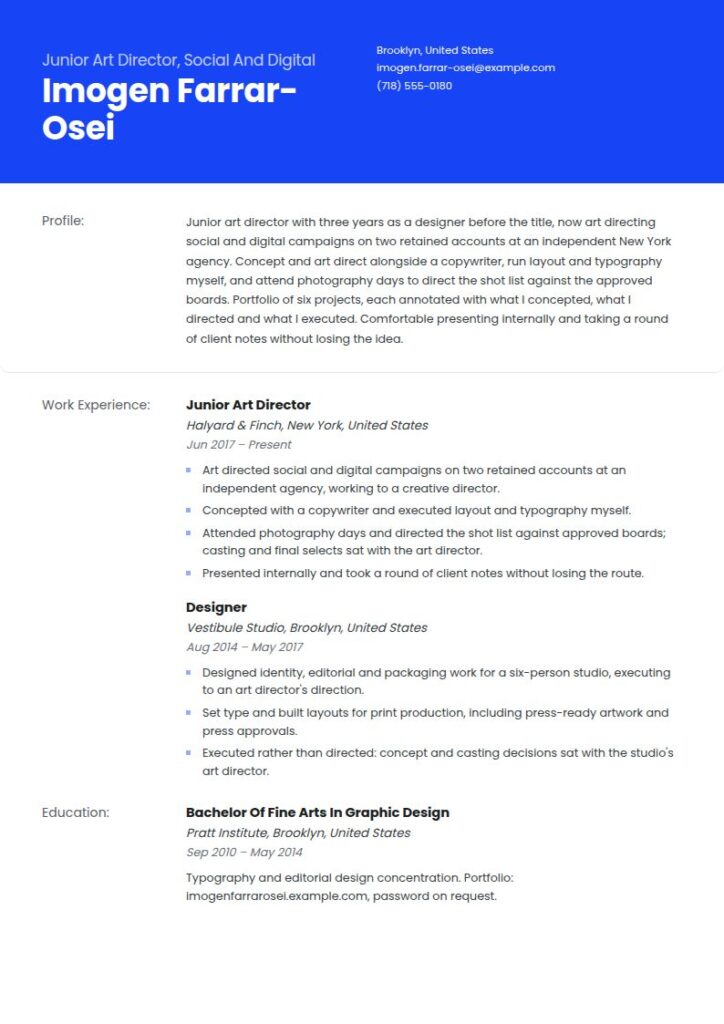
Junior art director with three years as a designer before the title, now art directing social and digital campaigns on two retained accounts at an independent New York agency. Concept and art direct alongside a copywriter, run layout and typography myself, and attend photography days to direct the shot list against the approved boards. Portfolio of six projects, each annotated with what I concepted, what I directed and what I executed. Comfortable presenting internally and taking a round of client notes without losing the idea.
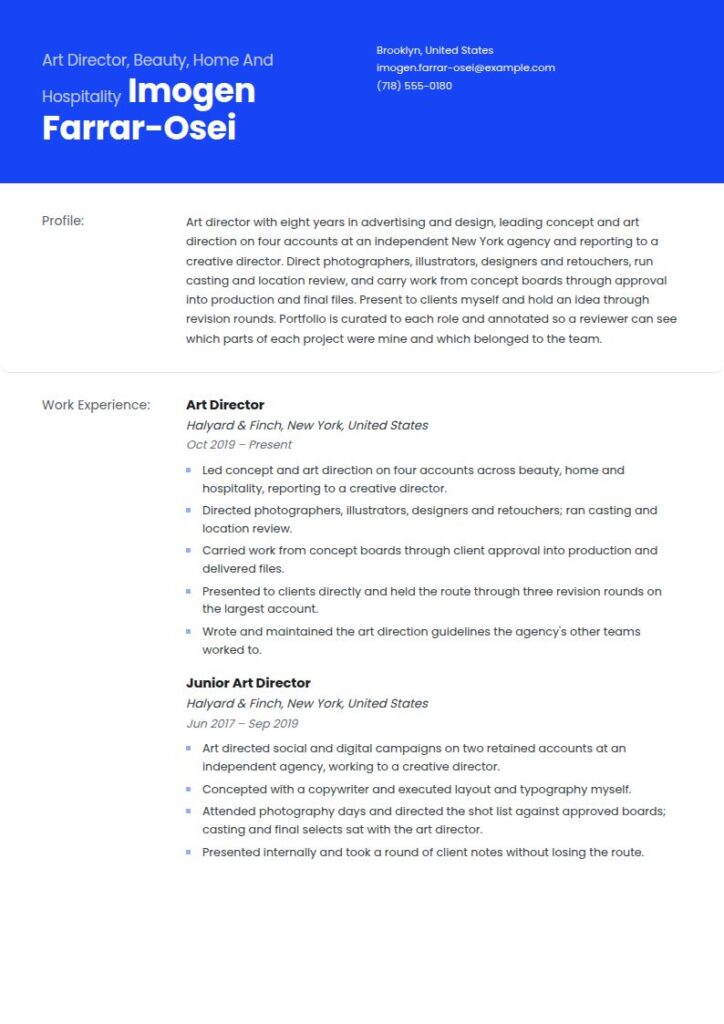
Art director with eight years in advertising and design, leading concept and art direction on four accounts at an independent New York agency and reporting to a creative director. Direct photographers, illustrators, designers and retouchers, run casting and location review, and carry work from concept boards through approval into production and final files. Present to clients myself and hold an idea through revision rounds. Portfolio is curated to each role and annotated so a reviewer can see which parts of each project were mine and which belonged to the team.
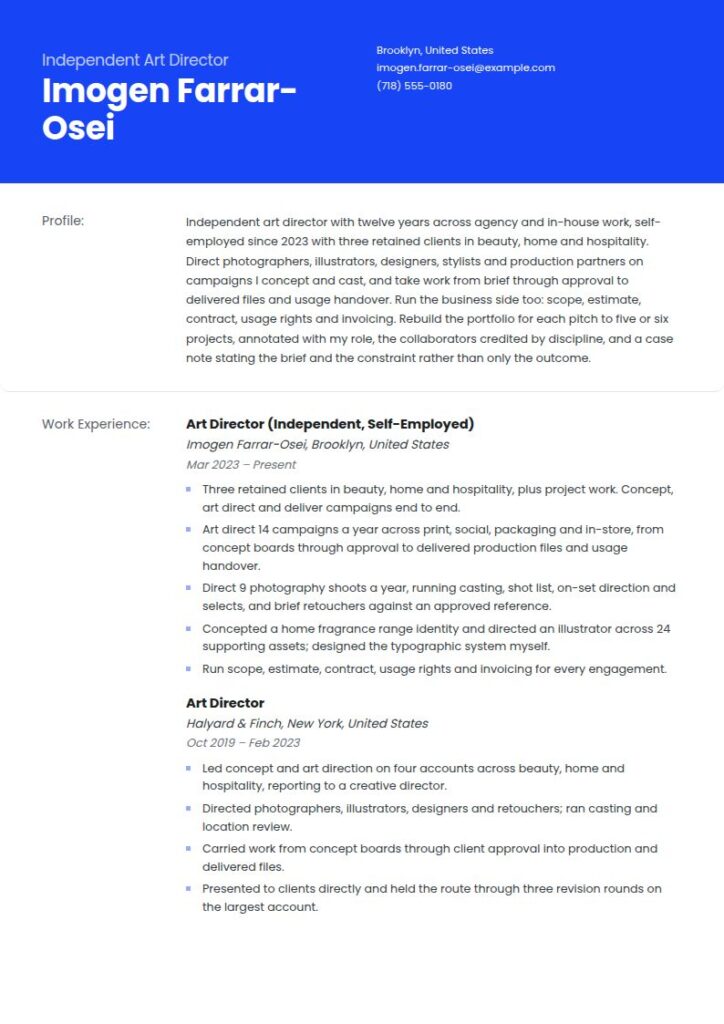
Independent art director with twelve years across agency and in-house work, self-employed since 2023 with three retained clients in beauty, home and hospitality. Direct photographers, illustrators, designers, stylists and production partners on campaigns I concept and cast, and take work from brief through approval to delivered files and usage handover. Run the business side too: scope, estimate, contract, usage rights and invoicing. Rebuild the portfolio for each pitch to five or six projects, annotated with my role, the collaborators credited by discipline, and a case note stating the brief and the constraint rather than only the outcome.
Right vs wrong: the same art director summary, twice
| ✅ Right | ❌ Wrong |
|---|---|
| Direct photographers, illustrators, designers and retouchers; run casting and location review. | Oversee all creative output from concept to completion. |
| Carry work from concept boards through approval into production and final files. | Deliver stunning visuals that exceed client expectations. |
| Portfolio annotated so a reviewer can see which parts were mine and which belonged to the team. | Extensive portfolio of award-winning work available. |
The right column tells a creative director what to staff you on and what you will need help with. The left column is what every applicant writes, which is why nobody reads it.
Outline your experience
Agency, studio or brand, the categories you worked in, who you reported to, who you directed, then dates. Three to five bullets, each naming a discipline you directed or a decision you owned.
| Instead of | Use |
|---|---|
| Managed creative projects from start to finish | Art directed 14 campaigns a year across print, social and in-store, from concept boards to delivered production files |
| Worked closely with photographers | Directed 9 photography shoots, including casting, shot list, on-set direction and selects |
| Created beautiful visual designs | Concepted and designed the identity system; directed an illustrator on 24 supporting assets |
| Collaborated with the marketing team | Presented concepts to the client directly and held the route through three revision rounds |
| Oversaw junior designers | Directed two designers and a retoucher, reviewing and approving all work before it left the studio |
Art Director (independent, self-employed), Brooklyn, NY, March 2023 to Present
Three retained clients in beauty, home and hospitality, plus project work. Concept, art direct and deliver campaigns end to end; direct photographers, illustrators, designers, stylists and production partners.
Art direct 14 campaigns a year across print, social, packaging and in-store, from concept boards through client approval to delivered production files and usage handover.
Direct 9 photography shoots a year, running casting, shot list, on-set direction and selects, and brief retouchers against an approved reference.
Concepted a home fragrance range identity and directed an illustrator across 24 supporting assets; designed the typographic system myself.
Run scope, estimate, contract, usage rights and invoicing for every engagement, which is the half of independent art direction that is not art direction.
Make the portfolio a field, and direct the reader through it
Because entry to this occupation runs through a portfolio rather than a credential, your resume is a routing document. Three decisions do most of the work.
Curate to the role, not to your career. A retrospective is the wrong shape. A reviewer hiring for a beauty account wants to see beauty, or something that proves you can do it, in the first two pieces. Five or six projects, chosen for this application, beats twenty that show everything you have ever made. If you have a body of work in a category the role does not touch, leave it out and say you have more on request.
Annotate every piece with your actual contribution. This is the single most common gap. A reviewer looking at a campaign cannot tell whether you concepted it, art directed it, designed it, or were one of four people in a room. Write it: role, what you did, who else was involved, and what you did not do.
Give each piece a brief and a constraint, not just an outcome. "Launch a fragrance range on a two-week production window with no photography budget" tells a creative director more about how you think than any result line. Constraints are how the craft becomes legible.
Portfolio: imogenfarrarosei.example.com, password on request
Fieldhouse Home, autumn range launch, 2025. Role: art director and designer. Concepted the campaign with a freelance copywriter, cast and directed the photographer, designed the typographic system, directed a retoucher. Brief: launch eleven products across print, social and in-store on a two-week production window. Constraint: a single shoot day.
Marchetti Hotels, brand refresh, 2024. Role: art director. Directed a photographer, an illustrator and two designers. Wrote the art direction guidelines the client's in-house team now works to. Did not design the logotype, which was drawn by a type designer I briefed and reviewed.
Verrine Beauty, launch campaign, 2024. Role: art director, agency team of five. Concepted with the creative director, ran casting, directed the shoot, approved all retouching. Copy by the team copywriter.
Saltgrass Provisions, packaging system, 2023. Role: designer and art director. Designed the structure and surface myself; directed a photographer on the range imagery.
More work, including editorial and motion, on request.
Separate what you directed from what you personally executed
Here is the line most art director resumes never draw, and experienced reviewers notice it missing every time.
Art direction is the work of deciding and approving: developing the concept, choosing the visual approach, casting, directing photographers, illustrators, designers, stylists and production partners, and reviewing and approving what comes back. Execution is the work of making: the layout, the type, the retouching, the artwork, the build.
Most art directors do both, in a ratio that changes with seniority. A junior art director designs most of what they direct. A senior one may not touch a file for weeks. A reviewer needs to know which you are, because the two are staffed differently and paid differently.
| Say this | Rather than this |
|---|---|
| Directed a photographer and a retoucher on a 9-shoot program | Produced photography for national campaigns |
| Concepted with a copywriter and designed the typographic system myself | Developed creative concepts and visual identity |
| Briefed and reviewed an illustrator across 24 assets | Created illustration for the campaign |
| Cast talent and directed on set; selects and approvals mine | Managed photoshoots |
| Designed the packaging structure and surface myself | Oversaw packaging design |
Two notes on getting this right.
Crediting collaborators makes you look bigger, not smaller. Saying a type designer drew the logotype you briefed does not diminish the project; it tells a reviewer you have worked at a level where specialists are hired, briefed and reviewed. The opposite move, implying you made everything, reads as either inexperience or as a claim that will unravel when someone recognizes the work.
Be precise about team projects. In agency work an idea is usually shared. "Concepted with the creative director and a copywriter; art direction and casting mine" is an honest sentence that keeps the credit you earned and gives away nothing you did not.
Put the full portfolio address as plain text in the header, with the password beside it if there is one. Curate to five or six pieces chosen for this role. Annotate each with your role, your contribution and your collaborators. Give each piece a brief and a constraint. Say which disciplines you direct and which you execute yourself.
Do not submit a heavily designed resume into an application system. Do not use a shortened link or a QR code as the only route to the work. Do not put a social handle where the portfolio should be. Do not imply you made every element of a collaborative project. Do not send a career retrospective when the role is specific.
Build a snapshot of your key skills
Two labeled groups, and the labels matter more than the entries: what you direct, and what you make yourself. Ten to fourteen entries in total.
Direct: Photography and on-set direction, Casting, Illustration briefing and review, Retouching direction, Set and prop styling, Motion and edit review, Print production and press approval, Design team review and approval
Execute: Typography and typesetting, Layout and composition, Identity systems, Packaging structure and surface, Concept boards and mood direction, Presentation design
Tools: Adobe Creative Cloud (InDesign, Illustrator, Photoshop, After Effects), Figma, Capture One, Keynote, Frame.io
List your education and certifications
Short. In this occupation the degree is a floor and the portfolio is the argument, so keep this block to a few lines and put continuing education only where it is genuinely relevant.
Bachelor of Fine Arts, Graphic Design, Pratt Institute, Brooklyn, NY, 2014
Typeface Design intensive, Type@Cooper, Cooper Union, New York, NY, 2019
Color management and press approval workshop, run by the agency's production partner, 2021
Member, The One Club for Creativity, since 2020
The BLS notes that art directors typically enter the occupation with a bachelor's degree and several years of experience in another creative occupation such as design, illustration or photography before taking the title (BLS Occupational Outlook Handbook, accessed September 2026). If that is your route, show it plainly in the experience section rather than apologizing for it; it is the standard path, not a detour.
Choose the right layout and design
Single column, one typeface, 10 to 12 point, generous margins, no photograph, no graphic devices, PDF. The restraint is a professional signal in its own right: it says you know what an application document is for and can separate it from the work.
Keep the portfolio address as live, selectable text in every version you send, and check it after exporting. A link that looks fine on screen and is flattened into an image in the PDF is the quietest way to lose a job.
Art director job market and outlook
A small, slow-growing occupation with an unusual shape: most of the people in it work for themselves.
| Measure | Value |
|---|---|
| Median annual wage, May 2025 | $114,850 |
| Hourly median, May 2025 | $55.22 |
| Lowest 10 percent | less than $64,900 |
| Highest 10 percent | more than $213,050 |
| Employment, 2025 | 140,200 |
| Projected employment, 2035 | 146,000 |
| Projected change, 2025 to 2035 | 4 percent |
| Projected annual openings | about 12,200 |
| Typical entry-level education | Bachelor's degree |
Source: U.S. Bureau of Labor Statistics, Occupational Outlook Handbook, May 2025 wage data and 2025 to 2035 projections.
Sixty-two percent of art directors are self-employed
The largest single employer of art directors is the art director. Self-employed workers accounted for 62 percent of employment in the occupation in 2025, against 11 percent in advertising, public relations and related services, 4 percent in publishing, broadcasting and content providers, 3 percent in management, scientific and technical consulting services, and 2 percent in motion picture and video industries (BLS Occupational Outlook Handbook, 2025).
The occupation employed 140,200 in 2025, projected to reach 146,000 by 2035, a change of 4 percent, with about 12,200 openings projected each year on average (BLS Occupational Outlook Handbook, 2025 to 2035 projections).
That share changes what a resume is for. For most art directors the document is a credentials page attached to a pitch, and the reader is a prospective client rather than a hiring manager. A client reads for different facts: what categories you have worked in, who you can assemble, whether you can scope and cost a job, and whether usage rights and production are handled. If you are self-employed or expect to be, add scope, estimating and rights to the skills block and keep the portfolio curation habits identical. It is the same document with the business half restored.
What salary you can expect as an art director
The median annual wage for art directors was $114,850 in May 2025, an hourly median of $55.22, with the lowest 10 percent earning less than $64,900 and the highest 10 percent more than $213,050 (BLS Occupational Outlook Handbook, May 2025).
Industry moves the number substantially. In May 2025, motion picture and video industries paid a median of $142,570, publishing, broadcasting and content providers $122,700, advertising, public relations and related services $121,490, and management, scientific and technical consulting services $95,200 (BLS Occupational Outlook Handbook, May 2025). The same craft is valued differently depending on what it is selling.
For the self-employed majority the band is not a salary at all. It is a day rate multiplied by booked days, minus unbilled pitching, with usage rights as a separate negotiation that can be worth as much as the fee. A resume or credentials page that shows category range, the collaborators you can assemble and evidence that you handle scope and rights is arguing for the top half of that spread. One that shows only finished images is arguing on price.
Key takeaways for an art director resume
- The resume's job is to route a reviewer into the portfolio and tell them what to look at.
- Put the full portfolio address as plain text in the header, with the password beside it.
- Curate to five or six pieces chosen for the role, not a career retrospective.
- Annotate every piece with your role, your contribution and your collaborators.
- Separate the disciplines you direct from the work you execute yourself.
- Credit collaborators by discipline; it raises the level the work reads at.
- If you are self-employed, add scope, estimating and usage rights to the page.
Build your art director resume in 15 minutes.
Related marketing resume examples
- Creative director resume
- Graphic designer resume
- UX designer resume
- UX researcher resume
- Advertising director resume
- Magazine editor resume
- Content acquisitions director resume
- Marketing director resume
- Brand manager resume
- Content writer resume
- Marketing consultant resume
- Public relations resume
Pair it with a matching art director cover letter.
Art director resume questions, answered
How long should an art director resume be?
One page for your first five years, two once you have a client list, a team or a decade of categories. The portfolio carries the depth, so length here buys you very little and a third page buys you nothing.
Where exactly should the portfolio link go?
In the contact header, written out as plain selectable text, and repeated once at the top of your selected work block. Not inside a graphic, not as a QR code alone, not shortened. If the site is password protected, put the password next to the link rather than making a reviewer ask for it.
How many projects should I show?
Five or six, chosen for the specific role, with a line offering more on request. The BLS treats the portfolio as essential to entering this occupation (BLS Occupational Outlook Handbook, accessed September 2026), and a curated set reads as editorial judgement, which is a large part of what the job is.
How do I credit work I did as part of a team?
Name your role and the collaborators by discipline: "concepted with the creative director and a copywriter; art direction, casting and approvals mine; logotype drawn by a type designer I briefed". Precise credit reads as seniority. Implied sole authorship reads as risk, and in a small industry it is often recognized.
Is it worth writing a resume at all if the portfolio decides it?
Yes, because the portfolio rarely decides who gets looked at. Applications are screened and searched before anyone opens a link, and the resume is the only part a system can read. It also carries what a portfolio cannot: who you directed, what you executed, and how you work with clients.
Should a freelance art director write a different resume?
Keep one document and restore the business half. Self-employed workers made up 62 percent of the occupation in 2025 (BLS Occupational Outlook Handbook, 2025), so a credentials page aimed at clients is the normal case rather than the exception. Add category range, the collaborators you can assemble, and evidence that you handle scope, estimating, production and usage rights.