Assistant Editor, Delta Trade Review Odalys Lemaitre-Fontaine
Assistant Editor
[email protected] | (504) 555-0121 | New Orleans, United States
Profile
Assistant editor on a monthly B2B title, print and digital, shipping 12 issues a year at 64 pages. Commission 4 pieces an issue from a roster of 9 regular contributors against a $1,200 monthly budget, brief and line edit them, and run the copy schedule for the front section. Fact-check every feature in my section against two independent sources. Two published corrections across 24 issues, neither on a fact-checked feature.
Work Experience
03/2024 - Present, Assistant Editor, Delta Trade Review, Metairie, United States
- Monthly B2B title for the inland marine industry, print and digital, 12 issues a year at 64 pages.
- Commission 4 front-of-book pieces an issue from a roster of 9 regular contributors against a $1,200 monthly budget held by the editor.
- Run the copy schedule for the front section and the proofing round before pages go to the managing editor.
- Fact-check every feature in the section against two independent sources.
- Two published corrections across 24 issues, neither on a fact-checked feature.
08/2022 - 02/2024, Editorial Assistant, Delta Trade Review, Metairie, United States
- Copy edited to house style, wrote headlines and standfirsts, and kept the contributor payment log.
- Built the title's first written style guide, 26 pages, still in use.
Education
08/2018 - 05/2022, Bachelor of Arts, English, Loyola University New Orleans, New Orleans, United States
Minor in journalism. Two years on the student magazine, final year as copy chief.
Skills
Line editing and copy editing, 80
Headline and standfirst writing, 75
Fact-checking to two sources, 80
House style development, 70
Copy scheduling, 70
InCopy and InDesign workflow, 65
Languages
English, native
French, advanced
Spanish, intermediate
Certificates
06/2023, Poynter ACES Introductory Certificate in Editing, Poynter Institute and ACES: The Society for Editing
Six to seven courses and a final assessment.
Summary
A magazine editor resume is a one to two page document whose first job is to say where you sat on the masthead and what that position let you commission. This guide gives you three adaptable versions, the numbers that prove editorial authority, the corrections record that proves judgement, and current Bureau of Labor Statistics pay and outlook for editors.
Magazine Editor resume examples by experience level
A magazine editor resume is a one to two page document that answers one question before any other: where did you sit on the masthead, and what did that position let you commission.
"Editor" is the loosest title in publishing. It covers a copy editor who fixes hyphenation and never chooses a story, and an editor in chief who signs off a 132-page issue and carries the commissioning budget. Both are called editor. A hiring editor reads the masthead title first precisely because it is the only word that distinguishes them, and a resume that leaves it vague is read as the smaller of the two.
Resume guide for a magazine editor resume
This guide and the corresponding magazine editor resume example will cover:
- How to write a magazine editor resume, section by section
- What each masthead position actually controls, and how to say which one you held
- Three adaptable summaries: assistant editor, section editor and editor in chief
- The numbers that prove editorial authority: budget, roster, pages, issues shipped
- What the job market looks like for editors and what you can expect to earn
How to write a magazine editor resume
Six blocks: contact header, summary, masthead history, selected commissions, skills and systems, and education. One page for your first five years, two once you have shipped issues as a section editor or above.
Masthead history is simply your experience section with the position written properly. Title, publication, frequency, format, and then what the position controlled.
| Section | What it is answering | Where it goes |
|---|---|---|
| Masthead position | Which job was this, on a ladder with five rungs? | Job title line, exactly as it appeared on the masthead |
| Scope of the title | Frequency, page count, print or digital or both | Same line as the publication |
| Commissioning | What could you buy, from whom, on whose budget? | First bullet of every editorial role |
| Corrections record | Does copy leave this person's desk correct? | Its own line, with a number |
Write the masthead title exactly, then translate it
Masthead titles are not standardized across publishing. An associate editor at a national monthly may commission more than a managing editor at a trade weekly. The same word means different things at a consumer title, a B2B title and a custom publishing house.
So do both. Write the title as it appeared on the masthead, because a hiring editor will check, and then translate it in the same line: "Section Editor, Food and Drink (commissioned 14 pieces an issue against a $9,400 monthly budget)".
The translation is what survives a reader who does not know your title. The exact masthead title is what survives the reference call.
Run the finished file through the free Rezoom ATS resume checker before you send it. Publishing groups run applications through the same parsers as everyone else.
Choosing the best resume format for a magazine editor resume
Reverse chronological, single column, one page early and two once you have run a section or a title.
Editors sometimes build the file around skills, because the craft looks portable: line editing, headline writing, production. It is portable, and the format still fails, because progression up a masthead is the argument. A reader wants to see the rungs in order and how long each one took, since that is how editorial judgement is understood to accumulate.
Freelance and contract editing belongs in the same list. Self-employed workers made up 9 percent of editor employment in 2025 (BLS Occupational Outlook Handbook, 2025), so a run of contract work is unremarkable. Label it as contract, name the titles, and give the same numbers you would give for a staff role.
Include your contact information
| ✅ Right | ❌ Wrong |
|---|---|
| Odalys Lemaitre-Fontaine | Odalys Lemaitre-Fontaine |
| Editor in Chief, Levee Review, quarterly, print and digital | Experienced editorial professional and storyteller |
| Commissioning, flat plan, production calendar, final sign-off | Editing, writing, proofreading, content |
| New Orleans, LA, (504) 555-0121, [email protected] | New Orleans, LA, [email protected] |
The second line does the work. Title, publication, frequency, format. Four facts, and a hiring editor can place you on their own masthead before they read a bullet.
Make use of a summary
Four lines: your masthead position and the title's frequency and format, what you commissioned and on what budget, the roster you ran, and one number for volume shipped.
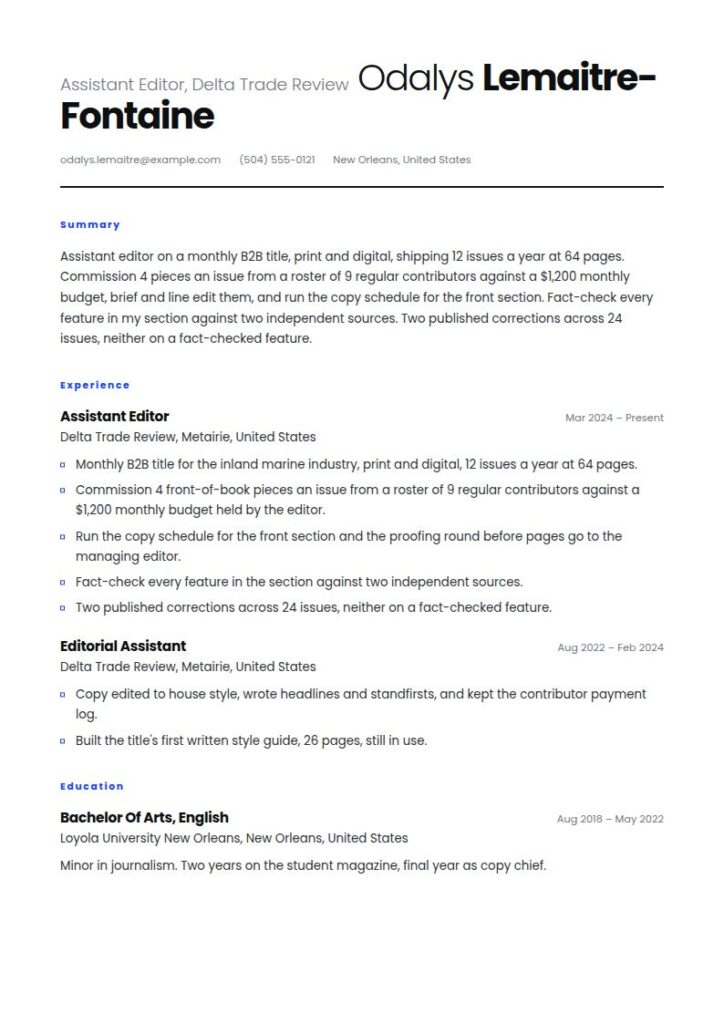
Assistant editor on a monthly B2B title, print and digital, shipping 12 issues a year at 64 pages. Commission 4 pieces an issue from a roster of 9 regular contributors against a $1,200 monthly budget, brief and line edit them, and run the copy schedule for the front section. Fact-check every feature in my section against two independent sources. Two published corrections across 24 issues, neither on a fact-checked feature.
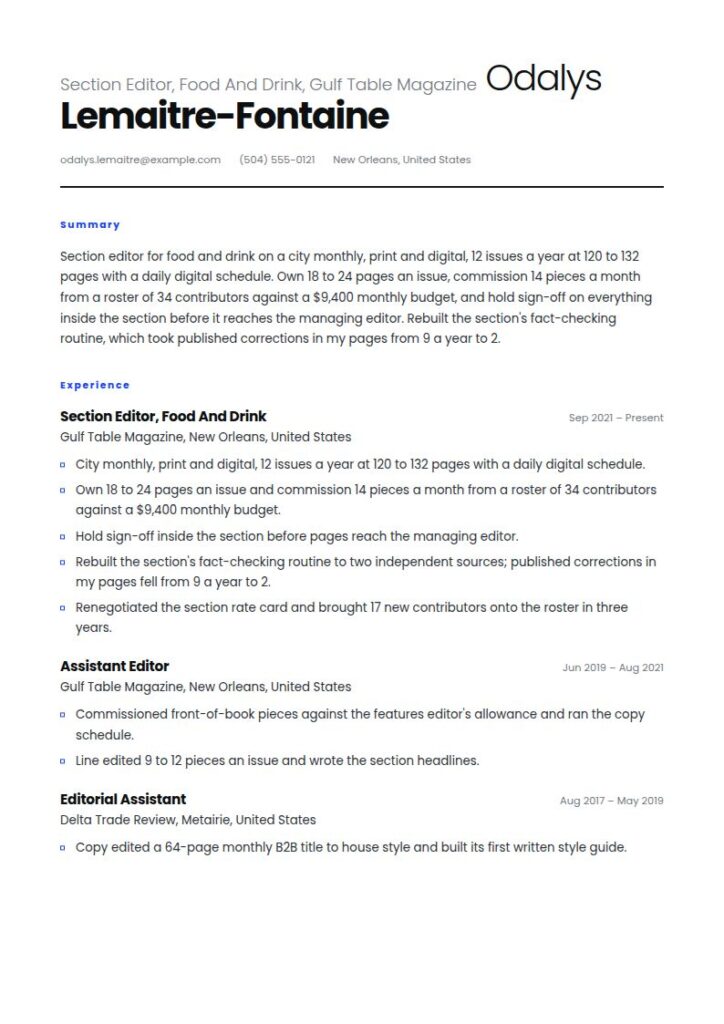
Section editor for food and drink on a city monthly, print and digital, 12 issues a year at 120 to 132 pages with a daily digital schedule. Own 18 to 24 pages an issue, commission 14 pieces a month from a roster of 34 contributors against a $9,400 monthly budget, and hold sign-off on everything inside the section before it reaches the managing editor. Rebuilt the section's fact-checking routine, which took published corrections in my pages from 9 a year to 2.
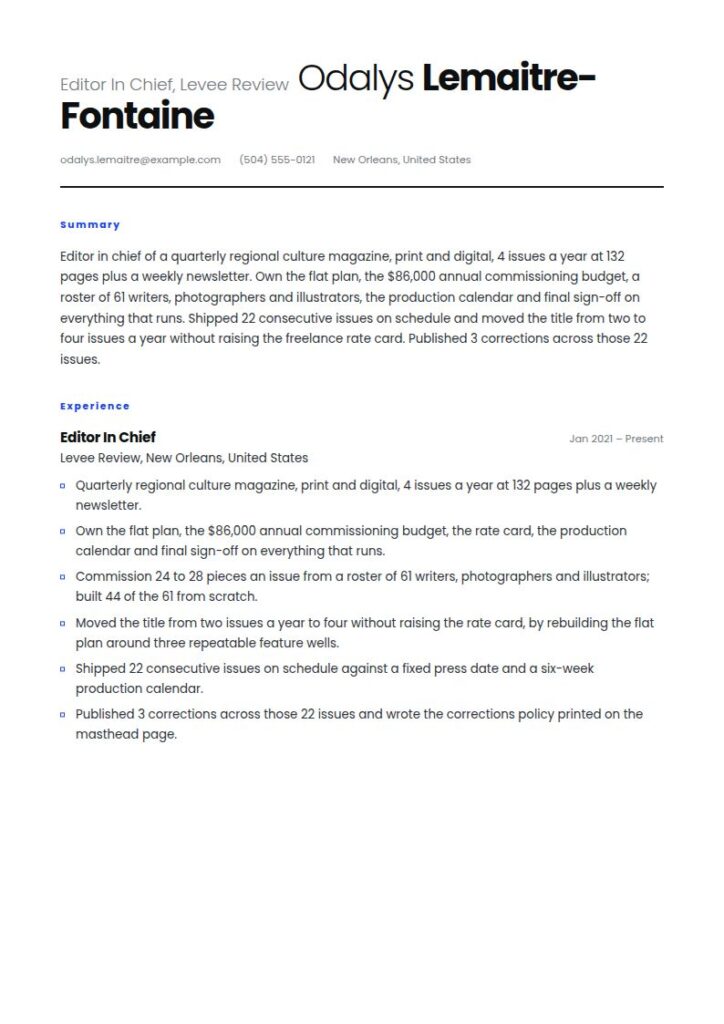
Editor in chief of a quarterly regional culture magazine, print and digital, 4 issues a year at 132 pages plus a weekly newsletter. Own the flat plan, the $86,000 annual commissioning budget, a roster of 61 writers, photographers and illustrators, the production calendar and final sign-off on everything that runs. Shipped 22 consecutive issues on schedule and moved the title from two to four issues a year without raising the freelance rate card. Published 3 corrections across those 22 issues.
Right vs wrong: the same magazine editor summary, twice
| ✅ Right | ❌ Wrong |
|---|---|
| Own 18 to 24 pages an issue and commission 14 pieces a month from a roster of 34. | Responsible for editorial content across the publication. |
| Hold sign-off inside the section before it reaches the managing editor. | Work closely with senior editorial staff. |
| Rebuilt the fact-checking routine; corrections in my pages went from 9 a year to 2. | Ensure accuracy and quality in all published content. |
The right column is a job description a publisher could staff against. The wrong column could be written by anyone who has ever held a red pen.
Outline your experience
Publication, frequency, format, your masthead title, then dates. Three to five bullets. Every bullet carries a number, and at least one of them is about what you were allowed to buy.
| Instead of | Use |
|---|---|
| Edited articles for a monthly magazine | Line edited 14 pieces an issue across 18 to 24 pages, monthly, print and digital |
| Managed freelance writers | Commissioned from a roster of 34 contributors against a $9,400 monthly budget, and rebuilt the rate card |
| Worked on the editorial calendar | Owned the flat plan and the production calendar; shipped 22 consecutive issues on schedule |
| Ensured content accuracy | Rebuilt fact-checking to two independent sources; corrections fell from 9 a year to 2 |
| Helped grow the magazine's audience | Took the title from two to four issues a year and added a weekly newsletter, 11,400 subscribers |
Editor in Chief, Levee Review, New Orleans, LA, quarterly, print and digital, January 2021 to Present
Own the flat plan, the commissioning budget, the freelance roster, the production calendar and final sign-off for a 132-page quarterly with a weekly newsletter.
Commission 24 to 28 pieces an issue against an $86,000 annual budget from a roster of 61 writers, photographers and illustrators; brief, edit and pay every one of them.
Moved the title from two issues a year to four without raising the rate card, by rebuilding the flat plan around three repeatable feature wells.
Shipped 22 consecutive issues on schedule with the printer, working to a six-week production calendar and a fixed press date.
Published 3 corrections across those 22 issues and wrote the corrections policy now printed on the masthead page.
State your masthead position and what it let you commission
Here is the ladder, and what each rung actually controls. Write yours in these terms and a hiring editor knows exactly what to do with your file.
| Masthead position | What it controls |
|---|---|
| Copy editor | House style, accuracy of copy, headlines and standfirsts. No commissioning, no page allocation. |
| Assistant or associate editor | A small commissioning allowance, usually for short front-of-book pieces, against someone else's budget. Runs the copy schedule. |
| Section editor | A named section: its page count, its commissioning budget, its contributor roster, and sign-off inside those pages. |
| Managing editor | The flat plan, the production calendar, the page count against the ad sales, and the print deadline. Often the budget holder. |
| Executive editor or editor in chief | Editorial direction, the commissioning budget as a whole, the masthead, the rate card, and final sign-off on everything that runs. |
The federal occupational description recognizes this spread: the Bureau of Labor Statistics names copy editors, assistant editors, executive editors and managing editors as editor specialisms, and describes the work as planning, reviewing and revising content for publication (BLS Occupational Outlook Handbook, accessed September 2026). The title alone is not enough, which is why the five facts below matter.
Your position, written as it appeared. Not "editor". Not "editorial lead". The masthead title, because it is checkable and because publishing is small enough that people check.
The commissioning budget you held. The single strongest signal of seniority on an editor's resume, and the one most often left off. Give the figure and the period: "$9,400 a month", "$86,000 a year", "no independent budget, commissioned against the features editor's allowance". That last sentence is not a weakness. It is a precise description of an assistant editor's job, and it is more credible than vagueness.
The freelance roster you ran. How many contributors you commissioned from regularly, and whether you built the roster or inherited it. Say if you set or renegotiated the rate card, because rate card authority usually travels with real budget authority.
Issues shipped and pages per issue. Volume is the proof that you can close. "22 consecutive issues on schedule at 132 pages" tells a publisher you have lived inside a production calendar. An editor who has never shipped against a fixed press date is a different hire, whatever the craft.
Frequency and format. Weekly, monthly, quarterly. Print, digital, or both. A weekly is a production job with editing attached; a quarterly is a commissioning job with production attached; a digital-first title is a publishing rhythm that never stops. Say which rhythm you have worked in, because the adjustment between them is real and editors who have made it should say so.
Editor in Chief, Levee Review. Quarterly, print and digital, 132 pages, weekly newsletter. Flat plan, budget, roster, production calendar and final sign-off.
Commissioning budget: $86,000 a year. Set and published the rate card.
Roster: 61 regular contributors, 38 of them commissioned in the last twelve months. Built 44 of the 61 from scratch.
Volume: 22 consecutive issues shipped on schedule, six-week production calendar, fixed press date.
Corrections: 3 published across 22 issues. Wrote the corrections policy printed on the masthead page.
Previously: Section Editor, Food and Drink, Gulf Table Magazine. Monthly, print and digital, 18 to 24 pages an issue, $9,400 monthly commissioning budget, roster of 34.
The corrections record is evidence, and almost nobody uses it. Editors are hired to be right. A published correction is the only public, countable record of an editorial failure, which makes it the cleanest evidence an editor has.
Use it in one of two ways. If your number is low, give it plainly with the denominator: "3 corrections published across 22 issues". If you inherited a mess and fixed it, give the before and after: "corrections in my section fell from 9 a year to 2 after I moved fact-checking to two independent sources". Name the routine you built, because a hiring editor is buying the routine, not the number.
Two cautions. Do not claim zero corrections over a long run; either it is not true, or it means nothing was checked hard enough to find out. And never write about a correction in a way that identifies the writer responsible.
Write the masthead title exactly, then translate it in the same line. Give the commissioning budget with its period. Give the roster size and say whether you built it. Give issues shipped and pages per issue. Say the frequency and whether the title was print, digital or both. Give a corrections figure with its denominator.
Do not write "editor" and leave the rung to be guessed. Do not describe commissioning you did not have the budget for. Do not claim a zero corrections record. Do not hide contract editing; 9 percent of editors were self-employed in 2025. Do not name a writer in connection with an error.
Build a snapshot of your key skills
Three labeled groups: editorial judgement, production, and the systems a modern title actually runs on. Ten to fourteen entries.
Editorial: Commissioning and briefing, Structural and line editing, Headline and standfirst writing, Fact-checking to two sources, House style development, Corrections and ethics policy
Production: Flat planning, Production calendar and press deadlines, Page budgets against ad sales, Print specification and proofing, Photo and illustration commissioning, Rights and usage clearance
Systems: WordPress VIP, InCopy and InDesign workflow, Airtable editorial calendars, Chicago and AP style, Newsletter platforms, Analytics for editorial planning
List your education and certifications
Short. The Bureau of Labor Statistics reports that editors typically need a bachelor's degree in communications, journalism or English, along with writing and proofreading experience (BLS Occupational Outlook Handbook, accessed September 2026), so the degree line is expected rather than persuasive. Put the editing credentials underneath it.
Bachelor of Arts, English, Loyola University New Orleans, New Orleans, LA, 2011
Poynter ACES Advanced Certificate in Editing, Poynter Institute and ACES: The Society for Editing, 2022
Poynter ACES Introductory Certificate in Editing, Poynter Institute and ACES: The Society for Editing, 2015
Chicago Manual of Style and AP Stylebook, both in daily use; house style guide written and maintained for two titles
Poynter and ACES: The Society for Editing issue their editing certificates at introductory, intermediate and advanced levels, each comprising six to seven courses and a final assessment (Poynter Institute, accessed September 2026). Name the level rather than writing "certified editor", which means nothing on its own.
Choose the right layout and design
Single column, one typeface, 10 to 12 point, generous margins, no photograph, PDF. An editor's resume should look like something that has been through a copy desk, which means consistency before decoration: one date format, one capitalisation rule for titles, serial commas either everywhere or nowhere.
This is the one occupation where a typo is close to disqualifying, because the job is catching them. Read it backwards, read it on paper, and have someone else read it too.
Magazine editor job market and outlook
A shrinking occupation with steady replacement demand, and a wide pay spread driven almost entirely by which kind of publisher you work for.
| Measure | Value |
|---|---|
| Median annual wage, May 2025 | $77,920 |
| Hourly median, May 2025 | $37.46 |
| Lowest 10 percent | less than $41,250 |
| Highest 10 percent | more than $153,700 |
| Employment, 2025 | 105,000 |
| Projected employment, 2035 | 103,800 |
| Projected change, 2025 to 2035 | 1 percent decline |
| Projected annual openings | about 7,900 |
| Typical entry-level education | Bachelor's degree |
Source: U.S. Bureau of Labor Statistics, Occupational Outlook Handbook, May 2025 wage data and 2025 to 2035 projections.
The pay gap between publishers is wider than the gap between seniorities
Editors working in motion picture and video industries had a median annual wage of $103,320 in May 2025, and those at media streaming distribution services, social networks and other content providers $86,470. Editors in professional, scientific and technical services had a median of $77,400, and editors at newspaper publishers $62,600 (BLS Occupational Outlook Handbook, May 2025).
The employment shares point the same way. In 2025, professional, scientific and technical services accounted for 17 percent of editor employment, newspaper publishers 12 percent, self-employed editors 9 percent, media streaming distribution services and other content providers 7 percent, and motion picture and video industries 7 percent (BLS Occupational Outlook Handbook, 2025).
Employment of editors is projected to decline 1 percent from 2025 to 2035, falling from 105,000 to 103,800, with about 7,900 openings projected each year on average (BLS Occupational Outlook Handbook, 2025 to 2035 projections).
For a magazine editor, the practical reading is that the skills transfer further than the job titles do. Commissioning, flat planning and a production calendar are the same craft at a custom publishing agency inside professional services, at a streaming platform's editorial team, or at a brand's own title. Write the masthead numbers in a way those readers can use, and the corrections record travels with you.
What salary you can expect as a magazine editor
The median annual wage for editors was $77,920 in May 2025, an hourly median of $37.46, with the lowest 10 percent earning less than $41,250 and the highest 10 percent more than $153,700 (BLS Occupational Outlook Handbook, May 2025).
That top decile is not reached by line editing faster. It belongs to editors who hold a budget, a masthead and a press date. Which is the practical argument for writing the commissioning figure, the roster size and the issues shipped on the page: they are the facts that move a candidate from the craft band into the responsibility band.
Industry matters as much as rung. The gap between the motion picture median of $103,320 and the newspaper publisher median of $62,600 in May 2025 is larger than most promotions inside a single title (BLS Occupational Outlook Handbook, May 2025). If your experience is in print magazines, write it so that a digital publisher or a custom publishing team can read your numbers without translation.
Key takeaways for a magazine editor resume
- Write the masthead position exactly, then translate it in the same line.
- Give the commissioning budget with its period; it is the strongest seniority signal you have.
- State the freelance roster size and whether you built it or inherited it.
- Give issues shipped and pages per issue; volume proves you can close.
- Name the frequency and whether the title was print, digital or both.
- Use the corrections record with a denominator, and name the routine behind it.
- Keep contract editing in the same list; nearly one editor in ten is self-employed.
Build your magazine editor resume in 15 minutes.
Related marketing resume examples
- Content writer resume
- Blog writer resume
- Content acquisitions director resume
- Art director resume
- Graphic designer resume
- Creative director resume
- Advertising director resume
- Public relations resume
- Content marketing associate resume
- SEO resume
- Social media manager resume
- Marketing consultant resume
Pair it with a matching magazine editor cover letter.
Magazine editor resume questions, answered
How long should a magazine editor resume be?
One page for your first five years, two once you have run a section or a title. If you have a long masthead history, keep the page count at two and let the earliest roles shrink to a title, a publication and a date.
What if my masthead title does not match the job I actually did?
Write both. The masthead title first, because it is checkable, then the translation in the same line: what you commissioned, on what budget, across how many pages. Inflating a title is the one thing a reference call in publishing will catch immediately.
Should I list the pieces I commissioned or the ones I wrote?
Commissioned, if you are applying for an editing job. A short selected commissions block with the writer credited, the section and the result is stronger than your own bylines, because it shows judgement rather than output. Keep your own writing to a line saying it exists.
How do I show editorial authority without a budget?
By naming what you did control. The copy schedule, the front section, the style guide, the fact-checking routine, the proofing round, the press deadline. Then say plainly that commissioning ran through someone else's allowance. BLS lists copy editors and assistant editors alongside executive and managing editors as editor specialisms (BLS Occupational Outlook Handbook, accessed September 2026); they are different jobs, and the precise one reads better than the inflated one.
Is print magazine experience still worth writing up in detail?
Yes, and translate it. Employment of editors is projected to decline 1 percent from 2025 to 2035, with about 7,900 openings a year, while median pay ranges from $62,600 at newspaper publishers to $103,320 in motion picture and video industries (BLS Occupational Outlook Handbook, May 2025 and 2025 to 2035 projections). Flat planning, commissioning and press deadlines are the transferable part; write them as process, not as nostalgia.
How do I handle a gap or a run of freelance editing?
Put it in the same reverse chronological list, labeled as contract, with the titles named and the same numbers you would give a staff role: pieces commissioned or edited, budget if you held one, issues shipped. Self-employed workers made up 9 percent of editor employment in 2025 (BLS Occupational Outlook Handbook, 2025), so it needs no apology.