Blog Writer, B2B software and logistics Anwar Osei-Whitlock
Blog Writer (contract)
[email protected] | (253) 555-0158 | Tacoma, United States
Profile
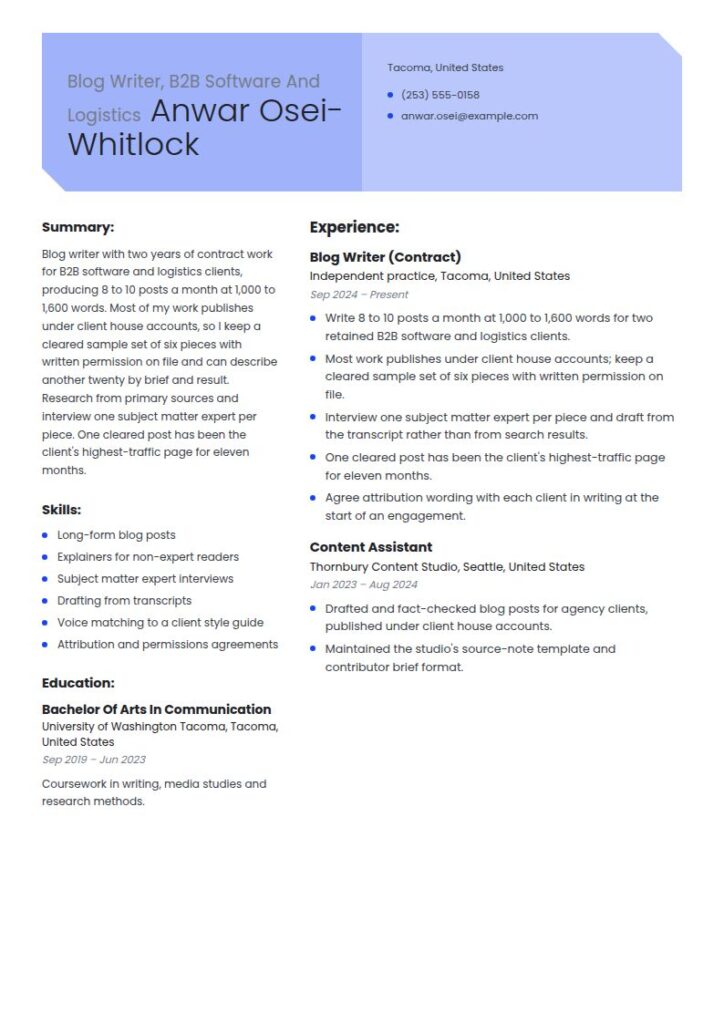
Blog writer with two years of contract work for B2B software and logistics clients, producing 8 to 10 posts a month at 1,000 to 1,600 words. Most of my work publishes under client house accounts, so I keep a cleared sample set of six pieces with written permission on file and can describe another twenty by brief and result. Research from primary sources and interview one subject matter expert per piece. One cleared post has been the client's highest-traffic page for eleven months.
Work Experience
09/2024 - Present, Blog Writer (contract), Independent practice, Tacoma, United States
- Write 8 to 10 posts a month at 1,000 to 1,600 words for two retained B2B software and logistics clients.
- Most work publishes under client house accounts; keep a cleared sample set of six pieces with written permission on file.
- Interview one subject matter expert per piece and draft from the transcript rather than from search results.
- One cleared post has been the client's highest-traffic page for eleven months.
- Agree attribution wording with each client in writing at the start of an engagement.
01/2023 - 08/2024, Content Assistant, Thornbury Content Studio, Seattle, United States
- Drafted and fact-checked blog posts for agency clients, published under client house accounts.
- Maintained the studio's source-note template and contributor brief format.
Education
09/2019 - 06/2023, Bachelor of Arts, Communication, University of Washington Tacoma, Tacoma, United States
Coursework in writing, media studies and research methods.
Skills
Long-form blog posts, 75
Explainers for non-expert readers, 70
Subject matter expert interviews, 65
Drafting from transcripts, 70
Voice matching to a client style guide, 70
Attribution and permissions agreements, 65
Languages
English, native
Twi, advanced
Certificates
05/2024, Technical writing for non-technical readers, Continuing education course
Summary
A blog writer resume is a one to two page document whose hardest job is evidence, because most blog writing publishes under someone else's name. This guide gives you three adaptable versions, six ways to prove unbylined work without breaching a contract, the volume and cadence numbers that matter, and current Bureau of Labor Statistics pay and outlook for writers and authors.
Blog Writer resume examples by experience level
A blog writer resume is a one to two page document with an unusual problem at its center: most of the work you are applying on the strength of does not have your name on it.
Blog writing publishes ghostwritten under a founder's byline, unbylined, or under a house account standing for a whole content team. The craft is yours and the public record is not. Most occupations can point at their output; a blog writer has to build the pointing mechanism, and doing it without breaching a contract is what this page is about.
Resume guide for a blog writer resume
This guide and the corresponding blog writer resume example will cover:
- How to write a blog writer resume, section by section
- Six ways to prove work that published under someone else's name
- Three adaptable summaries: new freelance, working blog writer and lead ghostwriter
- The volume, cadence and word count numbers that hiring managers actually use
- What the job market looks like for writers and what you can expect to earn
How to write a blog writer resume
Six blocks: contact header, summary, evidence set, writing experience, subjects and sectors, and education. One page for your first five years, two once you have a client list and a body of cleared samples.
The evidence set is the block that does not exist on other resumes, and it goes above experience. It is a short, labeled list of what a reader may look at, what they may not, and what you can describe instead.
| Section | What it is answering | Where it goes |
|---|---|---|
| Evidence set | What can I read, right now, that you definitely wrote? | Above experience, three to six items |
| Attribution status | Bylined, ghostwritten, house account, unbylined? | Beside every item, one word |
| Volume and cadence | Can you produce at the rate this job runs at? | First bullet of every writing role |
| Sectors | Do you already understand what we sell? | Its own short block |
Label the attribution status of every sample
A hiring manager looking at six links has no way of knowing which ones you wrote, and no polite way to ask. Tell them, in one word per item, before they wonder.
Four labels cover nearly everything. Bylined, meaning your name is on it. Ghostwritten, meaning it ran under a named person with your work behind it. House, meaning it published under a company account. Unbylined, meaning it ran with no name at all.
Then add the clearance state: cleared to share, cleared to describe only, or under contract. A reader who sees "ghostwritten, cleared to share" trusts the whole list more than one who sees six naked links, because the labeling is itself evidence that you handle confidentiality carefully.
Run the finished file through the free Rezoom ATS resume checker before you send it. Agencies and in-house content teams both parse applications before anyone reads a sample.
Choosing the best resume format for a blog writer resume
Reverse chronological, single column, one page early. Clients and staff roles go in the same list, in date order, with overlaps left visible, because a blog writer with four concurrent clients is normal rather than untidy.
Self-employment is the ordinary case here. Self-employed workers accounted for 65 percent of employment among writers and authors in 2025, against 9 percent in professional, scientific and technical services and 8 percent in information (BLS Occupational Outlook Handbook, 2025). A file full of client engagements is what a hiring manager expects, so do not reshape it into something that looks like a staff career.
Include your contact information
| ✅ Right | ❌ Wrong |
|---|---|
| Anwar Osei-Whitlock | Anwar Osei-Whitlock |
| Blog Writer, B2B software and logistics | Freelance writer and content creator |
| Cleared samples: anwarosei.example.com/samples | Portfolio: various clients, samples on request |
| Tacoma, WA, (253) 555-0158, [email protected] | Tacoma, WA, [email protected] |
"Samples on request" is the sentence that loses the application: it asks a busy reader to do work in order to find out whether you can do work. Put a live address on the page, and make the first thing there a list with attribution labels on it.
Make use of a summary
Four lines: what you write and for whom, your monthly volume and typical word count, your attribution reality stated plainly, and one result you are allowed to describe.
Blog writer with two years of contract work for B2B software and logistics clients, producing 8 to 10 posts a month at 1,000 to 1,600 words. Most of my work publishes under client house accounts, so I keep a cleared sample set of six pieces with written permission on file and can describe another twenty by brief and result. Research from primary sources and interview one subject matter expert per piece. One cleared post has been the client's highest-traffic page for eleven months.
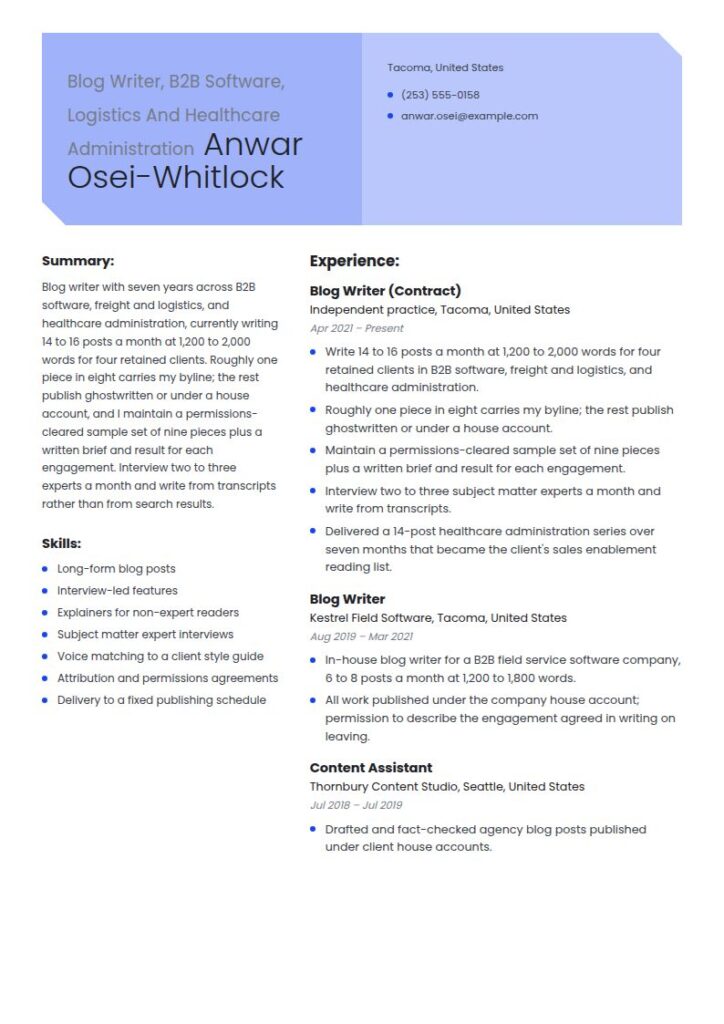
Blog writer with seven years across B2B software, freight and logistics, and healthcare administration, currently writing 14 to 16 posts a month at 1,200 to 2,000 words for four retained clients. Roughly one piece in eight carries my byline; the rest publish ghostwritten or under a house account, and I maintain a permissions-cleared sample set of nine pieces plus a written brief and result for each engagement. Interview two to three experts a month and write from transcripts rather than from search results.
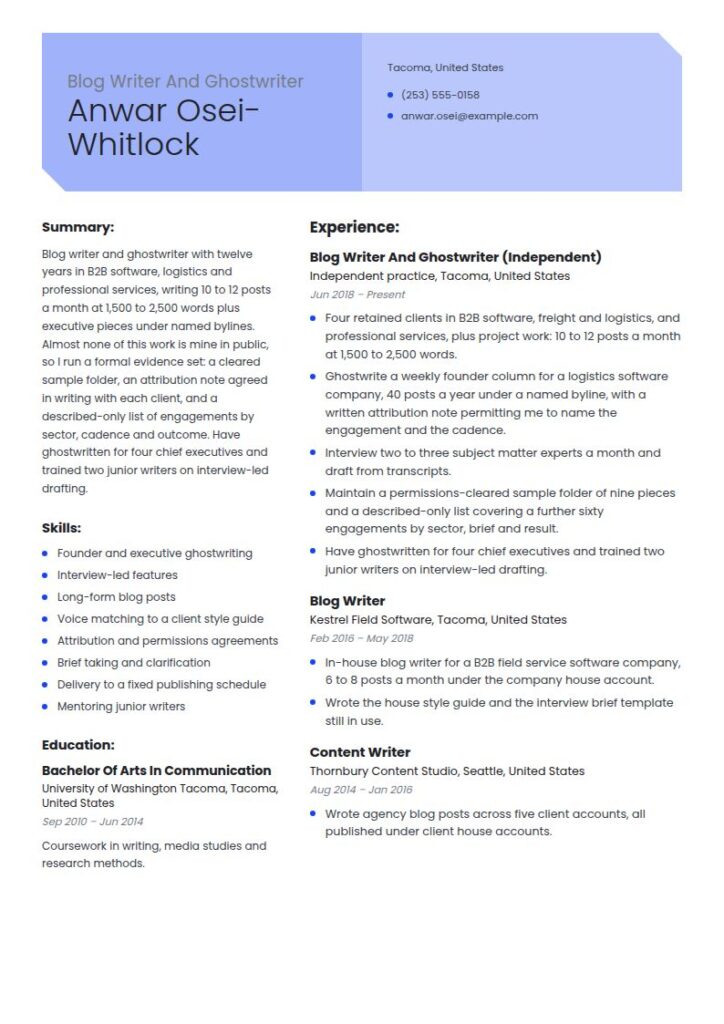
Blog writer and ghostwriter with twelve years in B2B software, logistics and professional services, writing 10 to 12 posts a month at 1,500 to 2,500 words plus executive pieces under named bylines. Almost none of this work is mine in public, so I run a formal evidence set: a cleared sample folder, an attribution note agreed in writing with each client, and a described-only list of engagements by sector, cadence and outcome. Have ghostwritten for four chief executives and trained two junior writers on interview-led drafting.
Right vs wrong: the same blog writer summary, twice
| ✅ Right | ❌ Wrong |
|---|---|
| 14 to 16 posts a month at 1,200 to 2,000 words for four retained clients. | Prolific writer producing high-quality content for a range of clients. |
| Roughly one piece in eight carries my byline; the rest publish ghostwritten or under a house account. | Extensive portfolio of published work across many industries. |
| Permissions-cleared sample set of nine pieces plus a written brief and result for each engagement. | Writing samples available upon request. |
The right column is checkable in ninety seconds. The wrong column asks a reader to take a stranger's word for it, which is the job the byline would have done.
Outline your experience
Client or employer, the sector, the engagement shape, then dates. Three to five bullets. Every writing role leads with volume and cadence, and at least one bullet names the attribution arrangement.
| Instead of | Use |
|---|---|
| Wrote blog posts for various clients | Wrote 14 to 16 posts a month at 1,200 to 2,000 words for four retained B2B clients |
| Created engaging content | Interviewed two to three subject matter experts a month and drafted from transcripts |
| Increased website traffic | One cleared post has been the client's highest-traffic page for eleven months |
| Ghostwrote for executives | Ghostwrote 40 posts under a named founder byline, with an agreed attribution note allowing me to say so |
Blog Writer and Ghostwriter (independent), Tacoma, WA, June 2018 to Present
Four retained clients in B2B software, freight and logistics, and professional services, plus project work. 10 to 12 posts a month at 1,500 to 2,500 words.
Ghostwrite a weekly founder column for a logistics software company, 40 posts a year under a named byline, with a written attribution note permitting me to name the engagement and the cadence.
Interview two to three subject matter experts a month and draft from transcripts, which is why the work reads like the client rather than like search results.
Maintain a permissions-cleared sample folder of nine pieces and a described-only list covering a further sixty engagements by sector, brief and result.
Trained two junior writers on interview-led drafting and on agreeing attribution at contract stage rather than afterwards.
Solve the byline problem: proving work that published under someone else's name
This is the section that decides a blog writer's application, and most candidates handle it by writing "samples available on request" and hoping.
There are six real solutions. Use three or four of them at once, because they cover different kinds of restriction.
1. Build a permissions-cleared sample set. Six to nine pieces you have written permission to share, kept at one address. Permission means an email from the client saying you may show the piece and how you may describe your role. Ask at the end of an engagement, while the relationship is warm and the person who briefed you is still in the job. Store the emails.
2. Describe a piece by its brief and its result instead of linking it. This works when you may not share the file at all, and it is often more persuasive than a link, because it shows judgement rather than output. Give the brief you were set, the constraint, what you did, and what happened. "Brief: explain a freight tendering change to shippers who had never heard of it. Constraint: no customer names, no numbers from the platform. Approach: interviewed two operations managers and built the piece around one worked example. Result: the client's highest-traffic page for eleven months." No link, no breach, and a hiring manager now knows how you think.
3. Name the publication and the cadence without claiming the byline. You are allowed to have worked somewhere. "Wrote the weekly founder column on a named logistics software company's blog, 40 posts a year, published under the founder's byline" claims no authorship of the name on the page and states a verifiable fact about the engagement. Check that naming the client is permitted first, which is the next point.
4. Use the client's own attribution language. Ask the client how they would like the work described, in writing, then use their sentence. One email converts a gray area into a documented agreement, and the answer tends to be generous: clients who would never let you claim a byline are usually comfortable with "contributing writer to the company blog, 2023 to 2026", because that is a sentence they can stand behind.
5. Write a short original piece as a hiring sample. When restrictions are total, write something new, 800 to 1,200 words, on a subject the employer actually cares about, published under your own name somewhere you control. It is unarguably yours, it is current, and it can be aimed at the job in a way that archived client work never can. One well-aimed original piece beats four old links you have to explain.
6. Know what your contract does and does not restrict. Confidentiality clauses differ. Some restrict the content: the numbers, the customers, the internal information you were given. Some restrict the relationship as well, meaning you may not say the client's name at all. Some are silent on showing work that is already public. Read the clause before you write the resume, and ask the client if it is ambiguous. A published post is public, but your role in it may still be covered, so the safe default is to describe rather than claim.
| The restriction | What you can usually still say |
|---|---|
| Content is confidential | The sector, the brief, the format, the cadence, and the outcome in general terms |
| The client cannot be named | "A B2B logistics software company, Series B, 200 staff" plus the same brief and result |
| The byline belongs to a named person | That you wrote to that byline, if the client agrees the wording |
| Nothing is agreed in writing | Ask now; until then, describe rather than link, and say the work is under contract |
Cleared samples: anwarosei.example.com/samples
1. Freight tendering explainer, logistics software client. Ghostwritten, published under the founder's byline. Cleared to share, wording agreed with the client.
2. Warehouse automation series, three parts. House account. Cleared to share.
3. Onboarding teardown, B2B software client. Bylined. Cleared to share.
Described only, under contract:
4. Healthcare administration series, 14 posts over seven months. Brief: translate a billing rule change for practice managers. Constraint: no client data, no named customers. Result: the series became the client's sales enablement reading list.
5. Weekly founder column, logistics software company. Ghostwritten, 40 posts a year. Attribution note agreed in writing permits naming the engagement and the cadence.
Original, written under my own name: "What freight brokers actually read", 1,100 words, published on my own site, March 2026.
Then the volume question, the other half of the hiring decision. Blog writing is bought by the month. Anyone hiring a blog writer is filling a schedule, so give the three numbers that fill it: posts per month, typical word count, and the sectors you can write in without a fortnight of ramp.
Be honest about how those numbers relate. Twenty posts a month at 600 words is a different job from six at 2,500 with two interviews each, and a writer who claims both reads as someone who has done neither. If volume varies by client, give the range and its shape: "8 to 16 posts a month, at the higher end for shorter product-led pieces".
Put a live sample address in the header. Label every sample bylined, ghostwritten, house or unbylined, and say whether it is cleared. Ask for written permission at the end of each engagement. Describe restricted work by brief, constraint, approach and result. Write one original piece aimed at the job. Give posts per month, word count range and sectors.
Do not write "samples available on request". Do not show a piece you have no permission to show. Do not claim a byline that belongs to the client. Do not paste a client's confidential numbers into a sample description. Do not imply you wrote a whole publication when you wrote for a house account alongside others.
Build a snapshot of your key skills
Three labeled groups: the writing itself, the research that makes it credible, and the working practice a content lead is buying. Ten to fourteen entries.
Writing: Long-form blog posts, Explainers for non-expert readers, Founder and executive ghostwriting, Interview-led features, Headline and introduction writing, Voice matching to a client style guide
Research: Subject matter expert interviews, Drafting from transcripts, Primary source research, Technical documentation reading, Fact-checking and source notes
Working practice: Brief taking and clarification, Delivery to a fixed publishing schedule, Attribution and permissions agreements, Style guide adherence, Handover notes and source lists
List your education and certifications
Short. The Bureau of Labor Statistics reports that writers and authors typically need a bachelor's degree, and that a college degree in English, communications or journalism is generally required for a salaried position (BLS Occupational Outlook Handbook, accessed September 2026). For contract work the degree matters less than the evidence set, so keep this block brief.
Bachelor of Arts, Communication, University of Washington Tacoma, Tacoma, WA, 2014
Technical writing for non-technical readers, continuing education course, 2019
Interviewing for writers, two-day workshop, 2022
Subjects written in depth: B2B software and onboarding, freight and logistics operations, healthcare administration and billing, professional services
The last line is worth more than the first three. Sector fluency cannot be learned in a month, and it is why one blog writer is shortlisted over another with identical craft.
Choose the right layout and design
Single column, one typeface, 10 to 12 point, no photograph, PDF. Keep the sample address as live, selectable text and check it survives the export; a flattened link is the quietest way to lose a writing job.
Make the first line of your summary the best sentence on the page. A content lead reads a writer's resume as a writing sample whether you intended it or not.
Blog writer job market and outlook
There is no federal profile for "blog writer". The occupation to read is writers and authors, and its defining feature is that two thirds of it works for itself.
| Measure | Value |
|---|---|
| Median annual wage, May 2025 | $76,910 |
| Hourly median, May 2025 | $36.98 |
| Lowest 10 percent | less than $44,310 |
| Highest 10 percent | more than $139,870 |
| Employment, 2025 | 140,300 |
| Projected employment, 2035 | 139,900 |
| Projected change, 2025 to 2035 | little or no change |
| Projected annual openings | about 11,900 |
| Typical entry-level education | Bachelor's degree |
Source: U.S. Bureau of Labor Statistics, Occupational Outlook Handbook, May 2025 wage data and 2025 to 2035 projections.
Sixty-five percent of writers work for themselves
Self-employed workers made up 65 percent of employment among writers and authors in 2025, ahead of professional, scientific and technical services at 9 percent, information at 8 percent, educational services at 3 percent and religious, grantmaking, civic and professional organizations at 2 percent (BLS Occupational Outlook Handbook, 2025).
Employment is projected to show little or no change from 2025 to 2035, moving from 140,300 to 139,900, with about 11,900 openings projected each year on average (BLS Occupational Outlook Handbook, 2025 to 2035 projections).
That share is why the byline problem exists at all. When two writers in three are contractors, most published work carries a client's name rather than the writer's, and the public record understates what a working writer has produced. The resume that fixes it privately, with cleared samples and described-only engagements, is doing the job a byline would have done in a salaried occupation.
What salary you can expect as a blog writer
The median annual wage for writers and authors was $76,910 in May 2025, an hourly median of $36.98, with the lowest 10 percent earning less than $44,310 and the highest 10 percent more than $139,870 (BLS Occupational Outlook Handbook, May 2025).
Industry shifts the figure. In May 2025 the median was $80,480 in religious, grantmaking, civic and professional organizations, $77,860 in professional, scientific and technical services, $74,590 in information and $72,610 in educational services (BLS Occupational Outlook Handbook, May 2025).
For contract blog writing, none of those is a salary you will be offered. Your income is a per-piece or per-word rate multiplied by monthly volume, and the rate is set by how much subject knowledge the client would otherwise have to supply and how much of your work you can prove. A writer who arrives with cleared samples in the client's sector negotiates from evidence; one who arrives with "samples on request" negotiates from trust, and trust is cheaper.
Key takeaways for a blog writer resume
- The central problem is evidence, because most blog writing publishes under someone else's name.
- Put a live cleared-sample address in the header, never "samples on request".
- Label every sample bylined, ghostwritten, house or unbylined, and say if it is cleared.
- Ask for written permission at the end of each engagement, not years later.
- Describe restricted work by brief, constraint, approach and result.
- Write one original piece aimed at the job when everything else is locked.
- Give posts per month, word count range and sectors; that is what fills a schedule.
Build your blog writer resume in 15 minutes.
Related marketing resume examples
- Content writer resume
- Magazine editor resume
- Content marketing associate resume
- SEO resume
- Social media manager resume
- Digital marketing resume
- Marketing associate resume
- Content acquisitions director resume
- Marketing coordinator resume
- Public relations resume
- Brand ambassador resume
- Ecommerce resume
Pair it with a matching blog writer cover letter.
Blog writer resume questions, answered
How do I prove I wrote something that published under someone else's name?
Four ways, used together. A cleared sample set with written permission. An attribution note agreed with the client in their own wording. A described-only entry giving the brief, the constraint, your approach and the result. And one original piece written under your own name for this application. One alone is thin; three together are convincing.
Can I show a ghostwritten post in my portfolio?
Only with permission, and get it in writing. The post being publicly visible does not mean your role in it is yours to publish. Ask at the end of the engagement, ask for the wording the client is comfortable with, and keep the email. If the answer is no, move the piece to your described-only list and lose nothing but the link.
What do I put on a blog writer resume with no clients yet?
Write three pieces under your own name, aimed at the sector you want, and publish them somewhere you control. Then build the resume around the volume you can sustain, your research method, and the subjects you already understand. Three sharp, current, unarguably-yours pieces are easier to hire than a long list of links you have to explain.
How many posts a month should I claim?
The number you have actually sustained, with the word count attached. Volume without word count is meaningless, and a rate you cannot hold collapses in the first month. If it varies, give the range and say what moves it.
Does an NDA stop me listing a client at all?
It depends on the clause, and clauses genuinely differ. Some cover only the confidential information you were given; some also cover the existence of the relationship. Read it before you write anything, and ask the client if it is ambiguous. When in doubt, describe the client by sector, size and stage, which keeps the comparison intact and the obligation unbroken.
Is freelancing the normal path in this occupation?
Yes. Self-employed workers were 65 percent of employment among writers and authors in 2025, and employment overall is projected to show little or no change from 2025 to 2035, with about 11,900 openings a year (BLS Occupational Outlook Handbook, 2025 and 2025 to 2035 projections). Write your client engagements as the main history rather than as a gap between jobs.