Marketing Analyst Ileana Moldovan
Marketing Analyst
[email protected] | (312) 555-0200 | Chicago, United States
Profile
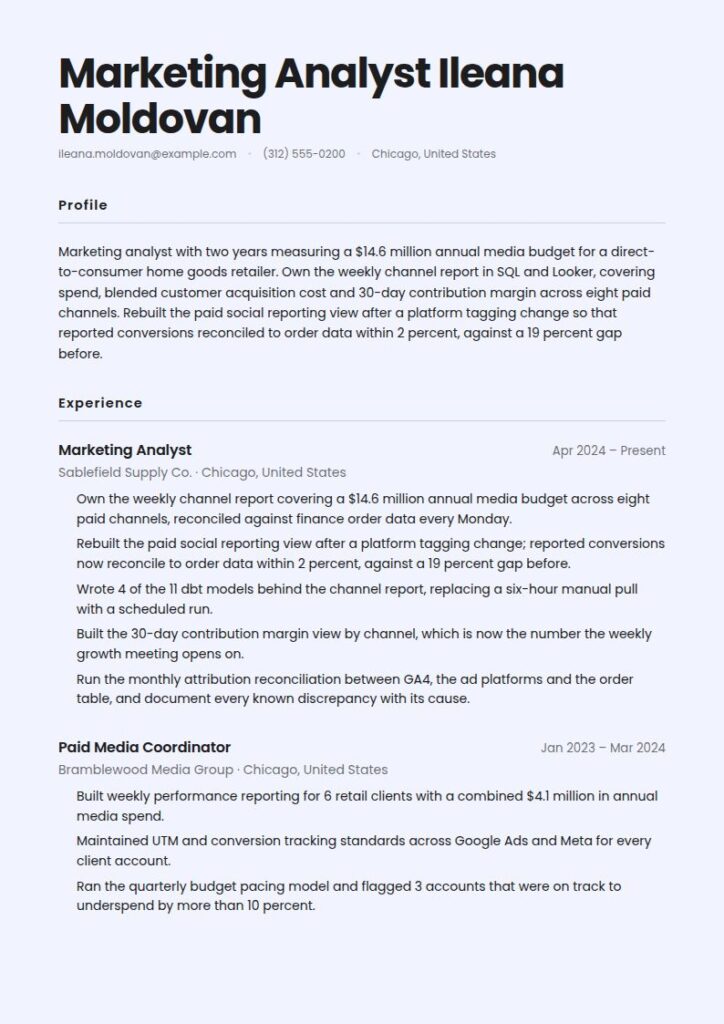
Marketing analyst with two years measuring a $14.6 million annual media budget for a direct-to-consumer home goods retailer. Own the weekly channel report in SQL and Looker, covering spend, blended customer acquisition cost and 30-day contribution margin across eight paid channels. Rebuilt the paid social reporting view after a platform tagging change so that reported conversions reconciled to order data within 2 percent, against a 19 percent gap before.
Work Experience
04/2024 - Present, Marketing Analyst, Sablefield Supply Co., Chicago, United States
- Own the weekly channel report covering a $14.6 million annual media budget across eight paid channels, reconciled against finance order data every Monday.
- Rebuilt the paid social reporting view after a platform tagging change; reported conversions now reconcile to order data within 2 percent, against a 19 percent gap before.
- Wrote 4 of the 11 dbt models behind the channel report, replacing a six-hour manual pull with a scheduled run.
- Built the 30-day contribution margin view by channel, which is now the number the weekly growth meeting opens on.
- Run the monthly attribution reconciliation between GA4, the ad platforms and the order table, and document every known discrepancy with its cause.
01/2023 - 03/2024, Paid Media Coordinator, Bramblewood Media Group, Chicago, United States
- Built weekly performance reporting for 6 retail clients with a combined $4.1 million in annual media spend.
- Maintained UTM and conversion tracking standards across Google Ads and Meta for every client account.
- Ran the quarterly budget pacing model and flagged 3 accounts that were on track to underspend by more than 10 percent.
Education
08/2018 - 05/2022, Bachelor of Science, Economics, statistics minor, University of Illinois Urbana-Champaign, Champaign, United States
Coursework in econometrics, probability and regression analysis. Senior thesis on price elasticity in subscription retail.
Skills
SQL (Snowflake), 75
dbt, 60
Looker and LookML, 70
GA4 and Google Tag Manager, 80
Attribution reconciliation, 75
Customer acquisition cost and payback modeling, 65
Excel and Google Sheets modeling, 85
Languages
English, native
Romanian, native
Certificates
03/2025, Google Analytics 4 Certification, Google Skillshop
Renewed annually.
03/2025, Google Ads Measurement Certification, Google Skillshop
Summary
A marketing analyst resume is a one to two page document showing the spend you measured, the attribution and test design behind your numbers, and the budget decisions those numbers changed. This guide gives you three adaptable versions, a test card format that survives a technical interview, and current Bureau of Labor Statistics pay and outlook for the occupation.
Marketing Analyst resume examples by experience level
A marketing analyst resume is a one to two page document that shows how much money you measured, how you measured it, and which budget decision moved because of the answer.
Almost every applicant writes a version of the same sentence: "analyzed campaign performance and provided insights to stakeholders". That sentence is true of an intern pulling a weekly screenshot and true of the analyst who told a CMO to stop spending $1.2 million on branded search. The reader cannot tell them apart, so they assume the cheaper one.
Resume guide for a marketing analyst resume
This guide and the corresponding marketing analyst resume example will cover:
- How to write a marketing analyst resume, section by section
- Why the spend you measured belongs in the first line of your summary
- Three adaptable summaries: analyst, senior analyst and analytics manager
- How to write a result that a hiring manager can test you on in the interview
- What the job market looks like and what you can expect to earn
How to write a marketing analyst resume
Six sections: contact header, summary, experience, a measurement block, technical skills, and education with certifications. One page for your first five years, two once you are setting budget policy rather than reporting against it.
The order matters because marketing analytics interviews go the same way every time. The reader scans for scale, then for tooling, then for one claim they can interrogate. Give them all three in that order.
| Section | What it is answering | Where it goes |
|---|---|---|
| Summary | How much spend, which channels, what decision changed? | Top, four lines |
| Experience | What did the business do differently because of your work? | Reverse chronological, one number per bullet |
| Measurement and testing | Do you know the difference between reported and incremental? | Its own block, not buried |
| Technical skills | Can you get your own data, or do you wait for someone? | Split by layer: warehouse, modeling, reporting |
Say what you could query yourself, and what you had to ask for
There are two kinds of marketing analyst and the resume rarely says which one you are. The first reads dashboards built by someone else and assembles them into a deck. The second has warehouse credentials, writes the query, and can tell you why last Tuesday's number is wrong.
Nothing on a skills list distinguishes them, because both write "SQL, Excel, Tableau". What distinguishes them is a sentence about access: "Held read access to the marketing schema in Snowflake and wrote the dbt models behind the channel report" is a different claim from "Used Tableau dashboards to monitor campaign performance."
State the layer you worked at. Warehouse and transformation, modeling, or reporting. If you worked at all three, say so, because that person is rare and expensive.
Run the finished file through the free Rezoom ATS resume checker before you submit. Analytics roles are frequently posted by the same recruiting teams that fill engineering, and they use the same parsers.
Choosing the best resume format for a marketing analyst resume
Reverse chronological. One page for your first five years, two once you have managed analysts, owned a measurement standard, or run testing against budgets large enough to name.
Functional formats fail here for a specific reason. Analytics hiring reads for progression of scale: the size of the budget you measured, the number of channels, whether you moved from reporting to causal work. A format that strips the timeline strips exactly the signal being looked for.
Include your contact information
| ✅ Right | ❌ Wrong |
|---|---|
| Ileana Moldovan | Ileana Moldovan |
| Marketing Analyst, Performance and Incrementality | Data-driven marketing professional |
| SQL, dbt, Python, GA4, Looker | Analytics expert |
| (312) 555-0200, [email protected], Chicago, IL | (312) 555-0200, [email protected] |
Put the technical stack in the header line, not only in a skills block halfway down. Recruiters screening analytics applications are looking for two or three specific tool names in the first four seconds, and a header is where the eye lands.
Make use of a summary
Four lines: the spend or revenue you measured, the channels, the measurement approach you own, and one result with the decision attached.
Marketing analyst with two years measuring a $14.6 million annual media budget for a direct-to-consumer home goods retailer. Own the weekly channel report in SQL and Looker, covering spend, blended customer acquisition cost and 30-day contribution margin across eight paid channels. Rebuilt the paid social reporting view after a platform tagging change so that reported conversions reconciled to order data within 2 percent, against a 19 percent gap before.
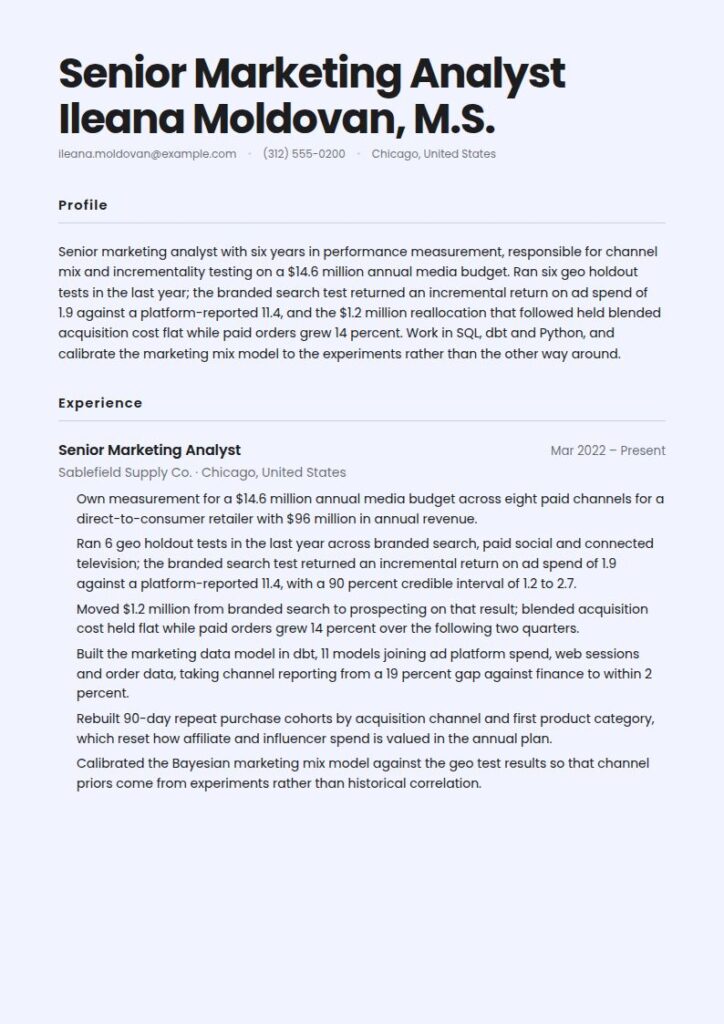
Senior marketing analyst with six years in performance measurement, responsible for channel mix and incrementality testing on a $14.6 million annual media budget. Ran six geo holdout tests in the last year; the branded search test returned an incremental return on ad spend of 1.9 against a platform-reported 11.4, and the $1.2 million reallocation that followed held blended acquisition cost flat while paid orders grew 14 percent. Work in SQL, dbt and Python, and calibrate the marketing mix model to the experiments rather than the other way around.
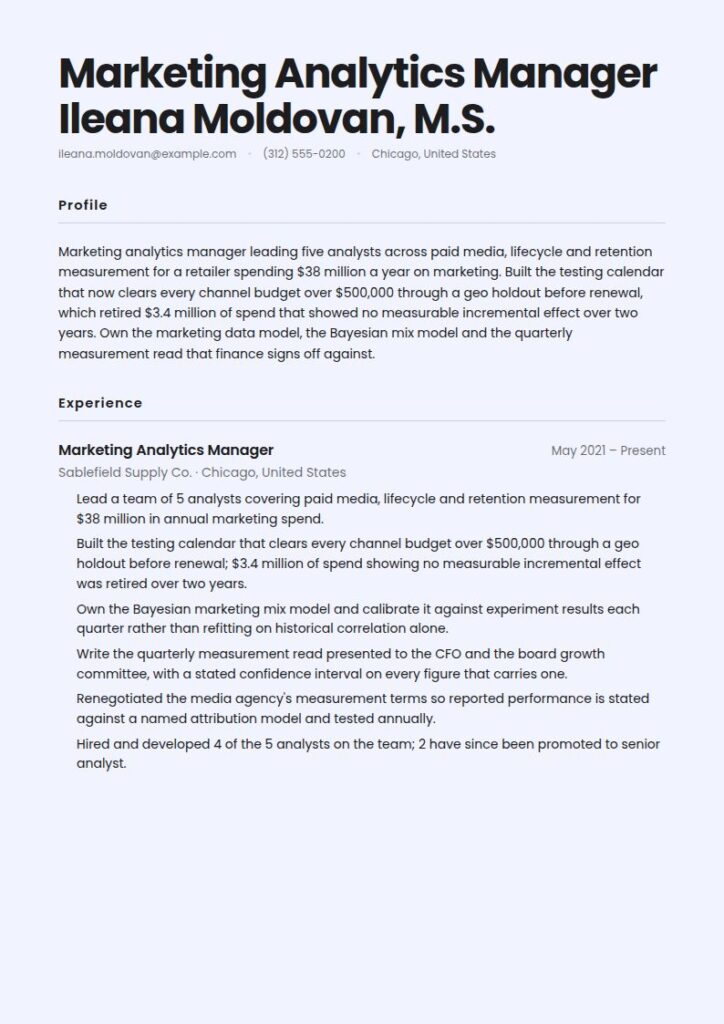
Marketing analytics manager leading five analysts across paid media, lifecycle and retention measurement for a retailer spending $38 million a year on marketing. Built the testing calendar that now clears every channel budget over $500,000 through a geo holdout before renewal, which retired $3.4 million of spend that showed no measurable incremental effect over two years. Own the marketing data model, the Bayesian mix model and the quarterly measurement read that finance signs off against.
Right vs wrong: the same marketing analyst summary, twice
| ✅ Right | ❌ Wrong |
|---|---|
| Senior marketing analyst responsible for channel mix and incrementality testing on a $14.6 million annual media budget. | Results-oriented marketing analyst with a strong background in data analysis. |
| Branded search returned an incremental return on ad spend of 1.9 against a platform-reported 11.4. | Delivered actionable insights that improved campaign performance. |
| The $1.2 million reallocation that followed held blended acquisition cost flat while paid orders grew 14 percent. | Partnered with cross-functional stakeholders to optimize marketing spend. |
The right column tells a hiring manager what to ask you in the interview. The wrong column tells them nothing, and an analytics interviewer with nothing to ask about will ask you to write SQL on a whiteboard instead.
Outline your marketing analytics experience
Company, sector, the marketing spend under measurement, and dates. Then four to six bullets. Every bullet carries a number, and at least half of them carry a decision.
| Instead of | Use |
|---|---|
| Analyzed marketing campaign performance across channels | Owned weekly measurement of a $14.6 million media budget across eight paid channels, reconciled to order data within 2 percent |
| Built dashboards for the marketing team | Wrote the 11 dbt models behind the channel report, cutting the Monday reporting cycle from six hours of manual pulls to a scheduled run |
| Provided insights that improved return on ad spend | Ran a four-week geo holdout on branded search; incremental return on ad spend of 1.9 against a reported 11.4, and $1.2 million was moved to prospecting |
| Worked with the media agency on optimization | Set the agency's measurement standard: no channel budget over $500,000 renews without a holdout result inside the last two quarters |
| Analyzed customer data to support segmentation | Built 90-day repeat purchase cohorts by acquisition channel; the affiliate cohort repeated at 11 percent against 29 percent for organic search, which changed how affiliate was valued |
| Reported on marketing metrics to leadership | Wrote the quarterly measurement read that finance signs off against, covering blended acquisition cost, contribution margin and payback period |
Senior Marketing Analyst, Sablefield Supply Co., Chicago, IL, March 2022 to Present
Own measurement for a $14.6 million annual media budget across eight paid channels for a direct-to-consumer home and garden retailer with $96 million in annual revenue.
Ran six geo holdout tests in the last year across branded search, paid social and connected television. Branded search returned an incremental return on ad spend of 1.9 against a platform-reported 11.4; $1.2 million moved to prospecting and blended acquisition cost held flat while paid orders grew 14 percent.
Built the marketing data model in dbt, 11 models joining ad platform spend, web sessions and order data, so that channel reporting reconciles to finance within 2 percent rather than the 19 percent gap it carried before.
Rebuilt 90-day repeat purchase cohorts by acquisition channel and first product category, which reset how affiliate and influencer spend is valued in the annual plan.
Calibrated the Bayesian marketing mix model against the geo test results, so the model's channel priors come from experiments rather than from historical correlation.
Present the quarterly measurement read to the CFO and the head of growth, including the confidence interval on every number that carries one.
Show the holdout: what you proved was incremental, not just attributed
This is the section that separates a marketing analyst from someone who assembles reports, and almost nobody writes it.
Every attribution model is a set of assumptions about credit. Last click, data-driven, position-based and media mix modeling all answer the question "how should we divide credit for the conversions that happened", and none of them answers the question a finance team is actually asking, which is "what would have happened if we had not spent the money". Only a test answers that.
Attribution and experiment do not agree, and the gap is not small
Gordon, Zettelmeyer, Bhargava and Chapsky compared the observational measurement approaches marketers normally use against 12 large randomized advertising experiments covering roughly 435 million user observations and 1.4 billion impressions. The observational estimates diverged sharply from the experimental results, and the divergence was worst for lower-funnel outcomes like purchases. In one of the studies a simple exposed-versus-unexposed comparison put lift at 416 percent where the randomized experiment measured 77 percent (Marketing Science, 2019).
The measurement landscape has been moving in the same direction since. Google released Meridian, its open-source Bayesian marketing mix model, to all advertisers on 29 January 2025, and the design explicitly expects incrementality experiment results to be used as calibration inputs rather than treated as a separate opinion.
The platform-level picture did not simplify either. On 22 April 2025 Google said it would keep its existing approach to third-party cookie choice in Chrome and would not roll out a standalone prompt, reversing the deprecation timeline the industry had spent four years planning around (Privacy Sandbox blog, April 2025). An analyst who can explain what that did and did not change to a measurement stack is answering the question most interviews are circling.
Write your tests as cards. Each one is four lines and a hiring manager can read three of them in fifteen seconds.
Branded search holdout, Q3 2025. Design: 24 designated market areas, 12 test and 12 control, matched on trailing 12-week paid order volume and baseline organic share. Four weeks dark in control markets. Result: incremental return on ad spend 1.9 against a platform-reported 11.4, 90 percent credible interval 1.2 to 2.7. Decision: $1.2 million moved from branded search to prospecting; blended acquisition cost held flat, paid orders grew 14 percent over the following two quarters.
Connected television lift test, Q1 2026. Design: geo holdout across 18 markets, eight weeks, measured on site visit rate and new customer orders. Result: no statistically distinguishable effect on orders at the spend level tested; site visit lift of 3 percent with an interval crossing zero. Decision: reported honestly as a null, spend held rather than scaled, and the retest specified at double the weekly impression weight.
Affiliate incrementality review, 2025. Design: coupon code exposure analysis plus a two-week partner pause across a matched subset. Result: 38 percent of attributed affiliate orders were from customers who had already visited within 24 hours. Decision: commission structure moved to new customer only.
Three things make this block work. You name the design, so the reader knows you understand assignment and control. You report at least one null result, which is the fastest way to prove you are not selling. And every card ends in a decision, because a test that changed nothing is a hobby.
Build a snapshot of your key skills
Twelve to fifteen entries in four groups: data access, measurement methods, marketing platforms, and the reporting layer. Grouping matters more here than in most jobs, because the groups map to the layers of the stack and the reader is checking how far down you can go.
Data and modeling: SQL (Snowflake, BigQuery), dbt, Python (pandas, statsmodels), experiment design and power analysis, Bayesian marketing mix modeling
Measurement: Geo holdout and conversion lift testing, multi-touch attribution and its limits, cohort and retention analysis, customer acquisition cost and payback period, contribution margin modeling
Marketing platforms: Google Ads, Meta Ads Manager, GA4, Google Tag Manager, Amazon Ads, affiliate and partner platforms
Reporting: Looker and LookML, Tableau, Google Sheets and Excel modeling, writing a measurement read for a finance audience
List your education and certifications
Degree, institution, year, then any quantitative coursework worth naming, then certifications with the issuing body and date.
Master of Science, Analytics, DePaul University, Chicago, IL, 2021. Coursework in causal inference, experimental design and Bayesian statistics.
Bachelor of Science, Economics, statistics minor, University of Illinois Urbana-Champaign, Champaign, IL, 2016
Certifications: Google Analytics 4 Certification, Google Skillshop (2025, renewed annually). Google Ads Measurement Certification, Google Skillshop (2025). Tableau Desktop Specialist, Tableau (2022).
Analytics certifications are cheap and most of them are renewals of platform product knowledge rather than statistical training. List them, keep them current, and do not let them take more than three lines. The graduate coursework line does more work than all of them together if your degree is not obviously quantitative.
Choose the right layout and design
Single column, plain type at 11 point, clear section headings, no photograph and no skills chart. Nothing damages an analytics resume faster than a five-bar rating graphic that assigns yourself 4 out of 5 in SQL, because the whole file is a claim about measurement discipline.
Name the total marketing spend you measured, in dollars, in the first line. Say which attribution model produced each number you quote. Report at least one test that returned a null or a negative result. Split your skills by layer so the reader can see how far down the stack you go. Give a confidence interval on at least one figure. Name the warehouse, not just the dashboard.
Do not write "data-driven" anywhere; every candidate does, and it says nothing. Do not quote a platform-reported return on ad spend without saying it is platform-reported. Do not claim a result from a test you observed rather than designed, and do not describe team results in the first person singular. Do not use a rating bar graphic for technical skills. Do not round a lift figure to a number you did not calculate.
Marketing analyst job market and outlook
The Bureau of Labor Statistics does not publish a profile titled "marketing analyst". The work sits inside market research analysts and marketing specialists, which is one of the larger and faster-growing occupations the Handbook tracks.
| Measure | Value |
|---|---|
| Market research analyst jobs, 2025 | 952,700 |
| Projected employment, 2035 | 1,019,000 |
| Projected change, 2025 to 2035 | 7 percent, much faster than average, 66,300 jobs |
| Projected annual openings | About 82,000 |
| Typical entry-level education | Bachelor's degree |
| Median annual wage, May 2025 | $78,760 |
Source: U.S. Bureau of Labor Statistics, Occupational Outlook Handbook, May 2025 wage data and 2025 to 2035 projections.
A large occupation growing faster than average, with a wide industry spread
Market research analysts numbered 952,700 in 2025 and are projected to reach 1,019,000 by 2035, a gain of 66,300 jobs and a growth rate of 7 percent, which the Handbook describes as much faster than the average for all occupations. About 82,000 openings a year are projected over the decade, many of them from people transferring out or retiring rather than from growth (BLS Occupational Outlook Handbook, 2025 to 2035 projections).
The median annual wage was $78,760 in May 2025, with the lowest 10 percent under $43,390 and the highest 10 percent over $155,480 (BLS Occupational Outlook Handbook, May 2025). That is a spread of more than three to one inside one occupation code.
Most of that spread is industry, not seniority. Information paid a median of $102,670 and management of companies and enterprises $99,850, against $77,820 in management, scientific and technical consulting services (BLS, May 2025). Naming the sector you measured is worth as much on the page as naming the tools.
Where the jobs sit:
| Industry | Share of employment | Median annual wage (May 2025) |
|---|---|---|
| Management, scientific and technical consulting services | 11 percent | $77,820 |
| Finance and insurance | 10 percent | $94,330 |
| Information | 9 percent | $102,670 |
| Management of companies and enterprises | 7 percent | $99,850 |
| Wholesale trade | 7 percent | $78,780 |
Source: U.S. Bureau of Labor Statistics, Occupational Outlook Handbook, May 2025.
What salary you can expect as a marketing analyst
The median annual wage for market research analysts was $78,760 as of May 2025, with the lowest 10 percent under $43,390 and the highest 10 percent over $155,480 (BLS, May 2025).
Industry moves that number more than title does. Information paid a median of $102,670 and finance and insurance $94,330 in May 2025, against $77,820 in consulting services and $78,780 in wholesale trade (BLS, May 2025). An analyst who moves from a wholesale employer to a software or media employer doing recognizably the same work is moving across most of the interquartile range.
Inside a band, three things move you. The first is spend under measurement, because it is the cleanest available proxy for consequence. The second is causal work: an analyst who designs and reads experiments is priced differently from one who maintains reporting, and the resume has to make that visible or the assumption defaults downward. The third is whether finance trusts your numbers. An analyst whose read the CFO signs off against has a different negotiating position from one whose deck the marketing team circulates internally, and that difference is worth writing down.
Key takeaways for a marketing analyst resume
- Lead with the marketing spend you measured, in dollars, and the number of channels.
- Say which attribution model produced every number you quote.
- Write your tests as cards: design, result, decision, and an interval where you have one.
- Include at least one null or negative result, because it proves you are measuring rather than selling.
- Split technical skills by layer so the reader can see whether you get your own data.
- Name the sector you measured; industry moves pay more than title does.
- End every experience bullet with what the business did differently.
Build your marketing analyst resume in 15 minutes.
Related marketing resume examples
- Digital marketing manager resume
- Marketing manager resume
- Marketing associate resume
- Marketing coordinator resume
- Digital marketing resume
- SEO resume
- Social media manager resume
- Content marketing associate resume
- Brand manager resume
- Marketing director resume
- Ecommerce resume
- Marketing resume
Pair it with a matching marketing analyst cover letter.
Marketing analyst resume questions, answered
How long should a marketing analyst resume be?
One page for your first five years. Two once you have managed analysts, owned a measurement standard across an agency relationship, or run a testing program against budgets worth naming. The second page has to earn itself with test results and decisions, not with a longer tool list.
Do I need SQL on a marketing analyst resume?
In practice yes, and vaguely claiming it is worse than leaving it off. Say what you did with it: the tables you modeled, the warehouse, whether you wrote transformation code or only queried views someone else built. An analyst who cannot get their own data is dependent on a queue, and hiring managers price that dependency in.
What is the difference between a marketing analyst and a data analyst resume?
The data analyst resume is organized around data problems: pipelines, model quality, query performance. The marketing analyst resume is organized around commercial decisions: acquisition cost, payback, channel mix, budget reallocations. Same tooling, different spine. If you are applying to marketing teams, lead with the money, not the schema.
How do I write results when the campaign was not mine?
Claim the measurement, not the campaign. "Ran the geo holdout that showed branded search at an incremental return on ad spend of 1.9, which moved $1.2 million" is accurate and impressive whether or not you bought a single ad. Analysts get into trouble writing resumes that read as though they ran the media.
Should I include a portfolio or dashboard screenshots?
A short public writeup of one analysis helps more than screenshots do, and it can go in your header as a single link. Dashboard images usually contain employer data you should not be publishing, and a hiring manager cannot verify anything from a picture of a chart. If you want to show work, write up a test design with a public dataset.
Which certifications are worth holding as a marketing analyst?
The platform ones are worth keeping current because they are free and recruiters search for them: GA4 and Google Ads measurement certifications from Google Skillshop, and a Tableau or Looker credential if your reporting layer is one of those. None of them substitute for coursework in experimental design or causal inference, which is what actually separates candidates at the senior end.